

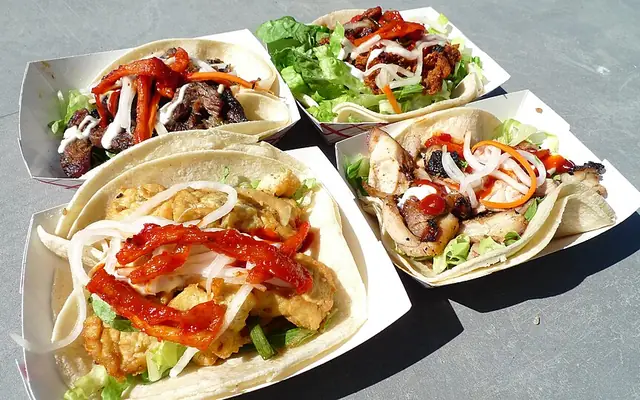
Asian fusion cuisine is the post-1990 dining mode that explicitly mixes Asian and non-Asian (typically Western, often Latin American) cooking grammars into a single coherent dish or restaurant. The genre's roots run to several parallel scenes: the California cuisine movement of the 1980s (Wolfgang Puck at Chinois on Main in Santa Monica, opened 1983, often credited as the first deliberate East-meets-West fine-dining restaurant), the Pacific Rim cuisine of Hawaii (Sam Choy, Roy Yamaguchi, and the 1991 Hawaii Regional Cuisine movement), the Australian Modern Asian scene that developed through the 1990s in Sydney and Melbourne (Tetsuya Wakuda, Neil Perry), the New York Momofuku revolution of the 2000s (David Chang's Momofuku Noodle Bar opened 2004), and the Los Angeles Kogi-truck street-food generation (Roy Choi's Korean BBQ tacos, 2008).
The defining grammar is the deliberate combination of ingredients, techniques, and dish-types across cuisines that historically did not meet: Korean tacos (gochujang short ribs in a corn tortilla with kimchi salsa), Japanese-Peruvian Nikkei (its own separate pillar; ceviche with shoyu and yuzu), Vietnamese banh mi spinoffs (Korean banh mi, banh mi with pulled pork), Chinese-Mexican (Asian-Mex's Mexican-style tacos with hoisin or char siu pork, popularized in Los Angeles and increasingly Mexico City), Filipino-American adobo presented in Western fine-dining formats, and the Asian-French fusion of the post-Robuchon generation (David Bouley at Brushstroke, Tetsuya Wakuda, Daniel Boulud's Asian-influenced French rooms). The line between fusion and confusion is real: a fusion that works has both grammars intact and reasoning behind the combination; a fusion that fails reads as two cuisines pasted together.
The genre is geographically concentrated in a handful of cities: Los Angeles (the densest Asian-fusion scene, anchored by the second-generation Asian-American chef wave: Roy Choi, Niki Nakayama, Bryant Ng, Walter Manzke, plus the Korean-Latino crossover that defines the city), Sydney and Melbourne (Tetsuya, Sepia, Sake, Tonka), Vancouver and Toronto (Tojo's Restaurant, Wing's Restaurant), New York (Momofuku and its descendants, Atomix's Korean-modern, Buddakan's Pan-Asian), Honolulu (the Hawaii Regional Cuisine pioneers), and increasingly Singapore (the early Asian-fusion lab at the Raffles, Burnt Ends, Cure). Outside these cities the genre exists but at lower density.
Book a food experience
Tours, tastings and classes that match this page, bookable on GetYourGuide.

Top picks
The best-scored Asian fusion place in each of 12 cities.
The Honey Paw ★ 4.8
The Honey Paw on Middle Street is the Big Tree Hospitality noodle counter, with hand-pulled noodles, dumplings and seafood served through a pan-Asian lens.
OrderHand-pulled noodles with the daily sauce, plus the kimchi fried rice.
TipDaily 11:00-22:00. Book tables via Resy for dinner; the bar takes walk-ins through last call.
Supernormal ★ 4.8
Supernormal on Flinders Lane runs an Asian-influenced menu drawing on Tokyo, Shanghai and Seoul. One Good Food Guide hat and perpetually full since 2014.
OrderNew England lobster roll and slow-cooked lamb shoulder
logy 2 ★ ★ 4.8
logy celebrates Asian diversity through the lens of its Japanese and Taiwanese heritage, and its story began anew in 2025 after origins in a Taipei alley.
OrderThe tasting menu, 4,750 TWD per person.
TipBook online up to 30 days ahead with a credit card guarantee; logy does not take reservations by phone, email or social media.
Tim Raue ★ 4.8
Tim Raue's two-Michelin-star room near Checkpoint Charlie in Berlin Kreuzberg cooks a chef-led Asian-French tasting; the Peking duck is the city's defining.
OrderThe Peking duck, the wasabi langoustine and whichever pork-belly course is on; Raue's signatures stay on the carte.
TipLunch tasting at €178 is the easier entry vs the €248 dinner. Book four weeks ahead at minimum.
Gēn ★ 4.7
Gēn is chef Johnson Wong's Michelin-listed tasting room in Penang, building menus from Malaysian produce and local fish down to their bones.
Book2-4 weeks ahead
TipThe name means root, and the menu reads like a Penang market list; take the wine or juice pairing built to match.
Fera ★ 4.7
Fera sits in a restored Palma mansion on Carrer de la Concepció, folding Asian technique into Mediterranean produce across tasting and carte menus.
OrderThe lunch tasting menu, which is the best-value route into the kitchen.
Book2 weeks ahead
TipThe garden courtyard seats fill first. Ask for it when you book rather than on arrival.
Mugen Waikiki ★ 4.7
Mugen Waikiki is the Forbes Five-Star 34-seat fine dining room inside ESPACIO Waikiki, in Honolulu, where chef Colin Sato runs a five-course menu designed.
OrderThe full five-course tasting with wine pairing from the Wine Spectator Best Of collection.
Book3 weeks ahead
TipResort wear required. Valet on the ESPACIO motor lobby is complimentary for diners; book three weeks out.
taku 1 ★ ★ 4.6
taku in Cologne's Excelsior Hotel Ernst near the Cathedral holds one Michelin star for contemporary Asian cuisine; established and consistent fine dining.
OrderThe six-course menu with wine pairing; the 4-course option at €121 is the more affordable entry point
Book2-3 weeks ahead
TipLocated in the Excelsior Hotel Ernst, one of Cologne's grand hotels from 1863. Dinner only, Tuesday to Saturday.
Ta Vie 3 ★ ★ 4.6
Ta Vie, on 2/F of The Pottinger on Queen's Road Central, offers a tasting menu designed by Chef Hideaki Sato, pairing meats, seafoods and vegetables.
OrderThe tasting menu designed by Chef Hideaki Sato.
TipReservations are taken up to 2 months ahead via WhatsApp and email only, and parties cannot be over 6 people.
Mee 1 ★ ★ 4.6
Mee is the Copacabana Palace's pan-Asian restaurant, led by chef Alberto Morisawa, with an omakase sushi bar and one Michelin star in Rio de Janeiro.
OrderOmakase at the sushi bar, or one of the two tasting menus, one of them vegan
BookBook ahead through the hotel ahead
TipThe hotel asks for smart casual dress and does not allow flip-flops, slippers or shorts; the omakase is served only at the sushi bar.
Ekiben ★ 4.6
Ekiben in Fells Point built a citywide following on steamed bao, plating the Neighborhood Bird fried-chicken bun and a tempura broccoli bun in a tiny shop.
OrderThe Neighborhood Bird steamed bun, fried chicken with herbs and spicy sauce.
TipThe Fells Point shop is counter-service and tight; there are also Hampden and Locust Point outposts.
Lalo ★ 4.5
Lalo on Main Street in OTR is Cincinnati's Asian-Mexican mash-up, with mapo carnitas, char siu tacos and quesadillas folded around general Tso chicken.
SignatureMapo carnitas, Char siu tacos
Find a place
The Honey Paw ★ 4.8
The Honey Paw on Middle Street is the Big Tree Hospitality noodle counter, with hand-pulled noodles, dumplings and seafood served through a pan-Asian lens.
OrderHand-pulled noodles with the daily sauce, plus the kimchi fried rice.
TipDaily 11:00-22:00. Book tables via Resy for dinner; the bar takes walk-ins through last call.
Supernormal ★ 4.8
Supernormal on Flinders Lane runs an Asian-influenced menu drawing on Tokyo, Shanghai and Seoul. One Good Food Guide hat and perpetually full since 2014.
OrderNew England lobster roll and slow-cooked lamb shoulder
logy 2 ★ ★ 4.8
logy celebrates Asian diversity through the lens of its Japanese and Taiwanese heritage, and its story began anew in 2025 after origins in a Taipei alley.
OrderThe tasting menu, 4,750 TWD per person.
TipBook online up to 30 days ahead with a credit card guarantee; logy does not take reservations by phone, email or social media.
Tim Raue ★ 4.8
Tim Raue's two-Michelin-star room near Checkpoint Charlie in Berlin Kreuzberg cooks a chef-led Asian-French tasting; the Peking duck is the city's defining.
OrderThe Peking duck, the wasabi langoustine and whichever pork-belly course is on; Raue's signatures stay on the carte.
TipLunch tasting at €178 is the easier entry vs the €248 dinner. Book four weeks ahead at minimum.
Gēn ★ 4.7
Gēn is chef Johnson Wong's Michelin-listed tasting room in Penang, building menus from Malaysian produce and local fish down to their bones.
Book2-4 weeks ahead
TipThe name means root, and the menu reads like a Penang market list; take the wine or juice pairing built to match.
Fera ★ 4.7
Fera sits in a restored Palma mansion on Carrer de la Concepció, folding Asian technique into Mediterranean produce across tasting and carte menus.
OrderThe lunch tasting menu, which is the best-value route into the kitchen.
Book2 weeks ahead
TipThe garden courtyard seats fill first. Ask for it when you book rather than on arrival.
T+T 1 ★ ★ 4.7
T+T is a modern, simple room reminiscent of a French bistro, where the chef draws on Malaysian, Korean, Taiwanese and other Asian influences.
OrderWheel cake with a savoury filling as a starter and a deconstructed martabak manis for dessert.
TipOpen daily in two sittings, from 12:00 to 14:30 and from 18:00 to 22:00.
Mugen Waikiki ★ 4.7
Mugen Waikiki is the Forbes Five-Star 34-seat fine dining room inside ESPACIO Waikiki, in Honolulu, where chef Colin Sato runs a five-course menu designed.
OrderThe full five-course tasting with wine pairing from the Wine Spectator Best Of collection.
Book3 weeks ahead
TipResort wear required. Valet on the ESPACIO motor lobby is complimentary for diners; book three weeks out.
taku 1 ★ ★ 4.6
taku in Cologne's Excelsior Hotel Ernst near the Cathedral holds one Michelin star for contemporary Asian cuisine; established and consistent fine dining.
OrderThe six-course menu with wine pairing; the 4-course option at €121 is the more affordable entry point
Book2-3 weeks ahead
TipLocated in the Excelsior Hotel Ernst, one of Cologne's grand hotels from 1863. Dinner only, Tuesday to Saturday.
Ta Vie 3 ★ ★ 4.6
Ta Vie, on 2/F of The Pottinger on Queen's Road Central, offers a tasting menu designed by Chef Hideaki Sato, pairing meats, seafoods and vegetables.
OrderThe tasting menu designed by Chef Hideaki Sato.
TipReservations are taken up to 2 months ahead via WhatsApp and email only, and parties cannot be over 6 people.
Emilio Innobar ★ 4.6
Emilio Innobar works a small Palma room on Carrer de la Concepció, building raw fish plates that cross Asian technique with Mexican seasoning.
OrderLet the counter decide. The kitchen builds around whatever came off the boat that morning.
TipThere is no fixed carte on some nights. Say what you dislike and let the kitchen work around it.
Mee 1 ★ ★ 4.6
Mee is the Copacabana Palace's pan-Asian restaurant, led by chef Alberto Morisawa, with an omakase sushi bar and one Michelin star in Rio de Janeiro.
OrderOmakase at the sushi bar, or one of the two tasting menus, one of them vegan
BookBook ahead through the hotel ahead
TipThe hotel asks for smart casual dress and does not allow flip-flops, slippers or shorts; the omakase is served only at the sushi bar.
Ekiben ★ 4.6
Ekiben in Fells Point built a citywide following on steamed bao, plating the Neighborhood Bird fried-chicken bun and a tempura broccoli bun in a tiny shop.
OrderThe Neighborhood Bird steamed bun, fried chicken with herbs and spicy sauce.
TipThe Fells Point shop is counter-service and tight; there are also Hampden and Locust Point outposts.
Lalo ★ 4.5
Lalo on Main Street in OTR is Cincinnati's Asian-Mexican mash-up, with mapo carnitas, char siu tacos and quesadillas folded around general Tso chicken.
SignatureMapo carnitas, Char siu tacos
Lee Restaurant ★ 4.5
Lee Restaurant on Richmond West is chef Susur Lee's reborn fusion kitchen since 2023, French technique on Hong Kong-Singaporean lines, the room that wrote.
OrderThe 19-ingredient Singaporean slaw and the crispy chicken.
TipSusur ran the King Street original 20 years; the Richmond location is two blocks south. Tasting menu Tuesdays cheapest entry.
DaiLo ★ 4.5
DaiLo on College is chef Nick Liu's modern Chinese kitchen since 2014, big-flavour Cantonese-meets-Sichuan plates with a strong cocktail bar program.
OrderThe truffle fried rice and the Hakka tasting menu.
TipClosed Sunday and Monday. The upstairs bar takes walk-ins; main room books on OpenTable.
Xiao Bao Biscuit ★ 4.5
Xiao Bao Biscuit in Charleston's Cannonborough runs pan-Asian cooking out of a converted gas station on Rutledge Avenue since 2011. Located in Upper King.
OrderThe okonomiyaki cabbage pancake and whatever daily noodle is up.
TipLunch only Mon-Fri 11:30-15:00, plus weekday dinner. Cash and card; no reservations.
Kaizen ★ 4.5
Kaizen on South Central, chef Jesse Newmister's Asian-fusion room in the Old City since 2016, runs steamed buns, ramen and rotating chef plates a block.
OrderA round of steamed buns with the chef's noodle bowl of the week.
TipThe Old City location runs busier than the kitchen seats can handle on Friday and Saturday nights; aim for Tuesday or Wednesday.
Gran Dabbang ★ 4.5
Gran Dabbang is Mariano Ramons no-reservations, no-signage Palermo room where the nights plates land on a chalkboard; arrive by 20:00 or wait.
Why locals goNo reservations, no signage, no wine list; Mariano Ramon writes the night's plates on a chalkboard.
TipArrive by 20:00 or sit and wait.
Buddha bar ★ 4.5
Buddha-Bar Paris is a festive Asian fusion restaurant in the 8th arrondissement, open daily from 7pm, with the bar and mezzanine from 6pm until 2am.
OrderSushi, sashimi and rolls, or the sharing plates.
TipReservations are strongly recommended and smart attire is required; valet parking is available from 8:00 pm.
Best Quality Daughter ★ 4.5
Chef Jennifer Dobbertin's New Asian American restaurant sits in the historic Mueller House at the Pearl, drawing on her Chinese-American heritage.
OrderCrab rangoon dip, Taiwanese popcorn chicken and the family-style noodles.
TipThe patio and the funky Mueller House interior are both worth requesting. Cocktails lean playful; ask for the seasonal special.
Hello Please ★ 4.4
Hello Please, on Fish Lane between Grey and Hope Streets, takes walk-ins, large groups and snappy pre-theatre dinners of modern Asian-Australian flavour.
Quan Hapa ★ 4.4
Quan Hapa on Vine Street in OTR is the Cincinnati Pan-Asian room from Daniel Wright's group, running bao buns, pho, ramen and Korean fried chicken.
SignaturePho, Bao buns
KYU ★ 4.4
KYU in Wynwood is the wood-smoked Asian counter at 251 NW 25th Street, the kitchen that earned TIME's Best Restaurant in Florida in 2017 and still pulls.
OrderThe duck-fat fried rice and the charred cauliflower with shishito-herb dressing.
TipWalk-ins seat fastest at the central bar facing the wood-grill; book the dining room two weeks out.
Mémoire ★ 4.4
Mémoire stages chef Chong Chian Fung's molecular tasting menus on Beach Street, Penang childhood nostalgia rebuilt with smoke, dry ice and sparklers.
Book1-2 weeks ahead
TipChoose the longer tasting; the interactive courses, including a paint-your-own flatbread, only appear on the full menu.
Loro ★ 4.4
Loro in Austin is Aaron Franklin and Tyson Cole's Asian smokehouse on South Lamar, a Texas BBQ and Southeast Asian small-plates mashup under live oaks.
OrderThe smoked brisket with rice noodle and Thai chiles; it is the most direct Franklin handprint on the menu.
TipThe South Lamar patio under live oaks is the best seat; no reservations, walk-in only, go early.
Myers + Chang ★ 4.4
Joanne Chang and Christopher Myers run Myers and Chang on Washington Street as a pan-Asian diner in Boston's South End since 2007. Priced at $$.
OrderThe dan dan noodles with house-ground Sichuan peppercorn.
TipCheap Date Mondays runs a fixed $50 menu for two. The bar pours an excellent gin cocktail list.
Sansho ★ 4.4
Sansho has been Prague's serious modern-Asian kitchen since 2011. The 2025 Michelin guide kept it in the selection; the no-choice tasting menu changes weekly.
OrderThe chef's tasting, family-style for two or four.
Chinois on Main ★ 4.4
Chinois on Main is Wolfgang Puck's 1983 Santa Monica original, still folding Chinese tradition and French technique into California produce on Main Street.
OrderThe whole sizzling catfish and the Chinois chicken salad
TipExecutive chefs Junuen Saldana and Ramiro Saucedo keep the classics on; book OpenTable or phone the room.
El Mano ★ 4.4
El Mano on Yesod HaMa'ala Street in Tel Aviv blends Vietnamese and Filipino cooking, a family kitchen serving egg rolls and lechon since 2020.
TryVietnamese egg rolls and Filipino lechon
TipOrder the rice paper egg roll and the Vietnamese-style fried chicken wings, two dishes that show off the Filipino and Vietnamese mix.
Poor Calvin's ★ 4.4
Poor Calvin's in Midtown Atlanta opened 2010 with chef Calvin Phan's mash-up of Thai, Vietnamese and Chinese plates. Kitchen leans asian fusion.
OrderLobster pad Thai, the dish that put Calvin Phan on the city's map.
TipCash and card. Reservations on OpenTable; Saturday night books a week ahead. Casual atmosphere despite the price.
Ace Eat Serve ★ 4.4
Ace Eat Serve in Denver is Justin Cucci's pan-Asian dining room on 17th Avenue since 2012, set in a former 1880s carriage house with ping-pong tables.
OrderThe pad see ew and pork bao; the kitchen runs late on weekends until 11 pm.
TipThe patio takes walk-ins and the ping-pong tables are first-come; bar in the dining room takes reservations.
Esta Saigon ★ 4.4
TipNo private parking is available, so park at nearby facilities; your reservation is held for up to 15 minutes.
UMA ★ 4.4
UMA, whose name stands for Unorthodox Modern Asian, is the LP Hospitality group's Bib Gourmand room in Noblessner, returning to the 2026 Michelin Guide.
OrderThe tasting menu; the kitchen blends Japanese and Korean technique with Estonian produce.
TipClosed Sunday and Monday. Shares the Peetri 12 address with Lore Bistroo but runs an entirely separate kitchen.
Lake Inez ★ 4.3
Lake Inez on Gerrard East is chef Robbie Hojilla's pan-Asian gastropub since 2016, Filipino, Thai, Vietnamese and Korean dishes with an Ontario beer list.
OrderThree or four small plates and a flight from the rotating beer list.
TipWalk-ins easy at the bar Tuesday through Thursday. Weekends book on Resy. The Byzantine mosaic on the wall is original.
Jasmijn en Ik Kanaalstraat ★ 4.3
Jasmijn en Ik in Lombok cooks Chinese dim sum, Vietnamese plates and Thai mains with organic meat and sustainably caught fish. Gault-Millau recognised.
OrderShrimp and bamboo dumplings then a sharing main with coconut curry
Ginger ★ 4.3
Ginger has done downtown Anchorage Pacific Rim cuisine since 2007. The kitchen blends Asian techniques with local Alaska produce on a steady menu.
SignatureAlaska tofu and quinoa bowl, Vegan curry
Hello Beasty ★ 4.3
Hello Beasty mixes Japanese, Korean and Chinese influences on Customs Street West in Auckland CBD. The city's most-booked Asian fusion room.
SignatureBeef tartare with kimchi, Pork bao, Crispy duck
Aroi Asian Fusion ★ 4.3
Aroi on Friary Street has been Kilkenny's Asian restaurant of choice since 2015, chef Fadilah named Best Asian Fusion Chef in Ireland in 2019.
OrderRed duck curry or spicy kimchi chicken ramen; vegan options are genuinely well-constructed.
TipTuesday Movie Night includes a main, gelato and cinema ticket for €24. TripAdvisor Travellers Choice for four consecutive years.
Zenzakan ★ 4.3
Zenzakan stages pan-Asian dinners across a dark 2,000 square metre hall on Frankfurt's Taunusanlage, sushi and robata plates under lantern light.
OrderBlack cod and duck from the robata section, shared
TipGo with four people and order in waves; the Geisha Room for two is the city's oddest and best private table.
Taizu ★ 4.3
Taizu on Menachem Begin runs chef Yuval Ben Neriah's Asian and Middle Eastern fusion menu for sharing, from har gow dumplings to wild fish ceviche.
TipEvery Sunday night from 19:00 is the Indian Feast; the regular menu runs the rest of the week.
Sakura ★ 4.3
Sakura runs Belgrade's most established sushi room on the Beton Hala terrace overlooking the Sava-Danube confluence. Pan-Asian and sake list.
SignatureBelgrade roll, Sashimi platter
Lucky Tortoise Temple Bar ★ 4.3
Lucky Tortoise Temple Bar on Asdills Row off Fleet Street is an Asian sharing-plate counter for handmade dumplings and bao under one Temple Bar roof.
Why locals goTucked on Asdill's Row off Fleet Street, an Asian sharing-plate counter the tourist drag walks past, handmade dumplings and bao under one Temple Bar roof.
TipSaturday hands-on dumpling classes book a month ahead; the walk-in dinner runs Tuesday to Sunday from 17:00. Friday and Saturday open lunch from 12:30.
FUHU ★ 4.3
FUHU at Resorts World in Las Vegas is the high-energy modern Asian dining room with cross-Asia plates, late-night service and patio fountain views.
OrderPeking duck pizza on flatbread; the signature share plate built for the booths.
TipLate-night menu runs to 02:00 weekends; the after-show crowd from Resorts World theatres fills the patio.
Noodle ST ★ 4.3
The Westwood noodle shop at 10936 Weyburn Ave serves Asian fusion hand pulled noodles and house made specials, led by its signature noodles.
TrySignature hand pulled noodles
Departure ★ 4.3
The 15th-floor pan-Asian rooftop at The Nines in downtown Portland, with two outdoor decks and the city's largest sake list. Modern Asian cooking.
OrderThe kushiyaki tasting flight from the grill
TipTwo outdoor decks with views of Mount Hood. Sunset is the seat to book.
Stage22 ★ 4.3
Stage22 sits on the top floor of the Grand Hotel Kempinski Riga on Elizabetes, listed in the Michelin Guide 2026 with Asian fusion plates and panoramic city.
OrderThe chef's tasting menu paired with cocktails from the adjoining bar.
TipBook a window seat at sunset for the Vērmanes park panorama; share the room with the bar's after-work crowd.
OB Noodle House ★ 4.3
OB Noodle House in San Diego is the Ocean Beach pan-Asian noodle counter on Cable Street, with tonkotsu ramen, Vietnamese banh mi and a wall-deep sake list.
OrderThe tonkotsu ramen with a bonus pork belly add-on; the brisket banh mi for lunch.
TipWait can be long after 6pm; the Bar 1502 sister location on Niagara has shorter waits.
Azerole ★ 4.2
Azerole is chef Xin Meng's Michelin Selected neo-bistro on Rue Berbisey in Dijon, a solo kitchen folding Chinese spice into French seasonal produce.
Why locals goAzerole is run solo by chef Xin Meng in a plain neo-bistro room on Rue Berbisey, open weekday lunches only and easy to walk past unnoticed.
TipMeng cooks alone most services, so the weekday lunch menu moves at a relaxed, unhurried pace.
The Amber Terrace ★ 4.2
The Amber Terrace at The Leela Palace Jaipur is an adults-only terrace bar and restaurant serving modern Asian small plates against the Aravalli range.
OrderDim sum or sushi, then robatayaki and teppanyaki from the modern Asian menu.
TipIt is on the Palace Wing terrace, third floor, and closed on Mondays; children are not allowed, and it opens only from 16:00.
Zarin ★ 4.2
Zarin at Fairmont Jaipur in Kukas serves Chinese, Thai and Japanese dishes, with a teppanyaki grill where the chef cooks in front of the table.
OrderThe raw papaya som tam, then the five-spice chocolate fondant with coconut and jaggery ice cream.
TipZarin opens at 18:00 for dinner only; tell the team if you are marking an anniversary, as couples get a Thai-inspired welcome.
Gopuram Taste of India ★ 4.2
Gopuram Taste of India in Oklahoma City delivers authentic Indian curries, biryani, and tandoor dishes at accessible prices with a weekday buffet lunch.
OrderLunch buffet; chicken tikka masala; garlic naan
TipThe weekday lunch buffet is one of the best-value meals in Oklahoma City, around $12 for unlimited plates.
Sticky Rice ★ 4.2
Sticky Rice on Main has run Asian-fusion sushi and a bucket-of-tots tradition since 1999. Open until 2 am daily, the late-night sit-down in the Fan.
SignatureBucket of tots, Sushi rolls, Vegan rolls
Kayuputi ★ 4.2
Kayuputi is the St. Regis Bali Resort restaurant in Nusa Dua, with Pan-Asian inspired cooking, Indian Ocean views, private cabanas and a two-storey cellar.
Andō 1 ★ ★ 4.2
Andō, on 1F of Somptueux Central at 52 Wellington Street, is chef-founder Agustin Balbi's tasting menu, fusing his ancestral roots with Japanese influences.
OrderThe signature caldoso rice, dubbed "Sin Lola", a homage to his grandma.
TipA 3 course menu at $688 runs Monday to Friday, and the sommelier's wine flight offers some inspired choices.
Boa-Bao ★ 4.2
Boa-Bao is a pan-Asian restaurant at Largo Rafael Bordalo Pinheiro 30, Lisbon, with original recipes, no fusions, in a space inspired by Asian markets.
Sunda New Asian ★ 4.2
Sunda New Asian reimagines traditional Southeast Asian cuisine in The Gulch, with a menu running from fresh sushi and dim sum to noodles and rice.
OrderSteamed buns with adobo pork belly, then the signature crispy rice with spicy tuna or the yuzu ribeye.
TipHappy hour runs Monday thru Friday from 5:00 PM to 6:00 PM, and the restaurant also hosts a sushi rolling class.
Origami Asian Grill ★ 4.2
Origami Asian Grill on Folsom Boulevard draws on Japanese, Chinese, Korean, Vietnamese and Thai cultures for a customizable menu of ramen and rice bowls.
SignatureRamen, Rice bowls
TipOrigami serves until 2am on Friday and Saturday nights, and orders can be placed online.
The Red Room by Chefs Warehouse ★ 4.2
The Red Room serves Pan-Asian small plates, dim sum and robata grill dishes under the Mount Nelson hotel in Gardens, Cape Town, a Liam Tomlin venture.
OrderThe four course Chefs' Choice menu, one small plate per course from har gow and siu mai to the robata grill
TipArrive at 17:00 for a cocktail and the Dim Sum Lounge menu in the bar before the dining room opens at 18:00.
Service 1921 Restaurant & Bar ★ 4.2
Set in Anantara's restored 1921 British consulate, a spy-themed dining room plating Thai, Chinese and Vietnamese dishes beside the Mae Ping riverbank.
Mosa Asian Bistro ★ 4.2
Mosa Asian Bistro on White Station Road in East Memphis runs a Chinese, Thai, Korean and Vietnamese menu from a strip-mall favoured by chefs on their nights.
OrderBeef pho and spicy Korean noodles.
TipLunch is the easier seat; the room fills with regulars after 18:00. Closed Mondays.
Lazy Susan ★ 4.2
Lazy Susan on South Howell Avenue in Bay View runs a small-plates menu of wood-roasted vegetables, steamed buns and a cocktail program with an Asian pantry.
Why locals goA Bay View small-plates kitchen with steamed buns and wood-roasted carrots that most visitors haven't heard of and locals book year-round here.
TipOrder the wood-roasted carrots and steamed pork buns with kimchi from the small kitchen counter.
Ma Khin Cafe ★ 4.2
Ma Khin Cafe on the lower floor of Mercado de Colon in Valencia is a pan-Asian kitchen, with curries, noodles and bao under the 1916 modernista market vault.
OrderThe Thai green curry or a plate of bao buns with iberico pork.
TipOpen daily through the day. The Colon market complex hours run longer than the upstairs grocery stalls.
L'Arôme ★ 4.1
L'Arôme is a Michelin Selected pocket-sized dining room on Rue Jean-Jacques-Rousseau in Dijon, alternating gyozas with French bistro classics.
OrderThe picanha with its Asian-style sauce, chef Kadoguchi's crossover between Japanese and French technique.
TipThe room seats few, so a weekday lunch booking is the surer route in than a weekend evening.
Tao Asian Kitchen ★ 4.1
Tao Asian Kitchen on Jawahar Lal Nehru Marg in Malviya Nagar, Jaipur, is a vegetarian-focused Pan-Asian room with dim sum, ramen and baos on the menu.
OrderThe miso ramen meal, plus the shiitake mushroom and tofu dim sum.
TipTravel + Leisure Asia puts a meal at about ₹2,500 for two and notes an expansive outdoor seating area and free street parking.
Tanoshii ★ 4.1
Tanoshii on Brabanter Strasse in Cologne's Belgisches Viertel offers classic nigiri and maki alongside creative Asian-European fusion rolls and warming pho.
OrderCreative fusion rolls and warming Vietnamese pho alongside the traditional nigiri
TipClose to Rudolfplatz U-Bahn stop. Book ahead for weekend evenings.
Spicy Fish ★ 4.1
Spicy Fish fuses Japanese and Korean cooking from chef Emerson Kim in a four-storey Ipanema house, listed in the Michelin Guide, in Rio de Janeiro.
OrderThe bibimbap finished at the table, or the Kagoshima wagyu on a hot stone
TipIf you cannot choose from the long menu, the chef's selection brings two portions of nigiri, sashimi and the house special.
Lily's Original ★ 4.1
Open since 1999 on Langstrasse, Lily's runs long communal tables and an open kitchen serving Japanese noodles, Malaysian satays, Korean salads.
SignatureJapanese noodle bowls, Pakistani curries
LE:EN ★ 4.0
LE:EN at Heuveloord in Rotsoord serves Korean, Vietnamese, Indonesian and Thai sharing plates from a former industrial building with outdoor terrace.
OrderThree to four sharing plates per person from the seasonal menu
East ★ 4.0
East is a fully vegetarian modern Asian room on the ground floor of the Sudima Hotel at 63-67 Nelson Street, Auckland CBD. Sunday vegan yum cha service.
SignatureVegan yum cha, Vegetable dumplings, Tofu claypot
1-800-Lucky ★ 4.0
1-800-Lucky in Wynwood is Miami's pan-Asian food hall at 143 NW 23rd Street, with six counters from ramen and sushi to Vietnamese banh mi and karaoke in back.
OrderA bowl of ramen at Hot Soup Dumplings, then taiyaki ice cream from the front cone counter.
TipCash on the karaoke deposit, card at the counters. Saturday lines hit at 8pm; come for lunch instead.
Sambal ★ 4.0
Sambal reworks Malaysian favourites with European technique at 300 Beach Street, a halal-friendly modern dining room in Penang's banking quarter.
SignatureLap mei fun, Sambal fried rice
TipThe lap mei fun twist is the signature; come at lunch when the set menus make the kitchen's fusion ideas cheapest.
SOHO Bistro and Coffee ★ 4.0
SOHO Bistro and Coffee on Sturova 8 brings the pan-Asian repertoire to the Old Town with Pad Thai, pho and Thai-leaning small plates for a young crowd.
OrderPad Thai with prawn and the Thai green curry; the bao buns work as the table starter.
TipThe lunch denne menu is the cheapest pan-Asian seat in the Old Town; arrives in under 15 minutes.
Funky Geisha ★ 4.0
Funky Geisha at Boulevard Kukulcán km 15 in Cancún is a Thai and Japanese room on a floating deck over Nichupté Lagoon, with pad Thai, curries and robata.
OrderPad Thai or a Thai curry, sashimi of the day, and robata-grilled meat or seafood.
TipGuests reach the deck through a mangrove tunnel; there are taiko drum shows and a shisha lounge, so expect noise.
Juju Durham ★ 4.0
A Ninth Street fixture for Asian fusion tapas and sake. The menu roams across East and Southeast Asian influences; order broadly and share across the table.
SignatureSake-steamed mussels, Crispy Brussels sprouts, Duck pot stickers
Chopsuey Cafe ★ 4.0
The PS.Cafe group's Chinese-inspired concept at Dempsey Hill serves a crowd-pleasing menu of noodles, dumplings, wok-fried rice dishes and sharing plates in a bright bungalow setting. A reliable option for groups who want something more substantial than a cafe but less formal than a dinner reservation.
OrderCrispy duck pancakes, Claypot tofu, Egg noodles
TipThe large shaded terrace handles groups well and is good for family lunches. Open daily from 11am.
Briusly ★ 4.0
Briusly on Islandijos stays open to 01:00 Monday through Saturday, a pan-Asian-bar Senamiestis nightlife anchor for late cocktail orders and Asian snacks.
TryPan-Asian small plates
TipThe Senamiestis nightlife-triangle includes Briusly, Alchemikas, Apoteka. Closed Sunday.
Li Jiang ★ 3.9
Li Jiang is a Michelin Selected Asian restaurant at The Ritz-Carlton Abu Dhabi, Grand Canal, known for wok dishes and views toward the Grand Mosque.
OrderWok-fried scallops and butter prawns, plus the Szechuan chilli lamb loin the Michelin Guide mentions.
TipHappy Hour runs daily from 17:00 to 19:00, and the restaurant states that reservations are not required.
Ginger Moon Canteen ★ 3.9
Ginger Moon Canteen is a modern Asian restaurant on Jalan Kayu Aya in Seminyak, Bali, with a food-market feel, curries, salads and house cocktails.
OrderStart with the green papaya salad, then order the chicken curry with rice cake.
TipPork appears here as babi guling in steamed buns. The canteen has two sister restaurants, in Seminyak and in Kuta.
Mama Rich ★ 3.9
Mama Rich in Woodquay Galway brings Malaysian and Thai street food at family-recipe prices; the yaki soba and har mee broth anchor a menu of generous wok.
OrderThe Rich Har Mee noodle broth; the Malaysian curries are the other reliable order
TipBook ahead as the dining room is small; the rebranded Mama Rich is the continuation of the long-running Papa Rich kitchen.
Papa Rich ★ 3.9
Papa Rich brings Malaysian street food to Galway with no dish over ten euros; the yaki soba, har mee broth and wok plates come on a four-flame heat scale.
OrderThe Rich Har Mee at three flames is the defining bowl; the yaki soba is a crowd-pleaser
TipProbably Galway's best-value full meal; bring cash for slightly faster service.
Miss Bao ★ 3.9
Miss Bao steams its baos and gyozas on Place de la Gare in Rennes, a pan-Asian counter open every day of the week across the square from the station.
OrderA round of steamed baos before your train; the station is across the square
Saii Asian Bistro ★ 3.8
Saii Asian Bistro on N May Avenue in Oklahoma City serves pan-Asian cuisine with Japanese, Thai, and Chinese dishes in a polished north OKC room.
Siddharta Lounge ★ 3.8
Siddharta Lounge by Buddha-Bar holds its Sensory Brunch on Saturday evenings, 19:00 to 23:00, on the Yas Bay rooftop in Abu Dhabi, with a live DJ.
OrderThe curated Mediterranean-Asian set menu, served with live DJ beats and views over Yas Bay
TipYas Bay lists AED 259 with soft drinks, AED 359 with house beverages and AED 459 with sparkling wine for the Saturday session.
La Mian ★ 3.8
La Mian sells Asian street food on Rue Chanzy in Reims: house-made noodles, dumplings, nems and bowls to eat in or take away, with most dishes under €15.
TryStir-fried noodles, dumplings, nems and noodle bowls
TipNems, gyoza and skewers are €4.20 to €6 a portion and a bowl with lacquered duck is €13; the site takes takeaway orders and it shuts from 15:00 to 16:30.
Ni Hao Bao Dumpling House ★ 3.7
Ni Hao Bao Dumpling House on Shea Boulevard in Scottsdale is a fast-casual counter making dumplings, bao and bowls to order, and opened in January 2026.
OrderThe Korean fried chicken from the Main Squeeze menu, with an order of dumplings.
TipDumplings, bao and bowls are made when you order, and the shop is closed on Sunday.
My Wok République ★ 3.6
My Wok République builds fresh wok bowls to order on Place de la République in Dijon, a build-your-own Asian takeaway counter open into the evening.
TryBuild-your-own wok bowl
TipStays open later on Fridays and Saturdays; build your own bowl in three steps at the counter.
Asian fusion by city
 Dijon7 places
Azerole, L'Arôme
 Jaipur6 places
The Amber Terrace, Zarin
 Oklahoma City6 places
Gopuram Taste of India, Saii Asian Bistro
 Brisbane4 places
Hello Please
 Cincinnati4 places
Lalo, Quan Hapa
 Toronto4 places
Lee Restaurant, DaiLo
 Utrecht4 places
Jasmijn en Ik Kanaalstraat, LE:EN
 Anchorage3 places
Ginger
 Auckland3 places
Hello Beasty, East
 Kilkenny3 places
Aroi Asian Fusion
 Miami3 places
KYU, 1-800-Lucky
 Penang3 places
Gēn, Mémoire
 Portland3 places
The Honey Paw
 Richmond3 places
Sticky Rice
 Abu Dhabi2 places
Li Jiang, Siddharta Lounge
 Austin2 places
Loro
 Bali2 places
Kayuputi, Ginger Moon Canteen
 Boston2 places
Myers + Chang
 Charleston2 places
Xiao Bao Biscuit
 Cologne2 places
taku, Tanoshii
 Frankfurt2 places
Zenzakan
 Galway2 places
Mama Rich, Papa Rich
 Hong Kong2 places
Ta Vie, Andō
 Knoxville2 places
Kaizen
 Lisbon2 places
Boa-Bao
 Melbourne2 places
Supernormal
 Nashville2 places
Sunda New Asian
 Palma2 places
Fera, Emilio Innobar
 Prague2 places
Sansho
 Rio de Janeiro2 places
Mee, Spicy Fish
 Sacramento2 places
Origami Asian Grill
 Santa Monica2 places
Chinois on Main
 Scottsdale2 places
Ni Hao Bao Dumpling House
 Taipei2 places
logy, T+T
 Tel Aviv2 places
El Mano, Taizu
 Zurich2 places
Lily's Original
 Atlanta1 place
Poor Calvin's
 Baltimore1 place
Ekiben
 Belgrade1 place
Sakura
 Berlin1 place
Tim Raue
 Bratislava1 place
SOHO Bistro and Coffee
 Buenos Aires1 place
Gran Dabbang
 Cancún1 place
Funky Geisha
 Cape Town1 place
The Red Room by Chefs Warehouse
 Chiang Mai1 place
Service 1921 Restaurant & Bar
 Denver1 place
Ace Eat Serve
 Dublin1 place
Lucky Tortoise Temple Bar
 Durham1 place
Juju Durham
 Ho Chi Minh City1 place
Esta Saigon
 Honolulu1 place
Mugen Waikiki
 Las Vegas1 place
FUHU
 Los Angeles1 place
Noodle ST
 Memphis1 place
Mosa Asian Bistro
 Milwaukee1 place
Lazy Susan
 Paris1 place
Buddha bar
 Portland1 place
Departure
 Reims1 place
La Mian
 Rennes1 place
Miss Bao
 Riga1 place
Stage22
 San Antonio1 place
Best Quality Daughter
 San Diego1 place
OB Noodle House
 Singapore1 place
Chopsuey Cafe
 Tallinn1 place
UMA
 Valencia1 place
Ma Khin Cafe
 Vilnius1 place
Briusly
Regional variations
California (Los Angeles, San Francisco)
The densest Asian-fusion scene globally. Roy Choi's Korean BBQ tacos (the Kogi food truck movement, 2008-present), Niki Nakayama's modern kaiseki, Bryant Ng's Cassia, the Vietnamese-French Crustacean Beverly Hills, the Korean-Cal-Mex crossover at Hanjip and Sun Nong Dan, the Korean fried chicken explosion. Los Angeles produces more Asian-fusion concepts than any other US city.
Pacific Northwest (Vancouver, Seattle, Portland)
Cantonese-Pacific-Northwest crossover. Tojo's Restaurant (Vancouver, where the California Roll was reportedly invented in 1974), Vij's (Indian-Pacific-Northwest), the deep Chinese-Hong Kong scene in Richmond BC, Seattle's Stateside and Joule. The fusion here is fish-and-vegetable-led and more restrained.
Australia (Sydney, Melbourne)
Modern Asian cooking that mixes Cantonese, Thai, Japanese, Vietnamese with European technique. Tetsuya Wakuda (Tetsuya's, founded 1989, the lineage room), Neil Perry's Rockpool, Spice Temple, Sake, Tonka, the modern fusion of David Thompson. The cooking is more European in technique than American fusion; Asian flavors are absorbed into French-Italian frameworks.
New York
Momofuku and descendants. David Chang's Momofuku Noodle Bar (2004) and the broader Momofuku group (Ssam Bar, Ko, Nishi, the closed Milk Bar). The Atomix-Atoboy Korean-modern wave (Junghyun Park). Wd-50, Pok Pok NYC (Andy Ricker's Thai), the Pan-Asian Buddakan, Carbone's Italian-American (not Asian-fusion). The New York scene is more publication-driven and Michelin-recognized.
Hawaii
The Hawaii Regional Cuisine movement founded in 1991 by 12 chefs (Sam Choy, Roy Yamaguchi, Alan Wong, Peter Merriman, Mark Ellman, others), declaring a deliberate fusion of Hawaiian indigenous, Japanese, Filipino, Portuguese, Korean, Chinese, and Polynesian cooking on local ingredients. The earliest formal Asian-fusion declaration.
Defining Asian fusion dishes
- Korean Tacos (Kogi Style)
- Korean short rib bulgogi or pork in a corn tortilla with kimchi salsa, chile-soy sauce, cilantro, and onion. Invented by Roy Choi for the Kogi food truck in Los Angeles in 2008, now exported globally. The defining Asian-fusion street food of the 21st century.
- Bao Slider
- Steamed Chinese-style bao bun filled with pork belly (or fried chicken, or beef cheek), pickled cucumber, scallion, and a hoisin or Asian-leaning sauce. Popularized by David Chang at Momofuku Noodle Bar (2004); the basis of an industry of fusion-bao restaurants worldwide.
- Truffle Shoyu Ramen
- Japanese ramen elevated with French truffle and reductions, a defining Asian-fusion crossover. Founded as a concept by Ivan Orkin in Tokyo, now a global format at Momofuku Ko, Ippudo, and high-end ramen rooms across cities.
- Sashimi Tacos
- Tuna or salmon sashimi in a mini taco-shell (often a wonton or rice paper crisp), topped with avocado, lime, chile, and cilantro. The Mexican-Japanese fusion that became a ubiquitous fine-dining one-bite. Originated in Pacific Rim cooking; now everywhere.
- Asian-Mex Burrito or Taco
- Mexican-format burrito or taco filled with char siu (Cantonese roast pork), hoisin, Asian vegetables, and chile sauce. The Chinese-Mexican fusion of Los Angeles (Two Asian Brothers, Lotus Asian Cuisine) and increasingly Mexico City.
- Banh Mi with Western Filling
- Vietnamese baguette format filled with brisket, pulled pork, fried chicken, or short rib, in addition to the traditional pate-and-cold-cuts version. The Banh Mi shop's expansion into Western proteins is a Pacific-Asian-American innovation popularized in the 2010s.
- Wagyu Sliders with Asian Sauce
- Mini wagyu beef sliders topped with miso aioli, kimchi, or wasabi creme fraiche. A bar-snack format invented in Los Angeles fusion rooms and copied widely.
- Furikake-Crusted Salmon
- Salmon with a crust of furikake (Japanese rice seasoning, sesame, seaweed, salt) seared and served with miso glaze or yuzu sauce. The Hawaiian Regional Cuisine signature, now a fine-dining staple worldwide.
- Tuna Tartare with Asian Seasoning
- Diced raw tuna with sesame oil, shoyu, scallion, chile, avocado, served on crisp wonton or with rice cracker. The single most reproduced Asian-fusion appetizer of the 1990s and 2000s.
- Modern Kaiseki with Western Components
- The Niki Nakayama style: kaiseki framework with Western ingredients (foie gras, truffle, caviar) placed alongside indigenous Japanese ingredients and presented in classic kaiseki sequence. The Los Angeles n/naka is the global flagship.
How to order
At an Asian-fusion fine-dining restaurant, the tasting menu (5 to 12 courses) is typically the right order; the chef has composed the cross-cultural sequence deliberately. At a fast-casual Asian-fusion place (Kogi truck, the bao shop, the Korean-Mexican spot), order what looks unique to that restaurant; the Asian-fusion concept that mirrors what every other restaurant does (generic bao, generic truffle ramen) is usually less interesting than the chef's specific cross-cultural idea. Read the menu for the specific fusion grammar (Korean-Mexican? Japanese-French? Vietnamese-Italian?); the best restaurants commit to one cross.
The rookie mistakes: confusing Asian fusion with Pan-Asian (Pan-Asian restaurants serve dishes from multiple Asian cuisines on the same menu without combining them; Asian fusion combines Asian and non-Asian into single dishes), assuming all fusion is gimmicky (a serious fusion restaurant has a coherent reasoning behind every cross), and assuming Nikkei is the same thing (Nikkei is Japanese-Peruvian, a 100-year-old specific tradition; Asian fusion is the broader, mostly newer Western-mixed cooking). Tipping follows the local norm of the host country. The fine-dining tasting menus run pricey; the Kogi-style street fusion remains accessible.
What to drink with it
Asian-fusion drink programs run as eclectic as the food. Sake-based cocktails (yuzu-sake spritz, gin with sake and basil), Japanese whisky as the prestige bottle, Champagne or sparkling for the Pacific Rim seafood, off-dry Riesling and Gewurztraminer for spice-mid dishes, sour beer (gose, Berliner Weisse) for chile-led food, and the increasing use of Asian-influenced cocktails (the Pisco-sour-with-yuzu, the bourbon-with-Korean-ginseng). Tea programs are central at the modern kaiseki rooms; soft-serve and Asian shaved-ice desserts close many meals. The genre has no single pairing tradition; the better restaurants invent one specific to their menu.
Where to eat it
Los Angeles is the densest Asian-fusion city in the world. Kogi (Roy Choi's now-restaurant-chain), n/naka (Niki Nakayama, two Michelin stars, modern kaiseki), Cassia (Bryant Ng, Cambodian-French), Republique (Walter Manzke), Sun Nong Dan, the Korean-Mexican trucks. New York: Momofuku Ko (two stars, the David Chang flagship), Atomix (two stars, Korean-modern), Buddakan, Cote (Korean steakhouse-modern). Sydney and Melbourne: Tetsuya's (the founding room), Sepia, Sake, Tonka. Vancouver: Tojo's, Wing's. Honolulu: Alan Wong's, Roy's Restaurant, Chef Mavro. Singapore: Burnt Ends (modern Australian-Asian, two stars), Cure (modern Irish-Asian). London's Asian-fusion is led by Roka, Zuma, Hakkasan (Pan-Asian leaning). Outside these cities, the genre is widely imitated but the lineage rooms cluster on the US West Coast, Australia, and Honolulu.
A short history
Asian fusion as a deliberate genre began in early-1980s California with Wolfgang Puck's Chinois on Main (Santa Monica, 1983) and accelerated through several distinct moments: the 1991 Hawaii Regional Cuisine declaration, the 1990s Tetsuya's-Sydney emergence of Modern Australian Asian, the 2004 Momofuku Noodle Bar opening in New York, the 2008 Kogi truck launch in Los Angeles, and the 2010s globalization of Korean-Mexican and Vietnamese-American crossovers. The genre is roughly 40 years old and continues to evolve as second- and third-generation Asian immigrant chefs reinterpret their heritage dishes for Western fine-dining and street-food formats.
Frequently asked
What is the difference between Asian fusion and Pan-Asian?
Pan-Asian restaurants serve dishes from multiple Asian cuisines on the same menu (a Japanese sushi, a Thai curry, and a Vietnamese pho would all appear, each cooked authentically). Asian fusion deliberately combines Asian and non-Asian (typically Western, often Latin American) cooking grammars into a single dish or dish set: Korean tacos, Chinese-Mexican burritos, Japanese-French kaiseki. The two are distinct and easily confused.
Is Nikkei cuisine Asian fusion?
Nikkei (Japanese-Peruvian) is technically a fusion cuisine, but it is much older than the modern Asian-fusion movement (Japanese immigrants arrived in Peru in 1899; Nikkei evolved over 100+ years organically). The modern Asian-fusion genre treats Nikkei as a separate, historically specific cuisine rather than part of itself; we have a separate pillar for it.
Is Asian-fusion food still considered current or has it dated?
The 1990s-2000s wave of generic Asian fusion (truffle ramen, sashimi tacos, wonton-shell appetizers) is now considered dated. The current wave (Korean-Mexican, Vietnamese-American banh mi spinoffs, modern kaiseki with Western ingredients, second-generation Asian-American chef cooking) is treated as serious cuisine and earning Michelin stars. The genre evolves; the early shorthand has aged out.
More cities are in research. Want Asian fusion covered somewhere specific? Tell us where you want to eat.