

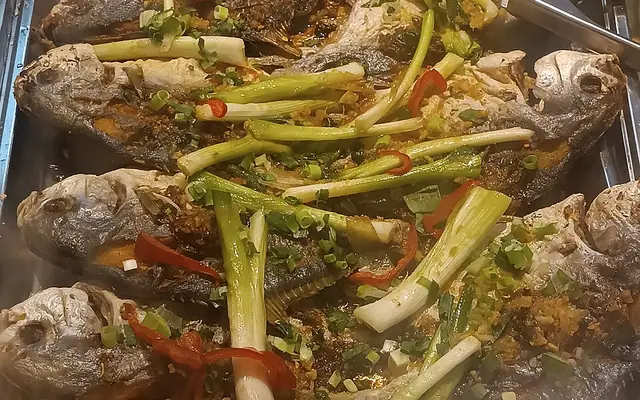
Cantonese cuisine (Yue caixi) is the food of Guangdong province, Hong Kong, and Macao, and the most globally exported of the eight great Chinese culinary traditions. Where Sichuan transforms and Hunan smokes, Cantonese cooks try to preserve the original character of the ingredient: a steamed fish should taste like the fish, not the seasoning. Restraint is the discipline. A Cantonese fine-dining kitchen will source rare fish, kill them seconds before service, and steam them with ginger and scallion oil for exactly the time the species requires. The seasoning sits at the edge, not the center.
The Cantonese repertoire divides into a few major categories: dim sum (the small-plate tea-house tradition eaten at brunch), siu mei (roasted meats like char siu, roast goose, soy-sauce chicken), seafood (live tanks of fish, shrimp, abalone, geoduck), congee (rice porridge with toppings), claypot rice, double-boiled soups (slowly steamed in a covered ceramic vessel), and a vast wok-stir-fry repertoire (chow fun, hor fun, chow mein, beef with broccoli). The cooking depends on wok hei, the smoky char produced by extremely hot carbon-steel woks; a Cantonese cook is judged by their wok hei the way a French cook is judged by their stock.
Cantonese is also the most refined Chinese fine-dining tradition. Hong Kong holds more Cantonese three-starred restaurants than any other city, and the Cantonese tasting menu format (multi-course set menus rotating with the season) sets the modern Chinese fine-dining standard. Lung King Heen, T'ang Court, and the older institutions like Fook Lam Moon and Lei Garden are the global benchmarks.
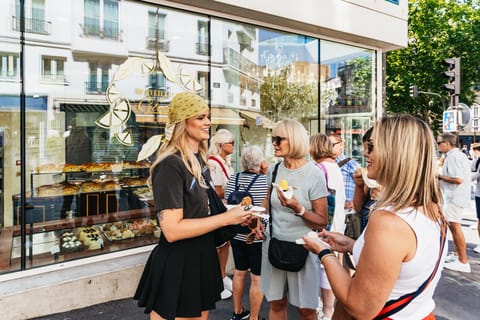
Book a food experience
Tours, tastings and classes that match this page, bookable on GetYourGuide.

Top picks
The best-scored Cantonese place in each of 12 cities.
Le Palais 3 ★ ★ 4.9
Le Palais serves Cantonese cooking on the 17F of Palais de Chine Hotel, using Cherry Valley ducks from Yilan for its crispy-skin roast duck.
OrderCantonese-style crispy-skin roast duck, and Chinese spinach and salted egg dumplings at dim sum.
TipPre-order the crispy-skin roast duck and the Peking duck four ways to avoid missing out.
The Chairman 1 ★ ★ 4.8
The Chairman serves Cantonese cooking on Wellington Street in Central, built on tradition with locally sourced ingredients and seafood from local fishermen.
OrderSteamed crab with Huadiao and chicken fat on a bed of Chen Cun rice noodles.
TipGuests are contacted three days in advance to reserve their dishes, and the menu reservation system applies to both lunch and dinner.
Stanley Restaurant ★ 4.8
Stanley is a Cantonese restaurant on the river at Howard Smith Wharves, pairing mostly local produce with traditional Cantonese flavours, shared family style.
Mr Wong ★ 4.8
Mr Wong is a Cantonese restaurant at 3 Bridge Lane in Sydney that seats 240 people over two levels and serves a selection of up to 80 dishes.
T'ang Court 2 ★ ★ 4.7
T'ang Court at 99 Madang Road is a Two-Michelin-Starred restaurant where you dine on Cantonese dishes or enjoy a set menu amid lavish furnishings.
OrderOrder the wok-fried abalone and geoduck with Thai basil and fermented black beans.
TipThree private dining rooms, Willow, Parasol and Padauk, sit beside the a la carte room with its Xintiandi view; reserved tables are held for 15 minutes.
Tek Sen ★ 4.7
Tek Sen is a Cantonese restaurant at 18 & 20 Lebuh Carnarvon, 10100 George Town, Penang.
The Parlor Dim Sum ★ 4.7
The Parlor Dim Sum is a Cantonese restaurant at 4401 Butler St, Pittsburgh, PA 15201.
Bonnie's ★ 4.6
Bonnie's is a Cantonese American restaurant at 398 Manhattan Ave, Brooklyn, with a menu of shrimp + pork wontons and wok salt & pepper crispy squid.
OrderShrimp + pork wontons with shacha peanut sauce, or the caramelized onion daikon radish cake.
TipBonnie's menu invites you to check out its cookbook, Salt Sugar MSG.
Long Trieu 1 ★ ★ 4.6
Long Trieu looks over Nguyen Hue Boulevard from the 4th floor of the Times Square Building, known for its dim sum and holding a Michelin Star.
OrderThe baked Barbecued Pork Puff Buns, the Honey-glazed Barbecued Pork and the Mango Pudding.
TipElegant attire or smart casual is required: no shorts, undershirts, tank tops, flip flops, pajamas or slippers.
Bonnie's ★ 4.5
Bonnie's sits on a corner in east Williamsburg, a retro Hong Kong diner where Chef Calvin Eng plates Cantonese regional cuisine with modern interpretations.
OrderYeung yu sang choi bao, stuffed with shrimp, green mustard and lettuces, then crisped and presented whole.
TipTry the classic Hong Kong street food like cheung fun, with seared rice noodles tossed with shrimp and scallop X.O. sauce.
Dragon Beaux ★ 4.5
Dragon Beaux at 5700 Geary Blvd serves dim sum, tea and hot pot in the Richmond District, with a modern spin on Koi's Palace for a refined experience.
OrderShrimp dumplings topped with Chilean sea bass, or the BBQ pork puff pastries with organic apple.
TipBook online or by phone (parties of 8 or more must call), and say whether you want the hot pot dinner or the traditional menu.
Lai Wah Heen ★ 4.5
Lai Wah Heen is a Cantonese restaurant on the 2nd Floor at 108 Chestnut Street, serving Cantonese cuisine and dim sum under Executive Chef Heyden Sin.
SignatureRefined dim sum tasting, Cartless dim sum
TipThe New York Times named it North America's best dim sum; it was founded in 1995 in downtown Toronto.
Find a place
Le Palais 3 ★ ★ 4.9
Le Palais serves Cantonese cooking on the 17F of Palais de Chine Hotel, using Cherry Valley ducks from Yilan for its crispy-skin roast duck.
OrderCantonese-style crispy-skin roast duck, and Chinese spinach and salted egg dumplings at dim sum.
TipPre-order the crispy-skin roast duck and the Peking duck four ways to avoid missing out.
The Chairman 1 ★ ★ 4.8
The Chairman serves Cantonese cooking on Wellington Street in Central, built on tradition with locally sourced ingredients and seafood from local fishermen.
OrderSteamed crab with Huadiao and chicken fat on a bed of Chen Cun rice noodles.
TipGuests are contacted three days in advance to reserve their dishes, and the menu reservation system applies to both lunch and dinner.
Kau Kee Restaurant ★ 4.8
Kau Kee on Gough Street in Central has traded since the 1930s and built such a following that you will probably line up in the street first to eat here.
OrderBeef noodles, the speciality, in a tasty broth or spicy sauce.
TipExpect a basic room and a shared table, and try the milk tea too.
Yat Lok ★ 4.8
Yat Lok on Stanley Street in Central is a family business founded in 1957, running at this spot since 2011 and marinating its roast geese to a secret recipe.
Why locals goFounded in 1957, this family business has run its Stanley Street spot since 2011, putting its roast geese through over 20 preparatory steps.
TipBeyond the goose, the char siu, roast pork belly and soy-marinated chicken are also good.
Stanley Restaurant ★ 4.8
Stanley is a Cantonese restaurant on the river at Howard Smith Wharves, pairing mostly local produce with traditional Cantonese flavours, shared family style.
Mr Wong ★ 4.8
Mr Wong is a Cantonese restaurant at 3 Bridge Lane in Sydney that seats 240 people over two levels and serves a selection of up to 80 dishes.
T'ang Court 2 ★ ★ 4.7
T'ang Court at 99 Madang Road is a Two-Michelin-Starred restaurant where you dine on Cantonese dishes or enjoy a set menu amid lavish furnishings.
OrderOrder the wok-fried abalone and geoduck with Thai basil and fermented black beans.
TipThree private dining rooms, Willow, Parasol and Padauk, sit beside the a la carte room with its Xintiandi view; reserved tables are held for 15 minutes.
Tek Sen ★ 4.7
Tek Sen is a Cantonese restaurant at 18 & 20 Lebuh Carnarvon, 10100 George Town, Penang.
The Parlor Dim Sum ★ 4.7
The Parlor Dim Sum is a Cantonese restaurant at 4401 Butler St, Pittsburgh, PA 15201.
Bao Li Xuan 2 ★ ★ 4.6
Bao Li Xuan is a Cantonese restaurant serving haute Guangdong cuisine on the third floor of Shanghai's historic Chamber of Commerce building.
OrderOrder the roasted suckling pig, served with lotus leaf buns.
TipSix private dining rooms are each clad in a different colour silk wallpaper, in hues inspired by Bvlgari gemstones.
Bonnie's ★ 4.6
Bonnie's is a Cantonese American restaurant at 398 Manhattan Ave, Brooklyn, with a menu of shrimp + pork wontons and wok salt & pepper crispy squid.
OrderShrimp + pork wontons with shacha peanut sauce, or the caramelized onion daikon radish cake.
TipBonnie's menu invites you to check out its cookbook, Salt Sugar MSG.
Long Trieu 1 ★ ★ 4.6
Long Trieu looks over Nguyen Hue Boulevard from the 4th floor of the Times Square Building, known for its dim sum and holding a Michelin Star.
OrderThe baked Barbecued Pork Puff Buns, the Honey-glazed Barbecued Pork and the Mango Pudding.
TipElegant attire or smart casual is required: no shorts, undershirts, tank tops, flip flops, pajamas or slippers.
Imperial Treasure Fine Chinese Cuisine 2 ★ ★ 4.5
Imperial Treasure Fine Chinese Cuisine is a Cantonese restaurant of a Singaporean group, with a dim sum, barbecued meat and seafood repertory.
OrderOrder the scrambled osmanthus egg with crabmeat or the claypot diced chicken with tofu and salted fish.
TipSpecialities include scrambled osmanthus egg with crabmeat and roasted chicken stuffed with glutinous rice; walnut sweet soup is also very popular.
Bonnie's ★ 4.5
Bonnie's sits on a corner in east Williamsburg, a retro Hong Kong diner where Chef Calvin Eng plates Cantonese regional cuisine with modern interpretations.
OrderYeung yu sang choi bao, stuffed with shrimp, green mustard and lettuces, then crisped and presented whole.
TipTry the classic Hong Kong street food like cheung fun, with seared rice noodles tossed with shrimp and scallop X.O. sauce.
Dragon Beaux ★ 4.5
Dragon Beaux at 5700 Geary Blvd serves dim sum, tea and hot pot in the Richmond District, with a modern spin on Koi's Palace for a refined experience.
OrderShrimp dumplings topped with Chilean sea bass, or the BBQ pork puff pastries with organic apple.
TipBook online or by phone (parties of 8 or more must call), and say whether you want the hot pot dinner or the traditional menu.
Yuet Lee Seafood ★ 4.5
Yuet Lee Seafood is a Cantonese restaurant at 1300 Stockton Street, San Francisco, CA 94133.
Hang Ah Tea Room ★ 4.5
Hang Ah Tea Room at 1 Pagoda Place has been a Chinatown tradition since 1920, known for authentic Hong Kong dim sum and classic Cantonese dishes.
Why locals goOpen since 1920, it bills itself as the oldest dim sum spot in America, found at 1 Pagoda Place in Chinatown.
Lai Wah Heen ★ 4.5
Lai Wah Heen is a Cantonese restaurant on the 2nd Floor at 108 Chestnut Street, serving Cantonese cuisine and dim sum under Executive Chef Heyden Sin.
SignatureRefined dim sum tasting, Cartless dim sum
TipThe New York Times named it North America's best dim sum; it was founded in 1995 in downtown Toronto.
Summer Pavilion 1 ★ ★ 4.5
Summer Pavilion is a one Michelin star Cantonese restaurant at The Ritz-Carlton Millenia, with six- to eight-course set menus by Chef Cheung Siu Kong.
Book1-2 weeks ahead
Swee Choon Tim Sum Restaurant ★ 4.5
Singapore's legendary dim sum since 1962, famous for handmade Hong Kong and Shanghai dim sum and hand-pulled noodles.
TryDim sum
Mei Dim ★ 4.5
Mei Dim is a Cantonese restaurant at 45-47 Faulkner Street, Manchester M1 4EE.
Yauatcha ★ 4.5
Yauatcha is an all-day Cantonese dim sum tea house at Raheja Tower in Bandra Kurla Complex, with a list of over 24 types of tea. The menu is dim sum dominant.
OrderSteamed, baked or fried dim sum such as scallop shui mai, prawn and beancurd cheung fun, and venison puffs.
TipThe menu is served throughout the day and is dim sum dominant, so you can come between the usual meal hours.
Donna Chang ★ 4.5
Donna Chang gives the centuries old traditions of Cantonese and Sichuan cuisines a modern approach, inside a heritage-listed former bank on George Street.
Dim Sum Restaurant ★ 4.5
Dim Sum Restaurant, at 69 West Nile Street, serves dim sum and Cantonese cuisine from a chef with 40 years of practice, passing his art to his son.
OrderDim sum, plus authentic, fresh Cantonese cuisine.
TipThe site offers reservations, takeaway and a lunch box deal, and it opens at 12:00 every day.
Mott 32 ★ 4.5
Mott 32 is a Cantonese and Sichuanese restaurant inside The Palazzo at The Venetian, known for its order-in-advance Peking duck roasted over applewood.
OrderOrder-in-advance Peking duck roasted over applewood, or the xiao long bao.
TipOrder the Peking duck in advance, and weekend brunch offers an all-you-can-eat dim sum service.
Sek Yuen ★ 4.4
Sek Yuen has been a neighbourhood favourite at 313 Jalan Pudu in Kuala Lumpur since it opened in 1948, with comforting Cantonese fare on the menu.
OrderPipa duck with spot-on seasoning, firm flesh and crispy skin.
TipRoast suckling pig must be ordered two days ahead, so ask for it when you book a table.
Fu Chun Ju 1 ★ ★ 4.4
Fu Chun Ju is a contemporary Chinese restaurant rooted in Cantonese cooking on the third floor of The PuXuan Hotel, led by chef Yeung Wai Kit.
OrderTry the classic Cantonese soups and seasonal seafood, or ask about the bespoke menus tailored to the occasion.
TipFive private dining rooms carry the names of renowned modern Chinese artists, and there is indoor and terrace seating.
The House of Dynasties 1 ★ ★ 4.4
The House of Dynasties at Rosewood Beijing serves traditional and creative Cantonese cuisine in a grand dynastic setting with seven private rooms.
OrderOrder the double-boiled duck and fish maw soup, jackfruit wood roast pork or Zhanjiang-style sautéed lobster.
TipThe restaurant has a public dining area, seven private rooms, live cooking stations and curated teas, with stunning Beijing views.
Lei Garden (Jinbao Tower) 1 ★ ★ 4.4
Lei Garden is the group's first Beijing outpost, from Hong Kong, specialising in authentic Cantonese fare on the third floor of Jinbao Tower.
OrderOrder the signature roasted pork belly with crispy skin, and pre-order a slow-cooked soup.
TipPre-order the slow-cooked soups, which take over six hours to make, to avoid disappointment.
Wu's Wonton King ★ 4.4
Wu's Wonton King at 165 E Broadway serves Chinese food from sesame chicken and pepper steak to moo shu pork and fried rice, with beer and wine available.
OrderThe wontons, a mixture of pork and big chunks of shrimp.
TipOpen daily from 7:00 AM to 10:30 PM; come in for a lunch special, or in the evening for dinner.
Hakkasan ★ 4.4
Hakkasan Mumbai in Bandra West, on Waterfield Road, serves modern Chinese cuisine, with cocktail mixologists creating a unique drinks collection.
OrderA cocktail from the mixologists' unique drinks collection.
TipThe group encourages you to make reservations up to one month in advance.
Li Wah ★ 4.4
Li Wah, inside Asia Plaza at 2999 Payne Avenue, opened in 1991 and serves dim sum and authentic Chinese cuisine, open 365 days a year in Cleveland.
TryDim sum and authentic Chinese cuisine.
Mike's Noodle House ★ 4.4
Mike's Noodle House is a Cantonese restaurant at 418 Maynard Ave S in Seattle, with Wonton Noodle Soup, Preserved Egg & Pork Congee and Chinese Donut.
OrderThe Wonton Noodle Soup, or the Wonton & Beef Brisket Noodle Soup.
Joy King Lau ★ 4.4
Joy King Lau at 3 Leicester Street, London WC2H, is a Cantonese restaurant in Chinatown, established in 1977 and serving dim sum and crispy roast duck.
TryDim sum and crispy roast duck
TipLarge groups are offered a bespoke menu: email with your group size, preferred date and any special requirements.
Lin Asian Bar + Dim Sum ★ 4.4
Lin Asian Bar + Dim Sum is a restaurant at 1203 W 6th Street in Austin that specializes in Asian home cooking and Dim Sum, open for lunch and dinner.
Why locals goOn weekdays the restaurant offers a limited Dim Sum menu, and a full Dim Sum menu is served during Sunday Brunch.
TipReservations are open for lunch, dinner and weekend Dim Sum Brunch, and walk-in guests are welcomed daily.
Chaoran ★ 4.4
Chaoran is a Cantonese restaurant at 30 Dalmaji-gil, Haeundae-gu, Busan, open daily from 12:00 to 15:00 and from 18:00 to 21:30.
TipLast order is at 21:00; the dining room is open daily from 12:00 to 15:00 and again from 18:00 to 21:30.
Yue Huang ★ 4.4
Yue Huang on Truxel Road serves Michelin-rated authentic Chinese food and dim sum from traditional recipes, with dim sum hour running until 3:00pm daily.
Why locals goMichelin's inspectors note that this Cantonese favorite stands out in a Natomas shopping center flanked by standard-issue chain restaurants.
TipDim sum items and times can be limited, and orders can be picked up in person or delivered through DoorDash.
Wong Ah Wah ★ 4.3
Wong Ah Wah is a Cantonese restaurant at 1 Jalan Alor in Bukit Bintang, Kuala Lumpur.
SignatureGrilled chicken wings, Charcoal satay, Salted egg squid
Great N.Y. Noodletown ★ 4.3
Great New York Noodletown is a no frills Chinese restaurant at the corner of Bayard & Bowery in Manhattan Chinatown, cooking Cantonese dishes since 1981.
TryRoasted barbeque meats with the signature ginger-scallion sauce
TipIt is cash only, with no credit cards, and takes no reservations: tables go on a first-come, first-serve basis.
Rol San ★ 4.3
Rol San is a Cantonese restaurant at 388 Spadina Avenue.
SignatureDim sum, BBQ pork rice
Summer Palace 1 ★ ★ 4.3
Summer Palace is a Cantonese restaurant at 1 Cuscaden Road, serving dim sum, roasts, soups and live seafood, from a la carte to tasting menus.
OrderDim sum and roasts, which the menu features alongside soups and live seafood
TipSummer Palace has two private dining rooms for intimate celebrations and events.
Clouds ★ 4.3
Clouds is a dim sum cafe and wine bar in St Werburghs, Bristol, from the team behind Ah Ma's Dumplings; parties of more than 6 enquire by email.
SignatureHandmade dim sum
TipFor parties larger than 6, enquire by email rather than booking online.
Duck and Rice ★ 4.3
The Duck + Rice, at 90 Berwick Street, London W1F, is an English pub and a Chinese kitchen in one, in Soho since 2014, with dim sum made to order.
TryDim sum made to order and roast duck
TipGround floor for walk-ins, upstairs for something more considered.
Wong Mei Kee ★ 4.2
Wong Mei Kee is open for just a few hours a day on Jalan Nyonya in Pudu, Kuala Lumpur, and draws foodies for its siew yok, roast pork with crackling skin.
OrderSiew yok, the roast pork with crackling skin and succulent meat.
TipArrive early and wait for the pork to come out of the oven at noon sharp.
House of Gourmet ★ 4.2
House of Gourmet is a Cantonese restaurant at 484 Dundas Street W in Chinatown whose menu lists congee, BBQ, hotpot, Peking Duck, lobster and crab.
OrderPeking Duck, or a bowl of congee from the menu.
TipOpen until 01:00 Mon-Thu and Sun, and until 02:00 Fri-Sat, for a late meal.
Bao Teck Tea House ★ 4.2
Bao Teck Tea House is a Cantonese restaurant on Lebuh Melayu for yum cha and dim sum, in a room with patterned tile flooring and a moss garden.
SignatureSteamed har gow dumplings, Deep-fried yam puffs
TipTry the steamed har gow dumplings made with local shrimp and the deep-fried yam puffs in airy honeycomb crust.
Tho Yuen ★ 4.2
Tho Yuen is a Cantonese restaurant at 92 Campbell Street, 10100 George Town, Penang.
Hei La Moon ★ 4.2
Hei La Moon at 83 Essex St in Chinatown is a sprawling dining spot known in part for its dim sum, on two floors near the Orange and Red Line.
OrderCarts of delicious Dim Sum alongside a wide variety of Chinese cuisine.
TipThe restaurant moved to a new location with two floors, so there is plenty of seats for everyone.
Yauatcha Late ★ 4.1
Yauatcha is an all-day Cantonese dim sum tea house at Raheja Tower in Bandra Kurla Complex, fusing dim sum, mixology and tea with a modern influence.
OrderScallop shui mai, prawn and beancurd cheung fun and venison puffs.
TipThe menu is served throughout the day and is dim sum dominant, with a list of over 24 types of tea to pair.
Amber Regent ★ 4.1
Amber Regent is a Cantonese restaurant at 50 West Regent Street, combining Scottish produce with classic Chinese flavours and quality seafood and shellfish.
OrderOrder the quality seafood and shellfish the kitchen is known for.
TipCredit card details are required to secure a booking, and a fee of £10pp is processed if you do not show up.
Restaurant Suli ★ 4.0
Restaurant Suli in Vienna serves authentic Chinese dishes, including fine dim sum and aromatic wok specialties, in a stylish setting with a garden.
OrderFine dim sum from the diverse selection of authentic Chinese specialties
TipYou can visit without a reservation, but special food requests are fulfilled upon prior booking.
Steam Bar ★ 3.7
Steam Bar is a dim sum restaurant in Saint-Germain-des-Prés, Paris. It serves fresh pasta and Italian specialties alongside its dim sum menu.
TipYou can buy gift vouchers to offer the Steam Bar experience to friends or family members.
Bao Bao ★ 3.6
Bao Bao is a dim sum and Chinese noodle restaurant in the 11th arrondissement near Nation. It serves handmade ramen and bao made in front of you.
OrderDelicious Ramen and handmade Bao
TipReservations without confirmation are not accepted. You can book online or by phone at +33 1 43 48 05 11.
Chef Tam's Seasons 2 ★
Chef Tam's Seasons at Wynn Palace serves reimagined Cantonese cuisine from chef Tam Kwok Fung, inspired by the 24 solar terms, with two MICHELIN Stars.
OrderBaked stuffed crab shell, one of the dining specials the restaurant lists.
TipOpen 12:00 pm to 3:00 pm and 5:30 pm to 10:30 pm; gentlemen need full-length trousers, and children age 5 or above are welcome.
Wing Lei 2 ★
Wing Lei at Wynn Macau serves authentic Cantonese cuisine in an opulent setting, with two MICHELIN Stars and a Five-Star award from Forbes Travel Guide.
OrderBarbecued Ibérico Pata Negra Pork with Maple Syrup, Wing Lei's signature barbecued pork.
TipOpen Monday to Saturday 11:30 am to 3:00 pm, Sunday and public holidays 10:30 am to 3:30 pm, and 6:00 pm to 11:00 pm.
Jade Dragon 3 ★
Jade Dragon at City of Dreams is a Cantonese restaurant that holds both Michelin three stars and Black Pearl three diamonds, run by Chef Kelvin Au Yeung.
OrderJade Dragon Deluxe Combination, listed among the restaurant's dining specials.
TipLunch is 12:00 to 15:00 and dinner 18:00 to 22:30; the dress code is smart casual, with ankle-length trousers and closed footwear for gentlemen.
Cantonese by city
 Hong Kong66 places
The Chairman, Kau Kee Restaurant
 Kuala Lumpur18 places
Sek Yuen, Wong Ah Wah
 Macau14 places
Chef Tam's Seasons, Wing Lei
 Beijing12 places
Fu Chun Ju, The House of Dynasties
 Shanghai10 places
T'ang Court, Bao Li Xuan
 New York City8 places
Bonnie's, Wu's Wonton King
 San Francisco8 places
Dragon Beaux, Yuet Lee Seafood
 Toronto8 places
Lai Wah Heen, Rol San
 Singapore7 places
Summer Pavilion, Swee Choon Tim Sum Restaurant
 Bristol5 places
Clouds
 Manchester5 places
Mei Dim
 Mumbai5 places
Yauatcha, Hakkasan
 Penang4 places
Tek Sen, Bao Teck Tea House
 Brisbane3 places
Stanley Restaurant, Donna Chang
 Cleveland3 places
Li Wah
 Seattle3 places
Mike's Noodle House
 Glasgow2 places
Dim Sum Restaurant, Amber Regent
 Las Vegas2 places
Mott 32
 London2 places
Joy King Lau, Duck and Rice
 Paris2 places
Steam Bar, Bao Bao
 Pittsburgh2 places
The Parlor Dim Sum
 Taipei2 places
Le Palais
 Austin1 place
Lin Asian Bar + Dim Sum
 Boston1 place
Hei La Moon
 Brooklyn1 place
Bonnie's
 Busan1 place
Chaoran
 Ho Chi Minh City1 place
Long Trieu
 Sacramento1 place
Yue Huang
 Sydney1 place
Mr Wong
 Vienna1 place
Restaurant Suli
Regional variations
Guangzhou (Canton)
The historical heart. The most extensive dim sum culture (Guangzhou is where yum cha began), the deepest siu mei tradition, and the strongest 'Cantonese home cooking' (jia chang cai) lineage. Less seafood-fancy than Hong Kong, more vegetable and braise.
Hong Kong
The modern apex. Refined seafood, three-starred dim sum (Lung King Heen, T'ang Court, Forum's abalone), and a cha chaan teng (Hong Kong-style diner) tradition that adds British, Portuguese, and Southeast Asian influence. Char siu rice, milk tea, French toast, polo bun.
Chaozhou (Teochew)
A distinct sub-tradition from coastal eastern Guangdong, often considered separately from mainstream Cantonese. Cold marinated goose, oyster omelet (often shared with the Min/Fujian tradition), congee with seafood, and an extensive cold-prepared appetizer culture.
Hakka
Hakka people are a Han Chinese sub-group with a distinct culinary tradition centered on preserved foods, stuffed tofu (yong tau foo), pounded tea (lei cha), and the salt-baked chicken that traveled with Hakka emigration to Malaysia and Singapore.
Defining Cantonese dishes
- Char Siu
- Honey-glazed roast pork. Marinated in maltose, soy, hoisin, five-spice, and red yeast rice, hung in a vertical oven. Sliced over rice (char siu fan) or paired with crispy roast pork in a sub gong fan.
- Dim Sum
- Yum cha small plates: har gow (shrimp dumplings), siu mai (open-top pork dumplings), char siu bao (steamed pork buns), cheung fun (rice noodle rolls), lo bak go (turnip cake), egg tart, mango pudding. Served from carts or order sheets.
- Steamed Whole Fish
- Live fish (grouper, sole, garoupa, sea bass) steamed with ginger and scallion, finished with hot peanut oil and light soy sauce. The Cantonese centerpiece, the test of a kitchen's restraint.
- Roast Goose
- Whole young goose roasted hanging in a vertical oven, crisp-skinned and juicy-fleshed. Yung Kee in Hong Kong and Yat Lok are the institutional names. Often served with plum sauce on the side.
- Wonton Noodle Soup
- Thin egg-noodle in a clear shrimp-and-pork broth with hand-folded shrimp wontons. Mak's Noodle, Tsim Chai Kee, and Ho Hung Kee in Hong Kong are the canonical bowls.
- Claypot Rice
- Rice cooked in a clay pot with Chinese sausage, chicken, fish, or beef, finished with dark soy sauce. The crisp rice crust at the bottom (fan jiu) is the prize.
- Double-Boiled Soup
- Soup made by placing ingredients (lean pork, herbs, dried scallop, dried fig) in a covered ceramic vessel and steaming it inside a larger pot of water for 4-6 hours. Clear, intensely flavored, traditionally considered health-restorative.
- Beef Chow Fun
- Wide rice noodles stir-fried over very high heat with beef, bean sprouts, scallion, and dark soy. The classic wok hei test; a cook who can't deliver smoky char on this dish is not Cantonese-trained.
- Congee
- Long-simmered rice porridge eaten at breakfast or as a late-night meal. Plain (bai jou), with century egg and pork, with fish slices, with shrimp. The Cantonese version is silkier than Chaozhou-style.
- Egg Tart
- Pao da daan tat. Custard tart in a Cantonese flaky pastry or a Portuguese-style shortcrust. The Hong Kong cha chaan teng version is firmer and yellower; the Portuguese-style (introduced via Macao) is jiggly and torched on top.
How to order
At yum cha (dim sum brunch), order in waves: 2 or 3 plates first, then more as the meal develops. The standard opener is har gow, siu mai, char siu bao, and cheung fun. Order tea first; pu'er or jasmine are the safest picks. Tap the table with two fingers when the server pours tea; this is the silent thank you. Refill your neighbors' cups before your own. At a Cantonese dinner restaurant, the menu is shared family-style; order one or two dishes more than diners. Start with a cold appetizer or roast meat plate, then a steamed seafood, a vegetable, a stir-fry, and a soup. Rice is automatic. The bill includes a 10% service charge in Hong Kong restaurants; an additional small tip is appreciated, not required. The rookie mistakes are over-ordering at dim sum (order three rounds, not eight plates at once), adding soy sauce to steamed fish (the chef has seasoned it precisely), and using a chopstick to pick up wonton soup noodles (use the spoon to support the noodle nest).
What to drink with it
Tea is the dominant pair: pu'er with dim sum, jasmine or oolong with dinner. Cantonese ferment-light cooking handles white wine better than most Chinese traditions: Riesling, Chenin Blanc, and Champagne all work. Hong Kong's modern Cantonese fine-dining scene runs serious wine programs. For roast meats and braises, light Pinot Noir or aged Burgundy. Beer (Tsingtao, San Miguel) is the casual pair. Cantonese cuisine is the gateway Chinese tradition for wine drinkers; the lighter seasoning lets wine speak.
Where to eat it
Hong Kong is the most concentrated Cantonese-food city in the world. Lung King Heen, T'ang Court, Forum, Fook Lam Moon, Lei Garden, and the cha chaan teng tradition (Australia Dairy Co., Tsui Wah, Cafe de Coral) all sit within a few MTR stops of each other. Guangzhou for the home cuisine and the deepest dim sum culture. Macao for Portuguese-Cantonese fusion (Lord Stow's egg tart, African chicken, minchi). Outside Greater China, San Francisco (the oldest Cantonese diaspora outside Asia), Vancouver, Sydney, London, and Singapore lead. Toronto, Houston, and Los Angeles also hold serious Cantonese kitchens.
A short history
Cantonese cuisine took its modern shape in the 19th century with the rise of Canton (Guangzhou) as China's primary trading port. The British takeover of Hong Kong in 1842 accelerated the diaspora; Cantonese emigrants carried the cuisine to North America, Australia, Southeast Asia, and Europe. Hong Kong's mid-20th century rise as a financial center created the modern Cantonese fine-dining canon, and Lung King Heen became the first Chinese restaurant to win three Michelin stars (2009).
Frequently asked
Is dim sum just a meal of dumplings?
No. Dim sum is a yum cha tradition that includes dozens of dumpling, bun, roll, and pastry forms, plus rice porridge, congee, claypot rice dishes, egg tarts, and sweet soups. Dumplings are one category; the format is the whole tea-house brunch.
What is the difference between Cantonese and Hong Kong food?
Hong Kong food is Cantonese with British, Portuguese, and Southeast Asian additions, especially the cha chaan teng tradition (milk tea, French toast, polo bun, baked rice). Mainland Cantonese is generally more traditional; Hong Kong adds an extra colonial-era layer.
Why is Cantonese food considered the most refined Chinese cuisine?
Because of the discipline of restraint. The cooking aims to highlight the ingredient rather than transform it, which requires the freshest possible product and the lightest possible touch. The modern fine-dining standard, three-starred dim sum and seafood, both emerged from Cantonese kitchens.
What is dim sum and how do you order it?
Dim sum is a Cantonese meal of small dishes eaten with tea, usually from morning to early afternoon. Classics are har gow (shrimp dumplings), siu mai (pork and shrimp dumplings), char siu bao (barbecue pork buns), cheung fun (rice noodle rolls), turnip cake and egg tarts. Order three or four dishes per person, either from a card you tick or from trolleys wheeled past the table, and keep your teapot full by leaving the lid ajar.
More cities are in research. Want Cantonese covered somewhere specific? Tell us where you want to eat.