-
Order Classic samgyetang: whole young chicken stuffed with glutinous rice.
The most visited samgyetang (ginseng chicken soup) restaurant in Seoul, set in a cluster of traditional hanok buildings near Gyeongbokgung Palace.
-
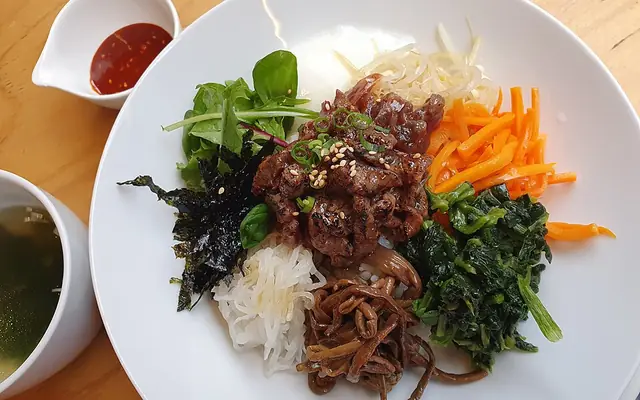
Order Dodam warm-steamed bibimbap: farm-direct vegetables on rice in the house build.
Insa Dodam is a renovated hanok off Insadong-gil that runs a lunch-only bibimbap programme, capping bowls per day to lock in same-morning vegetable delivery.
-
Order Pyongyang naengmyeon: hand-pulled buckwheat noodles in cold hanwoo bone broth.
Open since 1946, Woo Lae Oak is Seoul's canonical address for Pyongyang-style naengmyeon (cold buckwheat noodles), the broth made from hanwoo foreshank.
-
Order Bibim naengmyeon: chewy starch noodles in a sweet-spicy sauce with cold beef slices and a halved boiled egg.
Family-run since 1953, Ojangdong serves Hamheung-style cold noodles: the noodles are made from potato starch and are notably chewier than Pyongyang-style.
-
-
Order Seolleongtang: ox-bone broth cooked until milky-white without additives.
Hadongkwan has been open since 1939 in Myeongdong and is in the Michelin Guide for a bowl of seolleongtang that has not changed: slow-cooked ox bone.
-
Korea's first registered restaurant, open since 1904 in Jongno, still serving a single dish: 17-hour ox bone seolleongtang with sliced brisket.
-
Order Steamed mandu (dumplings) with kimchi and pork filling, thin pleated skin.
A hanok courtyard dumpling kitchen in Bukchon, selling hand-formed mandu (dumplings) by the basket to a patient queue of Seoulites who find the 20-minute.
-
Order Gamasot seolleongtang: broth from ten different beef cuts.
Near Dongdaemun Fashion Market, Bonga cooks its seolleongtang in a traditional gamasot (iron cauldron) from ten beef cuts for 24 hours straight.
-
Order Vegan bibimbap: the full Korean banchan spread reimagined without animal products.
Vegan Insa in Ikseon-dong Hanok Village serves fully plant-based Korean food in a traditional courtyard house, including vegan bibimbap and banchan spreads.
-
Order Halal Korean BBQ platter: marinated beef and chicken prepared according to Islamic dietary law by a Korean.
EID Halal Korean Food on Usadan-ro is one of Seoul's most respected halal restaurants, operated by a Korean Muslim family serving authentic Korean cuisine.
-
Order Vegan Korean set meal: the full spread of plant-based banchan with rice and a warming jjigae (stew) made.
Vegan Kitchen in Jung-gu serves Korean cuisine free of meat, fish and dairy in the temple food tradition, rated 4.5 stars across over 400 HappyCow reviews.
-
Order Samgyetang: whole young chicken packed with glutinous rice.
The most visited samgyetang restaurant in Seoul, set across several traditional hanok houses near Gyeongbokgung Palace with a long daily queue before 11:30.
-
Order Tteokbokki and odeng (fish cake skewer in anchovy broth).
The 200-metre stretch in front of Ikseon-dong from Exit 5 to Exit 6 at Jongno 3-ga Station is Seoul's most concentrated pojangmacha (street food tent).
-
Order Dolsot bibimbap in the stone pot with the rice crackling at the rim.
Insadong Geu Jib is a hanok-style Korean restaurant set in a narrow Insa-dong alley, serving dolsot bibimbap, beef-tartare bibimbap and bulgogi-and-vegetable.
-
Order Pyongyang-style naengmyeon: the original cold noodle bowl.
Open since 1946, Woo Lae Oak is Seoul's institution for Pyongyang-style naengmyeon: cold buckwheat noodles in clear hanwoo bone broth, in the Michelin Guide.
-
Order Seolleongtang: slow-cooked ox-bone broth in the bowl that has made this Myeongdong institution a Michelin.
One of Seoul's oldest restaurants, Hadongkwan serves only seolleongtang (milky-white ox bone soup) from morning until it sells out around 15:30.
-
Order Bibim naengmyeon: chewy potato starch noodles tossed in a sweet-spicy red sauce with cold beef and a soft-boiled egg.
Open since 1953, Ojangdong serves Hamheung-style naengmyeon: potato starch noodles notably chewier than Pyongyang style, best in the spicy bibim version.
-
Order Fully plant-based Korean banchan and rice.
Vegan Insa in the hanok lanes of Ikseon-dong is consistently rated one of Seoul's best vegan restaurants: purely plant-based Korean food in a traditional.
-
Order Gamasot seolleongtang from the iron cauldron.
Open 24 hours, Bonga near Dongdaemun cooks its seolleongtang in traditional cast-iron pots from ten beef cuts for 24 hours: the bowl that market traders.
-
Order Vegan kimbap (seaweed rice rolls) with seasonal vegetable fillings.
A traditional Korean lunch counter in Insadong serving plant-based kimbap and banchan, rated 4.5 stars across 400+ HappyCow reviews for consistent quality.
-
Order Halal bibimbap or Korean BBQ platter.
EID on Usadan-ro near Seoul Central Mosque is the city's most respected halal Korean restaurant, run by a Korean Muslim family since the 1990s.
-
Order Seolleongtang: the 1904 recipe unchanged, ox bones for 17 hours.
Korea's first registered restaurant, open since 1904 in Jongno, serving one dish unchanged: 17-hour seolleongtang.
-
Order Vegan Korean set meal: a full spread of plant-based banchan built on the Korean temple food tradition.
Vegan Kitchen in Jung-gu serves Korean cuisine in the temple food tradition: no meat, fish, dairy, and in the traditional style, often no garlic or spring.
-
One of South Korea's three-Michelin-star restaurants, where chef Mingoo Kang weaves jang (fermented pastes) and cho (vinegars) into contemporary modern.
-
The restaurant that coined New Korean fine dining, where chef Jung Sik Yim's avant-garde plating and Korean pantry ingredients earned two Michelin stars.
-
On the 23rd floor of the Shilla Seoul, La Yeon serves royal-tradition Korean tasting menus against a panorama of the Han River basin, holding two Michelin.
-
Two Michelin stars in the ES Building's fourth floor: seasonal tasting courses where Kwonsooksoo treats Korean fermentation tradition as a living canvas.
-
Two Michelin stars for a seasonal tasting menu structured like a narrative, each course titled as an act in chef Jun Lee's signature Episode format.
-
Australian chef Joseph Lidgerwood and his Korean wife Ginny Kim opened Evett in 2019; in 2025 it was elevated to two Michelin stars for its ingredient-led.
-
Chef Allen Suh, formerly of Eleven Madison Park, brings a Francophile sensibility to Korean ingredients at his two-Michelin-star table in the Centerfield.
-
One Michelin star for a cultural research institute disguised as a restaurant: chef Cho Eun-hee studies Joseon royal court recipes and reinterprets them.
-
Established in 1939, Hadongkwan is in the Michelin Guide for seolleongtang: ox bone broth slow-cooked to opaque white, seasoned only with salt at the table.
-
Seoul's oldest continuously operating restaurant, first licensed in 1904: ox bones boiled for 17 hours, broth poured over sliced beef and soft wheat.
-
Bukchon Son Mandu hides in the residential lanes above Bukchon-ro; jjin-mandu and gukbap mandu soup are the order, kitchen closes when dumplings run out.
-
Euljiro Pocha Alley in Seoul: the tented pojangmacha alley between euljiro 3-ga and the industrial backstreets is off every major tourist map.
-
Miro Sikdang is a five-table Korean drinking-food room near Hongik University, often filled by off-duty chefs; go early before the evening service fills it.
-
Mangwon Market Banchan Counters sell pre-made kimchi, japchae and braised vegetables to locals; visit before 10:00 weekday morning for freshest containers.
-
Try Seolleongtang (milky ox bone soup)
Hadongkwan has served seolleongtang (milky ox bone and brisket soup) from its Myeongdong address since 1939, at a price that remains practically unchanged.
-
Try Seolnongtang (ox bone broth soup) with rice
Imun Seolnongtang has served the same bowl since 1904 -- seolnongtang, a milky ox bone and brisket broth, for ₩10,000.
-
Try Kalguksu (knife-cut noodles in anchovy broth)
The kalguksu stalls inside Namdaemun Market serve knife-cut wheat noodles in a clean anchovy-and-kelp broth with zucchini and green onion for ₩7,000-8,000.