

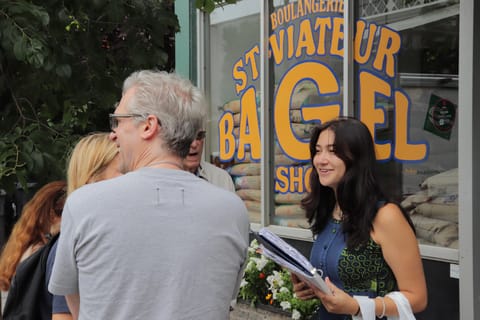
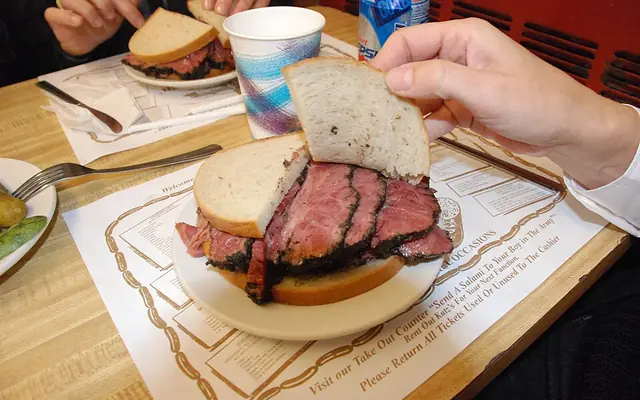
The Jewish deli is one of the great American culinary inventions, descended from the cooking of Ashkenazi Jews (the Yiddish-speaking communities of central and eastern Europe) who emigrated en masse to New York, Chicago, Montreal, and other Western cities between the 1880s and the 1920s. The cuisine is a fusion of Old World Ashkenazi traditions (kreplach, kasha, gefilte fish, brisket, herring, schmaltz, the Sabbath chicken soup) with the abundance of American meat and dairy that the immigrants suddenly had access to. The result is the sandwich-centric, hand-cut, mountain-portioned deli food that became a fixture of urban Jewish neighborhoods and then of American cuisine generally.
The defining items are pastrami (peppered, smoked, steamed beef brisket or navel, sliced thick by hand, piled on rye with mustard) and corned beef (brined beef brisket, boiled, sliced); the smoked fish counter (lox, nova, sable, whitefish, sturgeon, served with bagels, cream cheese, capers, and red onion); the matzo ball soup (chicken broth with light or dense matzo balls, depending on family preference); the chicken liver (chopped with schmaltz, onion, and hard-boiled egg); and a parade of pickles (sour, half-sour, garlic dills, the green tomatoes), coleslaw, and rye breads. The deli is also a place to drink celery tonic (Dr. Brown's Cel-Ray, the cult Jewish-deli soda) and end with a black-and-white cookie or a rugelach.
The Jewish deli has been in slow decline for decades (Carnegie, Stage, Second Avenue, and many others have closed), but the institution survives at the great New York delis (Katz's, since 1888; Russ & Daughters, since 1914; 2nd Ave Deli, now on Third), the Montreal smoked-meat institutions (Schwartz's, since 1928; Wilensky's, since 1932), and a 21st-century revival from a younger generation of Jewish chefs (Mile End in Brooklyn, Wexler's in Los Angeles, Mamaleh's in Cambridge).
Book a food experience
Tours, tastings and classes that match this page, bookable on GetYourGuide.


Top picks
The best-scored Jewish deli place in each of 12 cities.
Katz's Delicatessen ★ 4.9
Katz's Delicatessen, on East Houston Street at the corner of Ludlow, has served house-cured, hand-carved pastrami and corned beef since 1888.
OrderThe house-cured, hand-carved pastrami or corned beef, with rye and mustard.
TipKatz's is now open 24 hours on weekends, and it also ships nationwide if you want the pastrami at home.
Schwartz's Deli ★ 4.9
Schwartz's has served Montreal smoked meat since 1928: beef brisket marinated in the house spice blend, smoked, steamed, thinly sliced and served on rye.
OrderThe famous smoked meat on rye bread with mustard, and a cherry soda to wash it down.
TipTo avoid the queues, aim for off-peak times, sit at the counter, or share a table.
Larder Delicatessen and Bakery ★ 4.8
Larder Delicatessen and Bakery on West 29th Street in Hingetown, Jeremy Umansky's koji-and-curing project a 2025 James Beard semifinalist for Best Chef Great.
OrderPastrami on rye with a side of matzoh ball soup, plus a knish to go.
TipHot food service stops 17:45; walk-ins welcome. Closed Sunday and Monday.
Humble Bagel ★ 4.8
Humble Bagel on Freret Street hand rolls and kettle boils its bagels, made in-house daily from scratch in small batches with Steen's Cane Syrup since 2014.
Worth the queueA bagel with lox, red onion, tomato, capers and cream cheese.
TipIt is first come, first served with no phone orders, and the bagels sell out, so come early; it is closed Monday to Wednesday.
Caputo's Market and Deli ★ 4.7
Caputo's Market and Deli on West 300 South runs the Old School sandwich and rotating deli specials for $10 to $15 at the counter, with sandwiches to go.
TryOld School sandwich
Shapiro's Delicatessen ★ 4.6
Shapiro's Deli in Indianapolis opened in 1905. The Reuben, the corned beef on rye and the matzo ball soup have run the same counter for a century.
OrderThe Reuben, a side of macaroni salad, and a slice of sugar cream pie.
TipOrder at the counter, find a table, they bring it out. Cash-friendly. Weekend breakfast 9 to noon.
Famous 4th Street Delicatessen ★ 4.6
Famous 4th Street Delicatessen in Philadelphia is the 1923 Queen Village Jewish deli on the Bainbridge corner, 2025 Michelin Bib Gourmand for over-stuffed.
OrderPastrami on rye; matzo ball soup; a chocolate-chip cookie at the door on the way out.
TipCash gets a discount at the register. Halve the triple-decker with a friend; it is two sandwiches in one.
Nate'n Al's ★ 4.6
Nate 'n Al's on North Beverly Drive in Beverly Hills has been a delicatessen since 1945, serving classic deli favorites from bagels and knishes to latkes.
TryPotato knish with gravy, or potato latkes with sour cream and applesauce.
TipBagels and bialys come with cream cheese, and gluten-free options are available.
Black Bean Deli ★ 4.6
Black Bean Deli on East Colonial Drive in Mills 50 has run since 2001, with pressed Cuban sandwiches, cafecito and pastelitos from a family counter.
TryCuban sandwiches, pressed cubano, cafecito
Perly's Restaurant and Delicatessen ★ 4.5
Perly's on Grace Street is Richmond's daytime Jewish deli. House-cured pastrami and matzo ball soup; breakfast and lunch only, daily until 3 pm downtown.
SignaturePastrami sandwich, Matzo ball soup, Latkes
High Street Market & Deli ★ 4.5
High Street Market & Deli has stacked sandwiches in a 1927 corner grocery since before San Luis Obispo had a food scene, with a cult 4:20 pm discount.
OrderAny signature sando made stoney, which piles on extra ingredients.
TipAfter 16:20 every day the sandwich price drops; students with ID get the deal all day Tuesday.
Rose Foods ★ 4.5
Rose Foods on Forest Avenue opened 2017 from Chad Conley, a Jewish deli with hand-rolled bagels, house-cured lox, smoked whitefish and matzo ball soup.
OrderThe lox bagel with whipped cream cheese, plus a cup of matzo ball soup.
TipDaily 07:30-14:00. Counter ordering; takeout moves fast at peak weekend brunch.
Find a place
Katz's Delicatessen ★ 4.9
Katz's Delicatessen, on East Houston Street at the corner of Ludlow, has served house-cured, hand-carved pastrami and corned beef since 1888.
OrderThe house-cured, hand-carved pastrami or corned beef, with rye and mustard.
TipKatz's is now open 24 hours on weekends, and it also ships nationwide if you want the pastrami at home.
Russ & Daughters ★ 4.9
Russ & Daughters has sold smoked fish, caviar, bagels, bialys and babka from its original appetizing shop at 179 East Houston Street since 1914.
TipCall in an advance order at the Shop (212-475-4880) for courier or pick-up, or come to Houston St. and take a number.
Schwartz's Deli ★ 4.9
Schwartz's has served Montreal smoked meat since 1928: beef brisket marinated in the house spice blend, smoked, steamed, thinly sliced and served on rye.
OrderThe famous smoked meat on rye bread with mustard, and a cherry soda to wash it down.
TipTo avoid the queues, aim for off-peak times, sit at the counter, or share a table.
Sarge’s Delicatessen & Diner ★ 4.8
Sarge's Delicatessen and Diner is a New York deli that cures its own corned beef and pastrami in house and makes matzo ball soup and cheesecakes.
TryIn-house cured pastrami
TipThe tallest sandwich stacks pastrami, corned beef, roast beef, turkey and salami on three slices of rye, 10 to 12 inches high.
Larder Delicatessen and Bakery ★ 4.8
Larder Delicatessen and Bakery on West 29th Street in Hingetown, Jeremy Umansky's koji-and-curing project a 2025 James Beard semifinalist for Best Chef Great.
OrderPastrami on rye with a side of matzoh ball soup, plus a knish to go.
TipHot food service stops 17:45; walk-ins welcome. Closed Sunday and Monday.
Humble Bagel ★ 4.8
Humble Bagel on Freret Street hand rolls and kettle boils its bagels, made in-house daily from scratch in small batches with Steen's Cane Syrup since 2014.
Worth the queueA bagel with lox, red onion, tomato, capers and cream cheese.
TipIt is first come, first served with no phone orders, and the bagels sell out, so come early; it is closed Monday to Wednesday.
Flour Moon Bagels ★ 4.7
Flour Moon Bagels is a Crescent City bagel shop off the Lafitte Greenway in Mid-City, rolling its bagels by hand and giving them an 18 hour cold fermentation.
Worth the queueThe Full Moon tartine with plain cream cheese, ACME nova smoked salmon, cucumber, red onion and capers.
TipThe bakers recommend eating the bagels warm out of the oven and un-toasted; the shop is closed on Wednesday.
Killer Poboys ★ 4.7
Big Killer Poboys at 219 Dauphine makes internationally inspired, chef crafted New Orleans style sandwiches; the original sits in Erin Rose bar.
TipThe Dauphine shop opens 11-8 Wednesday to Monday; the original stand in the back bar of Erin Rose at 811 Conti is 21+ to enter.
Caputo's Market and Deli ★ 4.7
Caputo's Market and Deli on West 300 South runs the Old School sandwich and rotating deli specials for $10 to $15 at the counter, with sandwiches to go.
TryOld School sandwich
Shapiro's Delicatessen ★ 4.6
Shapiro's Deli in Indianapolis opened in 1905. The Reuben, the corned beef on rye and the matzo ball soup have run the same counter for a century.
OrderThe Reuben, a side of macaroni salad, and a slice of sugar cream pie.
TipOrder at the counter, find a table, they bring it out. Cash-friendly. Weekend breakfast 9 to noon.
Goose the Market ★ 4.6
Old Northside butcher and salumi shop on Delaware with sandwiches, gelato and Enoteca wine cellar; Smoking Goose charcuterie, Bon Appetit top-ten sandwiches.
Why locals goA full-service butcher and specialty grocer on North Delaware in Indianapolis with a hidden cellar bar pouring wine, beer and pulled-pork sandwiches.
TipThe cellar bar opens Thursday to Saturday evenings. Reserved bench seats only.
Famous 4th Street Delicatessen ★ 4.6
Famous 4th Street Delicatessen in Philadelphia is the 1923 Queen Village Jewish deli on the Bainbridge corner, 2025 Michelin Bib Gourmand for over-stuffed.
OrderPastrami on rye; matzo ball soup; a chocolate-chip cookie at the door on the way out.
TipCash gets a discount at the register. Halve the triple-decker with a friend; it is two sandwiches in one.
Nate'n Al's ★ 4.6
Nate 'n Al's on North Beverly Drive in Beverly Hills has been a delicatessen since 1945, serving classic deli favorites from bagels and knishes to latkes.
TryPotato knish with gravy, or potato latkes with sour cream and applesauce.
TipBagels and bialys come with cream cheese, and gluten-free options are available.
Black Bean Deli ★ 4.6
Black Bean Deli on East Colonial Drive in Mills 50 has run since 2001, with pressed Cuban sandwiches, cafecito and pastelitos from a family counter.
TryCuban sandwiches, pressed cubano, cafecito
Perly's Restaurant and Delicatessen ★ 4.5
Perly's on Grace Street is Richmond's daytime Jewish deli. House-cured pastrami and matzo ball soup; breakfast and lunch only, daily until 3 pm downtown.
SignaturePastrami sandwich, Matzo ball soup, Latkes
High Street Market & Deli ★ 4.5
High Street Market & Deli has stacked sandwiches in a 1927 corner grocery since before San Luis Obispo had a food scene, with a cult 4:20 pm discount.
OrderAny signature sando made stoney, which piles on extra ingredients.
TipAfter 16:20 every day the sandwich price drops; students with ID get the deal all day Tuesday.
Rose Foods ★ 4.5
Rose Foods on Forest Avenue opened 2017 from Chad Conley, a Jewish deli with hand-rolled bagels, house-cured lox, smoked whitefish and matzo ball soup.
OrderThe lox bagel with whipped cream cheese, plus a cup of matzo ball soup.
TipDaily 07:30-14:00. Counter ordering; takeout moves fast at peak weekend brunch.
Beyond Bread Sandwich ★ 4.5
Beyond Bread on North Campbell in Tucson runs the city's gold-standard scratch deli sandwich on European-oven house bread, an Annapurna staple.
TryAnnapurna or Tucson sub
Attman's Delicatessen ★ 4.5
Attman's Delicatessen has anchored downtown's Corned Beef Row since 1915, piling hand-cut corned beef and pastrami high in a no-frills lunch counter.
OrderThe corned beef sandwich, hand-cut and piled high, with a potato knish.
TipOrder at the counter, then grab a seat in the Kibbitz Room out back; cash moves the line fastest.
Beigelių Krautuvėlė ★ 4.5
Beigelių Krautuvėlė on Pylimo sells the most historic Litvak bagel in the Baltic between €4 and €6, with lox, cream cheese and the option of teyglakh sweets.
TryLitvak bagel with lox
TipCheapest historically grounded bagel in town. Sells out by mid-afternoon; arrive before 14:00.
Isola Forma ★ 4.4
Buy pecorino, Sardinian cured meat and Marghine produce to take away at Isola Forma in Alghero, or sit down for a guided tasting board. TableJourney pick.
OrderA tasting board of Marghine pecorino and Sardinian farm cured meat.
Accademia Olearia ★ 4.4
Accademia Olearia has pressed Sardinian DOP extra virgin olive oil at Ungias Galantè outside Alghero across four generations of the one family.
Diamond Deli ★ 4.4
Diamond Deli on South Main Street in downtown Akron, a long-running deli counter for the University of Akron and downtown lunch crowd, runs hot fat.
TryHot fat sandwiches and house soups
Rose Foods Bagels ★ 4.4
Rose Foods on Forest Avenue runs hand-rolled bagels, lox bagels, pastrami sandwiches and matzo ball soup under fifteen dollars from Chad Conley's deli.
TryLox bagel, matzo ball soup
TipDaily 07:30-14:00; online ordering saves the queue at peak weekend brunch. Cash and card both fine.
Layla Bagels ★ 4.4
Layla Bagels hand-rolls sourdough bagels daily on Ocean Park Boulevard in Santa Monica, open-face builds with seasonal fruit, honey and smoked salmon.
DrinkDrip coffee
TipThe Pre-Jam with seasonal fruit, cream cheese and honey is the signature; the everything loosies sell out first.
Centre Street Deli ★ 4.4
Centre Street Deli on Bay Street is the 2024 downtown outpost of the Thornhill original since 1988, Montreal-style smoked meat hand-sliced over light rye.
OrderThe classic smoked meat sandwich on rye with mustard and a pickle.
TipOrder the lean-and-medium mix; pure lean dries out fast. The Thornhill original is at 1136 Centre Street.
Katzinger's Delicatessen ★ 4.4
Katzinger's Delicatessen on South Third Street in German Village has run as Columbus's Jewish delicatessen since 1984, with the Reuben and matzoh ball soup.
OrderThe Reuben on rye with a cup of matzoh ball soup.
TipCounter ordering; the cured-meat case at the front sells whole salami and rye loaves to go.
Time Market ★ 4.4
Time Market is sam hughes corner store that doubles as a wood-fired pizzeria, deli, espresso bar and grocer since 1920, the neighborhood's quiet anchor.
Why locals goSam Hughes corner store that doubles as a wood-fired pizzeria, deli, espresso bar and grocer since 1920, the neighborhood's quiet anchor.
TipOrder the deli sandwich on house bread, the wood-fired pizza and a Time Market espresso to go. Bike-friendly.
Mogg ★ 4.4
Mogg reopened January 2026 inside Kalle Halle on Karl-Marx-Strasse in Neukoelln; the New York-style brine-and-smoke pastrami program runs at a counter window.
OrderThe pastrami sandwich on rye with mustard and pickles; the matzo ball soup in winter.
TipCounter-only service inside the Kalle Halle food court; busiest at lunch.
Rosenberg's Bagels and Delicatessen ★ 4.4
Rosenbergs Bagels and Delicatessen on East 26th in Five Points is the NYC-style water-boiled bagel shop Denvers mid-Atlantic transplants treat as essential.
Why locals goFive Points bagel shop with NYC-style water-boiled bagels, a Denver-corrected New York deli the city's mid-Atlantic transplants treat as essential.
TipThe everything bagel with house-made lox is the most ordered; the matzoh ball soup runs the lunch trade.
Sully's Steamers ★ 4.4
Sully's Steamers runs steamed bagel sandwiches from East Washington Street. Quick service, big late-night crowd Fridays and Saturdays when the kitchen.
SignatureSteamed bagel sandwiches, Breakfast bagels, Cream cheese spreads
Wise Sons Jewish Delicatessen ★ 4.4
Wise Sons on Telegraph in Temescal runs daily brunch with bagels, matzo ball soup and pastrami plates. The Mission deli's East Bay Oakland outpost.
OrderEverything bagel with house cream cheese and lox.
TipDaily breakfast all day; weekend lines snap by 10 a.m Weekends fill by noon.
United Bakers Dairy Restaurant ★ 4.3
United Bakers at Lawrence Plaza is the city's reference kosher-style dairy restaurant since 1912, no-meat menu with blintzes, smoked fish and split-pea soup.
OrderThe split pea soup with a potato latke and applesauce.
TipKosher-style, not certified kosher. Closed Saturday and most Jewish holidays. The Ladovsky family has run it since 1912.
Hoffy's ★ 4.3
Hoffy's on Lange Kievitstraat in Antwerp's diamond district is a Hungarian kosher counter feeding Belgium's biggest Hasidic crowd; cholent fills fast.
Why locals goHungarian kosher counter in the diamond district feeding Belgium's largest Hasidic community. The cholent on Friday is the under-the-radar Antwerp meal.
TipClosed Friday afternoon and Saturday. Friday morning cholent fills fastest with the post-prayer crowd.
Izzy's Deli ★ 4.3
Izzy's on Elm Street downtown is Cincinnati's century-old kosher-style Jewish deli since 1901, with the signature reuben and the giant potato pancake.
TryReuben sandwich and potato pancake
Katzinger's Half Sandwich ★ 4.3
Katzinger's half Reuben with a half-sour pickle from the barrel at the South Third Street counter runs under $13, the German Village cheap lunch.
TryHalf Reuben with pickle
Reuben's Deli ★ 4.3
Reuben's Deli in downtown Atlanta has run a lunch-only Reuben counter inside the Muse's Building for 20 years: yell your order, no dinner, eight tables.
OrderThe Eastsider on rye with a side of half-sour pickle.
Why locals goInside the historic Muse's Building downtown, Reuben's is a counter operation the after-court lunch crowd lines up for; lunch only, no dinner means tourists miss it.
TipClosed Sunday. Yell your sandwich order from the doorway, then grab one of the eight tables before the courthouse rush hits at 12:30.
Toto Love ★ 4.3
Toto Love inside Bordeaux's Marche des Capucins is Thomas's twelve-stool red counter where a pastrami sandwich with a side of homemade mac and cheese stays.
TryPastrami sandwich with mac and cheese
TipOrder at the counter and grab a stool; closed Mondays with the market.
Bagel Miller ★ 4.3
Bagel Miller in Lincoln Square makes bagels every day and donuts on the weekends, with sandwiches, a full espresso bar and two dog-friendly patios.
Worth the queueBagels every day, with donuts added on the weekends.
TipOrders are placed online, and the kitchen is open until 3pm daily; there is seating inside or on the patios.
Capriotti's Sandwich Shop (Sahara) ★ 4.3
Capriotti's on West Sahara in Las Vegas is the original Vegas Capriotti's where the Bobbie (slow-roasted turkey, cranberry, stuffing) runs $11 small.
TryBobbie sandwich, small around $11, large $18
TipThe small Bobbie feeds one, the large feeds two; order online for pickup, the counter line peaks 12:00-13:00 every weekday.
Rubicon Deli Mission Hills ★ 4.3
Rubicon Deli on India Street in Mission Hills, San Diego, the Dutch Crunch sandwich counter where the half Rubicon Special runs under seven and the whole.
TryDutch Crunch sandwiches, half or whole
Lincoln Market & Deli ★ 4.2
Lincoln Market & Deli, a 1941 corner store on Broad Street, stacks sandwiches like the Pastrami Sensation for San Luis Obispo families and Cal Poly students.
OrderThe Pastrami Sensation on Dutch crunch, plus a fresh-baked cookie.
TipMorning pastries come from Back Porch Bakery and the coffee is Joebella; go early for the breakfast burrito.
Izzy's ★ 4.2
Izzy's on Elm Street downtown is Cincinnati's kosher-style Jewish deli founded in 1901, with the signature reuben sandwich and giant potato pancake.
SignatureReuben sandwich, Potato pancakes
Mitchell Delicatessen ★ 4.2
Mitchell Delicatessen in Riverside Village first opened in 2008 and makes fresh artisan sandwiches, with most of its meat cured or smoked in house.
TryTurkey Avocado sandwich
TipOnline ordering starts at 8am for breakfast and lunch, the hot breakfast bar runs daily, and vegans can pick the hand-made seitan and tofu sandwiches.
Big Bad Bagels ★ 4.2
Big Bad Bagels keeps a full bagel with cream cheese under €8 and a Latvian smoked-salmon bagel around €12, anchoring the city's cheap brunch counter.
OrderA bacon-egg-cheese bagel and a filter coffee for under €10.
TipTake-away is faster than the dine-in queue; bring a Centrāltirgus pastry for dessert.
Tat's Delicatessen ★ 4.2
Tat's Delicatessen in Seattle's Pioneer Square is the East Coast deli proxy: cheesesteaks, pastrami subs and in-house brining since 2004, run by Brian Tatman.
OrderThe Philly cheesesteak with house-brined pastrami on the side; bring cash for the bomb.
TipClosed Sundays; the Tat's Bomb is a sandwich with everything plus a fried egg, on a custom roll.
Lester's Deli ★ 4.1
Lester's Deli has served Montreal smoked meat since 1951 at 1057 Avenue Bernard in Outremont, including a hearty plate with all the fixings.
OrderThe plate of famous Montreal smoked meat served with all the fixings.
TipNo reservations are needed at the Montreal location on Bernard Ave.
Barnini Bagel Shop ★ 4.1
Barnini in Antwerp on Oudevaartplaats serves NYC-style bagels under 14 euro. The smoked-salmon and cream-cheese build is the budget weekend lunch.
TryBagel sandwich
TipClosed Sunday. Bagels run out by 14:00; arrive before lunch.
The Cheese Connection ★ 4.1
The Cheese Connection curates South West and British artisan cheese from a Cargo 2 container, Bristol's harbourside cheesemonger with tasting events.
Why locals goA one-container cheesemonger tucked among Cargo's louder kitchens, curating South West wheels.
TipOrder a platter to eat on the wharf; the counter leans hard into Somerset and West Country wheels.
Saul's Restaurant and Deli ★ 4.1
Berkeley Jewish deli for weekend brunch. Lox and bagels, matzo brei, pastrami eggs and Dr. Brown's soda. Open from 09:00. Booths fill by 10:30 on Saturdays.
Young Avenue Deli ★ 4.1
Young Avenue Deli has anchored the Cooper-Young Memphis corner since 1995 with cold beer, deli sandwiches and the city's deepest tap lists, plus live music.
OrderDeli Club on sourdough with a cold pint of Wiseacre Tiny Bomb.
TipCounter service for food, table service for drinks. The patio fills first on game days.
Bertani Ristorazione ★ 4.0
Bertani Ristorazione runs a gastronomia counter inside Modena's Mercato Albinelli, a casual stop for ready made Emilian dishes since way back in 1994.
OrderWhatever fresh pasta or roast the counter has ready that morning.
TipClosed Sundays; go early as the best trays sell out before early afternoon.
The Pickle Barrel Yonge and Eglinton ★ 4.0
The Pickle Barrel at Yonge and Eglinton has run the Toronto-based deli chain since 1971, smoked meat sandwiches and Jewish-deli classics on the 2nd floor.
OrderA smoked meat sandwich on rye with deli pickle.
TipMultiple Toronto locations. The Yonge-Eglinton branch the most-visited, on the 2nd floor next to Cineplex.
Tower Market and Deli ★ 4.0
Tower Market and Deli on Gallatin Ave pours locally roasted Bongo Java Coffee and fills its sandwiches generously, with quality deli meats and cheeses.
TryDeli sandwich with your choice of toppings
TipThe market carries local organic produce, coffee, deli meats and cheeses to take home, and sandwiches are customized with your choice of toppings.
A Taste of Katz's ★ 4.0
A Taste of Katz's is a deli counter inside DeKalb Market Hall in Brooklyn, selling hand-carved pastrami and corned beef, matzo ball soup and latkes.
TryPastrami sandwich
TipStall inside DeKalb Market Hall, lower level of City Point. The hall opens 11:00 to 22:00 daily, and a few vendors open at 07:00.
Bagels Forever ★ 4.0
Bagels Forever on University Avenue, the long-running Madison west-side bagel bakery, hand-rolls New York-style bagels with lox and cream cheese daily.
OrderA New York-style sesame bagel with lox and cream cheese.
TipOpen early for the morning rush; the wholesale supply runs across Madison restaurants and cafes.
Benchwarmers Bagels ★ 3.9
Benchwarmers Bagels makes bagels from fresh-milled heirloom grains, boiled in honey water and baked dark in a wood-fired oven at 500 E Davie St.
Trenchers Delicatessen ★ 3.9
The rare Tulsa kitchen open until 11pm every night with a full deli menu of sandwiches, wraps, and bar bites, plus a video game lounge and cocktails.
Snarf's Sandwiches ★ 3.8
Snarf's toasts its sub rolls and piles on deli fillings at a South Grand counter, a fast cheap sandwich stop popular with the SLU and Grand Center crowd.
TryToasted oven subs
TipGet any sub toasted, the house move; the hot giardiniera adds heat. A half sub is plenty for a cheap lunch.
Jewish deli by city
 New York City8 places
Katz's Delicatessen, Russ & Daughters
New York City8 places
Katz's Delicatessen, Russ & Daughters
 Alghero5 places
Isola Forma, Accademia Olearia
Alghero5 places
Isola Forma, Accademia Olearia
 Montreal5 places
Schwartz's Deli, Lester's Deli
Montreal5 places
Schwartz's Deli, Lester's Deli
 Indianapolis4 places
Shapiro's Delicatessen, Goose the Market
Indianapolis4 places
Shapiro's Delicatessen, Goose the Market
 Richmond4 places
Perly's Restaurant and Delicatessen
Richmond4 places
Perly's Restaurant and Delicatessen
 San Luis Obispo4 places
High Street Market & Deli, Lincoln Market & Deli
San Luis Obispo4 places
High Street Market & Deli, Lincoln Market & Deli
 Cleveland3 places
Larder Delicatessen and Bakery, Diamond Deli
Cleveland3 places
Larder Delicatessen and Bakery, Diamond Deli
 Modena3 places
Bertani Ristorazione
Modena3 places
Bertani Ristorazione
 New Orleans3 places
Humble Bagel, Flour Moon Bagels
New Orleans3 places
Humble Bagel, Flour Moon Bagels
 Portland3 places
Rose Foods, Rose Foods Bagels
Portland3 places
Rose Foods, Rose Foods Bagels
 Santa Monica3 places
Layla Bagels
Santa Monica3 places
Layla Bagels
 Toronto3 places
Centre Street Deli, United Bakers Dairy Restaurant
Toronto3 places
Centre Street Deli, United Bakers Dairy Restaurant
 Antwerp2 places
Hoffy's, Barnini Bagel Shop
Antwerp2 places
Hoffy's, Barnini Bagel Shop
 Bristol2 places
The Cheese Connection
Bristol2 places
The Cheese Connection
 Cincinnati2 places
Izzy's Deli, Izzy's
Cincinnati2 places
Izzy's Deli, Izzy's
 Columbus2 places
Katzinger's Delicatessen, Katzinger's Half Sandwich
Columbus2 places
Katzinger's Delicatessen, Katzinger's Half Sandwich
 Nashville2 places
Mitchell Delicatessen, Tower Market and Deli
Nashville2 places
Mitchell Delicatessen, Tower Market and Deli
 Philadelphia2 places
Famous 4th Street Delicatessen
Philadelphia2 places
Famous 4th Street Delicatessen
 Tucson2 places
Beyond Bread Sandwich, Time Market
Tucson2 places
Beyond Bread Sandwich, Time Market
 Atlanta1 place
Reuben's Deli
Atlanta1 place
Reuben's Deli
 Baltimore1 place
Attman's Delicatessen
Baltimore1 place
Attman's Delicatessen
 Berkeley1 place
Saul's Restaurant and Deli
Berkeley1 place
Saul's Restaurant and Deli
 Berlin1 place
Mogg
Berlin1 place
Mogg
 Bordeaux1 place
Toto Love
Bordeaux1 place
Toto Love
 Brooklyn1 place
A Taste of Katz's
Brooklyn1 place
A Taste of Katz's
 Chicago1 place
Bagel Miller
Chicago1 place
Bagel Miller
 Denver1 place
Rosenberg's Bagels and Delicatessen
Denver1 place
Rosenberg's Bagels and Delicatessen
 Greenville1 place
Sully's Steamers
Greenville1 place
Sully's Steamers
 Las Vegas1 place
Capriotti's Sandwich Shop (Sahara)
Las Vegas1 place
Capriotti's Sandwich Shop (Sahara)
 Los Angeles1 place
Nate'n Al's
Los Angeles1 place
Nate'n Al's
 Madison1 place
Bagels Forever
Madison1 place
Bagels Forever
 Memphis1 place
Young Avenue Deli
Memphis1 place
Young Avenue Deli
 Oakland1 place
Wise Sons Jewish Delicatessen
Oakland1 place
Wise Sons Jewish Delicatessen
 Orlando1 place
Black Bean Deli
Orlando1 place
Black Bean Deli
 Raleigh1 place
Benchwarmers Bagels
Raleigh1 place
Benchwarmers Bagels
 Riga1 place
Big Bad Bagels
Riga1 place
Big Bad Bagels
 Salt Lake City1 place
Caputo's Market and Deli
Salt Lake City1 place
Caputo's Market and Deli
 San Diego1 place
Rubicon Deli Mission Hills
San Diego1 place
Rubicon Deli Mission Hills
 Seattle1 place
Tat's Delicatessen
Seattle1 place
Tat's Delicatessen
 St. Louis1 place
Snarf's Sandwiches
St. Louis1 place
Snarf's Sandwiches
 Tulsa1 place
Trenchers Delicatessen
Tulsa1 place
Trenchers Delicatessen
 Vilnius1 place
Beigelių Krautuvėlė
Vilnius1 place
Beigelių Krautuvėlė
Regional variations
New York
The dominant Jewish-deli city: Katz's, Russ & Daughters, 2nd Ave Deli, Liebman's in the Bronx, Mile End in Brooklyn, and the Upper West Side appetizing tradition (Barney Greengrass, Zabar's). Pastrami, corned beef, smoked fish, matzo ball soup; the menu is sandwiches over plated mains.
Montreal
Distinct enough to be its own subregion. Smoked meat (a brined-and-smoked brisket distinct from pastrami in cut, brine, and texture), Montreal-style bagel (denser, sweeter, smaller, boiled in honey water and wood-fired), and the egg-and-mustard salami sandwich at Wilensky's. Schwartz's is the institution.
Los Angeles
Canter's (1931), Langer's (1947), Brent's, Greenblatt's (closed but seminal). Langer's #19 pastrami on rye is considered by many critics the best pastrami sandwich in America. Strong LA-Jewish-deli scene, smaller than New York but with real depth.
Chicago, Boston, and elsewhere
Manny's in Chicago, Mamaleh's in Cambridge, the closed Carnegie and Stage in New York. Smaller but real deli scenes anchor most Jewish urban communities in the Midwest and Northeast.
Defining Jewish deli dishes
- Pastrami on rye
- Peppered, smoked, steamed beef brisket or navel, sliced thick by hand, piled five to seven inches high on seeded rye bread with yellow mustard. Pickles and slaw on the side. Katz's is the New York benchmark; Langer's #19 is the LA benchmark.
- Corned beef sandwich
- Brined-not-smoked beef brisket, sliced thick, on rye with mustard. Pinker, less peppery, juicier than pastrami. A half pastrami / half corned beef combo is the deli classic.
- Montreal smoked meat
- Distinct from pastrami: a different cut (Montreal uses primarily brisket but with a different bark and brine ratio), a longer cure with more pepper and coriander, eaten lean, medium, or fatty. Schwartz's is the original.
- Matzo ball soup
- Clear chicken broth with one or two matzo balls (the dumpling made from matzo meal, eggs, schmaltz, and water). Light (floaters) or dense (sinkers), a household-by-household preference.
- Bagel with lox and cream cheese
- A toasted bagel split, schmeared with cream cheese, topped with thin-sliced lox (or nova, the cold-smoked salmon), red onion, tomato, capers. Sunday-morning institution.
- Smoked fish platter
- Lox, nova, sable, whitefish, sturgeon, herring (in cream sauce, schmaltz, or wine), with bagels, cream cheese, sliced tomato, red onion, capers, and lemon. The Sunday brunch spread.
- Chopped liver
- Chicken livers cooked with onion and schmaltz, chopped or ground with hard-boiled egg, served on rye or with crackers as a starter.
- Knish
- Baked or fried potato-and-onion pastry, hand-sized, eaten as a snack or side. Yonah Schimmel's on Houston Street (1910) is the New York institution.
- Latkes
- Potato pancakes, fried in oil, served with sour cream and applesauce. Traditional at Hanukkah but on deli menus year-round.
- Brisket
- Slow-braised beef brisket with onion, carrot, garlic, and tomato or wine. The Sabbath and holiday main dish, served sliced with the cooking jus.
- Reuben sandwich
- Corned beef, sauerkraut, Swiss cheese, Russian dressing on griddled rye. Not strictly kosher (combines meat with cheese), but a deli classic invented in the 1920s. Disputed origin (New York Reuben Kulakofsky vs. Omaha Reuben Kulakofsky).
- Egg cream
- Milk, seltzer, and chocolate syrup (Fox's U-bet is the New York standard), stirred to a foamy head. No eggs, no cream, despite the name. A New York Jewish deli soda fountain classic.
How to order
At a serious deli, the sandwich is the meal. Order a pastrami on rye, mustard, pickle, and a Dr. Brown's Cel-Ray or a cream soda. Half a sandwich plus matzo ball soup is the standard 'cup and a half' order at many places. For breakfast or brunch, the bagel with lox is the classic single-order; a smoked fish platter is for two or more. Sides (knish, latke, kasha varnishkes, kishke) are scattered through the menu and worth one or two. Pickles are on the table; ask for sour, not half-sour, if you want the full deli pickle.
The rookie mistakes: asking for mayo on a pastrami sandwich (it does not go on; mustard only), ordering pastrami toasted (it is steamed and served warm, not griddled), expecting cheese on a deli sandwich (kosher delis do not serve cheese with meat; non-kosher delis like Carnegie historically did, but the classic combo is meat and rye, no cheese), and missing the smoked fish counter (the appetizing tradition is half the deli experience). Tipping is 20 percent, often more at takeout counters.
What to drink with it
Dr. Brown's sodas (Cel-Ray, Cream, Black Cherry) are the canonical deli drinks. Cream soda or a black-and-white egg cream as alternatives. Coffee with the sandwich or with dessert. Beer (often Budweiser or a deli-house lager) at the more bar-leaning places. Wine is unusual but appearing at newer-generation delis (Mile End, Wexler's, Mamaleh's), where natural wine lists pair with the salty-fatty deli food. Tea (in a glass with a sugar cube) closes the meal in the older Ashkenazi tradition.
Where to eat it
New York is the global capital: Katz's (since 1888), Russ & Daughters (since 1914), 2nd Ave Deli, Liebman's in the Bronx, Sammy's Roumanian (when open), Mile End in Brooklyn, the Upper West Side appetizing institutions (Barney Greengrass, Zabar's), Yonah Schimmel for knishes. Montreal for the smoked-meat tradition: Schwartz's, Lester's, Wilensky's, Snowdon Deli. Los Angeles for Langer's, Canter's, Brent's, Wexler's. Boston for Mamaleh's. Chicago for Manny's, Eleven City Diner. Outside North America, Jewish deli is rare; London, Paris, and Tel Aviv have small-scale versions but the cuisine is essentially a North American Jewish diaspora invention.
A short history
The Jewish deli emerged in the late 19th and early 20th centuries as Ashkenazi Jewish immigrants from the Pale of Settlement (modern-day Poland, Lithuania, Belarus, Ukraine, Russia) arrived in American and Canadian cities. The cuisine fused Old World Yiddish-Ashkenazi cooking (brisket, kreplach, herring, schmaltz, the chicken-soup tradition) with the abundance of American kosher beef and the urban sandwich format. Katz's opened in 1888, Russ & Daughters in 1914, Schwartz's in 1928. The deli peaked in the 1950s and has been in slow decline for decades, with a 21st-century revival from younger chefs.
Frequently asked
Is Jewish deli kosher?
Some are, many are not. A kosher deli serves no pork, no shellfish, and no mixing of meat and dairy (so no Reuben sandwich, no cheese on a pastrami, no butter on the bagel with the lox). Many of the most famous delis (Katz's, Carnegie historically) were 'kosher style' but not strictly kosher; they followed Ashkenazi conventions without rabbinical certification.
What is the difference between pastrami and corned beef?
Both start with beef brisket or navel. Corned beef is brined in salt and pickling spice, then boiled. Pastrami is brined, then dry-cured with pepper and coriander, then smoked, then steamed. Pastrami is peppery and smoky; corned beef is salty and milder.
What is the appetizing counter?
The Jewish-American grocery specialty of smoked fish, cured fish, and dairy. 'Appetizing' as a noun refers to the foods kosher Jews can eat with dairy (no meat). Russ & Daughters in New York is the most famous appetizing store. The bagel-and-lox tradition is the appetizing counter's most exported product.
More cities are in research. Want Jewish deli covered somewhere specific? Tell us where you want to eat.