Eleven Madison Park 3 ★ ★ 4.6
Daniel Humm three-Michelin-star Madison Square room serves an 8 to 10 course tasting in New York City. Located in Flatiron. Tasting menu $365.
Book6 weeks ahead
Tasting menus, Michelin stars and the chefs redefining New York City.
New York's fine-dining ecosystem is the densest in the Americas and one of the three deepest in the world, with roughly 75 Michelin-starred restaurants across the five boroughs in the 2024-25 guide and a working canon that runs from the French heritage rooms (Le Bernardin, Daniel, Per Se) through the modern American tasting-menu wave (Eleven Madison Park, Atera, The Modern) into the Korean-American canon that dominated the 2020s star promotions (Atomix, COTE, Jungsik, Kochi). What separates New York from Paris or Tokyo is the relative youth of the modern canon. Le Bernardin opened in 1986, Daniel in 1993, Per Se in 2004, and Eleven Madison Park reopened plant-based under Daniel Humm in 2021. The rooms have history, but the format and the culinary direction are still being negotiated.
The Korean-American shift is the structural story of New York fine dining in the 2020s. Atomix opened in 2018 with Junghyun and Ellia Park running a 14-seat counter tasting menu in Flatiron, and the room has since collected two Michelin stars and a spot in the World's 50 Best top 10. Jungsik in Tribeca runs a 28-seat tasting room with two stars. COTE in Flatiron rewrote what a Korean steakhouse looked like in America. Kochi in Hell's Kitchen runs a 28-seat skewer-format tasting room. The pattern: small counters, fixed tasting menus, Korean ingredients framed through French technique, 200 to 360 dollars before pairings.
The practical shape: book 30 to 90 days ahead, depending on the room. Eleven Madison Park opens 30 days out on Resy. Per Se runs through OpenTable with a 30-day window. Atomix opens 60 days out and sells in 90 seconds. Le Bernardin and Daniel keep more inventory than the small counters and can be booked 2 to 4 weeks out. Tasting menus run 245 to 365 dollars before pairings; the wine pairings add 150 to 320. Lunch service exists at Per Se, Le Bernardin, and Daniel at a meaningful discount, with the same kitchen and service. Cash tips of 20 to 22 percent of pre-tax remain the convention.
New York's three-star count sits at 5 to 7 rooms depending on the guide cycle. Per Se (Thomas Keller's Columbus Circle room, classical French technique on American ingredients, 365-dollar 9-course tasting menu, three Michelin stars continuously since 2006), Le Bernardin (Eric Ripert's midtown French seafood institution, three stars continuously since 2006 with one of the longest streaks in the guide), Eleven Madison Park (Daniel Humm's flatiron room, three stars, plant-based since 2021, the most-debated New York fine-dining shift of the decade), and Masa (Masa Takayama's Time Warner Center sushi room, three stars, 950-dollar omakase, the most expensive prix fixe in the United States). Two-star rooms include Atomix, Jungsik, The Modern, Daniel, Aska, and Atera. One-star rooms run a deep bench: Casa Mono, Kochi, Sushi Noz, Tatiana by Kwame Onwuachi, Frenchette, Crown Shy. The pattern: the three-star tier is mostly French; the two-star tier is the modern American, Korean, and Nordic wave; the one-star tier is the chef-driven everyday-luxury bracket.
Korean-American fine dining is the defining New York culinary movement of the 2020s. Atomix opened in 2018 with Junghyun (Joony) Park and Ellia Park running a 14-seat counter in a Flatiron townhouse, with a cardprinted course-by-course explainer that became the format model for the next wave of New York counters. The menu (200 to 250 dollars depending on cycle) runs through hanjeongsik tradition rebuilt with American produce: aged short rib, traditional Korean pickles, a famous rice course. Jungsik in Tribeca runs Jungsik Yim's larger 28-seat room with a 280-dollar tasting menu and a deeper wine list. COTE Korean Steakhouse in Flatiron under Simon Kim and chef David Shim runs the Korean barbecue format at Michelin level (the only Korean steakhouse in the United States with a Michelin star). Kochi in Hell's Kitchen under Sungchul Shim runs the skewer-format tasting room. The pattern is clear: small rooms, Korean ingredient frames, French technique discipline, 200 to 360-dollar tickets, 60 to 90-day booking windows.
Brooklyn now holds three Michelin-starred fine-dining rooms that work as Manhattan alternatives. Aska in South Williamsburg (Fredrik Berselius, two stars, Nordic-leaning, foraged Brooklyn-state ingredients, 245-dollar tasting menu) opened in 2014 and has held two stars since 2017. Olmsted in Prospect Heights (Greg Baxtrom, one star, garden-led plates, the carrot crepe is the famous dish, 165-dollar tasting menu) opened in 2016. Sushi by M in Bushwick (Min Joon Kim, one star) runs a 12-seat omakase at 285 dollars. The Brooklyn fine-dining context differs from Manhattan in scale (smaller rooms, 14 to 30 covers), price (15 to 25 percent below the Flatiron tasting-menu equivalents), and reservation difficulty (slightly easier but still requires the 60-day window). The trip from midtown Manhattan to South Williamsburg by subway runs 35 to 45 minutes; the L or J train and then a 10-minute walk. Worth the trip for the format and the lower-key dining-room mood that Brooklyn keeps offering even at the highest level.
New York's hardest Michelin tables open on tight 30 to 90-day windows through Resy, Tock, OpenTable, or the house reservation page. Atomix: 60 days out, midnight Eastern on Resy, sells in 90 seconds, only 28 seats nightly. Carbone (not Michelin but the same booking shape): 30 days out, midnight Eastern, sells in 60 seconds. Eleven Madison Park: 30 days out on Resy, plant-based 365-dollar tasting menu. Per Se: OpenTable 30-day window, dinner only Tuesday to Saturday. Le Bernardin: Tock, 30 days out, lunch easier than dinner. Daniel: SevenRooms, 30 days out. Masa: Resy, 60 days out, walk-in seats at the bar sometimes available at 7pm. The reliable cancellation drops happen at 24 and 4 hours out; Resy Notify is the best alert system. Dress code: jackets are no longer required at Per Se, Le Bernardin, or Daniel as of 2024 but smart-casual remains the expectation (no shorts, no athleisure, no caps). The Korean-American counters (Atomix, Jungsik, Kochi) accept clean denim and a shirt without comment.
Daniel Humm three-Michelin-star Madison Square room serves an 8 to 10 course tasting in New York City. Located in Flatiron. Tasting menu $365.
Book6 weeks ahead
Eric Ripert's three-Michelin-star seafood room on West 51st has held its stars since 2005 in New York City. Tasting menu mostly raw and barely-cooked fish.
Book4 weeks ahead
Thomas Keller's three-Michelin-star Time Warner Center room in New York City runs nine courses with a Central Park view. Located in Midtown.
Book8 weeks ahead

2 hours
Enjoy fine dining aboard a glass-roofed double-decker bus while touring NYC landmarks, with a seasonal gourmet menu, 3 non-alcoholic drinks, bottled water, and your ch...
1.5 hours
Enjoy fine dining aboard a glass-roofed bus while touring NYC landmarks, with a seasonal gourmet menu, 2 non-alcoholic drinks from our drink list, bottled water, and y...
Guided tour · 2.5 hours
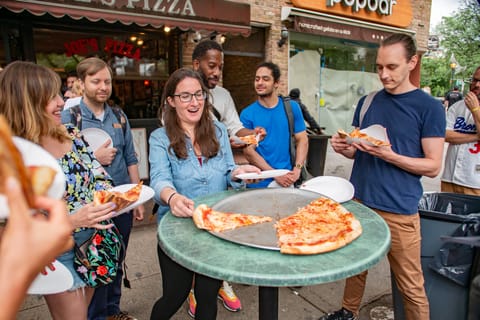
Satisfy your pizza cravings on a 3-hour walking tour of New York’s Greenwich Village. Sample 3 different pies in one of the city's most historic neighborhoods and tast...
Chef Junghyun Park's two-Michelin-star 14-seat NoMad counter runs the most ambitious Korean tasting menu in New York City. Ten courses, $385, set price only.
Book8 weeks ahead
Chef Ronny Emborg's two-Michelin-star 12-seat Tribeca counter runs a foraged Nordic-inflected tasting menu in New York City. One seating per night.
Book4 weeks ahead
Jungsik Yim's two-Michelin-star Tribeca room runs modern Korean tasting menus in New York City: bibimbap with sea urchin, dry-aged duck, abalone with kimchi.
Book4 weeks ahead
The Modern, on the MoMA sculpture garden in Midtown New York City, holds two Michelin stars under Thomas Allan. Six-course tasting with a Hudson Valley focus.
Book3 weeks ahead
Daniel Boulud's Upper East Side flagship has held two Michelin stars in New York City since the early 2000s. Seven-course French tasting, classic dining room.
Book3 weeks ahead
Chef Nozomu Abe's two-Michelin-star Edomae sushi counter on the Upper East Side runs eight seats in New York City. Cypress counter, 90-minute omakase.
Book8 weeks ahead
Simon Kim's Flatiron Korean steakhouse holds one Michelin star for tableside grilling in New York City. Led by chef David Shim. Book 3 weeks ahead.
Book3 weeks ahead
Andy Nusser's Gramercy tapas counter in New York City has held a Michelin star since 2009. Tasting menu $95-$150. Book 2 weeks ahead. At 52 Irving Pl..
Book2 weeks ahead
Chef Stefano Secchi's Flatiron pasta room holds a Michelin star in New York City. Tour of Emilia tasting: tortellini in brodo, anolini, gramigna.
Book4 weeks ahead
Riad Nasr and Lee Hanson's Tribeca brasserie holds a Michelin star in New York City. Duck frites, plateau de fruits de mer, a deep natural-wine list.
Book3 weeks ahead
Chef Kwame Onwuachi's Lincoln Center room holds one Michelin star in New York City. Afro-Caribbean cooking, jollof rice with curry goat, oxtail pepper-pot.
Book6 weeks ahead
Sungchul Shim's Hell's Kitchen skewer counter holds a Michelin star in New York City. Located in Midtown. Tasting menu $165. Book 3 weeks ahead.
Book3 weeks ahead
Roughly 75 starred restaurants in the 2024-25 New York guide, with 5 to 7 three-star rooms (Per Se, Le Bernardin, Eleven Madison Park, Masa, Chef's Table at Brooklyn Fare and others in recent cycles), around 10 to 12 two-star rooms (including Atomix, Jungsik, Aska), and the rest one-star. The city sits behind Paris and Tokyo but ahead of London and Los Angeles for star density.
The room kept three Michelin stars after Daniel Humm's 2021 plant-based pivot, but critic reception has been mixed. Pete Wells's New York Times review demoted the room from a four-star verdict. The 365-dollar tasting menu is technically excellent and politically interesting; whether it is the best 365 dollars you can spend on a New York dinner is the working debate. Many critics now point at Atomix as the more interesting two-star room.
Masa at Columbus Circle runs the most expensive prix fixe in the United States, 950 dollars before tax, tip, or pairings, for a 20-course omakase from Masa Takayama. Per Se is second at 365 dollars. Eleven Madison Park is third at 365. Brooklyn Fare's Chef's Table sits around 395. The Korean-American counters (Atomix, Jungsik) sit in the 200 to 280 range.
Lunch service at Per Se, Le Bernardin, Daniel, and Eleven Madison Park is meaningfully cheaper than dinner (often 30 to 40 percent off the dinner tasting price), uses the same kitchen and service brigade, and is easier to book by 1 to 3 weeks. The room mood is brighter and the meal is shorter (2 hours instead of 3 to 3.5). For visitors with limited evenings, lunch at the three-star rooms is the smart play.
No. Per Se, Le Bernardin, and Daniel dropped the jacket requirement in 2024. Smart-casual (no shorts, no athleisure, no caps, no flip-flops) is the working expectation at the three-star rooms. The Korean-American counters (Atomix, Jungsik, Kochi) and the Brooklyn rooms (Aska, Olmsted) accept clean denim and a shirt without comment. The Modern at MoMA and Sushi Noz still recommend a jacket but do not enforce it.