How New York City came to eat the way it does: the people, migrations and accidents that shaped the plate.
Key eras
1880s, the Lower East Side immigrant pantry
Two million Eastern European Jews, Italians and Irish landed in New York between 1880 and 1920 and pressed their pantries into the city's first food identity. Sussman Volk served the first pastrami sandwich on Delancey Street in 1887; Lombardi's opened the first New York pizzeria on Spring Street in 1905. Italian pushcarts ran the length of Mulberry Street by 1920.
1920s, the supper-club era
Prohibition turned the speakeasy into the city's first cocktail-culture institution. The 21 Club opened on West 52nd Street in 1922; the Cotton Club in Harlem drew Lena Horne and Duke Ellington from 1923. Lindy's on Broadway codified the New York cheesecake in the 1920s as the steakhouse-and-Broadway after-show dessert. The supper clubs trained the bartenders who would build the city's mid-century cocktail rooms.
1950s-60s, the deli and Chinese-American era
Katz's, Ratner's, the 2nd Avenue Deli and the Stage Deli ran lunch service for the Garment District and theatre crowds. The Chinese-American restaurant scaled out of Chinatown into Midtown after the 1965 Immigration Act lifted Asian-quota restrictions; Shun Lee Palace on East 55th opened in 1971 with Hunan cooking, where chef T.T. Wang invented the American General Tso's.
1990s, fine dining and the tasting menu
Daniel Boulud, Eric Ripert, Thomas Keller and the Pool Room generation rebuilt New York fine dining around French technique. Le Bernardin opened in 1986 and held three Michelin stars from 2005. Per Se opened in 2004 as a tasting-menu room and held three stars from year one.
2010s-2020s, the borough food scene
Brooklyn and Queens stopped being suburbs and became the city's most adventurous food borough. Roberta's in Bushwick set the wood-fired Brooklyn pizza template in 2008. Smorgasburg launched on the Williamsburg waterfront in 2011 and gave 100 pop-up vendors a Saturday platform. Flushing's New World Mall and Golden Mall replaced Manhattan Chinatown as the city's serious Chinese food destination by 2015.
Immigrant influences
- Eastern European Jewish: Bagels, pastrami, smoked fish, deli sandwiches, blintzes, knishes, the Jewish appetising counter and the dairy restaurant.
- Southern Italian: Pizza by the slice, red-sauce Italian-American, espresso bars, pasta service rooms. Lombardi's, John's of Bleecker, Patsy's and Don Peppe codified the Italian-American kitchen in New York City.
- Cantonese Chinese: Roast meats, dim sum, hand-pulled noodles, the Cantonese banquet hall in Chinatown and Flushing. Wo Hop, Nom Wah Tea Parlor and Joe's Shanghai built the post-1965 Chinese-American food scene.
- Caribbean (Jamaican, Haitian, Trinidadian): Jerk chicken, roti, oxtail, doubles and curry goat in Brooklyn's Crown Heights and Flatbush. Buyers' bakeries, ackee-and-saltfish counters and rum shops anchor a long Caribbean food map in New York City.
- Korean: Koreatown on West 32nd Street, the all-night BBQ restaurant, the kimchi counter at H Mart, the bibimbap diner. Atomix reached two Michelin stars for a Korean tasting menu in 2022.
- Mexican: Pueblan immigration after 1990 brought the al pastor trompo, the Sunbelt taqueria and the Mexican panaderia to Spanish Harlem, Sunset Park and Jackson Heights in New York City.
- South Asian (Bangladeshi, Indian, Pakistani): Curry Hill on Lexington Avenue, the Jackson Heights biryani halls, the Sixth Street Indian row, and the late-night Punjabi cab-driver kitchens. South Asian halal carts now run citywide.
- Middle Eastern (Lebanese, Syrian, Yemeni): Falafel, shawarma, the Atlantic Avenue spice shops in Brooklyn, and the Bay Ridge Levantine restaurant cluster. Mamoun's on MacDougal has fed Greenwich Village students since 1971.
Signature innovations
- The New York slice: foldable thin-crust pizza sold by the wedge
- Pastrami on rye, hand-sliced from a navel cure since 1887
- Egg cream: milk, seltzer and chocolate syrup
- Black-and-white cookie: two-fondant New York bake
- The chopped cheese: bodega sandwich from Spanish Harlem
- Halal cart chicken and rice with white sauce
- General Tso's chicken: Chinese-American flagship dish
- The American everything bagel: 1980 David Gussin
- The dollar slice: 1980s New York pizzeria pricing floor
- Brooklyn-style natural-wine bar: 2010s Williamsburg model
Book food experiences in New York City
Guided tour · 2h 30m
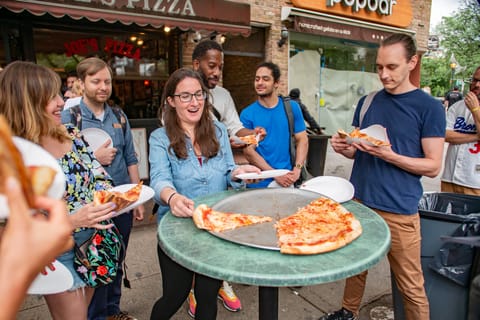
Satisfy your pizza cravings on a 3-hour walking tour of New York’s Greenwich Village. Sample 3 different pies in one of the city's most historic neighborhoods and tast...
Guided tour · 2h 30m
Explore Greenwich Village on a 2.5-hour guided food tour led by a local expert. Enjoy six food tastings, visit famous landmarks, and hear the stories behind the food a...
Water activity · 3 hours
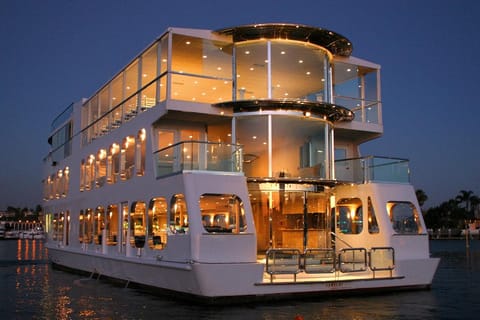
Experience the iconic sights of New York City on a luxury dinner cruise. Savor a 5-course gourmet dinner as you cruise past the Statue of Liberty, the Brooklyn Bridge,...
See all 806 bookable experiences in New York City