
The plates that define Rennes: what they are, where they came from, and where to eat the canonical version.
Signature dishes
-

Galette de sarrasin ★ 4.9
The galette de sarrasin is the savoury Breton pancake: buckwheat flour, water and salt, spread thin on a cast-iron billig and folded around egg, ham and cheese for the classic complète.
Where to try it: Crêperie La Saint-Georges, Bretone, Crêperie Ouzh Taol, Crêperie Sarrasin, Crêperie du Pont-Levis
Price: €8 to €14
Buckwheat reached Brittany in the late Middle Ages and thrived on the region's acid, poor soils where wheat struggled. Because it needs no leavening and no oven, the batter suited a hearth and a flat stone, and it became the everyday bread of the Breton countryside long before it became restaurant food. The split between the savoury buckwheat galette and the sweet wheat-flour crêpe is not universal across Brittany, but it is the convention that holds in Rennes. The complète, with egg, ham and grated cheese, is the reference order against which every crêperie in the city is measured, and the folded four-corner shape that leaves the yolk visible is the standard presentation.
Watch out for: Gluten, Eggs, Dairy
-

Galette-saucisse ★ 4.9
The galette-saucisse is a grilled pork sausage rolled in a cold buckwheat galette and eaten in the hand, no plate, no cutlery and traditionally no mustard, the street food of Rennes.
Where to try it: Crêperie au Marché des Lices, Le Plaisir du Breton, Maison Delaunay, Aux Caprices de Suzette, Madame Claude
Price: €3.50 to €16
The pairing belongs to Haute-Bretagne and to Rennes in particular, where it moved from country fairs and horse markets into the city's Saturday market and, above all, into the Roazhon Park stands on Stade Rennais match days. The rules are argued about with some seriousness: the galette is served cold and unheated, the sausage is a plain grilled pork saucisse, and the purist version carries nothing else. Rennes crêperies have spent the last decade rewriting it anyway, so the city serves the hand-held original at the Marché des Lices alongside sit-down variants with candied onion, mustard and cheese.
Watch out for: Gluten, Mustard
-

Crêpe au caramel au beurre salé ★ 4.7
The sweet wheat-flour crêpe folded over salted-butter caramel is Brittany's dessert default, thin and lacy under a caramel darkened almost to bitterness and cut with fleur de sel.
Where to try it: Œuf, la Crêperie, La Gavotte, La Crêperie du Thabor, Bretone
Price: €6 to €10
Salted butter is the Breton constant, the result of a medieval salt-tax exemption that left the region salting its butter long after the rest of France stopped. Caramel au beurre salé as a confection is far younger, developed in Quiberon in the 1970s and spread across Brittany within a generation, and it took over the sweet crêpe almost completely. The wheat-flour crêpe itself is the sweet counterpart to the buckwheat galette, and in a Rennes crêperie the two arrive in that order: galette first, crêpe second, cider throughout. A good caramel is cooked to the edge of catching, then loosened with cream and beaten with salted butter until it pours thickly rather than runs.
Watch out for: Gluten, Eggs, Dairy
-
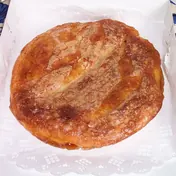
Kouign-amann ★ 4.8
The kouign-amann is a laminated Breton cake of bread dough, salted butter and sugar, folded and folded again until the sugar caramelises into a lacquered, shattering crust.
Where to try it: Boulangerie Hoche, Le Fournil des Halles, Maison Larnicol, La Tête Enfarinée, Boulangerie Elluard
Price: €2 to €4 a piece
The name is Breton for butter cake, and the recipe belongs to Douarnenez in Finistère, where a baker is said to have improvised it in the 1860s from bread dough, butter and sugar when he ran short of other ingredients. The proportions are close to a third each, which is why it eats the way it does. It travelled across Brittany and is now baked as far away as San Francisco and Tokyo, but the Breton version is still the reference: a single large cake cut in wedges, or the individual kouignettes that Rennes shops sell by the piece. Rennes bakeries compete on it openly, and the crust is the tell, because a good one crackles and a poor one is merely sweet.
Watch out for: Gluten, Dairy
-

Far breton ★ 4.5
Far breton is a dense baked batter pudding somewhere between a clafoutis and a flan, studded with rum-soaked prunes and set with a browned, slightly chewy skin on top.
Where to try it: Le Fournil des Halles, Pâtisserie 16h30, Boulangerie Hoche
Price: €3 to €6 a slice
Far comes from the Latin for flour, and the original was a savoury porridge cooked in a cloth alongside meat, still made in western Brittany as kig ha farz. The sweet baked version, thickened with wheat flour, eggs and milk, is the one that spread across the region and became a household dessert. Prunes are the classic addition in the Finistère version, raisins in others, and purists in some quarters insist on neither. What all versions share is the texture: much denser than a clafoutis, sliceable, better on the second day, and served in squares at room temperature rather than warm from the oven.
Watch out for: Gluten, Eggs, Dairy
-
Cidre de Bretagne ★ 4.6
Breton cider is the drink poured with galettes: dry cidre brut or gently sweet cidre doux, low in alcohol, cloudy, and served in a bolée, the wide handleless ceramic cup.
Where to try it: La Rozell, Crêperie Ouzh Taol, Crêperie du Pont-Levis, La Gavotte
Price: €4 to €9 a bolée or half-bottle
Cider replaced beer as the everyday Breton drink from the sixteenth century onwards as apple orchards spread across the peninsula, and by the nineteenth century Brittany and Normandy between them accounted for most of France's production. Breton cider is made from bittersweet cider apples rather than dessert fruit, fermented slowly and often bottled with residual sugar, which is why cidre doux can come in under 3% alcohol. The bolée, a shallow earthenware bowl with no handle, is still standard in Rennes crêperies. Cornouaille in Finistère is the one protected Breton cider AOC; most of what Rennes drinks is farmhouse cider from Ille-et-Vilaine.
Watch out for: Sulphites
-
Coucou de Rennes ★ 4.5
The Coucou de Rennes is the city's own barred grey-and-white chicken breed, slow-grown and firm-fleshed, saved from extinction in the 1980s and now a fixture on Rennes menus.
Where to try it: Jozy, Coquille, Fezi
Price: €22 to €34
The breed was standardised around Rennes in the nineteenth century and was the dominant table bird of Ille-et-Vilaine before industrial poultry displaced it. By the late 1980s the population had collapsed to a handful of birds, and a conservation programme run through the Écomusée du Pays de Rennes rebuilt it from that remnant. Coucou birds take five to six months to reach table weight against six weeks for a commercial broiler, which gives the meat a denser grain and a much stronger flavour, and makes it expensive. It now appears on Rennes bistro menus as a marker of local sourcing, usually roasted whole, grilled over wood or braised long enough to soften the working muscle.
-
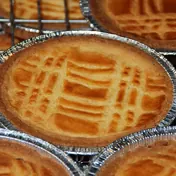
Gâteau breton ★ 4.3
Gâteau breton is a thick, close-textured butter cake of flour, sugar, egg yolks and a great deal of salted butter, scored in a lattice and baked until deep gold.
Where to try it: Le Fournil des Halles, Boulangerie Hoche, Maison Bouvier
Price: €3 to €7 a slice
The cake was developed in the Lorient area in the second half of the nineteenth century as a keeping cake for sailors and fishermen: high in butter and sugar, low in moisture, it lasted weeks at sea. The classic proportions run close to equal weights of flour, sugar and butter, bound with egg yolks alone rather than whole eggs, which is what gives the crumb its short, almost shortbread density. The criss-cross scoring on top, brushed with yolk before baking, is the standard finish. Some versions carry a layer of prune paste or salted-butter caramel through the middle; the plain one is the original.
Watch out for: Gluten, Eggs, Dairy
-
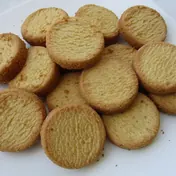
Palet breton ★ 4.2
Palets bretons are thick salted-butter shortbread discs, crisp at the edge and sandy at the centre, baked in a ring so they rise straight rather than spread.
Where to try it: Pâtisserie Le Daniel, Maison Bouvier, Maison Larnicol
Price: €2 to €5
The biscuit belongs to the same family as the flatter, wider sablé breton, and the two names are used loosely across Brittany, but the palet is by convention the thicker one, at least a centimetre deep. Both descend from the region's habit of baking with salted butter in quantities that would be unusual anywhere else in France, and both were sold from the late nineteenth century onwards by the Breton biscuit factories at Pont-Aven, Quimper and Saint-Michel-Chef-Chef. The fleur de sel and the yolks are what separate a palet from a British shortbread: it is saltier, richer and shorter, and it crumbles rather than snaps.
Watch out for: Gluten, Eggs, Dairy
-
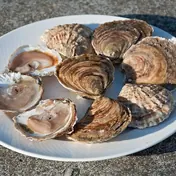
Huîtres de Cancale ★ 4.6
Cancale oysters come from the beds in the Bay of Mont-Saint-Michel an hour north of Rennes, flat plates and cupped creuses that carry an iodine bite from a fourteen-metre tide.
Where to try it: Peska, Le Galopin, Marché des Lices
Price: €12 to €24 a dozen
Cancale has been an oyster town since Roman times and supplied the French court from the seventeenth century onwards; the flat native oyster, the plate, was dredged wild until overfishing and disease all but destroyed the beds in the twentieth century. Cultivated creuses now make up most of the harvest, grown on trestles in the bay and finished in some of the strongest tidal currents in Europe, which is what gives them their firmness and their salinity. Rennes eats them without ever going to Cancale: the oysters travel the sixty kilometres inland the same morning and land on the Marché des Lices stalls and the seafood counters in town.
Watch out for: Molluscs
-

Coquille Saint-Jacques ★ 4.4
Breton scallops are dredged in the Bay of Saint-Brieuc from October to April and cooked plainly in Rennes: seared in salted butter, or raw in thin slices with citrus and oil.
Where to try it: Peska, Racines, Coquille
Price: €18 to €34
The Bay of Saint-Brieuc, an hour and a quarter west along the north Breton coast, is the largest natural scallop bed in France, and the fishery is tightly rationed to protect it: a short season, a small number of licensed boats and dredging windows measured in tens of minutes a day. That scarcity is why Breton scallops sell at a premium and why they arrive in Rennes fresh in the shell rather than frozen. The name comes from the pilgrim shell of Saint James, and the classic gratin preparation baked in the shell with mushrooms and cream is nineteenth-century restaurant cooking. Rennes kitchens now mostly do less to them: a hard sear on one side, brown butter, and nothing much else.
Watch out for: Molluscs, Dairy
-

Andouille de Guémené ★ 4.1
Andouille de Guémené is a smoked pork chitterling sausage built from nested layers of intestine, which slices into concentric rings, and it turns up inside Rennes galettes.
Where to try it: Bretone, La Gavotte
Price: €12 to €16 as a galette
The sausage comes from Guémené-sur-Scorff in Morbihan, where the technique of threading successive lengths of pork intestine one inside another produces the target-ring cross-section that distinguishes it from the coarser, chopped andouille de Vire in Normandy. It is salted, slowly smoked over beech or oak for weeks, then poached, and it is eaten cold in thin slices or warmed through. In Rennes it belongs to the crêperie repertoire more than the charcuterie board: the galette andouille, usually with apple or onion compote and sometimes melted cheese, is a standard on almost every menu in the city and one of the strongest-flavoured things on it.
Watch out for: Gluten, Dairy, Sulphites
-
Beurre demi-sel ★ 4.4
Salted Breton butter, churned from cultured cream and shot through with crystals of coarse salt, is the ingredient that underwrites almost every dish in the region.
Where to try it: Marché des Lices, Halles Centrales, La Criée, Le Fournil des Halles
Price: €3 to €8 per 250g
The habit is a tax accident. The gabelle, the French salt tax, exempted Brittany from the fifteenth century onwards, so salt stayed cheap in the region long after it became a luxury elsewhere, and Breton dairies went on salting butter for preservation when the rest of France moved to sweet butter. Demi-sel carries between 0.5 and 3 percent salt; anything more is beurre salé. The best is churned slowly from cream ripened with lactic cultures overnight, then finished with fleur de sel from the Guérande pans so the crystals stay whole. In Rennes it goes on bread at the table, into the caramel and into the pan for every galette.
Watch out for: Dairy
Signature Dishes in Rennes, FAQ
What food is Rennes known for?
Rennes's signature dishes include Galette de sarrasin, Galette-saucisse, Crêpe au caramel au beurre salé, Kouign-amann, Far breton. See our signature dishes chapter for where to eat each.