Paris holds more Michelin stars than any city in the world, by some margin. The 2024-25 guide lists roughly 130 starred restaurants across the city, including 10 three-star rooms, 16 two-star rooms, and the rest one-star. Tokyo's central wards collectively hold more stars at the regional level, but Paris within its 105 square kilometers holds the densest star count of any single municipality. The classical French fine-dining vocabulary, multi-course menus, sauces built on stocks reduced for days, tableside service, sommeliers who walk the cellar with you, was invented in Paris between roughly 1780 and 1900 and is still being practiced in the same buildings.
The Paris fine-dining canon runs across three formats. The classical haute-cuisine grand house: Arpege (Alain Passage's 7e arrondissement townhouse, three stars, vegetable-led, the famous garden ingredients sourced from the chef's own Sarthe property), Restaurant Guy Savoy (the artichoke soup with black truffle on a quay overlooking the Seine, three stars), Le Cinq at the Four Seasons George V (Christian Le Squer, three stars, the most opulent dining room in the city), Epicure at Le Bristol (Eric Frechon's three-star room behind the lobby). The modernist three-star wave: Pierre Gagnaire on rue Balzac (the deconstructed multi-plate format), Alleno Paris au Pavillon Ledoyen (Yannick Alleno's sauce-extraction technique, three stars), and Plenitude at Cheval Blanc (Arnaud Donckele's two-and-then-three-star room above the Pont Neuf opened in 2021). The contemporary star wave: Table Bruno Verjus (Bruno Verjus's 12e room, two stars), Pavyllon (Yannick Alleno's counter-format casual offshoot, one star).
The practical shape: Paris three-star rooms book 6 to 12 weeks ahead, with reservation windows opening on the date 12 weeks out at midnight Paris time. Tasting menus run 280 to 480 euros for dinner; lunch menus run 165 to 285 euros at most three-stars and are the smart play for visitors. Wine pairings add 180 to 360 euros; the by-the-glass route works better at many three-stars given the depth of the cellar. Dress code: jackets are still recommended at Le Cinq, Epicure, and Le Bristol; smart-casual works at Arpege, Pierre Gagnaire, and Plenitude. Cash tipping is not expected (service compris is built in) but a 10 to 20-euro cash tip for an outstanding meal is appropriate.
The Paris three-star canon
Paris holds 10 three-star Michelin restaurants in the 2024-25 guide. Arpege (Alain Passard's 7e townhouse, three stars continuously since 1996, vegetable-led haute cuisine sourced from his own garden, 480-euro dinner tasting), Restaurant Guy Savoy (on the Quai de Conti, the artichoke soup with black truffle is the signature, three stars), Le Cinq at the Four Seasons George V (Christian Le Squer running the most opulent hotel dining room in the city, three stars), Epicure at Le Bristol (Eric Frechon, three stars, the macaroni stuffed with black truffle is the famous order), Pierre Gagnaire on rue Balzac (the deconstructed multi-plate format that influenced a generation), Alleno Paris au Pavillon Ledoyen (Yannick Alleno's sauce-extraction technique, three stars), Plenitude at Cheval Blanc (Arnaud Donckele's three-star room above the Pont Neuf), Kei (Kei Kobayashi, the first Japanese chef in France to hold three stars at his own restaurant), L'Ambroisie on Place des Vosges (Bernard Pacaud's three-star room since 1988, the most discreet of the canon), Le Clarence in the 8e (Christophe Pele, three stars). Most run lunch service Tuesday to Friday at meaningful discounts.
Classical vs modernist haute cuisine
Paris fine dining splits philosophically. The classical canon (L'Ambroisie, Le Cinq, Epicure, Le Grand Vefour) runs the post-Carême tradition: stocks reduced for days, classical sauces (espagnole, veloute, hollandaise, bechamel), tableside service, the brigade kitchen, white tablecloths, jackets recommended. The modernist canon (Pierre Gagnaire from 1996, Alleno from 2014, Plenitude from 2021) breaks the format. Gagnaire serves a single dish as multiple small plates arriving simultaneously. Alleno extracts sauces from infusions rather than reductions. Donckele at Plenitude builds the meal around extraction and infusion technique he developed at La Vague d'Or in Saint-Tropez. Arpege occupies a third position: classical room, classical service, but a vegetable-led menu that was radical when it appeared in the late 1990s and now reads as the founding text of plant-led fine dining. The Restaurant KEI position is similar: classical French technique with Japanese ingredient framing. Pick the format that fits the occasion. The classical canon is the once-in-a-lifetime event; the modernist canon is the intellectually interesting dinner.
Lunch menus and tasting vs a la carte
Paris three-star lunch service is one of the underrated values in world fine dining. The same kitchen, the same dining room, the same wine cellar, the same service brigade, at a 30 to 50 percent discount on the dinner price. Le Cinq runs a 165-euro four-course lunch (vs 380-euro dinner tasting). Restaurant Guy Savoy runs a 165-euro lunch menu. Pierre Gagnaire runs a 195-euro lunch (vs 380-euro dinner). Epicure runs a 220-euro lunch (vs 420 dinner). Arpege runs a 220-euro lunch (vs 480 dinner). The format: 3 to 5 courses, no truffles in the seasons they are scarce, a tighter wine pairing. The lunch room is brighter, the meal shorter (2 hours instead of 3 to 4), and the booking is easier (2 to 6 weeks out instead of 6 to 12). For visitors with one Paris afternoon free, three-star lunch is the smart use of the budget. Tasting menus vs a la carte: most three-star rooms now run tasting-only at dinner; a la carte exists at Le Cinq, Epicure, and Le Grand Vefour but is the harder reservation.
How to book and what to wear
Paris three-star booking windows: 6 to 12 weeks ahead depending on the room. Arpege, Pierre Gagnaire, Plenitude, and Kei open 12 weeks out at midnight Paris time. Le Cinq, Epicure, and Restaurant Guy Savoy run their own reservation pages with shorter 6 to 8-week windows. L'Ambroisie books through phone (still no website reservations, by deliberate choice) at 8 weeks. The hotel dining rooms (Le Cinq, Epicure) keep some inventory through the concierge networks and can sometimes be booked closer to the date through Quintessentially, American Express Platinum, and the major luxury hotel concierge desks. Dress code: jackets are recommended at Le Cinq, Epicure, Restaurant Guy Savoy, and L'Ambroisie; smart-casual works at Arpege, Pierre Gagnaire, Plenitude, and Kei (no shorts, no athleisure, no caps). Wine pairings add 180 to 360 euros at the three-stars; the by-the-glass route or a single bottle from the cellar is often the better choice. Cash tip of 10 to 20 euros for an outstanding meal is appropriate; the 15-percent American convention is not expected and can be awkward.
Alain Passard's Arpège has cooked vegetable-first three-Michelin-star menus in Paris since 1986. The kitchen pulls produce daily from three estate gardens.
OrderThe full vegetable tasting menu; the chef's signature tomato confit dessert.
Book8 weeks ahead
TipLunch at €175 lands a fraction of the cost of dinner and uses the same kitchen line.
€€€€Tasting €280French fine diningChef Andrea Capasso
Andrea Capasso's Le Clarence in Paris cooks game- and shellfish-forward tasting menus inside a Domaine Clarence Dillon townhouse on the Champs-Élysées.
OrderWhatever game appears in winter; the chef's lobster course year-round.
Book4 weeks ahead
TipTwo seatings at lunch and dinner. Pelé works the floor; ask the maître d' to flag him.
€€€€Tasting €400French fine diningChef Arnaud Faye
Arnaud Faye's Épicure inside Le Bristol Paris keeps a three-star classical French line: truffled macaroni, Bresse poularde poached in a bladder for two.
OrderThe truffled macaroni in winter; the bladder-poached Bresse chicken for two.
Book6 weeks ahead
TipSunday lunch in the garden is the seating most locals book for a celebration.
€€€€Tasting €420French fine diningChef Christian Le Squer
Christian Le Squer's Le Cinq at the Four Seasons George V in Paris keeps three Michelin stars on a classical line built around lobster, caviar and butter.
OrderThe caviar-stuffed spaghetti; the Brittany lobster cooked in seaweed butter.
Book6 weeks ahead
TipLunch sets at €175 are the most under-priced way into a three-star palace room.
€€€€Tasting €225French fine diningChef Stéphanie Le Quellec
Stéphanie Le Quellec's La Scène in Paris cooks open-kitchen on the 8e: a long copper bar fronting a 12-seat dining room, two Michelin stars since 2020.
OrderThe lobster ravioli course; the wagyu main with seasonal vegetables.
Book3 weeks ahead
TipEight bar stools front the open kitchen; ask for those rather than the back tables.
Enjoy a gourmet picnic on the lawns surrounding the Eiffel Tower in Paris. Savor a selection of local French specialties, sip on French wines, and relax in a hassle-fr...
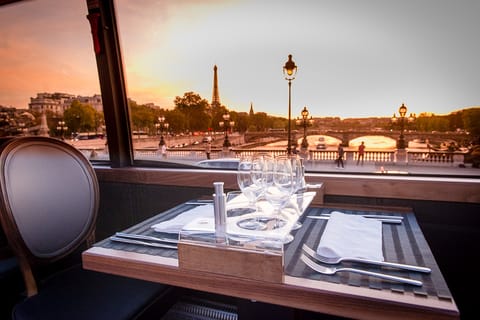
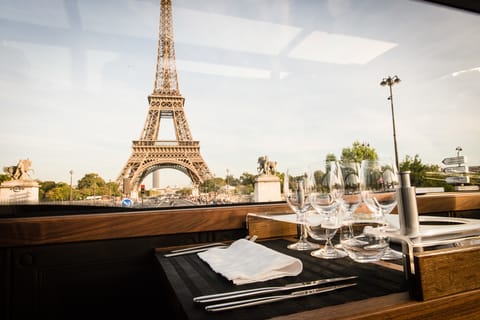
Enjoy fine French cuisine aboard a double-decker bus and take in awe-inspiring views of the city’s monuments, such as the Arc de Triomphe, Eiffel Tower, Notre Dame and...
See the sights of Paris on a unique food tour, traveling by a restaurant-style bus. Enjoy fine French cuisine aboard a double-decker bus and take in awe-inspiring view...
How many Michelin three-star restaurants does Paris have?
10 in the 2024-25 guide: Arpege, Restaurant Guy Savoy, Le Cinq, Epicure, Pierre Gagnaire, Alleno Paris au Pavillon Ledoyen, Plenitude at Cheval Blanc, Kei, L'Ambroisie, and Le Clarence. Paris holds more three-star rooms than any city in the world except Tokyo across its central wards.
Is the Paris three-star lunch menu really cheaper?
Yes, significantly. Le Cinq's lunch is 165 euros vs the 380-euro dinner tasting. Restaurant Guy Savoy's lunch is 165. Pierre Gagnaire runs 195 vs 380 at dinner. Arpege and Epicure run lunch at roughly half the dinner price. The kitchen, room, and service are identical; the meal is shorter and the booking is easier. For visitors with limited evenings, lunch is the smart play.
Do I need a jacket at Paris fine dining?
Jackets are still recommended at Le Cinq, Epicure, Le Bristol, Restaurant Guy Savoy, and L'Ambroisie. Smart-casual works at Arpege, Pierre Gagnaire, Plenitude, and Kei (no shorts, no athleisure, no caps, no flip-flops). The hotel rooms are stricter than the chef-led rooms. When in doubt, wear a jacket at dinner and leave it loose at lunch.
What is the best Paris fine-dining room for the first visit?
If you want the classical haute-cuisine experience, Le Cinq at the Four Seasons George V or Epicure at Le Bristol for the opulent hotel format. If you want the chef-led intellectual dinner, Arpege for the vegetable-led tasting menu or Pierre Gagnaire for the deconstructed multi-plate format. If you want the most-talked-about new room, Plenitude at Cheval Blanc. Arpege is the most influential and the most photographed; Le Cinq is the most opulent.
Are cash tips expected in Paris?
No. Service is included in the menu price (service compris is built in by French law). A 10 to 20-euro cash tip for an outstanding three-star meal is appropriate but not expected. A 5 to 10-euro round-up at a one-star bistro is fine. The 15 to 20-percent American convention does not apply and can be awkward for the staff.