146 editor-picked german restaurants across 25 cities.
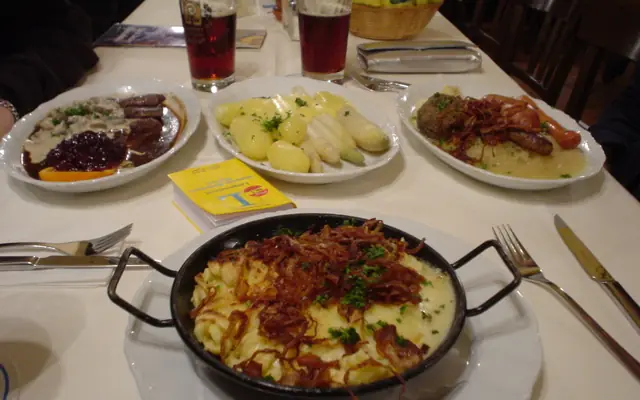
Photo: Les Hutchins from Berkeley, California · CC BY 2.0
German cuisine is less a single tradition than a federation of 16 regional kitchens organized around three rough north-south bands. The south (Bavaria, Baden-Wurttemberg) is beer country, with the deepest sausage tradition, the pretzel-and-weisswurst breakfast, schnitzel, pork knuckle (schweinshaxe), knoedel (potato or bread dumplings), and the strudel-and-cake culture that connects to Austria. The middle (Rhineland, Saarland, Hesse, Franconia) is wine country, with sauerbraten (the marinated beef roast), Riesling and Pinot Noir as the regional grapes, the apfelwein (apple-cider) tradition of Hesse, and a hybrid French-and-German cooking grammar. The north (Hamburg, Bremen, Lower Saxony, Schleswig-Holstein) is fish country, with rollmops, fischbrotchen (the herring sandwich), labskaus (the sailors' beef-beetroot-potato hash), and the Frisian shrimp tradition. Berlin sits east-of-center and runs its own eclectic kitchen: currywurst (the post-1949 invention), doner kebab (the post-1970s Turkish-immigrant invention that became a Berlin staple), and the modernist German fine-dining scene.
The defining dishes that cross regions are sausage (over 1,500 documented varieties, with each region having its own canonical wurst), bread (Germany has the world's deepest bread tradition with over 3,000 varieties, UNESCO-listed in 2014), pretzel (laugengeback, the lye-bath baked goods), sauerkraut (the lacto-fermented cabbage that survives the winter), Schwarzwalder Kirschtorte (Black Forest cake), apfelstrudel (Bavarian-Austrian apple strudel), and the deep beer-and-wine drinking culture. The Reinheitsgebot (the beer purity law of 1516, originally Bavarian) still shapes German brewing.
The modern German fine-dining scene is one of Europe's strongest. Germany has the second-highest number of Michelin-starred restaurants in Europe after France. The Berlin and Frankfurt restaurant scenes have rebuilt seriously since 2000; Munich and Hamburg hold long traditions. Top-end German cooking now reads as a confident regional French-German hybrid with a deeper sausage and bread tradition than its French neighbor.
Book a food experience
Tours, tastings and classes that match this page, bookable on GetYourGuide.
Discover Maeklong Railway Market and Damnoen Saduak Floating Market on a guided tour from Bangkok with a German-speaking guide. Experience authentic...
The Wine Tour is an amazing and real experience not to be missed in the surrounding area of Cagliari. Enjoy the beautiful scenery while tasting some...
Thomas Imbusch's two-Michelin-star room on Brandshofer Deich in Hamburg cooks carte-blanche around an open stove between 100C and 200C, sourced regionally.
OrderThe full tasting; everything is regional.
TipThird floor of a warehouse, lift on the right. Sister room Glorie downstairs runs a la carte.
Marco Mueller's Rutz in Berlin Mitte holds three Michelin stars on a Brandenburg-led tasting menu, with a wine-bar floor downstairs that serves walk-ups.
OrderThe eight-course Inspiration tasting with wine pairing; the trout course is the room's signature.
TipThe downstairs wine bar runs the same kitchen at a third of the price and takes walk-ins; arrive by 18:30.
Wurststandl Teltschik at Munich's Viktualienmarkt serves Weisswurst pairs and Schweinswürstl from a counter for under €7; cash-only Bavarian morning lunch.
Schilo's, the city's oldest restaurant, serves a bowl of its famous split-pea soup and a hearty sandwich downtown for a modest sum, a 1917 German-Texan deli.
TrySplit-pea soup and a sandwich
TipThe split-pea soup and house root beer make a cheap downtown lunch with a century of history behind it.
Thomas Imbusch's two-Michelin-star room on Brandshofer Deich in Hamburg cooks carte-blanche around an open stove between 100C and 200C, sourced regionally.
OrderThe full tasting; everything is regional.
TipThird floor of a warehouse, lift on the right. Sister room Glorie downstairs runs a la carte.
Marco Mueller's Rutz in Berlin Mitte holds three Michelin stars on a Brandenburg-led tasting menu, with a wine-bar floor downstairs that serves walk-ups.
OrderThe eight-course Inspiration tasting with wine pairing; the trout course is the room's signature.
TipThe downstairs wine bar runs the same kitchen at a third of the price and takes walk-ins; arrive by 18:30.
Wurststandl Teltschik at Munich's Viktualienmarkt serves Weisswurst pairs and Schweinswürstl from a counter for under €7; cash-only Bavarian morning lunch.
Sarah Hallmann and chef Rosa Beutelspacher's Hallmann und Klee on Berlin's Boehmische Strasse holds a Michelin star on a vegetable-led tasting that pulls.
OrderThe five-course tasting; the smoked carrot and the seasonal pike-perch are the signatures.
TipClosed Monday and Tuesday. Weekend brunch from 09:00, evening tasting from 18:00; book three weeks ahead via the website.
Pommes Imperivm at Heumarkt 59 in Cologne's Altstadt serves Currywurst mit Pommes from a late-night counter; open until 03:00 on Fridays and Saturdays.
Rievkoochbud at Vor Wieden in Cologne's Altstadt has fried thick, crispy potato pancakes for over 60 years; the most famous Reibekuchen kiosk in Rhineland.
Wahabi Nouri's Michelin-starred Piment on Lehmweg in Hamburg's Eppendorf threads French technique with Moroccan spice across a six-course tasting menu.
OrderThe full tasting; the lamb course is built around Nouri's Moroccan heritage.
TipU3 Hoheluftbruecke five minutes' walk; street parking on Lehmweg only after 18:00.
€€€€MunichGermanAltstadt LehelUntil Mon-Fri 02:00, Sun 02:00, Sat closed
Schumann's on Munich's Odeonsplatz transitions from restaurant to cocktail hour around midnight and pours late-night until 02:00; one of the city's classic.
Café Frischhut off Munich's Viktualienmarkt fries the Bavarian Schmalznudel doughnut all day for under €4; the city's classic counter snack with filter.
Schilo's, the city's oldest restaurant, serves a bowl of its famous split-pea soup and a hearty sandwich downtown for a modest sum, a 1917 German-Texan deli.
TrySplit-pea soup and a sandwich
TipThe split-pea soup and house root beer make a cheap downtown lunch with a century of history behind it.
$$$$$12-22DurhamGermanGerman bakery brunchOld West Durham
The German bakery's biergarten terrace is one of few Durham spots for rye bread, strudel and schnitzel before noon. Bakery opens at 07:30; restaurant follows.
Schulz Brau Beer Garden is a german room in Happy Holler. Closed Mondays; the outdoor beer garden runs weather-dependent. Drive over from downtown Old City.
Why locals goThe largest German-style beer garden in Knoxville hides on Bernard Avenue in Happy Holler where downtown tourists rarely venture for an authentic helles.
TipClosed Mondays; the outdoor beer garden runs weather-dependent. Drive over from downtown Old City.
Hofbrauhaus Cleveland on Chester Avenue downtown, a licensed branch of the 1589 Munich Hofbrauhaus, runs Hofbrau Original, Dunkel and a Bavarian kitchen.
TryMunich-imported lagers, schnitzel and Bavarian pretzel
Mader's on Old World Third Street has served German food in Milwaukee since 1902, with sauerbraten, schnitzel and a Knight's Bar of beer steins on the wall.
OrderThe sauerbraten with potato dumpling and the schnitzel a la Holstein.
TipLunch is the value play; the steins on the wall include over 200 vintage German pieces.
Jagerhof opened May 2015 as Plovdiv's first Bavarian gastro-pub. Live beer brewed under the 1516 Purity Law, 500-seat hall, Bavarian classics and Oktoberfest.
Bavarian beer hall on Peter Street next to the Albert Hall venue. House lager on tap, pretzels with obatzda, live music programme most nights of the week.
OrderBratwurst platter for the table; a pretzel with obatzda dip.
TipIt opens daily at 09:00 and runs to 02:00, with live Showtime performers every night of the week.
Old German Beer Hall on Old World Third Street downtown is a Hofbrau-style bier hall with one-liter steins, giant pretzels, bratwurst and Bavarian schnitzel.
OrderGiant Bavarian pretzel with beer cheese and a one-liter stein of Hofbrau Original.
TipWalk-in only; weekend nights stand for a long Bavarian sing-along around the communal tables in the front room.
Bar Lagoa has served German-leaning dishes and moqueca on Avenida Epitácio Pessoa since 1934, a Lagoa restaurant in Rio de Janeiro with bow-tied waiters.
OrderTornedor à Lagoa with bacon, peas and palm hearts, or the joelho de porco.
TipWaiters work the white-tablecloth room in bow ties, so treat it as a sit-down lunch rather than a quick chope.
Casa Urich serves German sausages, schnitzel and smoked kassler on Rua São José in Centro, a Rio de Janeiro restaurant founded in 1913 by Edmund Urich.
OrderSalsichinhas alemãs mistas, the schnitzel and the kassler defumado à mineira, then the apfelstrudel with cream
TipWeekday service only, 11:30 to 22:00; waiters wear bow ties and white jackets in a room that keeps its original wall tiles.
Beer-led. Weisswurst (the white veal sausage, eaten before noon with sweet mustard and a pretzel), bratwurst, schweinshaxe (pork knuckle), schnitzel, knoedel, obatzda (the cheese spread), Bavarian pretzel. The Oktoberfest tradition runs from here. Munich anchors the regional fine dining.
Rhineland and Franconia (middle, wine country)
Sauerbraten (marinated beef roast in spiced sour gravy with raisins, a Cologne-Rhineland specialty), Himmel und Erde (apple-and-potato mash with blood sausage), Riesling pairings, Franconian Bocksbeutel-bottled Silvaner. The wine-influenced cooking is lighter than the Bavarian.
Berlin and Brandenburg (east of center)
Currywurst (the 1949 Herta Heuwer invention), doner kebab (the 1970s Berlin invention by Turkish immigrant Kadir Nurman), Eisbein (pickled pork knuckle, the Berlin version of schweinshaxe), Bouletten (Berlin-style meatballs), Solyanka in eastern Germany (Soviet-influenced). The most eclectic regional kitchen, with the modernist fine-dining scene the densest in Germany.
Hamburg and the north (Schleswig-Holstein, Lower Saxony)
Fish-led. Fischbrotchen (the herring or matjes sandwich on a white roll), Labskaus (the sailors' hash of beef, beetroot, potato, and pickled herring), Krabben (the small North Sea shrimp), rollmops, scholle (Frisian plaice). The deepest fish-and-sea-trade tradition.
Swabia and Baden (southwest)
Maultaschen (the Swabian ravioli, sometimes called Herrgottsbescheisserle, 'tricking the Lord' because the meat is hidden inside the dough for Lenten compliance), spatzle (egg noodles), kasespatzle, flammkuchen (the Alsace-leaning tarte flambee), Black Forest cake. Borders Switzerland and France; the cooking reflects.
Defining german dishes
Schnitzel
Breaded and pan-fried veal (Wiener) or pork (Schnitzel Wiener Art) cutlet, served with potato salad, lemon wedge, and lingonberry. The Wiener Schnitzel is Austrian by law (must be veal); the German pork version is the workhorse.
Bratwurst
Coarse-ground pork sausage, grilled or pan-fried, served with mustard and bread, or sliced and topped with currywurst sauce. Hundreds of regional variations: Thuringer, Nurnberger (the small one), Frankfurter (the thin one, ancestor of the hot dog), Bockwurst, Weisswurst.
Sauerbraten
Beef roast marinated for 3 to 5 days in red-wine vinegar, water, onion, juniper, clove, and bay leaf, then slow-braised. The Rhineland version finishes with a sauce of raisins, gingerbread crumbs (or Lebkuchen), and the strained marinade. The country's defining slow-roast.
Schweinshaxe / Eisbein
Pork knuckle, either roasted (Bavarian schweinshaxe, with crackling skin and a beer-and-caraway glaze) or boiled-and-pickled (Berlin eisbein, served with sauerkraut, mustard, and a horseradish sauce). Served with sauerkraut or red cabbage, plus knoedel or potato.
Currywurst
Sliced bratwurst topped with a curry-spiced tomato sauce, dusted with curry powder, served with fries. Invented in West Berlin in 1949 by Herta Heuwer using British Army curry powder and ketchup. The Berlin street-food classic.
Bread (German Bread Culture, UNESCO 2014)
Germany documents over 3,000 bread varieties. Roggenbrot (rye), Vollkornbrot (whole-grain), Brezel (pretzel), Bauernbrot (peasant loaf), Pumpernickel (the dense black rye from Westphalia), and the Sunday Brotchen (bread rolls). The deepest bread tradition in the world.
Knoedel
Bavarian-Austrian dumplings, either potato (Kartoffelknodel) or bread (Semmelknodel), served alongside braised meats with the gravy. Hand-formed, boiled, served whole or sliced.
Schwarzwalder Kirschtorte (Black Forest Cake)
Chocolate sponge layered with whipped cream, sour cherries (Sauerkirsch), and Kirschwasser (cherry brandy), topped with chocolate shavings and a single cherry. The defining German layer cake, originating in the Black Forest region in the 1930s.
Doner Kebab (Berlin Style)
Vertical-spit-roasted lamb or chicken (or both), shaved into a pita with salad, yogurt-and-garlic sauce, and chile-tomato sauce. Invented in West Berlin in the 1970s by Turkish immigrant Kadir Nurman; the wrap-and-vegetable format is Berlin-specific and now exported globally as German-style doner.
Apfelstrudel
Paper-thin strudel pastry rolled around apple, raisin, walnut, cinnamon, and sometimes breadcrumbs, baked and served warm with vanilla cream or whipped cream. Bavarian-Austrian; the Habsburg-era technique came from Turkish baklava via the Ottoman influence.
How to order
At a Bavarian biergarten or beerhall, order a beer first (Helles, the pale lager, is the default; Dunkel, the dark lager, is the alternative; Weissbier is the wheat beer). The food menu runs to schnitzel, schweinshaxe, sausage platters, obatzda, pretzel, and roast pork. Order one main per person; portions are large. At a Rhineland wine tavern (Weinstube), the menu is lighter (flammkuchen, riesling-friendly fish, sauerbraten) and the wine list is the centerpiece. At a northern fish restaurant, fischbrotchen for lunch, scholle or matjes for dinner. At a Berlin bistro or modern German room, the menu is more eclectic.
The rookie mistakes: ordering weisswurst after noon (the white veal sausage is a Bavarian breakfast dish, traditionally not served past noon; some places still observe), tipping like an American (10 to 15 percent rounded up to a clean number, the German way is to tell the server the total amount including tip when paying), expecting tap water (German restaurants typically serve sparkling or still bottled water for a small fee), and assuming all German food is heavy (the Hamburg fish kitchen and the Rhineland wine cooking are restrained). Cash is still common; cards are increasingly accepted.
What to drink with it
Beer is the universal pair in the south and east. Helles (pale lager), Dunkel (dark lager), Weissbier (Bavarian wheat), Pils (north German pilsner), Kolsch (Cologne), Altbier (Dusseldorf), Berliner Weisse (the sour wheat beer of Berlin), Schwarzbier (black lager). German wine in the Rhine and Mosel: Riesling (dry, off-dry, Spatlese, Auslese, ice wine), Silvaner from Franconia, Pinot Noir (Spatburgunder) from Baden and Ahr, Pinot Gris and Pinot Blanc (Grauburgunder, Weissburgunder). Apfelwein (apple cider, the Frankfurt regional drink). Schnapps (fruit brandies from Black Forest) after dinner. Coffee culture is strong; Kaffee und Kuchen (coffee and cake) is the afternoon ritual.
Where to eat it
Munich: Hofbrauhaus and Augustiner for traditional Bavarian, plus the modern Tantris (the lineage room) and Restaurant Atelier (three-Michelin-starred). Berlin: the modernist fine-dining density is highest here (Rutz with three stars, Coda the dessert tasting menu, Restaurant Tim Raue, Horvath, Lorenz Adlon Esszimmer). Hamburg: The Table by Kevin Fehling (three stars), Haerlin. Frankfurt: Lafleur (two stars), the Apfelwein-culture restaurants in Sachsenhausen. Cologne: Le Moissonnier (Belgian-French-German). Stuttgart and the Swabian region for Maultaschen and spatzle. Outside Germany, Vienna's overlap is closest; Strasbourg's Alsace cooking is the French side of the same band.
A short history
German cuisine took its modern shape across many centuries of regional fragmentation (the Holy Roman Empire was hundreds of states; the Imperial Germany of 1871 was the first political unity), each region with its own brewing, baking, and sausage traditions codified before unification. The Reinheitsgebot of 1516 (the Bavarian beer purity law) is the world's oldest food regulation still in effect. UNESCO listed German Bread Culture in 2014. The post-1990 reunification opened the eastern kitchen back to the western, and the Berlin fine-dining scene exploded.
Frequently asked
Why are there so many German sausages?
Over 1,500 documented varieties, because every region developed its own (Thuringer, Nurnberger, Frankfurter, Bockwurst, Weisswurst, Mettwurst, Bratwurst, Blutwurst, Bierwurst, Bregenwurst), and the regulatory framework protected regional names. Each sausage has its own grind, casing, spicing, and cooking method. The trade tradition (Metzger, the German butcher) is one of the oldest documented in Europe.
Is Wiener Schnitzel German?
No, it is Austrian by law. The original Wiener Schnitzel must be veal (Kalbfleisch) and is a protected term in Austria. The German pork version is properly called Schnitzel Wiener Art (Vienna-style schnitzel) or Schweineschnitzel. The breading-and-pan-frying technique is identical.
What is the difference between Bavarian beer and northern German beer?
Bavarian beer leans toward the lager tradition (Helles, Dunkel, Marzen, Bock) plus the Weissbier (wheat beer). Northern Germany has the pilsner tradition (Pils) and the regional ales: Kolsch in Cologne, Altbier in Dusseldorf, Berliner Weisse in Berlin (a sour wheat beer). The styles are distinct enough that a Bavarian and a Berliner drinking each other's beer would be doing it as a curiosity.