

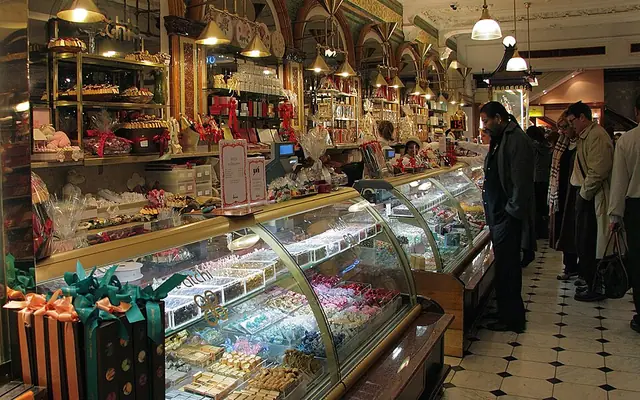
A food hall is a multi-stall food space where several independent vendors operate within a single shared room, with communal seating and shared bar service. The format has two distinct historical roots that have converged in the last decade. The first is the working public market: Barcelona's Mercat de la Boqueria, Lisbon's Mercado da Ribeira (the working market half), Madrid's Mercado de San Miguel, Rotterdam's Markthal, Florence's Mercato Centrale, Istanbul's Spice Bazaar, the Tokyo depachika basement food halls of Mitsukoshi and Isetan, and the Asian wet markets and hawker centers (Singapore's Tiong Bahru and Maxwell, Bangkok's Or Tor Kor, Hong Kong's Sheung Wan). The second is the designed-as-food-hall venue, pioneered by Eataly (Turin, 2007, then international expansion), Time Out Market (Lisbon, 2014), Mercado Roma in Mexico City, Smorgasburg in Brooklyn, and the Eatery, Urbanspace, and Hudson Yards food halls of New York.
The difference between a great food hall and a mediocre one is curation. The originals (Boqueria, San Miguel, the Tokyo depachika) are decades or centuries old, and the vendors are family-run businesses with serious lineage. The designed venues live or die by who is invited to operate. Time Out Lisbon set the global template: Time Out's food critics personally curated 20-plus chef stalls inside the existing Mercado da Ribeira market hall, with rotating residencies and a single shared payment system. The model was then exported to Time Out Markets in Boston, New York, Miami, Montreal, Chicago, Dubai, and London.
The Asian hawker tradition (Singapore's hawker centers are UNESCO-listed since 2020) is a related but distinct format: cooked-food vendors at price points far below restaurant level, operating under public-health regulation, with no shared service, no curation, and a deep generational lineage. Hong Kong's dai pai dong and the Tokyo standing-bar shotengai are looser cousins. The contemporary food hall in the West increasingly tries to import that lineage and ingredient-honest cooking into a designed, ticketed, brand-curated room, with mixed results: at its best (Time Out Lisbon, Mercado Roma) it makes serious food accessible at lower price points than a sit-down restaurant; at its worst it is a mall food court with better lighting.
Book a food experience
Tours, tastings and classes that match this page, bookable on GetYourGuide.

Top picks
The best-scored food hall place in each of 12 cities.
Fondy Farmers Market ★ 4.7
Fondy Farmers Market on West Fond du Lac Avenue, the largest farmers market in Wisconsin since 1917, runs 70+ vendors including a deep Hmong grower.
Why locals goThe largest farmers market in Wisconsin since 1917 with a deep Hmong grower contingent visitors rarely find.
TipGet there by 08:00 Saturday for the Hmong produce row including lemongrass and bitter melon.
Yassin's Falafel House ★ 4.7
Yassin's Falafel House at Marble City Food Hall, Yassin Terou's Syrian counter named Reader's Digest Nicest Place in America 2018, runs $7-10 falafel.
TryFalafel sandwich
TipFalafel sandwich runs under $10; add a side of hummus and pita for under $14.
Mercado de Sabores Poblanos ★ 4.6
Mercado de Sabores Poblanos gathers its comedores over two floors in Puebla, cooking mole, chalupas, cemitas, pipian and tamales de tlanipa daily.
TipTwo floors of comedores, so pick one and stay rather than trying to graze the whole hall in one visit.
Mercato Civico di San Benedetto ★ 4.6
Cagliari's biggest civic market trades from a temporary hall on Piazza Nazzari, some 170 stalls of fish, produce, cheese, bread and cured meat.
TipThe 1957 building on Via Cocco Ortu closed for reconstruction in March 2025, so the market you want is the Piazza Nazzari hall, shut on Sunday.
Mercado dos Lavradores ★ 4.6
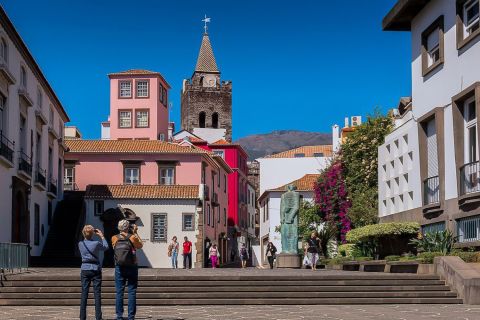
Mercado dos Lavradores opened in Funchal in 1940 to Edmundo Tavares's design, tiled front, fish hall downstairs and tropical fruit upstairs.
TipGo before 09:00 for the fish hall. Saturday shuts at 14:00 and Sunday is closed entirely.
Kalnciema Quarter Market ★ 4.6
Kalnciema Quarter Market is a Saturday-only Pardaugava farmers market most one-day tourists never cross the river to reach; tram 5 lands you there by 11:00.
Why locals goA Saturday-only Pārdaugava farmers' market most one-day tourists never cross the river to reach.
TipTake tram 5 across the Daugava; arrive by 11:00 for the strongest produce stalls and the live music sets.
Fenix Food Factory ★ 4.5
A former harbour warehouse turned indoor artisan market on Katendrecht, housing Jordy's Bakery, Booij Kaasmakers, Blije Wijnen natural wines and the Kaapse.
OrderSourdough from Jordy's Bakery and craft beer from Kaapse Brouwers.
TipThe waterfront terrace faces west over the Maas; the evening light from 17:00 is worth timing your visit.
Armature Works Food Hall Bowl ★ 4.5
Heights Public Market plates across Ling's Dumplings, Han Hand Roll and The Fold run $10 to $18, a sit-down option that beats the SoHo prices.
TryHeights Public Market plates
Yanagibashi Rengo Ichiba Breakfast ★ 4.5
Yanagibashi Rengo Ichiba opens at 08:00 with ready-to-eat seafood don and tempura plates at several market counters. Hakata's best two hours of breakfast.
OrderSeafood don and a tempura plate
TipClosed Sundays and public holidays. Five-minute drive from Hakata Station.
Kiełbaski z Niebieskiej Nyski (Blue Van) ★ 4.5
The blue Nysa van outside Kraków's Hala Targowa grills kielbasa from 20:00 until 02:00. At ul. Grzegórzecka 5. Booking recommended. Reservations advised.
TryGrilled kielbasa
TipCash only. Closed Sunday. Bread, sausage, mustard, 15 zl. Long queue past midnight; faster after 01:00.
Mercado Victoria ★ 4.4
Mercado Victoria was the first gastronomic market in Andalusia, more than twenty stalls under a late-nineteenth-century iron pavilion in central Córdoba.
OrderSalmorejo at La Salmoreteca before anything else.
TipThe drinks area at Sojo Mercado opens at 15:00 and runs later than the food stalls do.
Mercato Civico ★ 4.4
Alghero's covered civic market opens at 07:00 every day and is the easiest place in town to see the local catch before it reaches the menus.
Find a place
Fondy Farmers Market ★ 4.7
Fondy Farmers Market on West Fond du Lac Avenue, the largest farmers market in Wisconsin since 1917, runs 70+ vendors including a deep Hmong grower.
Why locals goThe largest farmers market in Wisconsin since 1917 with a deep Hmong grower contingent visitors rarely find.
TipGet there by 08:00 Saturday for the Hmong produce row including lemongrass and bitter melon.
Yassin's Falafel House ★ 4.7
Yassin's Falafel House at Marble City Food Hall, Yassin Terou's Syrian counter named Reader's Digest Nicest Place in America 2018, runs $7-10 falafel.
TryFalafel sandwich
TipFalafel sandwich runs under $10; add a side of hummus and pita for under $14.
Mercado de Sabores Poblanos ★ 4.6
Mercado de Sabores Poblanos gathers its comedores over two floors in Puebla, cooking mole, chalupas, cemitas, pipian and tamales de tlanipa daily.
TipTwo floors of comedores, so pick one and stay rather than trying to graze the whole hall in one visit.
Mercato Civico di San Benedetto ★ 4.6
Cagliari's biggest civic market trades from a temporary hall on Piazza Nazzari, some 170 stalls of fish, produce, cheese, bread and cured meat.
TipThe 1957 building on Via Cocco Ortu closed for reconstruction in March 2025, so the market you want is the Piazza Nazzari hall, shut on Sunday.
Mercado dos Lavradores ★ 4.6
Mercado dos Lavradores opened in Funchal in 1940 to Edmundo Tavares's design, tiled front, fish hall downstairs and tropical fruit upstairs.
TipGo before 09:00 for the fish hall. Saturday shuts at 14:00 and Sunday is closed entirely.
Kalnciema Quarter Market ★ 4.6
Kalnciema Quarter Market is a Saturday-only Pardaugava farmers market most one-day tourists never cross the river to reach; tram 5 lands you there by 11:00.
Why locals goA Saturday-only Pārdaugava farmers' market most one-day tourists never cross the river to reach.
TipTake tram 5 across the Daugava; arrive by 11:00 for the strongest produce stalls and the live music sets.
Fenix Food Factory ★ 4.5
A former harbour warehouse turned indoor artisan market on Katendrecht, housing Jordy's Bakery, Booij Kaasmakers, Blije Wijnen natural wines and the Kaapse.
OrderSourdough from Jordy's Bakery and craft beer from Kaapse Brouwers.
TipThe waterfront terrace faces west over the Maas; the evening light from 17:00 is worth timing your visit.
Armature Works Food Hall Bowl ★ 4.5
Heights Public Market plates across Ling's Dumplings, Han Hand Roll and The Fold run $10 to $18, a sit-down option that beats the SoHo prices.
TryHeights Public Market plates
Yanagibashi Rengo Ichiba Breakfast ★ 4.5
Yanagibashi Rengo Ichiba opens at 08:00 with ready-to-eat seafood don and tempura plates at several market counters. Hakata's best two hours of breakfast.
OrderSeafood don and a tempura plate
TipClosed Sundays and public holidays. Five-minute drive from Hakata Station.
Kiełbaski z Niebieskiej Nyski (Blue Van) ★ 4.5
The blue Nysa van outside Kraków's Hala Targowa grills kielbasa from 20:00 until 02:00. At ul. Grzegórzecka 5. Booking recommended. Reservations advised.
TryGrilled kielbasa
TipCash only. Closed Sunday. Bread, sausage, mustard, 15 zl. Long queue past midnight; faster after 01:00.
Mercado Victoria ★ 4.4
Mercado Victoria was the first gastronomic market in Andalusia, more than twenty stalls under a late-nineteenth-century iron pavilion in central Córdoba.
OrderSalmorejo at La Salmoreteca before anything else.
TipThe drinks area at Sojo Mercado opens at 15:00 and runs later than the food stalls do.
Mercado El Carmen ★ 4.4
Mercado El Carmen is the cemita market of Puebla, with sweets, produce and pinatas filling the aisles around the sandwich counters in the hall.
TipKnown city-wide as the cemita market, with Las Poblanitas the counter most locals recommend first.
Mercato Civico ★ 4.4
Alghero's covered civic market opens at 07:00 every day and is the easiest place in town to see the local catch before it reaches the menus.
Praça Mercado Municipal de Braga ★ 4.4
The renovated Municipal Market fish and deli counters sell pataniscas de bacalhau (cod fritters) and regional snacks from €2 Tuesday to Saturday mornings.
OrderTwo pataniscas de bacalhau with bread and a bica for under €5 at the fish counter.
TipThe fish hall counter pataniscas are eaten standing; arrive before 09:30 when the day's cod fritters are freshest and the market is busiest.
Hofbogen Food Stalls ★ 4.4
The Hofbogen viaduct has been converted arch by arch into creative businesses. Located in Rotterdam Noord. At Hofbogen railway arches. Booking recommended.
Why locals goThe arches run for 800m but most visitors only find Man Met Bril; the food stalls are scattered throughout
Mother Road Market ★ 4.4
USA Today's three-time Best Food Hall winner, housed in a restored 1939 warehouse on Route 66, with stalls from Akira Sushi to Howdy Burger.
Buford Highway Farmers Market Food Hall ★ 4.4
Buford Highway Farmers Market in Doraville, Atlanta houses an international grocery with a 12-stall food court running Korean, Vietnamese, Mexican.
OrderA bowl of pho from the Vietnamese counter, then tacos al pastor from the Mexican stall.
TipGrocery and food court open daily; food stalls run cash and card. Best Saturday morning when stalls are freshest.
Hoyo's Kitchen Sambusa Platter ★ 4.4
Hoyo's Kitchen at Columbus's North Market sells beef, chicken and veggie sambusas with rice under $12, a cheap meal at the downtown food hall.
TrySambusas with rice
Logan Street Market ★ 4.4
Logan Street Market in Shelby Park is Louisvilles first public market with 30-plus stalls under one roof, tacos to vegan plates and boba past the NuLu crowds.
Why locals goLouisville's first public market in Shelby Park: 30+ stalls under one roof for tacos, vegan plates and boba teas, far from the NuLu and Bardstown crowds.
TipClosed Mondays. Mix and match dishes across stalls for a budget feast.
Mercado de la Corredera ★ 4.3
The Mercado de la Corredera trades inside the arcade of Córdoba's Castilian-style square, five fishmongers and a spice stall among seventeen working units.
OrderBuy fish at one of the five pescaderías; the in-market bar will grill it for you.
TipThe bar inside grills whatever you have just bought for about €3, which is the whole point of coming.
DeKalb Market Hall ★ 4.3
DeKalb Market Hall is a food hall on the lower level of City Point in Downtown Brooklyn, with stalls from A Taste of Katz's to Pierogi Boys.
TipEntrances are at 445 Albee Square West and 336 Flatbush Avenue Extension; a few vendors open at 07:00.
Japan Village ★ 4.3
Japan Village is a two-floor Japanese food hall and Sunrise Mart grocery at Industry City in Sunset Park, Brooklyn, with about 12 ramen and onigiri vendors.
TipSunrise Mart keeps its own hours: Sun-Thu 11:00-20:00 and Fri-Sat 11:00-21:00, later than the food hall.
WOLF Sharing Food Market ★ 4.3
WOLF Sharing Food Market took over the Felix Pakhuis warehouse on Antwerp's Eilandje in December 2024; ten global kiosks, three bars and a wide terrace.
OrderMix kiosks: a Rambo smashburger plus a Curry Club bowl plus an oyster from 't Werftje to taste.
TipOpen daily from noon. The Scheldt-facing terrace is the room's sell, but the warehouse rafters are the architectural showpiece inside.
Eataly Las Vegas ★ 4.3
Eataly at Park MGM is the Strip's 40,000-square-foot Italian food hall with two sit-down restaurants, more than a dozen counters, a marketplace.
OrderCacio e pepe at La Pasta counter, prepared in a wheel of pecorino tableside.
TipThe downstairs Manzo dining room takes reservations; the upper counters run walk-in only.
Crossroads Collective ★ 4.3
Crossroads Collective food hall on North Farwell Avenue runs eight vendors including Frida Mexican, Heaven's Table BBQ and a craft cocktail bar in East Side.
OrderFrida tacos al pastor and Heaven's Table brisket sandwich.
TipWalk-in food hall with order-at-counter; lots of seating in winter, patio in summer.
Mercado del Marrubial ★ 4.2
The Marrubial is the biggest municipal market in Córdoba and sees no tourist trade at all, forty-five pitches including a stall selling only snails.
Why locals goIt is the only market in Córdoba with a dedicated snail stall among its pitches, and it runs ten fishmongers in a landlocked city.
TipGo before 11:00 if you want the fish counters at their best; everything shuts at 14:00.
Mercato Civico di Santa Chiara ★ 4.2
Mercato di Santa Chiara is the oldest civic market in Cagliari, 300 square metres above Piazza Yenne on the site of a convent bombed during the war.
TryMarket food court plates
TipRenovation turned part of the hall into a food court, so the stalls now run from breakfast into the evening above Piazza Yenne.
Mojo Market ★ 4.2
Mojo Market is an indoor food hall on Regent Road in Sea Point, Cape Town, open 365 days a year with free entry, food stalls, bars and live music.
TipFood stalls and bars close together, at 22:00 from Sunday to Thursday and 23:00 on Friday and Saturday, so order before then.
Mercado San Juan de Dios comedores ★ 4.2
Mercado San Juan de Dios comedores in Guadalajara are the third-floor lunch stalls, a Tapatio favourite for comida corrida under 120 pesos with sopa.
TryComida corrida
Transfer Co. Food Hall ★ 4.2
Transfer Co. Food Hall is a food hall, market and gathering place at 500 E Davie St, in the historic Carolina Coach Garage and Shops in downtown Raleigh.
SignatureChe Empanadas, Benchwarmers Bagels
The Exchange ★ 4.2
The Exchange stacks shipping-container kitchens around a common-consumption plaza on North College Avenue in Fort Collins, tacos to boba to beer.
TryContainer-kitchen grazing
TipIt is a licensed common consumption area, so a Penrose Tap House pour can follow you to any table; Vatos and La Piadina anchor the food.
Hondori Shopping Street ★ 4.2
Hondori is Hiroshima's covered arcade, 577 metres of shops running east from Peace Memorial Park to the Okonomimura building at the far end of the street.
TipAndersen's bakery market sits mid-arcade and Okonomimura at the far end, which makes Hondori an easy eating walk.
Han Hand Roll Trio ★ 4.2
Han Hand Roll at Heights Public Market runs three hand rolls plus miso for $17, a budget sushi option in the food hall. The room fills early on weekends.
TryThree temaki hand rolls
Kville Torget Market ★ 4.2
Kvilletorget market on Hisingen sells the cheapest fresh produce in Gothenburg, with Middle Eastern, African and Swedish vendors offering seasonal vegetables.
OrderFresh seasonal vegetables, Middle Eastern spices, Cheap flatbread and hummus
The Garage Food Hall ★ 4.2
The Garage at Bottleworks in Indianapolis is the city's largest food hall, with two dozen stalls covering pizza, ramen, tortas, ice cream and more.
OrderA Pizzology slice, a poke bowl from Poke Guys, gelato at the creamery.
TipLunch quieter than dinner; weekends queue from noon. Plenty of seating.
Grandi Matholl ★ 4.2
Grandi Mathöll at Grandagardur 16 is a food hall by the harbour serving Icelandic, Korean, Italian, American, Scandinavian and Middle Eastern food.
OrderFish & Chips from Frystihúsið, or lamb chops with potatoes and a salad with basil mayo.
TipIt is open in the hall and for take away from 11:00 to 21:00, and closed December 24th, 25th, 26th and 31st.
Makers Landing ★ 4.1
Makers Landing is the V&A Waterfront's food business incubator and market at the Cape Town cruise terminal, where select vendors trade daily.
TipAsk a vendor about the Kitchen Incubator, a six month programme run with Stellenbosch University's LaunchLab for young food brands.
Nicolinehus Food Market ★ 4.1
The market hall on Aarhus O brings together a dozen food and drink operators in a striking harbour warehouse. Kitchen leans waterfront food hall.
SignatureOysters from Limfjord, Smoked salmon platter, Nordic hotdog
Les Halles de Bacalan ★ 4.1
Les Halles de Bacalan in Bordeaux's Bacalan is the polished food hall beside Cite du Vin with around twenty vendors covering oysters, charcuterie.
SignatureArcachon oysters, Wine flights, Cannele de Bordeaux
TipApero hour starts at 17:00 and tables are first-come; the oyster vendor at the back has the freshest Arcachons.
Mesa na Praça Food Court ★ 4.1
The food court inside the renovated Mercado Municipal with multiple vendors serving petiscos, grills and regional plates from €5 at the shared tables.
OrderA selection of three petiscos from different stalls to sample the widest range for under €12.
TipTuesday to Thursday and Sunday until 22:30; Friday and Saturday until 23:30. The market vendors in the food hall turn over daily so the menu evolves each visit.
ekie ★ 4.1
ekie fills the concourse and viaduct at Hiroshima Station with bento counters, an oyster kitchen and one of the region's biggest souvenir halls.
TipThe souvenir hall opens at 08:00, well before the dining floor, which is the window for shinkansen bento.
Federal Galley ★ 4.1
Federal Galley on the North Side is a food hall of rotating chef concepts in Pittsburgh. Four kitchens and a bar across from the Children's Museum.
OrderGraze across the four rotating stalls and grab a cocktail at the central bar.
TipThe stall line-up changes; it incubates new chefs. Good for groups who can't agree.
89.7 Supper Club Geylang East ★ 4.1
A 24-hour halal supper club in a Geylang East HDB estate serving Chinese, Indian Muslim, Western and local Singaporean food under one roof on a single bill. The format is unusual for Singapore: a food-court model with restaurant-quality service that runs through the small hours with the same menu available at 3am as at 3pm. The prata, murtabak and local noodles are the late-night staples.
TipOpen 24 hours. The Geylang East location in the public housing estate is the original; a Changi Village location also operates.
HUTA ★ 4.1
HUTA on Grabiszyńska in Wrocław is the 2025 ten-concept street-food and arts hub inside the former Hutmen industrial complex with Friday-Saturday live music.
Why locals goA former Hutmen industrial complex on Grabiszyńska converted to a ten-concept street-food and arts hub on 27 June 2025, with an art-and-music programme tourists miss.
TipFriday-Saturday evenings turn into the live music programme; arrive earlier on weekdays for easier seats.
Mercato di Campagna Amica ★ 4.0
The Campagna Amica market brings Alghero growers into the Sant'Agostino quarter under yellow gazebos every Thursday morning of the year. TableJourney pick.
Time Out Market New York ★ 4.0
Time Out Market New York is a food hall in the Empire Stores building at 55 Water Street in Dumbo, Brooklyn, with restaurant stalls and bars on two floors.
TipChaat Dog, a Desi-American hot dog stand, opened here in June 2026. Individual kitchen times can differ from the market hours.
Tejuino Mercado San Juan ★ 4.0
Tejuino Mercado San Juan in Guadalajara is the Mercado San Juan de Dios stalls for tejuino, the fermented-masa drink with lime ice and salt under 30 pesos.
TryTejuino
Jericallas Mercado Corona ★ 4.0
Jericallas Mercado Corona in Guadalajara is the Avenida Hidalgo market stalls for jericalla, the canonical Tapatio caramel-custard dessert at 25 to 50 pesos.
TryJericalla
Aarhus Street Food ★ 4.0
Thirty stalls in the repurposed 1930s bus garage on Ny Banegardsgade. Since 2015 it has been the city's most democratic eating spot, with Thai, Palestinian.
SignatureThai noodle soup, Palestinian falafel, Grilled halloumi
Comedor Yolis (Mercado Sanchez Pascuas) ★ 4.0
Comedor Yolis inside Mercado Sanchez Pascuas runs comida-corrida lunch for 60-80 pesos and 20-peso tamales from morning, the locals-only daily crowd.
TryTamales and memelas
Mercado La Acocota ★ 3.9
Mercado La Acocota sells the mole ingredients and produce of Puebla on 6 Oriente, and pours a tepache that is worth the walk across town on its own.
TipThis is where Puebla buys the chiles and seeds for mole, and the tepache stalls are worth the walk on their own.
Cape Town Market ★ 3.9
Cape Town Market in Epping is the wholesale fresh produce floor that supplies most of Cape Town, open to the public in the early morning hours.
TipGo before 7am to watch the floor at full pace; register at the information office with ID to buy inside the covered hall.
Kitchen Market ★ 3.9
Kitchen Market fills a floor of the Tanneurs centre in Lille with sixteen stalls, Greek souvlaki, ramen, Neapolitan pizza and northern frites side by side.
TrySixteen stalls, from souvlaki to ramen
TipIndividual stalls shut an hour before the hall does, so order by 22:00.
Archipel ★ 3.7
Archipel is a food hall of 1,700 square metres at Aushopping Avignon Nord in Le Pontet, with several kitchens below and the La Bamboche rooftop bar.
TrySeveral kitchens under one roof, plus a rooftop bar
TipIt opened on 9 April 2025 inside the Auchan centre; full food service runs from 11:00 to 22:30 and the rooftop has its own events line.
Food hall by city
 Córdoba8 places
Mercado Victoria, Mercado de la Corredera
Córdoba8 places
Mercado Victoria, Mercado de la Corredera
 Puebla7 places
Mercado de Sabores Poblanos, Mercado El Carmen
Puebla7 places
Mercado de Sabores Poblanos, Mercado El Carmen
 Cagliari4 places
Mercato Civico di San Benedetto, Mercato Civico di Santa Chiara
Cagliari4 places
Mercato Civico di San Benedetto, Mercato Civico di Santa Chiara
 Alghero3 places
Mercato Civico, Mercato di Campagna Amica
Alghero3 places
Mercato Civico, Mercato di Campagna Amica
 Brooklyn3 places
DeKalb Market Hall, Japan Village
Brooklyn3 places
DeKalb Market Hall, Japan Village
 Cape Town3 places
Mojo Market, Makers Landing
Cape Town3 places
Mojo Market, Makers Landing
 Guadalajara3 places
Mercado San Juan de Dios comedores, Tejuino Mercado San Juan
Guadalajara3 places
Mercado San Juan de Dios comedores, Tejuino Mercado San Juan
 Raleigh3 places
Transfer Co. Food Hall
Raleigh3 places
Transfer Co. Food Hall
 Aarhus2 places
Nicolinehus Food Market, Aarhus Street Food
Aarhus2 places
Nicolinehus Food Market, Aarhus Street Food
 Antwerp2 places
WOLF Sharing Food Market
Antwerp2 places
WOLF Sharing Food Market
 Bordeaux2 places
Les Halles de Bacalan
Bordeaux2 places
Les Halles de Bacalan
 Braga2 places
Praça Mercado Municipal de Braga, Mesa na Praça Food Court
Braga2 places
Praça Mercado Municipal de Braga, Mesa na Praça Food Court
 Fort Collins2 places
The Exchange
Fort Collins2 places
The Exchange
 Hiroshima2 places
Hondori Shopping Street, ekie
Hiroshima2 places
Hondori Shopping Street, ekie
 Las Vegas2 places
Eataly Las Vegas
Las Vegas2 places
Eataly Las Vegas
 Milwaukee2 places
Fondy Farmers Market, Crossroads Collective
Milwaukee2 places
Fondy Farmers Market, Crossroads Collective
 Rotterdam2 places
Fenix Food Factory, Hofbogen Food Stalls
Rotterdam2 places
Fenix Food Factory, Hofbogen Food Stalls
 Tampa2 places
Armature Works Food Hall Bowl, Han Hand Roll Trio
Tampa2 places
Armature Works Food Hall Bowl, Han Hand Roll Trio
 Tulsa2 places
Mother Road Market
Tulsa2 places
Mother Road Market
 Atlanta1 place
Buford Highway Farmers Market Food Hall
Atlanta1 place
Buford Highway Farmers Market Food Hall
 Avignon1 place
Archipel
Avignon1 place
Archipel
 Columbus1 place
Hoyo's Kitchen Sambusa Platter
Columbus1 place
Hoyo's Kitchen Sambusa Platter
 Fukuoka1 place
Yanagibashi Rengo Ichiba Breakfast
Fukuoka1 place
Yanagibashi Rengo Ichiba Breakfast
 Funchal1 place
Mercado dos Lavradores
Funchal1 place
Mercado dos Lavradores
 Gothenburg1 place
Kville Torget Market
Gothenburg1 place
Kville Torget Market
 Indianapolis1 place
The Garage Food Hall
Indianapolis1 place
The Garage Food Hall
 Knoxville1 place
Yassin's Falafel House
Knoxville1 place
Yassin's Falafel House
 Kraków1 place
Kiełbaski z Niebieskiej Nyski (Blue Van)
Kraków1 place
Kiełbaski z Niebieskiej Nyski (Blue Van)
 Lille1 place
Kitchen Market
Lille1 place
Kitchen Market
 Louisville1 place
Logan Street Market
Louisville1 place
Logan Street Market
 Oaxaca1 place
Comedor Yolis (Mercado Sanchez Pascuas)
Oaxaca1 place
Comedor Yolis (Mercado Sanchez Pascuas)
 Pittsburgh1 place
Federal Galley
Pittsburgh1 place
Federal Galley
 Reykjavik1 place
Grandi Matholl
Reykjavik1 place
Grandi Matholl
 Riga1 place
Kalnciema Quarter Market
Riga1 place
Kalnciema Quarter Market
 Singapore1 place
89.7 Supper Club Geylang East
Singapore1 place
89.7 Supper Club Geylang East
 Wrocław1 place
HUTA
Wrocław1 place
HUTA
Defining food hall dishes
- Hawker chicken rice
- Singaporean and Malaysian hawker-center standard: poached chicken over rice cooked in chicken broth, with chile-garlic sauce, ginger paste, dark soy. The most-eaten meal in Singapore.
- Char kway teow
- Flat rice noodles stir-fried in pork lard with shrimp, Chinese sausage, egg, bean sprouts, chives, dark soy. The wok-hei (breath of the wok) is the diagnostic indicator of a serious hawker.
- Pintxos from a market bar
- San Sebastian and Bilbao market-bar staples: small bites on bread or skewered. La Boqueria's Pinotxo Bar and similar formats served at the Barcelona, Madrid, Bilbao mercados.
- Hong Kong cart noodles
- Pick-your-own noodle, broth, and toppings (fish balls, beef brisket, chicken feet, daikon, tofu). Dai pai dong staple, exported to food halls globally.
- Italian fresh pasta or pizza al taglio
- Eataly-style and Mercato Centrale Florence-style: pasta made fresh in front of you, or square Roman pizza al taglio sold by weight.
- Mexican taco or torta
- Mercado Roma (Mexico City) and Mercado de San Juan stalls: tacos al pastor, tortas, tlacoyos, esquites, served from a counter at street prices.
- Japanese depachika bento
- Department-store basement-floor food halls (Isetan, Mitsukoshi, Takashimaya): prepared bento boxes, wagyu yakiniku grilled to order, fresh sushi, Japanese pastry. The world's most-precise food halls.
- Greek market gyro
- Athens's Varvakios Agora and similar markets: gyros, souvlaki, grilled octopus, fresh fish cooked at the back of the market.
- Indian street-food platter
- Mumbai chaat (bhel puri, pani puri, sev puri, vada pav) and South Indian dosa-and-idli stalls in market settings.
- Turkish manti / kebap counter
- Istanbul Spice Bazaar and Kadikoy market: manti (Turkish dumplings), doner kebap, lahmacun, mezze, baklava.
How to order
Walk the room before committing. At a working public market, look for the longest local queue at lunch (locals know which stalls to use). At a designed food hall (Time Out Market, Eataly, Markthal), check the curation: do the stalls feel chef-led and ingredient-honest, or generic? Order at the stall counter (not at a central host), pay at the counter or with a shared wristband or card system depending on the venue, find a seat in the shared dining area. At hawker centers in Singapore and Malaysia, secure a seat first (Singaporeans use a packet of tissues to reserve), then order; food comes to you on numbered trays.
Don't try to eat everything. A food hall is a survey; pick three or four stalls maximum per visit and order one or two items per stall. At market originals (Boqueria, San Miguel, Mercato Centrale), the back-of-house bars often serve the best food: the produce vendors' family bars (Pinotxo at Boqueria, Bar Central at San Miguel) outclass the front-of-house tourist counters. The mistake at designed food halls is over-ordering small portions from many stalls; you end up with mediocre food at high cost. Pick the two strongest stalls and commit.
What to drink with it
Drinks are usually centralized at a shared bar rather than stall-by-stall. Wine, beer, and cocktails are easily available; coffee programs vary by venue. At Asian hawker centers, beer (Tiger in Singapore, Tsingtao in Hong Kong) is the standard pour; non-alcoholic options include kopi (Singaporean coffee), teh tarik (pulled tea), and lemon-lime drinks. At European market originals, wine by the glass from local regional bottles. At designed Western food halls, the cocktail-and-natural-wine program is usually serious. Coffee at the better halls (Eataly, Time Out, Mercato Centrale) is third-wave; at the originals, expect a workmanlike espresso bar.
Where to eat it
Originals: La Boqueria (Barcelona), Mercato Centrale Florence and Rome, Mercado de San Miguel (Madrid), Marche des Enfants Rouges (Paris), Mercado da Ribeira (Lisbon, the original-market half), Mitsukoshi and Isetan depachika basements (Tokyo and Osaka), Tiong Bahru, Maxwell, Old Airport Road, Lau Pa Sat hawker centers (Singapore), Or Tor Kor (Bangkok), Kadikoy and Spice Bazaar (Istanbul), Varvakios Agora (Athens), Mercado de San Juan and Mercado Medellin (Mexico City), Borough Market (London). Designed: Time Out Market (Lisbon, Boston, Miami, NY, Montreal, Chicago, London, Dubai), Eataly (Turin and international), Mercato Centrale Florence and Rome (modernized), Markthal Rotterdam, Smorgasburg (Brooklyn), Hudson Yards (NY), Ponce City Market (Atlanta), Anaheim Packing District (LA).
A short history
Public food markets date to antiquity in every major culture. The covered-market format with food-serving stalls dates in Europe to the 19th century (Les Halles in Paris, the 1853 Mercat de la Boqueria). The Asian hawker centers were created in Singapore in the 1970s as part of a public-health drive to move street vendors indoors with running water and waste management. The designed-as-food-hall format dates to Eataly's 2007 Turin opening, and Time Out Market's 2014 Lisbon opening (which inverted the Eataly retail model into a chef-curated dining hall). Singapore hawker centers were inscribed on UNESCO's Intangible Cultural Heritage list in 2020.
More cities are in research. Want food hall covered somewhere specific? Tell us where you want to eat.