Guided tour · 2h 30m
Lyon: Morning Market Tour in Les Halles Paul Bocuse
Immerse yourself in Lyon’s culinary heart: step into Les Halles Paul Bocuse, the ultimate destination for food lovers in Lyon!
from€130 Check dates

The mothers, the bouchons, and France's working capital of food.
Free cancellation on most tours, with live prices on the partner's site.
Lyon eats on a schedule that runs the city, and the schedule still belongs to the bouchon: a 12:30 lunch, three courses, half a pichet of cotes-du-rhone, and a Saint-Marcellin cheese plate before coffee. The Mothers (Mere Brazier, Mere Fillioux) wrote the rulebook between 1900 and 1950 and trained the chefs (Paul Bocuse foremost) who took Lyonnais cuisine global. The city now runs three layers in parallel: the classic bouchons certified by the Label Bouchons Lyonnais, the white-tablecloth heirs around Bocuse and Takao Takano, and a fast-growing neo-bistro scene at Regain, Soma, Arsene and Semo that pulls Lyon's natural-wine list onto plates of Mediterranean produce. Halles Paul Bocuse stocks all three.
Guided tour · 2h 30m
Immerse yourself in Lyon’s culinary heart: step into Les Halles Paul Bocuse, the ultimate destination for food lovers in Lyon!

Guided tour · 3 hours
Taste 5 authentic French dishes in Vieux Lyon & Presqu’île. From pastries & cheeses to seasonal dishes & wine, explore traboules, markets, and the world capital of gas...

Guided tour · 3.5 hours
Explore Lyon on a guided food tour, tasting praluline, charcuterie with wine, quenelle, and traditional sweets while discovering the city’s rich gastronomic heritage.
The plates that define eating in Lyon.
The quenelle de brochet is a poached pike dumpling the size of a fist, airy from egg white folded into a fish forcemeat, served bathed in sauce Nantua of crushed Ain river crayfish.
Where Daniel et Denise Saint-Jean, Le Garet, Chez Paul
Where to eat Quenelle de brochet sauce Nantua in Lyon →The Lyonnais pate en croute is a farce of pork, poultry, foie gras and sometimes truffle encased in a buttery pastry crust, cut in thick slabs at the counter.
Where Daniel et Denise Saint-Jean, Boucherie Trolliet, Jaja Bistro
Where to eat Pate en croute in Lyon →The salade lyonnaise is a warm salad of frisee dressed with lardons, croutons and a poached egg on top, dressed with a mustard-and-vinegar vinaigrette that wilts the leaves slightly from the heat of the bacon fat.
Where Cafe-Comptoir Abel, Le Garet, Le Bouchon des Filles
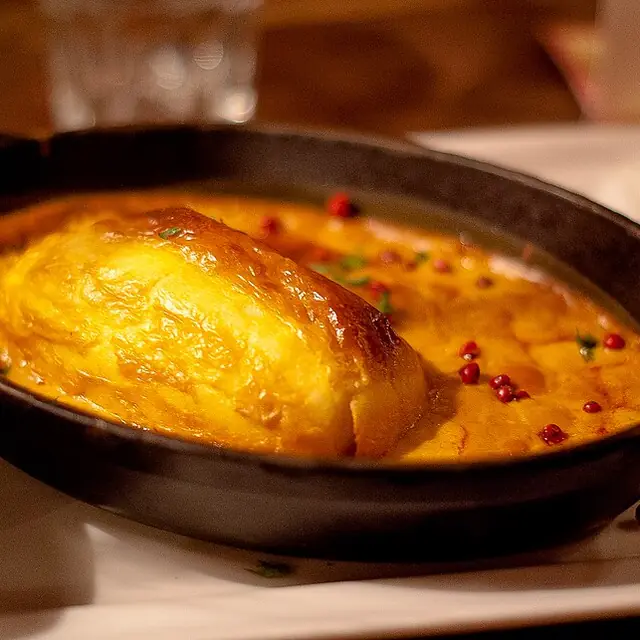
Where to eat Salade lyonnaise in Lyon →The soupe VGE is a single-serving beef and truffle broth sealed under a puff-pastry dome that you crack at the table, releasing the steam and aroma of black truffle in one theatrical moment.
Where L'Auberge du Pont de Collonges (Paul Bocuse)
Where to eat Soupe VGE (Soupe aux truffes Paul Bocuse) in Lyon →The tarte aux pralines is the Lyonnais pink-praline tart: a short-pastry shell filled with a molten pink-praline cream that sets to a glossy, sticky, intensely sweet slab, sold by the slice at every bakery in the city.
Where Pignol, Bouillet
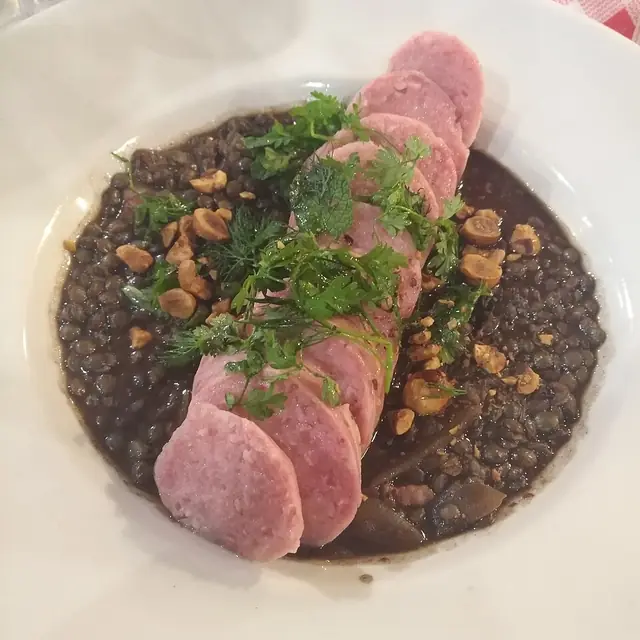
Where to eat Tarte aux pralines in Lyon →The saucisson de Lyon is a large-format cooked pork sausage, a close relative of the cervelas, with a loose grain and a mild seasoning, served sliced thick and eaten warm with boiled potatoes and mustard in every
Where Sibilia at Halles Paul Bocuse, Boucherie Trolliet, Le Garet
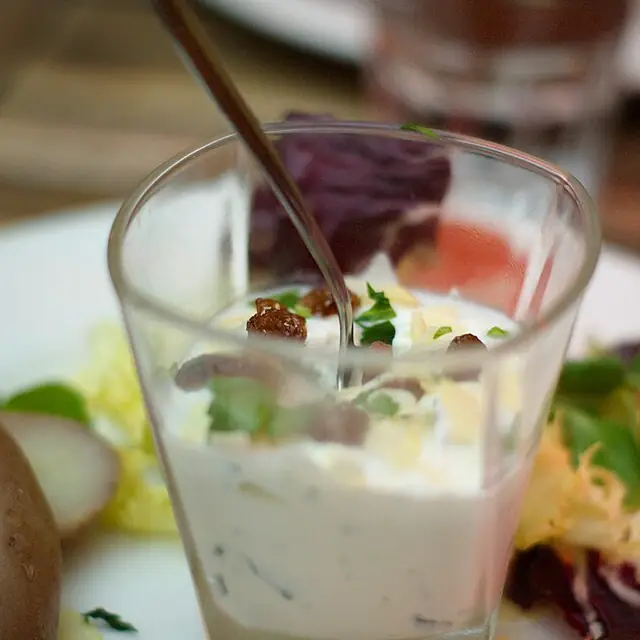
Where to eat Saucisson de Lyon in Lyon →Cervelle de canut is a fresh fromage blanc beaten with shallots, garlic, chives, olive oil and vinegar to the consistency of thick cream: the original cheap-and-sharp Lyon cheese course.
Where Le Bouchon des Filles, Cafe-Comptoir Abel, Le Musee
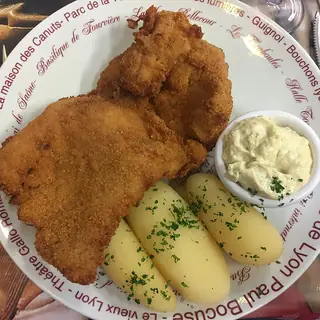
Where to eat Cervelle de canut in Lyon →Tablier de sapeur is breaded and fried tripe (specifically the gras-double, the second stomach of the cow), traditionally marinated in white wine and mustard before being coated in breadcrumbs and pan-fried until golden.
Where Le Garet, Cafe-Comptoir Abel, Le Musee
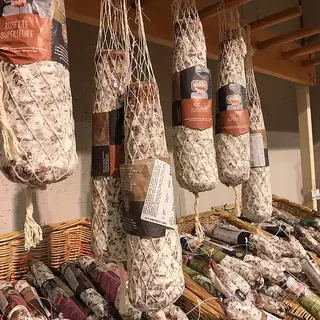
Where to eat Tablier de sapeur in Lyon →Rosette de Lyon is a cured dry sausage of the Lyon region, made from coarse-cut pork shoulder and back fat, cured for at least 2 months in a natural casing tied in distinctive cross-knot fashion.
Where Boucherie Trolliet, Sibilia at Halles Paul Bocuse
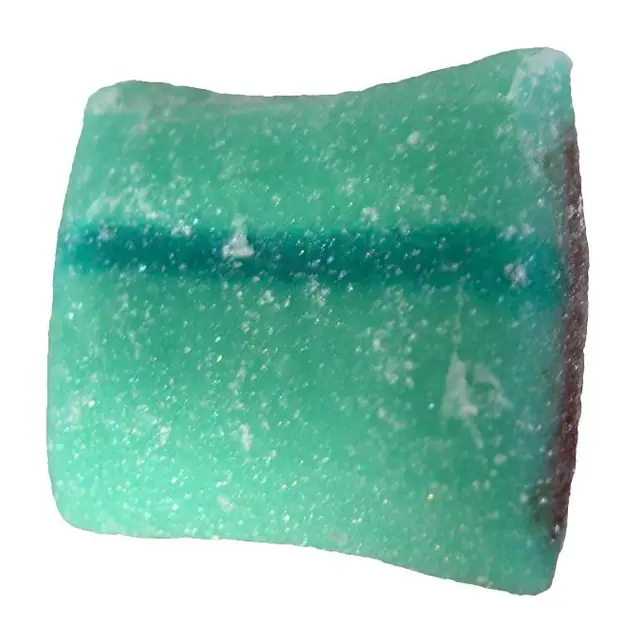
Where to eat Rosette de Lyon in Lyon →Coussin de Lyon is a cushion-shaped chocolate confection with an almond marzipan exterior tinted pale green to evoke the silk cushion that once carried Lyon's wax votive offering, filled with Curacao-perfumed chocolate
Where Voisin Chocolatier Lyon
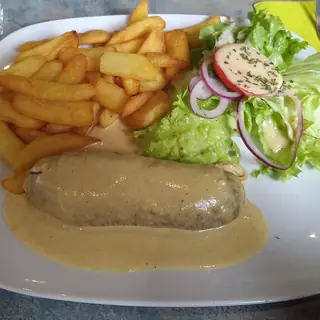
Where to eat Coussin de Lyon in Lyon →Andouillette lyonnaise is a coarsely-cut tripe sausage of pork chitterlings and stomach, sometimes with veal, served hot from the pan with a Dijon mustard sauce, sometimes a creamy cotes-du-rhone reduction.
Where Cafe-Comptoir Abel, Chez Hugon, Le Bouchon des Filles
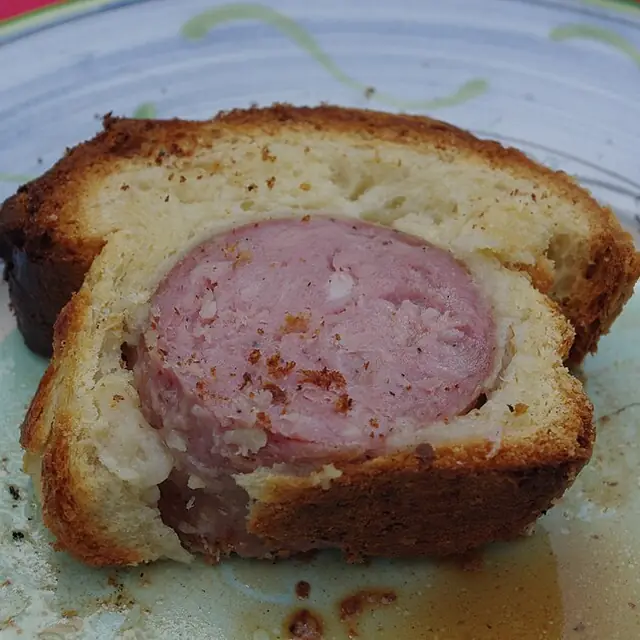
Where to eat Andouillette lyonnaise in Lyon →Lyonnais cooking sausage poached, cooled, then baked inside a buttery brioche loaf. Sliced warm into thick rounds and served with a mustard cream, the bouchon lunch classic.
Where Brasserie Georges, Daniel et Denise Saint-Jean, Le Garet
Where to eat Saucisson brioché in Lyon →A handful of the places we send friends to when they are in Lyon.
Regain in Lyon's 1er sits at the foot of the Croix-Rousse slope, where the kitchen runs a Mediterranean-leaning author menu paired with the city's tighter.
OrderThe carte changes weekly, take the chef's tasting at lunch for value.
Takao Takano in Lyon's 6e is the two-star tasting room where the chef applies Japanese training to French sourcing across a six-course set. Priced at €€€€.
OrderTasting only; let the kitchen drive.
La Mere Brazier in Lyon's 1er is the historic room where Eugenie Brazier earned six Michelin stars in 1933, now run by Mathieu Viannay in two-star form.
OrderThe Volaille de Bresse demi-deuil, the signature dish since 1921.
Tetedoie sits on the Fourviere hill above Lyon's old town, where Christian Tetedoie cooks a one-star menu from a glass-walled dining room with the city below.
OrderThe five-course tasting.
Prairial in Lyon's 2e Confluence is Gaetan Gentil's one-star room cooking a vegetable-forward tasting menu rooted in foraged herbs and small Rhone producers.
OrderThe vegetable tasting; the paired non-alcoholic juices are worth the supplement.
Circle in Lyon's 1er pulls a single seating around the kitchen counter for a chef's-choice tasting; the ten-cover room earned a Michelin star.
OrderThe full tasting; there is no carte at dinner.
The Renaissance old town below Fourviere hill, with traboules, cobbled streets and the bouchon-tourist heartland on Rue Saint-Jean.
Best for: Bouchons, Brunch, Cafes
The narrow peninsula between Saone and Rhone, with Place Bellecour at its centre and the densest grid of classic bouchons, brasseries and shops.
Best for: Bouchons, Brasseries, Fine dining
Also: 2e
The old silk weavers' hill, now Lyon's natural-wine and neo-bistro epicentre, with a weekday morning market and tightly-knit producer streets.
Best for: Natural wine, Neo-bistros, Markets, Coffee roasters
Also: 4e
The business district built around Lyon's main station and Halles Paul Bocuse, with neighbourhood bistros on Cours Lafayette and Rue de Crequi.
Best for: Markets, Casual dining, Late lunch
Lyon's affluent residential 6e, anchored by Parc de la Tete d'Or and home to Takao Takano, Tetedoie and the city's most-booked tasting tables.
Best for: Fine dining, Brunch, Bakeries
The most diverse arrondissement: North African and East Asian counters, the new student-led wine bars, Bieristan beer hall and Gus Gas neo-bistro.
Best for: North African, Asian, Budget
Lyon is the working capital of French gastronomy, the city that gave France the bouchon (the small family-run Lyonnais tavern that runs the local repertoire of charcuterie, offal and slow-cooked sauces), the Meres lyonnaises (the legendary women who, in the late 19th and early 20th centuries, ran the city's most influential restaurants and trained the generation of male chefs who codified French haute cuisine), and Paul Bocuse (the chef who held three Michelin stars from 1965 to 2018, the longest unbroken three-star run in history). Lyon's claim to be the world capital of gastronomy was first made in 1934 by critic Curnonsky, and the city's restaurant density (roughly 4,000 restaurants in a metropolitan area of 2.3 million, the highest density in France outside central Paris) has held it up for nearly a century. The classic Lyonnais plate is unrepentant: rosette de Lyon (the city's signature dry cured sausage), saucisson brioche, pate en croute, quenelle de brochet sauce Nantua (the pike-dumpling-in-crayfish-cream-sauce that defines Lyonnais fine dining), tablier de sapeur (the breaded fried tripe), cervelle de canut (the cottage-cheese-herb spread), salade lyonnaise (the warm bacon-and-poached-egg salad on bitter leaves), tarte aux pralines, and the Praluline brioche.
The city's geography organizes the food map across three working zones split by two rivers (the Saone runs north-south through the western half; the Rhone runs north-south through the eastern half, the two converging at Confluence at the southern tip of the central peninsula called the Presqu'ile). Vieux Lyon, the Renaissance old town west of the Saone in the 5th arrondissement, holds the densest concentration of bouchons (rue Saint-Jean, rue du Boeuf, rue des Trois Maries), mostly the tourist-heavy ones, with a few serious holdouts (Daniel et Denise Saint-Jean, Bouchon des Filles is in the Presqu'ile but adjacent). The Presqu'ile, the central peninsula between the two rivers in the 1st and 2nd arrondissements, holds the working bouchons (Le Garet, Cafe-Comptoir Abel, Chez Hugon, Le Musee, Daniel et Denise Croix-Rousse), the Halles de Lyon Paul Bocuse, the brasseries (Brasserie Georges, the 1836 Art Deco giant), and the modern bistros (Regain, Substrat, Le Kitchen). Croix-Rousse, the silk-worker hill in the 4th arrondissement, runs the morning Saturday market (the largest in the city) and the new-wave neo-bistros.
The modern axis is Michelin-heavy. Lyon holds the third-densest fine-dining scene in France after Paris and the Cote d'Azur, anchored by three-star Paul Bocuse (L'Auberge du Pont de Collonges in Collonges au Mont d'Or, 10 kilometers north, currently demoted to two stars in 2020 after holding three since 1965, but the most historically significant restaurant in modern French cooking), Mere Brazier (two stars, Mathieu Viannay, in the historic 1921 Mere Brazier room on rue Royale where Eugenie Brazier earned the first three stars in 1933), Takao Takano (two stars in Brotteaux, the Japanese-French version), Prairial (one star), Tetedoie (one star at Fourviere with the Rhone valley view), and a thick layer of bouchon-modern hybrids. The Halles de Lyon Paul Bocuse on Cours Lafayette, renamed after Bocuse's death in 2018, is the city's working pantry and the gateway food experience.
A bouchon is a Lyonnais tavern format that does not exist in this form anywhere else in France: small (typically 30 to 50 seats), family-run, red-and-white checkered tablecloths, the same chalkboard menu of the city's heritage plates (rosette de Lyon, saucisson brioche, salade lyonnaise, andouillette, quenelle, tablier de sapeur, ile flottante or tarte aux pralines for dessert), wine served in a 46-centiliter pot Lyonnais (the squat heavy-bottomed glass bottle invented to discourage Saone river bargemen from drinking faster than the boats could load). The format dates to the 17th century when the silk-trade trade post-houses (where horses were rebouchonner, the verb meaning to rub down a horse after a long ride) added food to the wine. Roughly 20 bouchons in the city carry the official Bouchon Lyonnais certification awarded by the city government and a chef-vetted committee (Authentique Bouchon Lyonnais since 2012). The reference addresses are Le Garet on rue du Garet (since 1922, the locals' favorite), Cafe-Comptoir Abel on rue Guynemer (since 1928, the meat-focused one), Chez Hugon on rue Pizay (since 1971, the cheese plates), Daniel et Denise (three locations, the city's most-decorated bouchon group, Saint-Jean is the Vieux Lyon address), Le Musee on rue des Forces, Le Bouchon des Filles on rue du Sergent Blandan (the female-chef-run modern reference). Lunch is the bouchon meal; book 1 to 2 days ahead for the certified ones.
The Halles de Lyon Paul Bocuse on Cours Lafayette in the 3rd arrondissement, renovated 1971 and renamed in 2018 after Paul Bocuse died, is the city's working pantry and the densest concentration of working artisan food vendors in France outside the Rungis wholesale market. The hall holds 48 permanent stalls inside a single covered space, anchored by the legendary cheese stall of Mere Richard (now run by daughter Renee Richard, the supplier to nearly every starred chef in Lyon for 50 years), the Sibilia cured-meat counter (the family-run saucisson and rosette specialist since 1930), Maison Bobosse for andouillette and the Lyonnais cervelas (the saucisson with truffles and pistachios), Maison Reynon for cured meats and the famous rosette de Lyon, Saint-Cyr fishmongers, Cellerier for poultry, Bahadourian for spices and Middle Eastern groceries, the seafood-and-oyster counter at L'Ecailler. The Halles run Tuesday to Sunday, 07:00-22:30 (most stalls close by 19:00, the bars and restaurants run later), closed Monday. A traditional Lyonnais morning ritual is plateau de fromages plus a glass of Beaujolais at Maison Richard's stand-up counter (the Mache au Comptoir tradition). The Halles also hold a half-dozen stand-up restaurants worth a lunch: Chez Mounier, Maison Antonin, the Beaujolais wine bar of Vins Etonnants.
Lyon's claim to be the capital of French gastronomy was built by Les Meres Lyonnaises, the legendary women who ran the city's most influential restaurants from the late 19th century through the mid-20th. The lineage starts with La Mere Guy in the 1750s (the first chronicled Lyonnaise restaurant matriarch), runs through La Mere Filloux (whose restaurant trained dozens of male chefs in the late 1800s), Eugenie Brazier (La Mere Brazier, the first chef in history to earn six Michelin stars across two restaurants, both three-star, at the same time, in 1933; she also trained Paul Bocuse), La Mere Bourgeois of Priay, La Mere Bizolon of the Halles, La Mere Leon. The phenomenon was sociological: in the 19th century, Lyon's silk-trade bourgeois families employed Meres as private cooks; when the silk industry collapsed after WWI, the Meres opened their own restaurants and codified the Lyonnais cuisine in public. The modern era begins with Paul Bocuse, who trained under Eugenie Brazier, returned to his family's auberge at Collonges in 1959, and earned three Michelin stars in 1965, holding them unbroken for 53 years until his death in 2018. Bocuse codified the nouvelle cuisine movement with the Troisgros brothers, Michel Guerard and Alain Chapel in 1970s France; he created the Bocuse d'Or competition in 1987; his name now anchors the Halles and the Institut Paul Bocuse cooking school in Ecully.
Lyon sits at the geographic crossroads of three major French wine regions: Beaujolais starts 30 kilometers north (the granite-soil Gamay vineyards across 10 villages between Macon and Lyon), the Northern Rhone starts 30 kilometers south (the steep-slope Syrah of Cote-Rotie, the Viognier of Condrieu, the Syrah of Saint-Joseph and Hermitage), and the Burgundy southern edge starts 60 kilometers north (the Pouilly-Fuisse and Macon villages). This wine triangle gives Lyon one of the most usable wine-by-the-glass scenes in France; even the simplest bouchon will pour a serious Cote-Rotie and a Beaujolais cru by the carafe. The reference wine bars are Vins Etonnants in the Halles de Lyon, Le Vin des Vivants on rue Saint-Pothin in the Brotteaux (natural wine), Le Bistrot du Potager in the 1st arrondissement, La Cave des Voyageurs by Perrache. The day-trip wine destinations are Beaujolais (30 to 45 minutes north by car, with the 10 crus Saint-Amour, Julienas, Chenas, Moulin-a-Vent, Fleurie, Chiroubles, Morgon, Regnie, Brouilly, Cote de Brouilly), Cote-Rotie and Condrieu (Ampuis, 35 minutes south on the Rhone), Hermitage and Crozes-Hermitage (Tain l'Hermitage, 1 hour south), and the Beaujolais Nouveau third Thursday of November is a city-wide drinking event.
 Quenelle de brochet sauce Nantua
The quenelle de brochet is a poached pike dumpling the size of a fist, airy from egg white folded into a fish forcemeat, served bathed in sauce Nantua of crushed Ain river crayfish
Quenelle de brochet sauce Nantua
The quenelle de brochet is a poached pike dumpling the size of a fist, airy from egg white folded into a fish forcemeat, served bathed in sauce Nantua of crushed Ain river crayfish
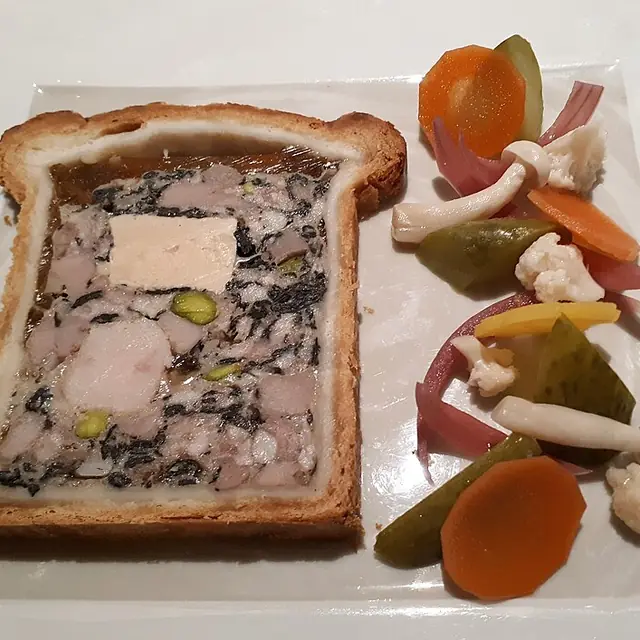 Pate en croute
The Lyonnais pate en croute is a farce of pork, poultry, foie gras and sometimes truffle encased in a buttery pastry crust, cut in thick slabs at the counter
Pate en croute
The Lyonnais pate en croute is a farce of pork, poultry, foie gras and sometimes truffle encased in a buttery pastry crust, cut in thick slabs at the counter
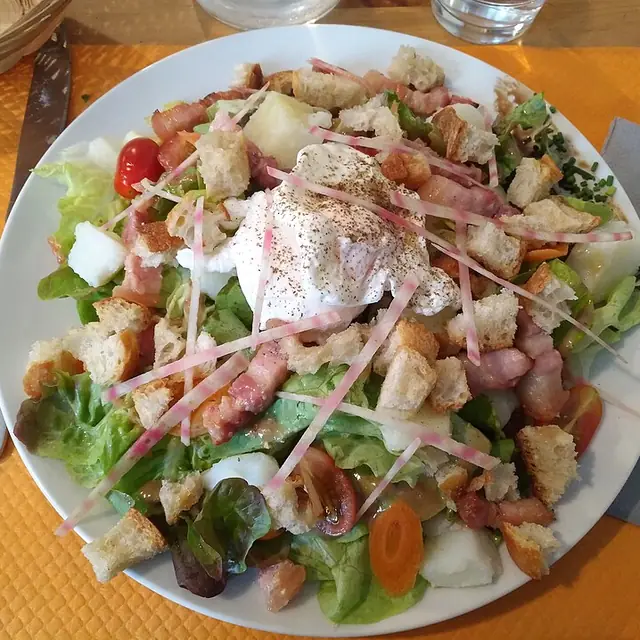 Salade lyonnaise
The salade lyonnaise is a warm salad of frisee dressed with lardons, croutons and a poached egg on top, dressed with a mustard-and-vinegar vinaigrette that wilts the leaves slightly from the heat of the bacon fat
Salade lyonnaise
The salade lyonnaise is a warm salad of frisee dressed with lardons, croutons and a poached egg on top, dressed with a mustard-and-vinegar vinaigrette that wilts the leaves slightly from the heat of the bacon fat
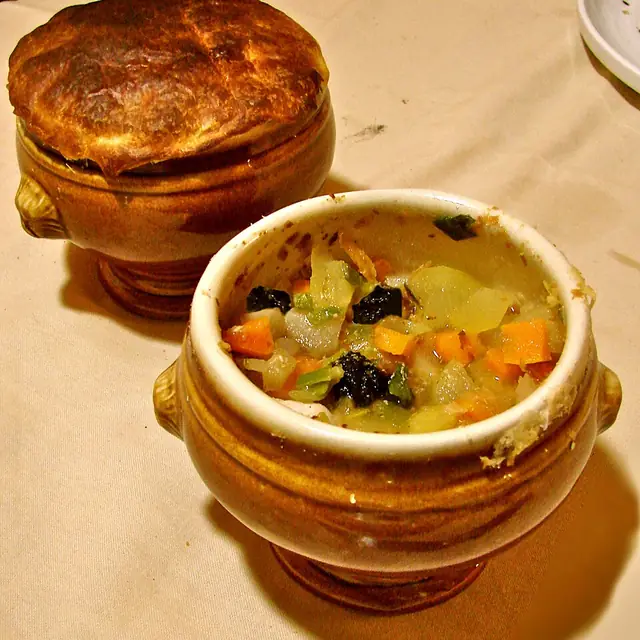 Soupe VGE (Soupe aux truffes Paul Bocuse)
The soupe VGE is a single-serving beef and truffle broth sealed under a puff-pastry dome that you crack at the table, releasing the steam and aroma of black truffle in one theatrical moment
Soupe VGE (Soupe aux truffes Paul Bocuse)
The soupe VGE is a single-serving beef and truffle broth sealed under a puff-pastry dome that you crack at the table, releasing the steam and aroma of black truffle in one theatrical moment
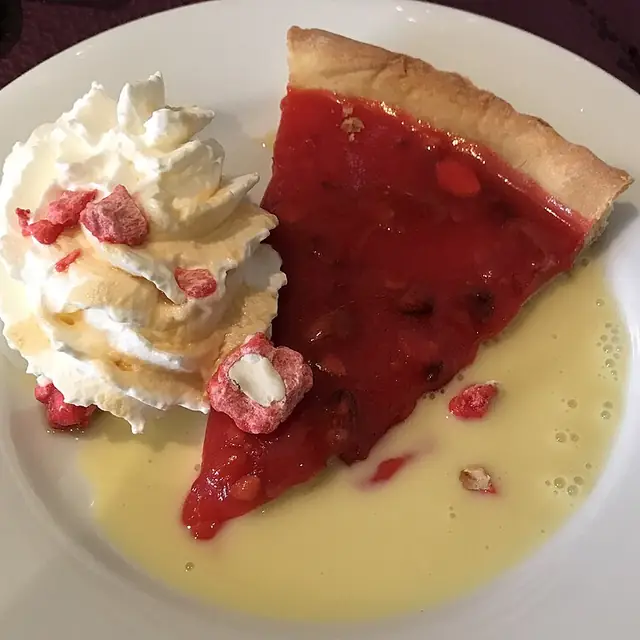 Tarte aux pralines
The tarte aux pralines is the Lyonnais pink-praline tart: a short-pastry shell filled with a molten pink-praline cream that sets to a glossy, sticky, intensely sweet slab, sold by the slice at every bakery in the city
Tarte aux pralines
The tarte aux pralines is the Lyonnais pink-praline tart: a short-pastry shell filled with a molten pink-praline cream that sets to a glossy, sticky, intensely sweet slab, sold by the slice at every bakery in the city
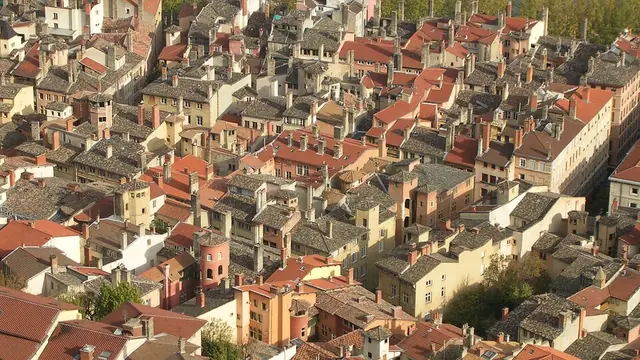 Vieux Lyon
The Renaissance old town below Fourviere hill, with traboules, cobbled streets and the bouchon-tourist heartland on Rue Saint-Jean
Vieux Lyon
The Renaissance old town below Fourviere hill, with traboules, cobbled streets and the bouchon-tourist heartland on Rue Saint-Jean
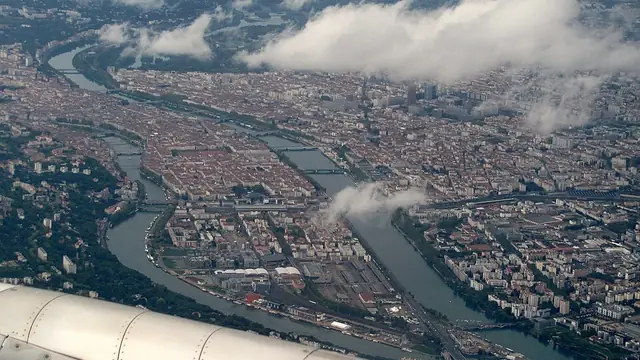 Presqu'ile
The narrow peninsula between Saone and Rhone, with Place Bellecour at its centre and the densest grid of classic bouchons, brasseries and shops
Presqu'ile
The narrow peninsula between Saone and Rhone, with Place Bellecour at its centre and the densest grid of classic bouchons, brasseries and shops
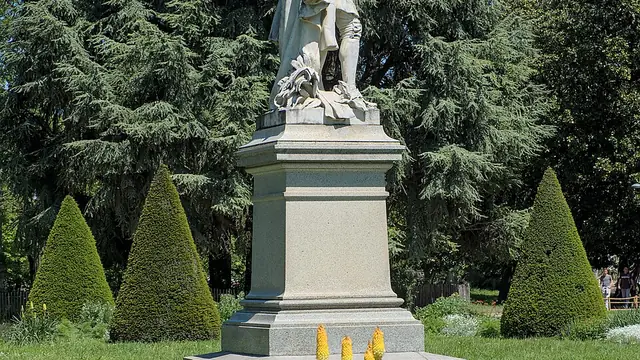 Tete d'Or and 6e
Lyon's affluent residential 6e, anchored by Parc de la Tete d'Or and home to Takao Takano, Tetedoie and the city's most-booked tasting tables
Tete d'Or and 6e
Lyon's affluent residential 6e, anchored by Parc de la Tete d'Or and home to Takao Takano, Tetedoie and the city's most-booked tasting tables
A sample of Lyon hotels from our booking partner, who list 446 here. Live prices and availability open on their site.
 Odalys City Lyon Bioparc
Located in Lyon (3rd Arrondissement), Odalys City Lyon Bioparc is within a 10-minute drive of Musee Lumiere...
Check dates
Odalys City Lyon Bioparc
Located in Lyon (3rd Arrondissement), Odalys City Lyon Bioparc is within a 10-minute drive of Musee Lumiere...
Check dates
 B&B Hotel Lyon Centre Monplaisir
A stay at B&B Hotel Lyon Centre Monplaisir places you in the heart of Lyon, steps from Musee Lumiere and 11...
Check dates
B&B Hotel Lyon Centre Monplaisir
A stay at B&B Hotel Lyon Centre Monplaisir places you in the heart of Lyon, steps from Musee Lumiere and 11...
Check dates
 HOTELO Lyon Charité
A stay at HOTELO Lyon Charité places you in the heart of Lyon, within a 5-minute drive of Textile Museum a...
Check dates
HOTELO Lyon Charité
A stay at HOTELO Lyon Charité places you in the heart of Lyon, within a 5-minute drive of Textile Museum a...
Check dates
 Hôtel Victoria Lyon Perrache Confluence
A stay at Htel Victoria Lyon Perrache Confluence places you in the heart of Lyon, steps from Massif Central...
Check dates
Hôtel Victoria Lyon Perrache Confluence
A stay at Htel Victoria Lyon Perrache Confluence places you in the heart of Lyon, steps from Massif Central...
Check dates
 Campanile Lyon Centre - Gare Part Dieu
A stay at Campanile Lyon Centre - Gare Part Dieu places you in the heart of Lyon, within a 10-minute walk o...
Check dates
Campanile Lyon Centre - Gare Part Dieu
A stay at Campanile Lyon Centre - Gare Part Dieu places you in the heart of Lyon, within a 10-minute walk o...
Check dates
 Residhotel Lyon Part Dieu
A stay at Residhotel Lyon Part Dieu places you in the heart of Lyon, within a 10-minute walk of Massif Cent...
Check dates
Residhotel Lyon Part Dieu
A stay at Residhotel Lyon Part Dieu places you in the heart of Lyon, within a 10-minute walk of Massif Cent...
Check dates
 Lagrange Apart'HOTEL Lyon Lumière
With a stay at Lagrange Apart'HOTEL Lyon Lumire, you'll be centrally located in Lyon, just a 3-minute walk ...
Check dates
Lagrange Apart'HOTEL Lyon Lumière
With a stay at Lagrange Apart'HOTEL Lyon Lumire, you'll be centrally located in Lyon, just a 3-minute walk ...
Check dates
 The Originals Hotelo Lyon Ainay
A stay at The Originals Hotelo Lyon Ainay places you in the heart of Lyon, steps from Massif Central and 3 ...
Check dates
The Originals Hotelo Lyon Ainay
A stay at The Originals Hotelo Lyon Ainay places you in the heart of Lyon, steps from Massif Central and 3 ...
Check dates
 ibis Lyon Gerland Rue Merieux
With a stay at ibis Lyon Gerland Rue Merieux in Lyon (7th Arrondissement), you'll be steps from Massif Cent...
Check dates
ibis Lyon Gerland Rue Merieux
With a stay at ibis Lyon Gerland Rue Merieux in Lyon (7th Arrondissement), you'll be steps from Massif Cent...
Check dates
 Montempô Lyon Part Dieu
With a stay at Montemp Lyon Part Dieu in Lyon, you'll be 1.3 mi (2.2 km) from Part Dieu Mall and 2.2 mi (3....
Check dates
Montempô Lyon Part Dieu
With a stay at Montemp Lyon Part Dieu in Lyon, you'll be 1.3 mi (2.2 km) from Part Dieu Mall and 2.2 mi (3....
Check dates
 AppartâCity Confort Lyon Gerland
A stay at AppartCity Confort Lyon Gerland places you in the heart of Lyon, steps from Massif Central and a ...
Check dates
AppartâCity Confort Lyon Gerland
A stay at AppartCity Confort Lyon Gerland places you in the heart of Lyon, steps from Massif Central and a ...
Check dates
 Hôtel Axotel Lyon Perrache
In the heart of Lyon, Htel Axotel Lyon Perrache is within a 5-minute drive of Lyon Confluence Shopping Cent...
Check dates
Hôtel Axotel Lyon Perrache
In the heart of Lyon, Htel Axotel Lyon Perrache is within a 5-minute drive of Lyon Confluence Shopping Cent...
Check dates
Also compare: Zen Hotels in Lyon from USD 69/night · Minor Hotels in Lyon · Holidu in Lyon from USD 52/night
Stays are listed by our booking partners, not editor picks. We earn a commission if you book, at no cost to you.
Every restaurant, cafe, market and bar we cover in Lyon, pinned. Click a pin for the page.
Peak food season: September to November (la rentree, game, Beaujolais Nouveau), plus April to June (asparagus, strawberries, the year's best terrace weather). August: most bouchons close two to three weeks for vacances.
Local dining hours: Lunch 12:00-14:00, dinner 19:30-22:00. Bouchons stop seating by 21:30. Sunday and Monday closing is common; many bouchons also close Saturday lunch.
Tipping: Service is included by law (service compris). Round up or leave a couple of euros for service that warranted it. Never more than 5 percent, and never typed into the card terminal.
Lyon's signature dishes include Quenelle de brochet sauce Nantua, Pate en croute, Salade lyonnaise, Praluline brioche, Soupe VGE (Soupe aux truffes Paul Bocuse). See our signature dishes chapter for where to eat each.
TableJourney editors map Lyon by district. Vieux Lyon, Presqu'ile, Croix-Rousse, Part-Dieu and 3e are among the strongest for food, each with its own guide.
Editor picks in Lyon include La Mere Brazier, Takao Takano, L'Auberge du Pont de Collonges (Paul Bocuse), plus the full fine dining chapter on TableJourney.
TableJourney covers 10 editor-picked food tours in Lyon, with what each shows you and how much to budget.
TableJourney's Lyon dietary chapter covers vegan, vegetarian, gluten_free, halal, kosher venues, each editor-picked with what to order and how to ask.