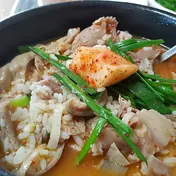
Busan's identity dish: milky pork-bone broth over rice, finished at the table with salted shrimp, chives and chilli paste until it tastes like yours alone.
Dwaeji gukbap is Busan's Korean War dish. Refugees who flooded the wartime capital simmered cheap pork bones into a milky broth and poured it over rice, borrowing from northern soups and Miryang market stalls. It became the city's everyday meal, from Seomyeon's gukbap alley to 24-hour shops like Jeongjitgan, and in 2025 the Michelin Guide crowned a generation of specialists such as Hapcheon Gukbapjip and Anmok.
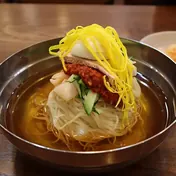
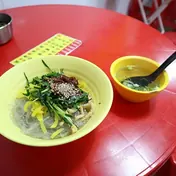
Busan's wheat-flour remake of naengmyeon: chewy noodles in iced beef-and-herb broth or slicked with chilli paste, born of wartime rations and never gone.
When northern refugees in wartime Busan could not find buckwheat for naengmyeon, they spun the American relief wheat flour instead, and milmyeon was born. The medicinal-herb broth and chewier noodle became the city's own summer ritual, eaten at busy halls like Halmae Gaya Milmyeon on Gwangbok-ro and at Choryang Milmyeon by the station. Seoul never adopted it, which is exactly why Busan keeps it close.
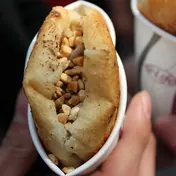
The BIFF Square pancake of Busan: a yeasted dough round fried in oil, split open and stuffed with molten brown sugar and a full scoop of toasted seeds.
Hotteok came to Korea with Chinese traders, but Busan gave it the split-and-stuff treatment. On BIFF Square in Nampo-dong, stallholders began slicing the fried pancake open and packing it with sunflower, pumpkin and peanut seeds over the brown-sugar core, and the ssiat, or seed, hotteok became the street snack every festival-goer carries. The stalls still work in pairs, one frying, one stuffing, all winter long.
Join a guided foodie adventure through Busan’s famous markets. Taste makgeolli, seafood, and street snacks while hearing fascinating local stories that bring the city’...
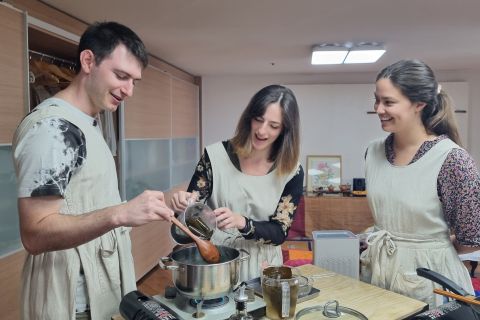
Discover Korean food and culture by taking part in a Korean cooking class. Taste and learn how to cook traditional Korean dishes together with an experienced chef.
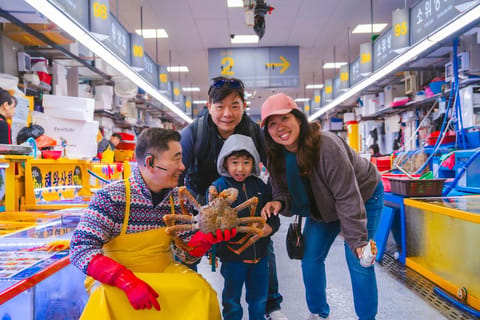
In Korea's seafood market, there are many seafood that are difficult to find in foreign countries. As a foreigner visiting Korea for the first time, it may not be easy...
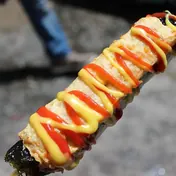
Eomuk workshops grew around Busan's port under Japanese rule, adapting kamaboko to Korean tastes, and the wartime boom made the city Korea's fish-cake capital. Bupyeong market carts sold it on skewers with broth; Samjin, founded 1953 on Yeongdo, is the oldest name still pressing it, and Goraesa turned it into a premium bakery counter. Ask for eomuk, not odeng, and drink the broth to the bottom.
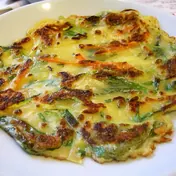
Dongnae pajeon belongs to Busan's old walled town, where the Dongnae market sat on the road to the hot springs. Local records tie it to the spring-onion harvests of the Nakdong delta and to offerings for the Dongnae magistracy; the dish survived as a market-day and rainy-day ritual. Dongnae Halmae Pajeon, four generations in, still griddles the canonical version, thick with onions, clams and prawn under a soft egg finish.
Busan's hoe culture runs on live tanks and volume: flounder, rockfish and seasonal catch sliced minutes after netting, eaten in chogochujang or wrapped in lettuce and perilla. The template is Jagalchi, buy downstairs, eat upstairs, and Millak Raw Fish Town, where the takeaway box and a beach wall count as a restaurant. It differs from sashimi on purpose: thicker cuts, bolder sauces, and a maeuntang stew boiled from the frame to close.
Busan's feather-thin dumpling soup: loose wisps of wonton skin and pork afloat in a clean anchovy and bone broth, a Nampo-dong specialty kept alive for about eighty years.
Wandang arrived through the open port as a cousin of Japanese-Chinese wantan soup and put down roots in Nampo-dong. 18beon Wandang has folded it for some eighty years, three generations pressing skins so thin they collapse into silk ribbons in the broth. The dish never spread far beyond Busan, which makes the surviving houses a pilgrimage: one soup, a handful of sides, and the same wrist work for three generations.
Bibim dangmyeon is pure Gukje Market: sweet-potato glass noodles, cheap and filling, dressed at speed for postwar shoppers who ate standing up. The stalls still serve it from mounded trays, tossed to order with spinach, seaweed and a soy-sesame slick, usually alongside chungmu gimbap or a yubu pocket. It never became restaurant food, which is the charm; the recipe lives on the benches of the market's eat-street.
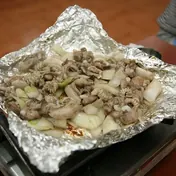
Gomjangeo, the inshore hagfish, became Busan food during hard times, when its skin went to wallets and the meat to open-fire grills. Postwar market rows at Jagalchi and Haeundae made it a specialty: rich, springy flesh charred over briquettes, either yangnyeom-slicked in chilli paste or salt-grilled with garlic. It remains a market-lane order, a dish for benches, tongs and a bottle rather than tablecloths.
Gukje Market's fried-tofu hotpot in Busan: stuffed yubu pockets, fish cake and glass noodles simmered in anchovy broth at the food alley's shared benches.
Yubu jeongol grew from Busan's eomuk and tofu workshops: fried tofu pockets stuffed with noodle mince, pinned shut and simmered with fish cake in anchovy broth. Gukje Market's food alley made it a fixture, a warming counterweight to the cold dangmyeon on the same bench, and stalls hand the pockets over the pot one by one. It stayed a market dish, its recipe passed between neighbouring ajummas rather than written down.
Watch out for: Soy, Fish, Wheat (gluten)
Signature Dishes in Busan, FAQ
What food is Busan known for?
Busan's signature dishes include Dwaeji gukbap, Milmyeon, Ssiat hotteok, Busan eomuk, Dongnae pajeon. See our signature dishes chapter for where to eat each.