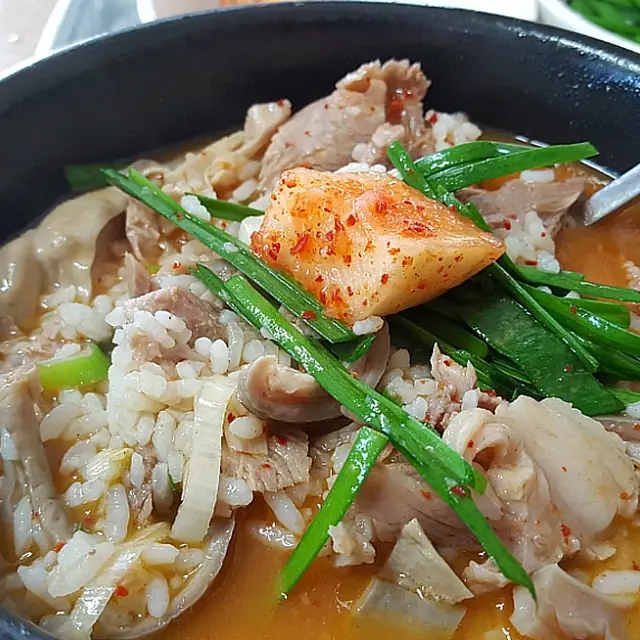
Busan's identity dish: milky pork-bone broth over rice, finished at the table with salted shrimp, chives and chilli paste until it tastes like yours alone.

Dwaeji gukbap is Busan's Korean War dish. Refugees who flooded the wartime capital simmered cheap pork bones into a milky broth and poured it over rice, borrowing from northern soups and Miryang market stalls. It became the city's everyday meal, from Seomyeon's gukbap alley to 24-hour shops like Jeongjitgan, and in 2025 the Michelin Guide crowned a generation of specialists such as Hapcheon Gukbapjip and Anmok.

Where to eat Dwaeji gukbap in Busan

3 editor picks for Dwaeji gukbap in Busan, ranked by editorial score. All Busan signature dishes · Dwaeji gukbap across every city.

  • Jeongjitgan

    Order Uiseong garlic gukbap, the house twist on Busan's pork and rice soup.

    Jeongjitgan cooks Busan-style dwaeji gukbap around the clock in Sinpyeong, a Michelin Bib Gourmand shop whose name is Gyeongsang dialect for kitchen.

  • Hapcheon Gukbapjip

    Order Ttaro gukbap, the broth and rice served separately in the old style.

    Hapcheon Gukbapjip has ladled old-style Busan dwaeji gukbap in Yongho-dong since 1999, a Bib Gourmand noteworthy for its clear, repeatedly basted broth.

  • Anmok

    Order The head-meat dwaeji gukbap with a half bottle of soju, as the locals order it.

    Anmok rethinks dwaeji gukbap for Namcheon-dong, Busan, a Bib Gourmand room where the pork soup comes clean and composed rather than heavy and cloudy.

Book food experiences in Busan

See all 582 food experiences in Busan

Make it at home

Serves Serves 44 hrIntermediate

Ingredients

  • 1kg pork leg bones, plus 400g pork shoulder in one piece
  • 1 onion, halved; 6 garlic cloves; 3 slices ginger
  • 2 spring onions, whites for the pot, greens sliced to serve
  • 1 tbsp doenjang (soybean paste)
  • Cooked short-grain rice, one bowl per person
  • To season at the table: saeujeot (salted shrimp), chopped chives, gochujang-based dadaegi, black pepper

Method

  1. Soak the bones in cold water for 1 hour to draw blood, then blanch in boiling water for 5 minutes and rinse.
  2. Cover bones and shoulder with 3 litres of fresh water. Add onion, garlic, ginger, spring onion whites and doenjang.
  3. Boil hard, uncovered, for the first 30 minutes to emulsify the broth white, then simmer 3 hours, topping up water once.
  4. Lift out the shoulder after 90 minutes; rest and slice thinly. Strain the finished broth and season only lightly with salt.
  5. Put hot rice in deep bowls, lay sliced pork on top and ladle over boiling broth. Serve with saeujeot, chives and dadaegi so each eater seasons their own bowl.

Editor tip. The rolling first boil is what turns the broth milky; a timid simmer gives you clear, thin soup.

Common allergens: Shellfish (saeujeot).