Eastern European cuisine is less one tradition than a band of related kitchens stretching from the Baltic to the Black Sea: Polish, Hungarian, Czech, Slovak, Romanian, Ukrainian, and (with overlap) Belarusian, Moldovan, and the German-speaking islands of Silesia and Bohemia. The shared grammar is built on the long winter and the agricultural calendar of the North European Plain and the Carpathian basin: cabbage in dozens of forms (raw, pickled, stuffed, soured), beets, root vegetables, rye and buckwheat as staple grains, pork as the dominant meat, dairy soured into sour cream and farmer's cheese, and dough turned into every conceivable dumpling. The Habsburg, Ottoman, and later Soviet empires all left ingredient and technique layers across the region.
The defining preparations are dumplings (pierogi in Poland, vareniki in Ukraine, halusky in Slovakia, knedliky in Czechia), stuffed cabbage rolls (golabki, holubtsi, sarma, sarmale), sour soups (zurek, borshch, kapusniak), and stews thickened with paprika or sour cream (goulash, beef stroganoff, paprikash). Rye bread is the daily staple; wheat bread is the festive one. Sour cream (smetana, kysla smotana) goes on or in almost everything. Pickled and fermented vegetables (sauerkraut, ogorki kiszone, kvass) survive the winter and add the lactic-sour edge that defines the cuisine.
At the table, the meal pattern is hot-soup-first (the soup course is taken seriously across the region), a meat-and-starch main, and often a sweet finish of fruit-filled pastry or a curd-cheese dessert. The drinking culture runs vodka in the north (Poland, Russia, Lithuania), beer in the middle (Czechia, Bavaria), and wine in the south (Hungary, Romania, Moldova). The modern Warsaw, Budapest, and Prague scenes have rebuilt the regional fine-dining tradition publicly over the last two decades.
Book a food experience
Tours, tastings and classes from the cities on this page, bookable on GetYourGuide.
Perfect for first‑time visitors, this small‑group food tour explores Bucharest’s history and daily life through neighborhood walks, a tram ride, and...
Three Brothers in Bay View, a Serbian tavern in an 1897 Schlitz tied house, has run by the Radicevic family since 1956 with burek and roasted lamb leading.
OrderThe cheese burek, slow-baked in a layered phyllo round, and the roasted lamb when available.
TipCash only and burek takes 90 minutes; phone to order it ahead. James Beard America's Classics, 2002.
The old banitsa counter beside Hali sells phyllo pastry under 4 BGN. Marmalade banitsa is the local favorite; queue early, gone by lunch most weekdays.
$$$$New York CityEastern EuropeanEast VillageUntil Open 24/7
Veselka on Second Avenue has served Ukrainian comfort food in the East Village New York City since 1954. 24-hour diner, pierogi, kasha varnishkes, borscht.
TryPierogi and borscht
TipThe fried pierogi at 03:00 is the institutional order. Cash and card both accepted; bar in the back pours kvas.
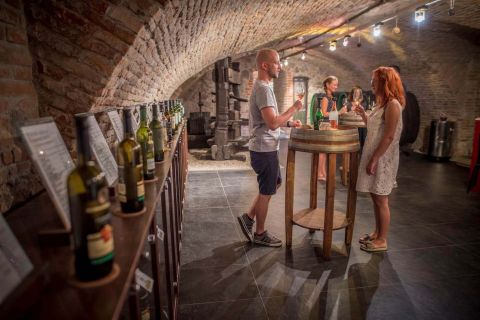
Abel's Wine Bar back room behind the Old Court on Tonitza in Bucharest is the city's most considered Romanian wine list, with eight tables on Saturdays.
Why locals goSet behind the Old Court on Tonitza, Abel's small back room is the city's most considered Romanian wine list, with tasting flights that rotate monthly.
TipReservation-only Saturdays; the back room sees eight tables at most.
Three Brothers in Bay View, a Serbian tavern in an 1897 Schlitz tied house, has run by the Radicevic family since 1956 with burek and roasted lamb leading.
OrderThe cheese burek, slow-baked in a layered phyllo round, and the roasted lamb when available.
TipCash only and burek takes 90 minutes; phone to order it ahead. James Beard America's Classics, 2002.
The old banitsa counter beside Hali sells phyllo pastry under 4 BGN. Marmalade banitsa is the local favorite; queue early, gone by lunch most weekdays.
$$$$New York CityEastern EuropeanEast VillageUntil Open 24/7
Veselka on Second Avenue has served Ukrainian comfort food in the East Village New York City since 1954. 24-hour diner, pierogi, kasha varnishkes, borscht.
TryPierogi and borscht
TipThe fried pierogi at 03:00 is the institutional order. Cash and card both accepted; bar in the back pours kvas.
Abel's Wine Bar back room behind the Old Court on Tonitza in Bucharest is the city's most considered Romanian wine list, with eight tables on Saturdays.
Why locals goSet behind the Old Court on Tonitza, Abel's small back room is the city's most considered Romanian wine list, with tasting flights that rotate monthly.
TipReservation-only Saturdays; the back room sees eight tables at most.
Prosperity Social Club on Starkweather Avenue in Tremont, an Eastern European tavern open continuously since 1938, runs pierogi, cabbage and craft beer.
OrderThe pierogi plate and a brandy Old Fashioned at the bar before sitting.
TipFirst Monday of the month is Prosperaoke karaoke night. Original wood-panel barroom unchanged since 1938.
Marmalad runs the central Plovdiv late-night kitchen on Bratya Pulievi. Salads, pasta, sandwiches and bar bites past midnight, with the club downstairs.
Rūmai on Pilies is a small Old Town wine bar with an Eastern European and Georgian skin-contact focus and a selected cheese board for Vilnius wine regulars.
Why locals goSmall Old Town wine bar locals book for skin-contact orange.
TipGeorgian qvevri orange is the signature order. The cheese board for two pairs well with one glass each.
Pierogi (boiled dumplings with ruskie, meat, sauerkraut-mushroom, or fruit fillings), zurek (sour rye soup with white sausage), bigos (hunter's stew of sauerkraut, fresh cabbage, mixed meats), golabki, kotlet schabowy (breaded pork cutlet), placki ziemniaczane (potato pancakes). Vodka and rye bread are the constants.
Hungary
Goulash (gulyas, a paprika-rich beef soup, not the stew most outsiders know), porkolt and paprikash (the actual paprika stews), halaszle (a fiery river-fish soup), toltott kaposzta (stuffed cabbage), langos (deep-fried flatbread), and the Tokaji aszu dessert tradition. Paprika is the defining seasoning.
Czechia and Slovakia
Veprzo-knedlo-zelo (roast pork, dumplings, sauerkraut), Czech-style goulash with bread dumplings, svickova (beef sirloin in cream sauce), bryndzove halusky (Slovak potato dumplings with sheep cheese and bacon). Pilsner and dark Bohemian lager carry the meal.
Romania and Moldova
Mamaliga (polenta), sarmale (stuffed cabbage or vine leaves), mititei (grilled minced-meat skinless sausages), ciorba de burta (tripe soup), placinta (filled flatbread), Cotnari and Moldovan wines. Ottoman and Slavic influence cross here.
Ukraine
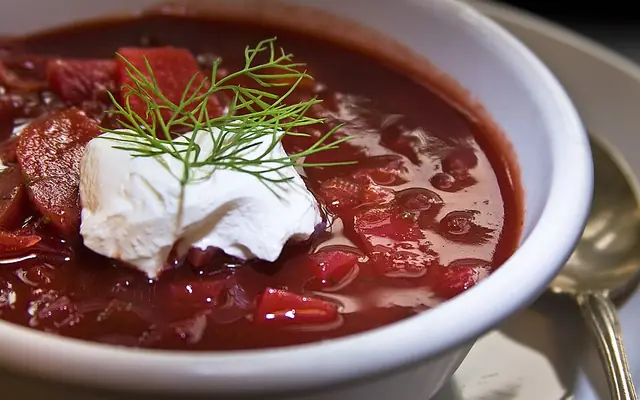
Borshch (the sour beet soup, UNESCO-listed Ukrainian heritage 2022), varenyky (Ukrainian dumplings), salo (cured pork fat eaten on rye with garlic), holubtsi (stuffed cabbage), kovbasa, kasha. The deepest beet, buckwheat, and salo tradition in the region.
Defining eastern european dishes
Pierogi
Boiled half-moon dumplings of unleavened dough, filled with farmer's cheese and potato (ruskie), sauerkraut and mushroom, ground meat, or sweet fruit. Often pan-finished in butter and topped with fried onion and sour cream.
Borshch
Sour beet soup with cabbage, onion, carrot, dill, and often meat or beans. Ukrainian and Russian versions differ in technique and acidity; the dish is on the UNESCO Intangible Cultural Heritage list as Ukrainian.
Goulash (Gulyas)
The Hungarian original is a paprika-rich beef soup with potato, onion, and caraway, cooked in a cauldron (bogracs) over open fire. The Czech and Austrian goulash is the thicker stew most outsiders know.
Bigos
Polish hunter's stew of sauerkraut, fresh cabbage, smoked sausage, pork, beef, sometimes game, plus mushrooms, prunes, and red wine. Improves over several reheats; traditionally made for hunts and Christmas.
Golabki / Holubtsi / Sarmale
Stuffed cabbage rolls (Polish, Ukrainian, Romanian, respectively) filled with rice, ground pork or beef, and herbs, simmered in tomato or sour cabbage broth. The same dish travels across the region under different names.
Zurek
Polish sour rye soup, the soured base made by fermenting rye flour and water for several days. Served with white sausage (biala kielbasa), hard-boiled egg, and potato. Easter breakfast tradition.
Svickova
Czech beef sirloin slow-braised with root vegetables, finished with a cream sauce thickened by the pureed vegetables, served with bread dumplings (houskovy knedlik), cranberry, whipped cream, and lemon.
Paprikash
Hungarian chicken (or veal) in sour cream and paprika sauce, served with nokedli (small egg dumplings) or rice. The defining home-cooked Hungarian dish.
Halusky
Slovak potato dumplings (small, gnocchi-like), classically served with bryndza sheep cheese and crisp bacon (bryndzove halusky), the national dish of Slovakia.
Mamaliga
Romanian and Moldovan polenta (cornmeal porridge), eaten as a starch base with sour cream, fresh cheese, and grilled meats, or with brinza (salty sheep cheese) and a fried egg on top.
How to order
At a traditional restaurant in any Eastern European city, start with a soup (the soup course is non-negotiable across the region) and a small bread basket with butter or lard spread. Order one meat-and-starch main per person; portions are large. Sour cream is a standard topping, not an extravagance, and shows up on soups, dumplings, pancakes, and stews alike. Cabbage in some form (pickled, stewed, raw) is almost always on the plate, even if you didn't ask.
The rookie mistakes: skipping the soup course (the kitchen takes it seriously and so should you), confusing Hungarian gulyas (the soup) with the Czech-Austrian goulash (the stew), expecting any vegetarian options at older village restaurants (modern Warsaw and Budapest are different, but the old kitchen runs on pork fat), tipping like an American (10 percent rounded up is plenty), and ordering vodka as a sipping spirit. Across the region vodka is drunk in shots, chilled, with a beer or pickled chaser, paced through the meal.
What to drink with it
Vodka in the north (Poland, the Baltics, Ukraine, Russia) drunk in chilled shots with herring, pickle, or salo as a chaser. Beer in the middle (Czech pilsner, Slovak Zlaty Bazant, Polish Zywiec and Tyskie). Wine in the south (Hungarian Tokaji aszu with sweet dishes and foie gras, Egri Bikaver and Furmint with mains, Romanian and Moldovan reds with grilled meats). Compote (a sweetened fruit drink, served warm or cold) is the universal non-alcoholic option; kvass (a fermented bread drink) shows up in Russia and Ukraine.
Where to eat it
Warsaw and Krakow for the deepest Polish kitchens; Budapest for the Hungarian canon, with the Costes / Onyx fine-dining scene at the top; Prague and Brno for Czech tavern cooking; Bratislava for Slovak; Bucharest, Cluj, and Sibiu for Romanian; Chisinau for Moldovan; Lviv and Kyiv for the deepest Ukrainian cooking outside the diaspora. Outside the region, Chicago (the largest Polish population outside Poland), Toronto and Mississauga (Ukrainian), Cleveland (Slovenian and Slovak), and New York all hold serious Eastern European restaurants.
A short history
Eastern European cuisine took its modern shape between the partitions of Poland, the Habsburg empire's culinary cross-pollination (Vienna picked up paprika from Hungary, dumplings from Bohemia, strudel from Ottoman-influenced kitchens), and the long shadow of the Soviet decades, when ingredient access shrank and home kitchens preserved the deeper recipes. The post-1989 generation has rebuilt the regional kitchens publicly, and Warsaw, Budapest, and Prague now hold genuinely ambitious fine-dining scenes alongside the surviving tavern tradition.
Frequently asked
Are Eastern European cuisines really all alike?
They share core ingredients (cabbage, beets, pork, sour cream, rye) and core techniques (pickling, fermenting, dumpling-making, slow braising), but the regional accents differ sharply. Polish food leans on sour and dill; Hungarian leans on paprika and lard; Czech leans on dumplings and beer-braised meats; Romanian and Moldovan lean Ottoman and Latin; Ukrainian leans deeply on beets and salo. A Pole and a Hungarian rarely confuse the two cuisines.
Is the food always heavy?
Traditional village cooking is, because it evolved to fuel agricultural work through cold winters. The lighter side, summer cold soups (chlodnik, okroshka), light salads (mizeria, surowka), and fresh-water fish dishes are also part of the canon and show up in season.
What is bortsch versus borshch?
Two transliterations of the same Ukrainian and Russian word for sour beet soup. UNESCO listed the dish in 2022 as Ukrainian Intangible Cultural Heritage; the Russian and Ukrainian versions differ in technique (the Ukrainian uses a fermented beet kvas base; the Russian often uses fresh beets and a meat stock).