
Cajun and Creole are the two great cuisines of Louisiana, often grouped together but fundamentally distinct, descended from different communities and producing different food. Cajun is the country cooking of southwest Louisiana, descended from the French-Acadian settlers expelled from Nova Scotia by the British in the 1755 Grand Derangement and resettled in the bayou and prairie country around Lafayette and the Atchafalaya. It is rustic, one-pot, deeply spiced, and built around what the marshes and farms produced: andouille and boudin sausage, crawfish, alligator, white rice, the holy trinity (onion, celery, bell pepper), and a roux as the foundation of nearly every sauce.
Creole is the urban cooking of New Orleans, descended from the Afro-French-Spanish-Caribbean population of the colonial city, with strong African (West African and Caribbean), French (the white Creole aristocracy and the New Orleans haute-cuisine kitchens), Spanish (the Caribbean-mediated influence), and Italian-American (the 19th-century Sicilian wave) elements. It is more refined, more sauced, more tomato-inclusive (gumbo z'herbes, jambalaya rouge), and more diverse in protein (seafood, beef, pork, veal, poultry) than Cajun. The grande dame restaurants of New Orleans, Antoine's (1840), Galatoire's (1905), Commander's Palace (1893), are Creole institutions.
The two cuisines share a lot (rice as foundation, the holy trinity, file powder, andouille, hot sauce on the table) and have cross-influenced each other for over two centuries. Many of the most famous Louisiana dishes (gumbo, jambalaya, etouffee) exist in both Cajun and Creole versions, with the Creole version typically including tomato (which the Cajun version often omits) and using a darker roux. A Louisiana meal might mix both traditions on the table without anyone thinking twice.
Book a food experience
Tours, tastings and classes that match this page, bookable on GetYourGuide.


Top picks
The best-scored Cajun & Creole place in each of 12 cities.
Commander's Palace ★ 4.8
Commander's Palace serves New Haute Creole cuisine at 1403 Washington Ave; the Brennan family took the reins in 1974, and it hosts a Jazz Brunch.
OrderThe martinis, which really are 25 cents, or a table at the Jazz Brunch.
TipThe martinis really are 25 cents, and Le Petit Bleu, the restaurant's shop, is the stop for a crepe and a cookbook.
Restaurant Iris ★ 4.6
Chef Kelly English's Restaurant Iris in Memphis moved to Poplar Avenue in 2022 with a tighter menu of New Orleans Creole built on Mississippi seafood.
OrderCrawfish and grits with andouille; a Sazerac to start.
TipLunch service was added with the move; the four-course tasting menu is the steady bet at dinner.
Lucile's Creole Cafe ★ 4.5
Lucile's Creole Cafe serves beignets, Eggs New Orleans and homemade gumbo out of a creaky house on Meldrum Street in Fort Collins, mornings only.
OrderBeignets first, then Eggs New Orleans with grits
TipStart with an order of hot beignets for the table; the Pain Perdu is the sweet main worth the queue.
Brenda's French Soul Food ★ 4.5
Brenda's French Soul Food in San Francisco is Brenda Buenviaje's Creole counter on Polk Street, with crawfish beignets and a strong brunch shrimp and grits.
OrderA flight of beignets: plain, chocolate, granny apple and crawfish.
TipNo reservations; arrive at 09:00 sharp or join the digital waitlist that opens at 08:30.
Crawfish and Noodles ★ 4.4
Crawfish and Noodles in Houston is Trong Nguyen's Viet-Cajun room on Bellaire Boulevard since 2008, the country's defining Viet-Cajun crawfish boil.
OrderA pound of crawfish (in season Feb to June), the blue crab in house garlic butter, salt-pepper shrimp.
TipCrawfish are seasonal. October to January menu pivots to blue crab and Dungeness. Cash card surcharges apply.
Herbe Sainte ★ 4.4
Herbe Sainte's Blackstone weekend brunch channels New Orleans with shrimp and grits, Cajun eggs, and bananas Foster toast from its evening-focused kitchen.
Seraphine ★ 4.4
Seraphine is a Michelin-recommended Cajun and Creole restaurant at American Tobacco Campus. Crawfish etouffee and Southern cocktails are the draw.
SignatureCrawfish etouffee, Fried green tomatoes, Beignets
Blues City Deli ★ 4.4
A Benton Park sandwich counter, Blues City turns out cheap po-boys and muffulettas with live blues some afternoons, a well-regarded lunch-only spot.
TryPo-boys and muffulettas
TipThe muffuletta and po-boys are the value picks; arrive before the lunch rush. Live blues plays some afternoons.
Bourbon n' Toulouse ★ 4.3
Bourbon n' Toulouse ladles etouffee, jambalaya and gumbo over rice on Euclid Avenue, Lexington's counter-service Cajun habit and a family business since 2004.
SignatureCrawfish etouffee, Gumbo
TipOrder at the counter and grab a porch table; vegan and gluten-free pots are always on the board.
Nola's Creole and Cocktails ★ 4.3
Nola's brings Louisiana Creole cooking to Cherry Street with an etouffee, shrimp and grits, and cocktail programme that draws from French, Spanish, West.
SignatureEtouffee, Shrimp and grits, Bananas Foster
Lou Lou on Market ★ 4.3
Lou Lou on Market took over the former Decca space on NuLu's East Market, a New Orleans-rooted Louisville dining room running shrimp and grits and Bananas.
Book1 week ahead
Tibby's New Orleans Kitchen ★ 4.3
Tibby's New Orleans Kitchen on Aloma Avenue in Winter Park is the Louisiana-rooted casual room with crawfish etouffee, po-boys, gumbo and beignets to finish.
SignatureCrawfish etouffee, Po-boy sandwich
Find a place
Commander's Palace ★ 4.8
Commander's Palace serves New Haute Creole cuisine at 1403 Washington Ave; the Brennan family took the reins in 1974, and it hosts a Jazz Brunch.
OrderThe martinis, which really are 25 cents, or a table at the Jazz Brunch.
TipThe martinis really are 25 cents, and Le Petit Bleu, the restaurant's shop, is the stop for a crepe and a cookbook.
Cafe Maspero ★ 4.7
Cafe Maspero has been a French Quarter landmark since 1971, serving meaty sandwiches, piled-high seafood platters and Cajun and Creole dishes on Decatur.
OrderThe original hot Muffaletta sandwich, the dish the cafe is known for.
TipIt does not take reservations, so stop by to dine in or order online; bottomless mimosas come with an entrée until 2pm daily.
Mosquito Supper Club ★ 4.7
Mosquito Supper Club serves Cajun Mama Cuisine as a communal supper, family style, on a menu that ebbs and flows with the seasons of south Louisiana.
BookReleased 30 days in advance ahead
Restaurant Iris ★ 4.6
Chef Kelly English's Restaurant Iris in Memphis moved to Poplar Avenue in 2022 with a tighter menu of New Orleans Creole built on Mississippi seafood.
OrderCrawfish and grits with andouille; a Sazerac to start.
TipLunch service was added with the move; the four-course tasting menu is the steady bet at dinner.
Lucile's Creole Cafe ★ 4.5
Lucile's Creole Cafe serves beignets, Eggs New Orleans and homemade gumbo out of a creaky house on Meldrum Street in Fort Collins, mornings only.
OrderBeignets first, then Eggs New Orleans with grits
TipStart with an order of hot beignets for the table; the Pain Perdu is the sweet main worth the queue.
Brenda's French Soul Food ★ 4.5
Brenda's French Soul Food in San Francisco is Brenda Buenviaje's Creole counter on Polk Street, with crawfish beignets and a strong brunch shrimp and grits.
OrderA flight of beignets: plain, chocolate, granny apple and crawfish.
TipNo reservations; arrive at 09:00 sharp or join the digital waitlist that opens at 08:30.
Crawfish and Noodles ★ 4.4
Crawfish and Noodles in Houston is Trong Nguyen's Viet-Cajun room on Bellaire Boulevard since 2008, the country's defining Viet-Cajun crawfish boil.
OrderA pound of crawfish (in season Feb to June), the blue crab in house garlic butter, salt-pepper shrimp.
TipCrawfish are seasonal. October to January menu pivots to blue crab and Dungeness. Cash card surcharges apply.
Herbe Sainte ★ 4.4
Herbe Sainte's Blackstone weekend brunch channels New Orleans with shrimp and grits, Cajun eggs, and bananas Foster toast from its evening-focused kitchen.
Seraphine ★ 4.4
Seraphine is a Michelin-recommended Cajun and Creole restaurant at American Tobacco Campus. Crawfish etouffee and Southern cocktails are the draw.
SignatureCrawfish etouffee, Fried green tomatoes, Beignets
Blues City Deli ★ 4.4
A Benton Park sandwich counter, Blues City turns out cheap po-boys and muffulettas with live blues some afternoons, a well-regarded lunch-only spot.
TryPo-boys and muffulettas
TipThe muffuletta and po-boys are the value picks; arrive before the lunch rush. Live blues plays some afternoons.
Bourbon n' Toulouse ★ 4.3
Bourbon n' Toulouse ladles etouffee, jambalaya and gumbo over rice on Euclid Avenue, Lexington's counter-service Cajun habit and a family business since 2004.
SignatureCrawfish etouffee, Gumbo
TipOrder at the counter and grab a porch table; vegan and gluten-free pots are always on the board.
Nola's Creole and Cocktails ★ 4.3
Nola's brings Louisiana Creole cooking to Cherry Street with an etouffee, shrimp and grits, and cocktail programme that draws from French, Spanish, West.
SignatureEtouffee, Shrimp and grits, Bananas Foster
Soul Fish Cafe ★ 4.3
Soul Fish Cafe in Cooper-Young Memphis on South Cooper runs catfish baskets, hush puppies and Mississippi-style po'boys under $15, the city's cheap-catfish.
OrderCatfish basket with hush puppies and turnip greens.
TipCounter service. The shrimp po'boy is the dark-horse order. Patio in spring is the seat.
Lou Lou on Market ★ 4.3
Lou Lou on Market took over the former Decca space on NuLu's East Market, a New Orleans-rooted Louisville dining room running shrimp and grits and Bananas.
Book1 week ahead
Tibby's New Orleans Kitchen ★ 4.3
Tibby's New Orleans Kitchen on Aloma Avenue in Winter Park is the Louisiana-rooted casual room with crawfish etouffee, po-boys, gumbo and beignets to finish.
SignatureCrawfish etouffee, Po-boy sandwich
Brennan's of Houston ★ 4.2
Brennan's of Houston is the 1967 Texas Creole dining room on Smith Street from the New Orleans Brennan family, with turtle soup, bananas Foster tableside.
OrderTurtle soup with sherry on the side. Bananas Foster, flambeed tableside, to close.
TipSunday jazz brunch at 10am or noon books fast.
Yats Broad Ripple ★ 4.2
Yats Broad Ripple in Indianapolis runs Cajun-Creole on North College for over two decades. Bowls of jambalaya, etouffee and drunken chicken over rice.
OrderThe chili cheese etouffee with crawfish, the drunken chicken, the cornbread.
TipOrder at the counter, find a table. The hot sauce on the table is the move. Cash and card both accepted.
Owen Brennan's ★ 4.2
Owen Brennan's in Regalia on Poplar Avenue is a long-running East Memphis Creole-Cajun room with French Quarter styling, baked oysters and tableside bananas.
OrderOysters Brennan to start and bananas Foster prepared tableside for dessert.
TipReserve online; the Sunday jazz brunch and the tableside bananas Foster are the marquee orders.
Lola's A Louisiana Kitchen ★ 4.1
Lola's A Louisiana Kitchen in Summerlin Las Vegas is the Town Center Drive Cajun-Creole room, pulling Leidenheimer's New Orleans French bread for po'boys.
Why locals goSummerlin gumbo room on Town Center Drive that imports Leidenheimer's French bread from New Orleans for the po'boys.
TipSit on the patio Wednesday through Friday for the 16:00-19:00 happy hour; po'boys are served on Leidenheimer's bread, the roast beef with gravy is the order.
Drago's Seafood Restaurant ★ 4.0
Drago's Seafood in north Jackson is the Mississippi outpost of the New Orleans chain, famous for charbroiled oysters with garlic butter and Gulf shellfish.
OrderCharbroiled oysters with garlic butter and parmesan
TipCrawfish season runs February through May; call ahead to confirm live product is available.
Toulouse Petit ★ 4.0
Toulouse Petit in Seattle's Lower Queen Anne is the city's largest Cajun-Creole kitchen: 200 covers, beignets and chicory coffee at breakfast.
OrderThe bouillabaisse with the Mardi Gras jambalaya for the table, or just beignets at the bar.
TipThe 09:00-11:00 breakfast service is the secret deal: beignets and eggs cardinal, fewer than 12 covers full.
Lucile's Creole Cafe ★ 4.0
Lucile's Creole Cafe in Denver is Frank and Mike Day's Cajun-Creole breakfast room on Logan since 1997, a Boulder-Denver chain serving New Orleans-style.
OrderEggs Sardou and a basket of beignets with cafe au lait; the Cajun breakfast plate runs at lunch.
TipWalk-in only; weekend morning wait runs 45 minutes. The Boulder and Fort Collins locations absorb the overflow.
The Palace Grill ★ 3.8
Cajun and Creole downtown since 1985. Authentic New Orleans-style blackened fish, jambalaya, and Bananas Foster. Team service, four-decade loyal following.
SignatureBlackened fish, Cajun jambalaya, Bananas Foster
Cajun & Creole by city
 New Orleans29 places
Commander's Palace, Cafe Maspero
New Orleans29 places
Commander's Palace, Cafe Maspero
 Lexington4 places
Bourbon n' Toulouse
Lexington4 places
Bourbon n' Toulouse
 Tulsa4 places
Nola's Creole and Cocktails
Tulsa4 places
Nola's Creole and Cocktails
 Houston3 places
Crawfish and Noodles, Brennan's of Houston
Houston3 places
Crawfish and Noodles, Brennan's of Houston
 Indianapolis3 places
Yats Broad Ripple
Indianapolis3 places
Yats Broad Ripple
 Memphis3 places
Restaurant Iris, Soul Fish Cafe
Memphis3 places
Restaurant Iris, Soul Fish Cafe
 Omaha3 places
Herbe Sainte
Omaha3 places
Herbe Sainte
 Durham2 places
Seraphine
Durham2 places
Seraphine
 Fort Collins2 places
Lucile's Creole Cafe
Fort Collins2 places
Lucile's Creole Cafe
 Jackson2 places
Drago's Seafood Restaurant
Jackson2 places
Drago's Seafood Restaurant
 Seattle2 places
Toulouse Petit
Seattle2 places
Toulouse Petit
 Denver1 place
Lucile's Creole Cafe
Denver1 place
Lucile's Creole Cafe
 Las Vegas1 place
Lola's A Louisiana Kitchen
Las Vegas1 place
Lola's A Louisiana Kitchen
 Louisville1 place
Lou Lou on Market
Louisville1 place
Lou Lou on Market
 Orlando1 place
Tibby's New Orleans Kitchen
Orlando1 place
Tibby's New Orleans Kitchen
 San Francisco1 place
Brenda's French Soul Food
San Francisco1 place
Brenda's French Soul Food
 Santa Barbara1 place
The Palace Grill
Santa Barbara1 place
The Palace Grill
 St. Louis1 place
Blues City Deli
St. Louis1 place
Blues City Deli
Regional variations
Cajun (southwest Louisiana: Lafayette, Breaux Bridge, Mamou, Eunice, the prairie country)
The Acadian country tradition. Crawfish etouffee, boudin (the unique Louisiana rice-and-pork sausage), andouille, cracklins, gumbo (often without tomato), fried catfish, gateau sirop. Music (Cajun fiddle and Zydeco) is tied to the cooking culture.
Creole (New Orleans)
The urban, multi-ethnic tradition. Gumbo (with or without tomato), jambalaya (rouge with tomato is the Creole standard), shrimp creole, oysters Rockefeller, oysters Bienville, bananas Foster, bread pudding with whiskey sauce, the Sazerac cocktail. The great old restaurants (Antoine's, Galatoire's, Commander's Palace, Brennan's, Arnaud's) are the Creole canon.
Yat / New Orleans Italian Creole
The Sicilian-Creole overlap of the late 19th and early 20th centuries gave New Orleans the muffuletta (the Sicilian olive-salad sandwich from Central Grocery), red gravy Italian-Creole pasta, and a distinct neighborhood food culture.
Coastal / Cajun seafood
The seafood-heavy Cajun coast (Houma, Morgan City, Grand Isle) produces the boil and blackened-fish tradition: crawfish boil, shrimp boil, blackened redfish (Paul Prudhomme's 1980s invention), oyster po-boys.
Defining Cajun & Creole dishes
- Gumbo
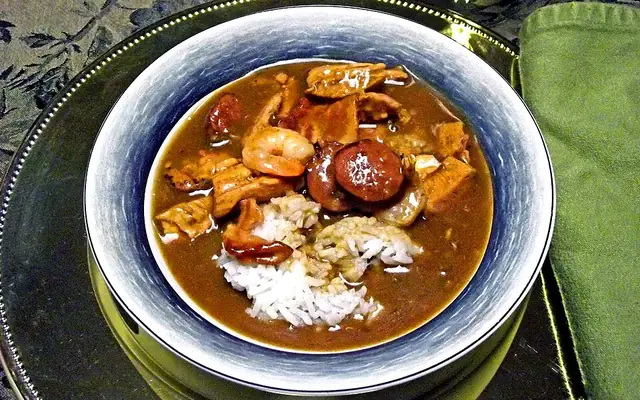
- The Louisiana stew: a dark roux base (flour and oil cooked to a chocolate-brown color, taking 30 to 45 minutes of constant stirring), the holy trinity, andouille and chicken or seafood, and either okra or file powder (sassafras leaf powder, added at the end) as thickener. Served over rice. Cajun gumbo often omits tomato; Creole gumbo often includes it.
- Jambalaya
- Rice cooked in stock with chicken, andouille, shrimp, and the holy trinity. Two main versions: Creole (red, with tomato, often called rouge) and Cajun (brown, without tomato). One of the great Louisiana rice dishes.
- Crawfish etouffee
- Crawfish tails in a blond-to-medium roux sauce with the holy trinity and stock, served over rice. The Cajun springtime dish (crawfish season is roughly February to June).
- Boudin
- Cajun sausage of rice, pork (often including liver and other organ meats), onion, and spices, in a natural casing. Sold from gas stations and butcher shops across south Louisiana. Squeezed out of the casing and eaten as a snack, or grilled.
- Andouille
- Cajun smoked pork sausage with garlic, pepper, and other spices. The base of gumbo, jambalaya, and red beans and rice. LaPlace, Louisiana, claims to be the andouille capital.
- Red beans and rice
- Slow-cooked kidney beans with andouille, ham hock, and the holy trinity, served over rice. Traditionally a Monday dish in New Orleans (using the ham bone from Sunday dinner). Louis Armstrong signed his letters 'red beans and ricely yours.'
- Po-boy
- The New Orleans sandwich: French bread (the local light, crisp version) filled with fried shrimp, fried oyster, roast beef with debris (gravy), or fried catfish. 'Dressed' means with lettuce, tomato, mayo, and pickle.
- Muffuletta
- Sicilian-Creole round bread filled with mortadella, salami, ham, provolone, and olive salad. Central Grocery in the French Quarter is the originator (1906); a quarter feeds one person.
- Crawfish boil
- Spring-and-summer outdoor gathering: live crawfish boiled in heavily seasoned water with corn, potatoes, sausage, and lemon, dumped on a newspaper-covered table. Eaten by hand, peeling each crawfish.
- Blackened fish
- Paul Prudhomme's 1980 invention: redfish coated with a paprika-cayenne-thyme spice rub and seared in a screaming-hot cast iron pan until the spices form a black crust. Sparked a national 'blackened' trend.
- Beignets
- Square deep-fried dough pillows dusted with powdered sugar. Cafe du Monde (1862) and Cafe Beignet are the New Orleans institutions, served with chicory coffee.
- Oysters Rockefeller
- Baked oysters with a green sauce of spinach, herbs, butter, and breadcrumbs. Invented at Antoine's in 1899.
How to order
A New Orleans Creole meal starts with raw oysters or a gumbo, then a main of fish, shrimp creole, jambalaya, or a steak (Creole steakhouses are their own subgenre), with sides of green beans, potato gratin, or red beans. Bread pudding with whiskey sauce or bananas Foster closes the meal. At a Cajun restaurant in Lafayette or Breaux Bridge, the meal is more direct: a gumbo or boudin starter, an etouffee or fried fish main, with potato salad on the side (the Cajun side that gets dropped into the gumbo bowl) and a King Cake during Mardi Gras season.
The rookie mistakes: confusing Cajun and Creole (they are related but distinct, and a serious restaurant identifies which tradition it is cooking in), asking for a margarita at a New Orleans cocktail bar (sazerac, French 75, vieux carre, ramos gin fizz are the local cocktails), missing the crawfish boil season (the late winter and spring is the peak), and skipping the chicory coffee at Cafe du Monde (it is the New Orleans coffee tradition). Tipping is 20 percent.
What to drink with it
New Orleans is one of the great American cocktail cities: the Sazerac (rye, absinthe, Peychaud's bitters), the French 75 (gin, champagne, lemon, sugar), the Vieux Carre, the Hurricane (Pat O'Brien's). With Creole food, a Sazerac as an aperitif and a Sauvignon Blanc or light red with the meal is the move. With Cajun food, beer (Abita Amber, Dixie) is more common. Chicory coffee (the New Orleans tradition of mixing coffee with chicory root, popularized during the Civil War when coffee was scarce) closes the meal, especially with beignets at Cafe du Monde. With crawfish boil, beer is the only acceptable drink.
Where to eat it
New Orleans for Creole: Commander's Palace, Galatoire's, Antoine's, Brennan's, August (modern Creole), Cochon (Cajun-Creole hybrid), Cafe du Monde for beignets, Central Grocery for muffulettas. Lafayette and the prairie country for Cajun: Prejean's, Cafe des Amis, Best Stop Supermarket in Scott (boudin), Hawk's Crawfish in Rayne. Outside Louisiana, Houston has the strongest Cajun-Creole diaspora scene; New York and LA hold a handful of serious places (Cochon Butcher's siblings, Susan Spicer projects). The cuisines have not exported widely; the trip to south Louisiana is the essential one.
A short history
Cajun cuisine descends from the French-Acadian settlers expelled from Nova Scotia by the British in 1755 (the Grand Derangement) and resettled in the swamps and prairies of southwest Louisiana, where they adapted to crawfish, alligator, and rice while preserving French country technique. Creole cuisine emerged from the multi-ethnic colonial population of New Orleans (French, Spanish, African, Caribbean, Native American) from the 18th century onward, with Italian-Sicilian and German immigration adding layers in the 19th century. The two cuisines have been in conversation for over two centuries.
Frequently asked
What is the difference between Cajun and Creole?
Cajun is rural southwest Louisiana cooking, descended from the French-Acadian settlers, more rustic, one-pot, often without tomato. Creole is urban New Orleans cooking, descended from a multi-ethnic colonial population, more refined, sauced, and tomato-inclusive. Many dishes (gumbo, jambalaya, etouffee) exist in both versions.
What is the holy trinity?
The Louisiana cooking foundation: equal parts onion, celery, and bell pepper, diced and sauteed at the start of nearly every Cajun and Creole dish. The local answer to the French mirepoix (carrot, celery, onion) and the Spanish sofrito.
What is file powder?
Powdered dried sassafras leaves, used as a thickener and seasoning in some gumbos, added at the end of cooking (not during, as it gets stringy if boiled). A Choctaw indigenous ingredient absorbed into Cajun and Creole cooking.
More cities are in research. Want Cajun & Creole covered somewhere specific? Tell us where you want to eat.