
The plates that define Taipei: what they are, where they came from, and where to eat the canonical version.
Signature dishes
-
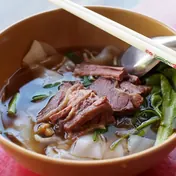
Beef noodle soup ★ 4.9
Taiwanese beef noodle soup is stewed beef in broth with noodles, served red-braised, in clear broth or with tomato, often topped with pickled mustard greens.
Where to try it: Yong Kang Beef Noodle, Lin Dong Fang Beef Noodle, Lao Shan Dong Homemade Noodles, Liu Shan Dong Beef Noodles
Taiwanese beef noodle soup was created in Taiwan by Kuomintang veterans from Sichuan who fled to Kaohsiung, and it was first eaten in military dependents' villages. Beef was long avoided because cattle were valuable farm animals. The Taipei City Office of Commerce holds the annual Taipei International Beef Noodle Festival, most recently on 9 to 11 October 2026. Lao Shan Dong has built a loyal following since 1949, with a broth slow cooked with beef bones and a blend of 10 Chinese herbs.
Watch out for: Gluten, Soy
-
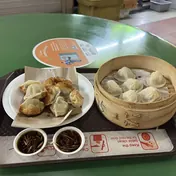
Xiaolongbao ★ 4.9
Xiaolongbao are small steamed buns of pork and aspic that melts into soup; Din Tai Fung's versions are known for 18 folds and began in a Xinyi Road oil shop.
Where to try it: Din Tai Fung Xinyi, Hangzhou Xiao Long Tang Bao
Xiaolongbao originated in the Shanghai region and evolved from the soup-filled buns of Kaifeng. Din Tai Fung was founded in 1958 by Yang Bing-Yi, who came from Shanxi, as a cooking-oil shop on Xinyi Road. When tinned cooking oil cut his sales in the early 1970s, a friend advised him to sell xiaolongbao from half the shop, and it became a restaurant. The New York Times recognized it as one of the world's top gourmet restaurants in January 1993. Michelin notes that the former flagship is takeaway only, with dine-in across the street.
Watch out for: Gluten, Soy, Pork
-
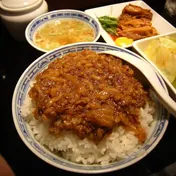
Lu rou fan ★ 4.9
Lu rou fan is minced pork braised in soy sauce and served over steamed rice, a staple of Taiwan and southern Fujian, made by frying pork belly with shallots.
Where to try it: Jin Feng Lu Rou Fan
Lu rou fan is eaten throughout Taiwan and southern Fujian, and the flavor varies by region. In northern Taiwan people favor a greasier sauce, sometimes with glutinous rice mixed in, while in the south it is made with less fat and called bah-so-png. In 2011 a Michelin green guide wrote that minced pork rice originated in Shandong, and the Taipei City Government held a press conference asking for a revision to say it is a Taiwanese dish.
Watch out for: Gluten, Soy, Pork, Egg
Book food experiences in Taipei


-
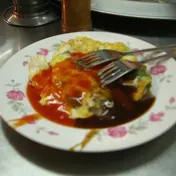
Oyster omelette ★ 4.8
The oyster omelette (o-a-tsian) is a Southern Min dish of small oysters in a starchy egg batter, usually with sweet potato starch, topped with a savory sauce.
Where to try it: Yuan Huan Bian Oyster Omelette, Shilin Night Market
The oyster omelette is a dish of Southern Min origin, from the Hokkien and Teochew communities, and it is popular in Taiwan. The Hokkien style uses chicken eggs and a batter of sweet potato flour with tapioca or corn starch, which gives it a chewy texture. Yuan Huan Bian at Ningxia Night Market has been making its omelettes since 1965, with oysters from Tainan drizzled in a homemade sweet hot sauce, and the Michelin Guide recognizes it. Shilin Night Market also lists the oyster omelet among its famous foods.
Watch out for: Egg, Mollusc, Soy
-
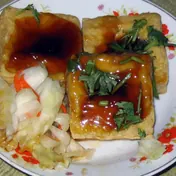
Stinky tofu ★ 4.6
Stinky tofu is fermented tofu with a pungent smell and a mild savory taste, most often deep-fried and served with chili or soy sauce at night markets.
Where to try it: Tien Hsiang Stinky Tofu, Shilin Night Market
A Chinese legend says a scholar named Wang Zhihe from Anhui invented stinky tofu in the Qing dynasty, and the dish is now extremely popular in Taiwan. It is sold at night markets such as Shilin and Linjiang, where Tien Hsiang Stinky Tofu is recognized by the Michelin Guide. Shenkeng Old Street in New Taipei bills itself as the hometown of tofu and sells fried stinky tofu and stinky tofu skewers.
Watch out for: Soy
-
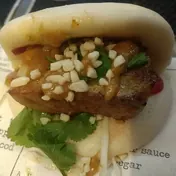
Gua bao ★ 4.7
Gua bao is a pork belly bun: red-cooked pork belly with pickled mustard greens, coriander and ground peanuts in a folded, steamed lotus leaf bun.
Where to try it: Lan Jia Gua Bao
Gua bao originated in the coastal regions of Fujian, from either Quanzhou or Fuzhou, and is believed to have reached Taiwan with Fuzhounese immigrants. In Taiwanese Hokkien it is called tiger bites pig because of the bun's mouth-like shape. It became a popular street food in Taiwan in the 1970s. Michelin lists Lan Chia Guabao, a shop outside National Taiwan University that has run for about 30 years, as a Bib Gourmand.
Watch out for: Gluten, Peanut, Soy
-
Cong you bing scallion pancake ★ 4.5
Cong you bing is a Chinese savory flatbread of wheat dough layered with scallions and oil, then pan-fried to give crisp edges and a chewy texture.
Scallion pancake is a Chinese savory flatbread made with wheat dough and minced scallions. The unleavened dough is folded repeatedly into layers with oil and green onions between them, then pan-fried. It is sold as a street food and as a restaurant dish. In Taiwanese cuisine, egg pancakes are cooked with egg coated on one side, from a thinner, moister dough.
Watch out for: Gluten
-
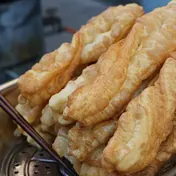
Hot soy milk and youtiao breakfast ★ 4.7
Soy milk, sweet or salty, is a popular Taiwanese breakfast, eaten with youtiao fried dough sticks, which can also be stuffed into shaobing flatbread.
Where to try it: Fuhang Soy Milk, Yong He Soya Milk King
In Taiwanese cuisine soy milk is a popular breakfast item, often served with youtiao, the fried dough sticks that are normally eaten at breakfast with congee or soy milk. At breakfast youtiao can be stuffed inside shaobing, a roasted flatbread, to make a sandwich. Fuhang Soy Milk, on the second floor of Huashan Market, was a Bib Gourmand: Michelin describes its youtiao, tandoor-baked buns, egg crepes and savory or sweet soy milk, and says it opens at 5:30 a.m. with long queues.
Watch out for: Gluten, Soy
-
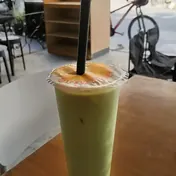
Bubble milk tea ★ 4.9
Bubble tea is a Taiwanese tea drink, most often black or green milk tea with tapioca pearls, and two tea rooms claim to have invented it in the 1980s.
Two Taiwanese tea rooms, Hanlin Tea Room in Tainan and Chun Shui Tang in Taichung, claim to have invented bubble tea, in 1986 and in 1987 or 1988 respectively. In 2009 they began legal proceedings against each other, and in 2019 a Taiwanese court ruled that bubble tea is not patentable. The ruling did not credit either party with the invention. The most common bubble tea is made with tapioca pearls, and the two most popular kinds are pearl black milk tea and pearl green milk tea.
Watch out for: Milk
-
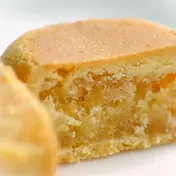
Pineapple cake ★ 4.8
Pineapple cake (fengli su) is a Taiwanese pastry of pineapple filling in a thin golden shell, and one of the top-selling souvenirs in Taiwan.
Where to try it: Chia Te Bakery, SunnyHills on the Park
Taiwan was the third-largest exporter of pineapples in the world by the late 1930s, and pineapple cakes, once ceremonial food, became one of the top-selling souvenirs in Taiwan. The Hokkien word for pineapple sounds like a phrase for prosperity, so the cakes are given as engagement or well-wishing gifts. The Taipei City Government ran an annual Pineapple Cake Cultural Festival from 2005 for several years. Chia Te Bakery in Songshan, established in 1975, says its cranberry pineapple cake was named one of Taipei's top ten souvenirs by the city's commerce department.
Watch out for: Gluten, Egg, Milk
-
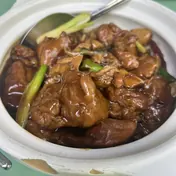
Three-cup chicken ★ 4.8
Sanbeiji, three-cup chicken, is chicken cooked with soy sauce, rice wine and sesame oil until the sauce is absorbed, served sizzling with basil in Taiwan.
Three-cup chicken is one of the best-known dishes of Jiangxi cuisine and a specialty of Ningdu, where the population is Hakka. It was introduced to Taiwan by Hakka people and is especially popular there. One legend ties the dish to the Song dynasty hero Wen Tianxiang. The Taiwan version has a simpler flavor and is not spicy. The chicken is cooked in an earthenware pot on high heat, then on low heat until the sauces are absorbed.
Watch out for: Gluten, Soy
-

Pepper bun ★ 4.7
Hujiao bing is a pepper bun: peppery marinated pork and scallion in a crisp dough shell, baked on the wall of a charcoal clay oven and sold at night markets.
Where to try it: Raohe Street Night Market
The pepper bun originated in Fuzhou, and Taiwanese vendors credit its creation to immigrants from Fuzhou. The buns are stuck to the walls of a cylindrical clay oven heated with charcoal. At the gate of Raohe Night Market, Fuzhou Black Pepper Bun was a Bib Gourmand in 2018, and Michelin describes golden crisp buns with a juicy black pepper pork filling and spring onions, with queues through the evening.
Watch out for: Gluten, Pork
-
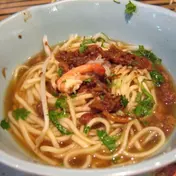
Danzai noodle ★ 4.6
Danzai noodles, from Tainan, are small bowls of noodles in shrimp-flavored soup with minced pork, shrimp and coriander; the name means shoulder-pole noodles.
Danzai noodles are said to date from about 1895 in Tainan, where the fisherman Hong Yutou sold noodles from shoulder poles to earn money in the off-season, when typhoons made fishing too dangerous. He later set up a stall in front of the Chuisian Temple under lanterns reading slack season danzai noodles.
Watch out for: Gluten, Crustacean, Soy
-
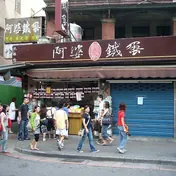
Iron egg ★ 4.3
Iron eggs (tiedan) are small eggs stewed over and over in spices and air-dried until dark, chewy and concentrated in flavor, a snack that began in Tamsui.
Iron eggs originated in Tamsui. Yang Bi-yun opened the first store selling them there in 1980 and sells them as Apotiedan, or Grandma's iron eggs; she said she invented them by accident while recooking soy eggs to keep them warm. A Tamsui local legend instead credits a noodle stall owner, Huang Chang-nian, in the 1970s. The New Taipei City tourism site lists Granny's iron eggs among the foods to try on Tamsui Old Street.
Watch out for: Egg, Soy
-
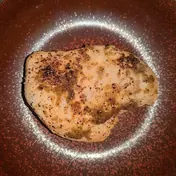
Salt and pepper chicken ★ 4.4
Taiwanese fried chicken (xiansuji) is bite-sized fried chicken seasoned with pepper, a night market snack, often with fried basil, chili powder and garlic.
Taiwanese fried chicken, called popcorn chicken in the West, is a street snack that is popular at the night markets of Taiwan. Its history is fairly recent, and it evolved quickly under stiff competition, from mild, medium and extra spicy seasoning to many flavors. Some vendors use two pots of oil at different temperatures to get a crunchy crust. Salt and pepper is the staple seasoning, and chili powder, lightly fried basil and garlic bits are added by preference.
Watch out for: Gluten, Egg
-
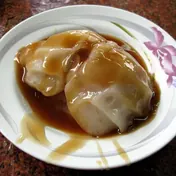
Ba wan ★ 4.2
Ba-wan is a Taiwanese dumpling of sweet potato starch and rice flour, translucent and gelatinous, usually filled with pork, bamboo shoots and shiitake.
Ba-wan are believed to have been first made in Beidou township, Changhua County, by Fan Wan-chu, as disaster relief food when heavy floods struck the region in 1898. They have since spread to different regions of Taiwan and are found in most night markets. The traditional wrapper was made with sweet potato starch alone. Ba-wan are cooked by steaming first and may then be deep-fried or gently poached in oil.
Watch out for: Gluten, Pork
-
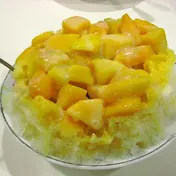
Mango shaved ice ★ 4.6
Mango snowflake ice is shaved ice served with fresh mango; Smoothie House bills itself as the original Yongkang Street mango snowflake ice shop.
Where to try it: Smoothie House
Shaved ice is called baobing in Taiwan, and its snowflake variation, xuehua bing, is made from milk instead of water. Irwin mangoes are in season from about May to August. Smoothie House says on its own site that it is the founding Yongkang Street mango snowflake ice shop and an internationally known mango snowflake ice brand, using purified water ice blocks and seasonal Taiwanese fruit.
Watch out for: Milk
-
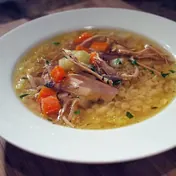
Sesame oil chicken soup ★ 4.5
Sesame oil chicken is a Taiwanese dish of chicken cooked with sesame oil, rice wine and ginger, eaten for warmth and recovery during postpartum confinement.
Postpartum confinement is widely practiced in Taiwan, and its food emphasizes warmth, nourishment and recovery. A defining feature of Taiwanese confinement cuisine is the extensive use of sesame oil, rice wine and ginger. One of the best-known dishes is sesame oil chicken, which is commonly eaten throughout the confinement period, alongside ginger duck, liver dishes, fish soup and herbal broths.
Watch out for: Sesame, Alcohol
Signature Dishes in Taipei, FAQ
What food is Taipei known for?
Taipei's signature dishes include Beef noodle soup, Xiaolongbao, Lu rou fan, Oyster omelette, Stinky tofu. See our signature dishes chapter for where to eat each.