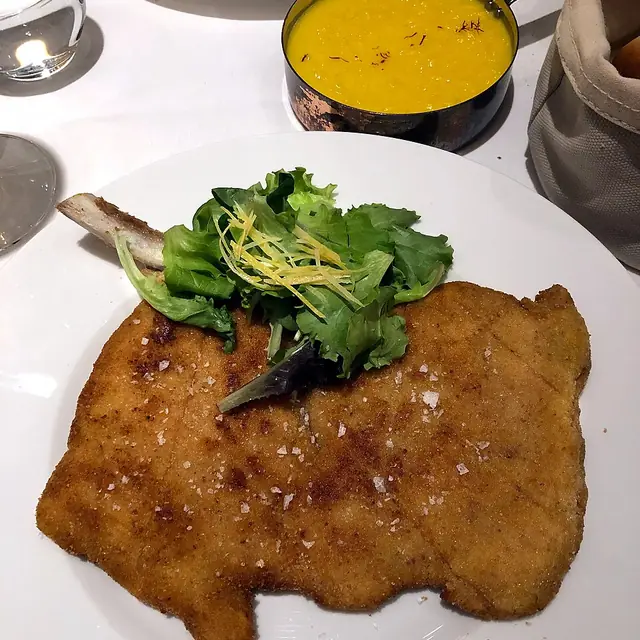
Cotoletta alla milanese is a veal chop cut on the bone, breaded and fried in butter, with a crisp crust and meat that stays pink near the bone.

Traditionally the cotoletta is a loin chop with the bone, breaded and fried in butter. Some historians trace it to lombolos cum panitio at the feast of the Sant'Ambrogio canons in the 12th century, and the city council gave it De.Co. status on 17 March 2008, but another scholar reads panitio as a side dish. The first printed recipe appears in Giuseppe Sorbiatti's Gastronomia moderna (1855). The thin boneless version is called oregia d'elefant. Trattoria Masuelli San Marco insists on the bone.

Where to eat Cotoletta alla milanese in Milan

6 editor picks for Cotoletta alla milanese in Milan, ranked by editorial score. All Milan signature dishes · Cotoletta alla milanese across every city.

Make it at home

Serves 240 minIntermediate

Ingredients

  • 2 bone-in veal rib chops, 300 to 350g each, trimmed
  • 2 large eggs, beaten with a pinch of salt
  • 150g dry white breadcrumbs (panko works too but coarser)
  • 200g clarified butter (or 100g butter plus 100g neutral oil)
  • Sea salt, freshly cracked black pepper
  • Lemon wedges to serve

Method

  1. Place each chop between two sheets of cling film. Pound with a meat mallet to 5 to 7mm thickness, keeping the bone intact. The chop should be the size of a small plate.
  2. Season with salt and pepper. Dip into the beaten egg and coat both sides.
  3. Press into the breadcrumbs, pushing the crumbs into the meat firmly. The coating should be thick.
  4. Heat the clarified butter in a wide heavy pan to 170C (a breadcrumb thrown in should sizzle gently, not violently).
  5. Lay the chop in flat, away from you. Cook 3 minutes on one side until deep gold; flip carefully and cook 2 to 3 minutes on the other.
  6. Drain briefly on kitchen paper. Serve immediately with lemon wedges. No sauce, no garnish.

Editor tip. The clarified butter is essential. Whole butter burns black at frying temperature; clarified butter holds the gold colour and the nutty taste.

Common allergens: Gluten, Egg, Dairy.