

The plates that define Genoa: what they are, where they came from, and where to eat the canonical version.
Signature dishes
-
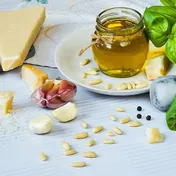
Pesto genovese ★ 4.9
Pesto genovese is raw basil pounded in a marble mortar with garlic, coarse salt, pine nuts, Parmigiano, Fiore Sardo and Ligurian oil, the green sauce Genoa puts on trofie, trenette and minestrone.
Where to try it: Trattoria Rosmarino, Toe Drue Antica Osteria, Il Genovese, Le Cicale in Trattoria, Osteria Le Colonne
Price: About €12 for a plate of trofie al pesto
Basil in Genoese pesto is documented only from the 1850s: Emanuele Rossi printed a pesto of garlic and basil in 1852, and Giovanni Battista Ratto's La cuciniera genovese of 1863 gave a version made with Dutch cheese, then common in the trading port. The Consorzio del Pesto Genovese now sets seven ingredients, from Basilico Genovese DOP to Fiore Sardo, and the Pesto World Championship brings mortars to Palazzo Ducale every other spring.
Watch out for: Milk, Nuts
-
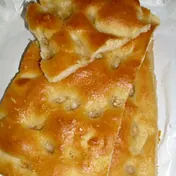
Focaccia genovese ★ 4.8
Focaccia genovese, fugassa in dialect, is a low, golden flatbread with oil pooled in its finger dimples and coarse salt on top, eaten by the slice from Genoa's bakeries from breakfast on.
Where to try it: Panificio Mario, Antico Forno della Casana, Il Focaccino
The word focaccia is first recorded in the 14th century, from the Latin focus, the hearth. The Genoese version is brushed with an emulsion of olive oil, water and coarse salt before its last rise, which gives the dimples, the ombrisalli, their pools of brine. The city's tourist office calls it an institution: Genoese eat it at breakfast dipped in cappuccino or milk, mid-morning, with a glass of white wine at aperitivo time, and at lunch.
Watch out for: Gluten
-
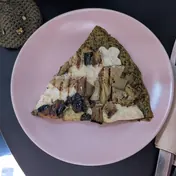
Farinata ★ 4.7
Farinata is a thin disc of chickpea flour, water, salt and olive oil baked in a wide shallow pan in a wood oven until crisp at the edges and soft inside, served warm in wedges with black pepper in Genoa.
Where to try it: Sà Pesta, Osteria della Foce, Il Genovese, Antica Friggitoria Carega, Pizzeria Da Raffa
Price: About €9 for a pizzeria-sized farinata
Chickpeas are widely held to have reached Genoese cooking through the medieval republic's trade with the Arab world. A decree of the Republic regulated the oil used for farinata in the 15th century, and a popular story credits its invention to galley crews who found their chickpea flour and oil soaked in seawater after the Genoese victory over Pisa at Meloria in 1284. It is also baked in Tuscany and in Buenos Aires and Montevideo, where it is called fainá.
Book food experiences in Genoa


-
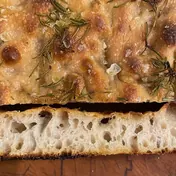
Focaccia di Recco col formaggio ★ 4.7
Focaccia di Recco col formaggio is two sheets of unleavened dough stretched almost transparent, filled with fresh crescenza and baked minutes in a very hot oven, the IGP speciality of Recco east of Genoa.
Where to try it: Strakkino, Le Cicale in Trattoria, Pizzeria Da Raffa, Antico Forno della Casana
Price: About €9 for a focaccia al formaggio
The Recco consortium traces a cheese focaccia back to the time of the Third Crusade, and local tradition says villagers fleeing Saracen raids first baked dough and cheese together. Trattorie in Recco served it for All Souls' Day from the late 1800s, the Consorzio Recco Gastronomica formed in 1985, and the European Union registered Focaccia di Recco col formaggio as an IGP in 2015, limited to Recco, Sori, Avegno and Camogli.
Watch out for: Gluten, Milk
-
Pansoti con salsa di noci ★ 4.6
Pansoti are pot-bellied Genoese ravioli filled with wild greens, borage and prescinsêua curd, dressed with salsa di noci, a raw sauce of pounded walnuts, garlic, bread and oil.
Where to try it: Il Genovese, Le Cicale in Trattoria, Sà Pesta, Trattoria detta del Bruxaboschi
Genoa's tourist office calls pansoti a fairly recent invention, a variant of the meatless ravioli di magro, and the name comes from their pot-bellied, bundle-like shape; along the Rivieras they are also made as triangles or half-moons. Walnut sauce, sarsa de noxe in dialect, is recognised as a traditional Ligurian food product and is made with prescinsêua, the tangy Genoese curd that also goes into the filling. Butter and sage is the simpler dressing the tourist office suggests.
Watch out for: Gluten, Eggs, Milk, Nuts
-
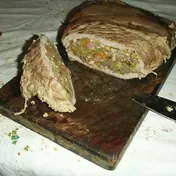
Cima alla genovese ★ 4.4
Cima alla genovese is a breast of veal sewn into a pocket, stuffed with eggs, vegetables, cheese, pine nuts and offal, poached for hours in broth, pressed and served in slices in Genoa.
Where to try it: Trattoria detta del Bruxaboschi, Antica Osteria dei Cacciatori
Genoa's tourist office dates cima to the 16th century and repeats the local joke that the Genoese invented it to save on meat, filling a cheap cut with humbler ingredients; it has since become one of the richest dishes of the Genoese table. Once a Christmas dish, it is now eaten all year, and the Genoese singer Fabrizio De André dedicated his song 'A çimma to it, in dialect, with the cook pricking the meat with a needle as it simmers.
Watch out for: Eggs, Milk, Nuts, Celery
-
Torta pasqualina ★ 4.5
Torta pasqualina is Genoa's Easter pie of chard or wild greens, prescinsêua curd, Parmigiano and marjoram between sheets of thin pastry, with whole eggs set in the filling to show when cut.
Where to try it: Focaccia e Dintorni, Antica Osteria dei Cacciatori
The pie was made at Easter to celebrate the Resurrection, and the old accounts praise Genoese housewives able to layer 33 sheets of pastry, one for each year of Christ's life. The filling is built on prescinsêua, the soft, slightly sour curd of the Genoese dairy, with bietoline or wild greens and marjoram, and whole eggs are set into hollows in the filling. The city's tourist office notes that it is now sold all year in Genoese restaurants and delicatessens.
Watch out for: Gluten, Eggs, Milk
-
Stoccafisso accomodato ★ 4.3
Stoccafisso accomodato is soaked stockfish stewed in a terracotta pot with potatoes, olives, capers, pine nuts, tomato, garlic and parsley, a winter dish of the old port city of Genoa.
Where to try it: Il Genovese, Toe Drue Antica Osteria
The port of Genoa was already among the most important in the world in the Middle Ages, and the city's tourist office explains that when fresh fish was scarce in winter, Genoese sailors relied on stockfish, dried cod that kept for months. Stockfish has been known in Liguria since the 17th century through trade with the Portuguese, and the region lists stoccafisso among its traditional food products; accomodato, stewed with olives and potatoes, is its best-known Genoese form.
Watch out for: Fish, Nuts
-
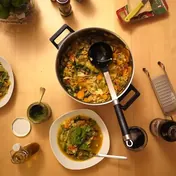
Minestrone alla genovese ★ 4.2
Minestrone alla genovese is a thick soup of beans, potatoes, pumpkin, courgettes, cabbage and short pasta, finished off the heat with a spoonful of pesto and eaten hot or cold in Genoa.
Where to try it: Il Genovese, Osteria Il Cadraio
Genoa's tourist office describes minestrone as a child of the cucina povera, a pot of whatever the garden gave, thickened by crushing the potatoes and beans halfway through cooking and made Genoese by the pesto stirred in at the end. Ligurian cooking has long added pesto to its minestroni, the vegetable soups richest in autumn, and the tourist office recipe still serves it in deep bowls, left to rest before eating and just as good cold.
Watch out for: Gluten, Milk, Nuts
-
Pandolce genovese ★ 4.5
Pandolce genovese is Genoa's Christmas sweet bread, studded with raisins, pine nuts, candied citron and fennel seed and scented with orange-flower water, sold tall or low in the city's bakeries.
Where to try it: Focaccia e Dintorni, Romeo Viganotti, Pasticceria Tagliafico, Antico Forno della Casana
Legend says Andrea Doria launched a contest among Genoese pastry cooks in the 16th century for a sweet that would keep on long voyages. The tall pandolce is the older, naturally leavened form; the low version came in the late 1800s with chemical raising agents. At Christmas the youngest at the table sets a sprig of olive or bay on top, the eldest cuts the first slice, and two pieces are kept, one for a poor visitor at the door and one for the feast of San Biagio.
Watch out for: Gluten, Milk, Nuts
Signature Dishes in Genoa, FAQ
What food is Genoa known for?
Genoa's signature dishes include Pesto genovese, Focaccia genovese, Farinata, Focaccia di Recco col formaggio, Pansoti con salsa di noci. See our signature dishes chapter for where to eat each.