

The plates that define Dijon: what they are, where they came from, and where to eat the canonical version.
Signature dishes
-
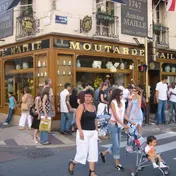
Moutarde de Dijon ★ 4.9
Moutarde de Dijon is the sharp, pale yellow mustard made with brown mustard seed and verjuice or white wine, hot enough to clear the nose, and on every Dijon table beside the charcuterie.
Where to try it: La Brasserie des Loges
Price: €4 to €15 a jar
Mustard is recorded on the table of King Philip VI in 1336, and by the late Middle Ages Dijon was the centre of French mustard making, with its makers granted exclusive rights in the 17th century. The modern style dates from 1856, when Jean Naigeon replaced vinegar with verjuice, the sour juice of unripe grapes. A 1937 decree made 'Dijon mustard' a generic method rather than a protected origin, so most of the seed now comes from Canada; the Burgundy-grown version carries its own protected name, moutarde de Bourgogne.
Watch out for: Mustard
-
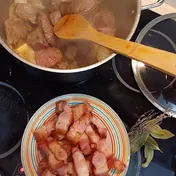
Boeuf bourguignon ★ 4.8
Boeuf bourguignon is beef braised for hours in red Burgundy with lardons, small onions and mushrooms until the sauce turns dark and glossy, the Sunday dish most Dijon bistros keep on the menu.
Where to try it: La Brasserie des Loges
Price: €18 to €28
Beef bourguignon is younger than its reputation: the dish was first documented in 1867, and similar 'à la bourguignonne' preparations of other meats appear earlier in the 19th century. It did not enjoy a great reputation at first, often being made with leftover cooked beef. Its fame came later, sealed by Simone Beck, Louisette Bertholle and Julia Child in Mastering the Art of French Cooking (1961), who called it one of the most delicious beef dishes concocted by man, and it has since become the dish most visitors expect in Dijon.
Watch out for: Gluten, Sulphites, Celery
-
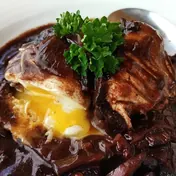
Oeufs en meurette ★ 4.7
Oeufs en meurette are eggs poached in red wine and served in a glossy meurette sauce of Burgundy wine, lardons and shallots, on garlic-rubbed toast: the classic Dijon starter.
Where to try it: Meurette et Persillé, William Frachot, La Brasserie des Loges, Le Caveau de Saulx
Price: €9 to €15
The meurette is the Burgundian red wine sauce, built on the region's own wine with lardons, onions and shallots sweated in butter,. Oeufs en meurette, poached eggs laid on toasted garlic bread and covered in that sauce, is the best-known use of it and one of the fixed starters of the Burgundy bistro repertoire. It is traditionally drunk with the same red wine that went into the sauce, which in Dijon usually means a Côte de Nuits Pinot Noir.
Watch out for: Eggs, Gluten, Sulphites, Milk
Book food experiences in Dijon
-
Jambon persillé ★ 4.6
Jambon persillé is chunks of cooked ham set in a clear white wine jelly thick with parsley, cut in cold slices from a terrine: the Burgundian Easter dish and a fixture of Dijon charcuterie counters.
Where to try it: La Brasserie des Loges, Le Caveau de Saulx
Price: €8 to €14
Jambon persillé, also called jambon de Pâques, is a traditional Burgundian charcuterie made in Côte-d'Or and around Dijon, Beaune in particular. It has been prepared for Easter since the 14th century, when families brought out the ham kept all winter in the salting tub. The meat, from the leg or shoulder, is cooked in a seasoned broth with white Burgundy, then layered with plenty of parsley in a terrine; the broth, set by veal or pork feet, is poured over and the terrine pressed and chilled.
Watch out for: Sulphites, Mustard
-
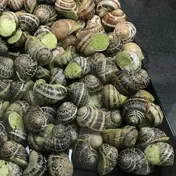
Escargots de Bourgogne ★ 4.5
Escargots de Bourgogne are snails baked in their shells under a thick seal of garlic and parsley butter, served by the half-dozen or dozen with bread to mop the butter: a Burgundy starter found across Dijon.
Where to try it: Loiseau des Ducs, La Brasserie des Loges
Price: €9 to €16 a dozen
The Burgundy snail, Helix pomatia, is the large Roman snail of European woods and vineyards, and its name travelled with the dish of snails baked in garlic and parsley butter that French menus call à la bourguignonne. Wild snails are protected in season: in France collecting them is banned from 1 April to 30 June and below a shell diameter of 3 cm. In Dijon they are still ordered as a first course, often alongside oeufs en meurette.
Watch out for: Milk, Molluscs
-
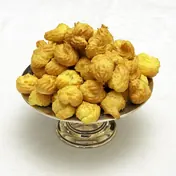
Gougères ★ 4.4
Gougères are small choux puffs baked with grated Comté or Gruyère, crisp outside and hollow and cheesy within, served warm with the apéritif and at every Burgundy wine tasting.
Where to try it: La Brasserie des Loges
Price: €3 to €8 a bag
The gougère is choux pastry with strong cheese beaten into the warm dough before baking. It comes from the Yonne side of Burgundy, around Auxerre, where a cheese tart called a 'goiere' is recorded as early as the late 14th century, and Flogny-la-Chapelle claims to be its birthplace. It was once served at the cheese course; today it is the standard bite with an apéritif or a glass at a cellar tasting, and Dijon bakers sell it by the bag.
Watch out for: Gluten, Eggs, Milk
-
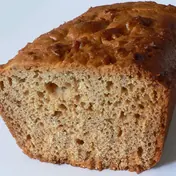
Pain d'épices ★ 4.7
Pain d'épices is Dijon's dense honey and spice bread, fragrant with anise, cinnamon and clove, sold in loaves and as nonnettes, small round cakes of pain d'épices filled with jam.
Where to try it: Mulot et Petitjean
Price: €5 to €15
Spiced honey bread is an ancient food, and Dijon tradition credits Margaret of Flanders, wife of Duke Philip the Bold, with bringing its ancestor to the ducal court. By the 20th century the city counted twelve gingerbread houses. Mulot et Petitjean, founded in 1796 and trading from Place Bossuet since 1805, is now the last of them, and moved production to Boulevard de l'Ouest in 1912. Besides loaves it makes nonnettes, small round pain d'épices filled with jam, from blackcurrant to orange.
Watch out for: Gluten, Eggs
-

Kir ★ 4.6
The kir is a glass of dry white Burgundy, traditionally Aligoté, coloured purple with a measure of crème de cassis: the apéritif Dijon poured for visitors and exported everywhere.
Where to try it: L'Un des Sens
Price: €4 to €8
Crème de cassis was first made in Dijon in 1841 by Auguste-Denis Lagoute, who ran the Café des Mille Colonnes. Mixed with white wine it was drunk locally as blanc-cassis until Canon Félix Kir, mayor of Dijon from 1945 until his death in 1968, made a habit of serving it to delegations visiting the city, and the drink took his name. The classic version uses Aligoté, the region's sharp white grape; made with champagne it becomes a kir royal.
Watch out for: Sulphites
-
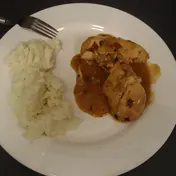
Poulet Gaston Gérard ★ 4.5
Poulet Gaston Gérard is Dijon's own chicken dish, pieces browned then baked in a sauce of white wine, cream, Dijon mustard and grated Comté until the top turns golden.
Where to try it: La Brasserie des Loges
Price: €16 to €24
The recipe is credited to Reine-Geneviève Bourgogne, first wife of Gaston Gérard, mayor of Dijon, who cooked it in August 1930 at their home on Rue du Petit-Potet for the food writer Curnonsky. The story goes that she spilled paprika into the pot and rescued it with white wine and grated Comté; Curnonsky approved and named the dish after his host. Gérard was also the mayor who founded the Foire gastronomique in 1921. The chicken, mustard, cream and Comté version is now a classic of Dijon cooking.
Watch out for: Milk, Mustard, Sulphites
-
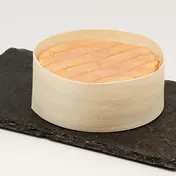
Époisses ★ 4.4
Époisses is Burgundy's washed-rind cow's milk cheese, its orange crust rubbed with marc de Bourgogne, soft and pungent inside, spooned at the end of a Dijon meal or baked warm.
Where to try it: La Brasserie des Loges
Price: €8 to €14 a whole cheese
Époisses takes its name from a village in Côte-d'Or between Dijon and Auxerre, where oral legend credits a community of Cistercian monks with starting production in the early 16th century. Farmers kept the recipe going, but production almost stopped after the First World War and had virtually ceased by the 1950s. In 1956 Robert and Simone Berthaut relaunched it, and their Fromagerie Berthaut still makes it. The cheese gained AOC status in 1991; it is washed in brine and marc de Bourgogne, the local pomace brandy.
Watch out for: Milk

Signature Dishes in Dijon, FAQ
What food is Dijon known for?
Dijon's signature dishes include Moutarde de Dijon, Boeuf bourguignon, Oeufs en meurette, Jambon persillé, Escargots de Bourgogne. See our signature dishes chapter for where to eat each.