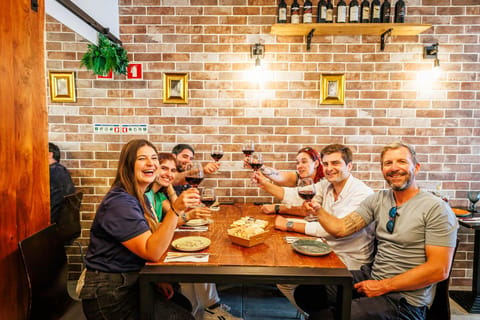


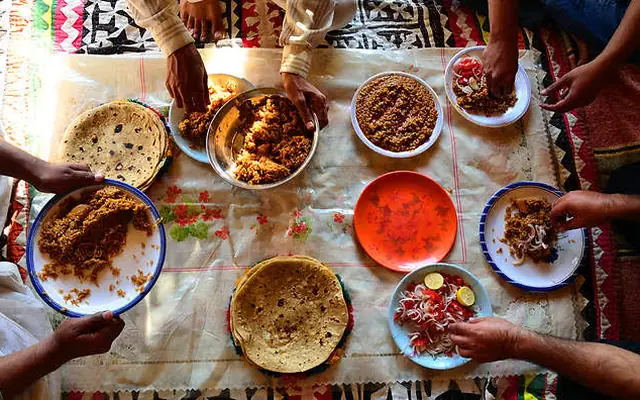
Pakistani cuisine is the food of Punjab, Sindh, Khyber Pakhtunkhwa, Balochistan, Kashmir, and the broader northern subcontinent, distinguished from Indian cuisine by Islamic dietary law (halal, no pork, less dairy-cream than north Indian Hindu cooking) and a heavier emphasis on grilled and roasted meat. It is closely related to north Indian cuisine and shares many dishes (biryani, kebab, naan, korma, nihari), but the regional flavor and cooking style diverge enough that Pakistani restaurants are a recognized category in the diaspora.
The core grammar is meat-led. Pakistanis eat significantly more meat per capita than Indians, with beef, lamb, goat (mutton), and chicken all common. Pork is absent. Cooking methods lean toward direct-fire (the tandoor and the angethi grill), long-simmered stews (nihari, haleem, paya), and dum (sealed slow-cook in a covered pot). Spice blends are bold but more savory and aromatic than Indian counterparts; cardamom, cinnamon, clove, mace, nutmeg, and black pepper carry over from the Mughal tradition, while red chile, cumin, and coriander provide the everyday base.
The Pakistani bread tradition is among the world's deepest. Naan (leavened, tandoor-baked), roti (unleavened wheat), paratha (laminated, ghee-fried), khameeri roti (leavened, soft), kulcha (Punjabi flat-bread, sometimes stuffed with potato or onion). Bread is the daily staple in Punjab and KP; rice dominates in Sindh. The traditional Pakistani meal is bread plus curry or grilled meat, with yogurt-based sides (raita), pickles, and a final round of qahwa (Kashmiri green tea) or chai.
Book a food experience
Tours, tastings and classes that match this page, bookable on GetYourGuide.
Top picks
The best-scored Pakistani place in each of 12 cities.
Himalaya Restaurant ★ 4.8
Himalaya Restaurant in Houston is Kaiser Lashkari's Pakistani-Indian Hillcroft strip-mall kitchen, a James Beard semifinalist room hiding in a freeway.
OrderLamb biryani slow-cooked dum, hunter's beef.
Why locals goA Pakistani strip-mall room on the Southwest Freeway, with chef Kaiser Lashkari running the most precise biryani in Texas since 2004.
TipOrder the slow-cooked dum lamb biryani and hunter's beef. BYOB; corner liquor store across Hillcroft is the run.
Der Wiener Deewan ★ 4.7
Der Wiener Deewan is a Pakistani restaurant at Liechtensteinstrasse 10, 1090 Wien.
Zainab Roshni Mahal ★ 4.5
A Pakistani community restaurant near Delfshaven with hefty portions of biryani, nihari, and daal that feed two for under €20. Located in Rotterdam West.
TipThe mixed biryani for two feeds three adults easily. Bring your own beer from the off-licence next door.
Ravi Restaurant ★ 4.4
Ravi Restaurant has served Pakistani karahi and kebabs in Al Satwa, Dubai, since 1978, a plain, busy room open from 05:00 until the small hours.
SignatureSeekh kebab, Mutton karahi, Chicken biryani
TipExpect a queue at dinner. Communal seating and a fast turnover are part of the Ravi routine.
Kabobeesh ★ 4.4
Kabobeesh in Philadelphia is the University City halal Pakistani-Indian counter on Chestnut, the city's best post-midnight kebab and biryani room.
TryCharcoal kebab plate, biryani
Lahore Tikka House ★ 4.4
Lahore Tikka House on Gerrard East is Little India's reference Pakistani halal kitchen since 1996, tandoor-grilled meats in a Persian-tile dining room.
OrderA platter of seekh kebab, butter chicken and a fresh naan from the tandoor.
TipHalal certified. The summer patio the city's most colourful outdoor strip; bring cash for tips.
Shalimar ★ 4.3
Shalimar in San Francisco is the Tenderloin's cash-and-card Pakistani counter, with a tandoor at the door turning out solid chicken tikka under fifteen.
OrderChicken tikka from the tandoor, with garlic naan and dal.
TipEat at the back of the room; the front benches give you a view of the tandoor cook at speed.
Namak Mandi ★ 4.2
Namak Mandi serves authentic Peshawari cuisine at 100 Norfolk Street in Glasgow, with karahi, grills, Kabuli pilau and slow-cooked Peshawari classics.
OrderKarahi, grills, Kabuli pilau or the slow-cooked Peshawari classics.
TipThere is a Desi Brunch at the weekend and a Grand Buffet on Monday and Tuesday evenings.
Lal Qila ★ 4.2
Manchester Curry Mile institution open until 01:00 on weekend nights. Lal Qila means Red Fort; everything cooked to order, spice tuned to each diner here.
TryMade-to-order curry
Taste of Pakistan ★ 4.2
Taste of Pakistan is a Pakistani restaurant at Rua de Sao Pedro Martir 37, 1100-034 Lisboa.
Punjab Tandoori ★ 4.2
Punjab Tandoori on Grønland is the family-run halal Pakistani room with a budget thali, naan from the tandoor and the long Grønland queue for take-away.
TryHalal thali with rice, raitha and curry
Kabab King ★ 4.2
Kabab King on McKnight Road serves cheap halal Pakistani food near Pittsburgh. A plate of biryani or seekh kebabs feeds you well for little in the North.
TryBiryani and kebabs
Find a place
Himalaya Restaurant ★ 4.8
Himalaya Restaurant in Houston is Kaiser Lashkari's Pakistani-Indian Hillcroft strip-mall kitchen, a James Beard semifinalist room hiding in a freeway.
OrderLamb biryani slow-cooked dum, hunter's beef.
Why locals goA Pakistani strip-mall room on the Southwest Freeway, with chef Kaiser Lashkari running the most precise biryani in Texas since 2004.
TipOrder the slow-cooked dum lamb biryani and hunter's beef. BYOB; corner liquor store across Hillcroft is the run.
Der Wiener Deewan ★ 4.7
Der Wiener Deewan is a Pakistani restaurant at Liechtensteinstrasse 10, 1090 Wien.
Zainab Roshni Mahal ★ 4.5
A Pakistani community restaurant near Delfshaven with hefty portions of biryani, nihari, and daal that feed two for under €20. Located in Rotterdam West.
TipThe mixed biryani for two feeds three adults easily. Bring your own beer from the off-licence next door.
Ravi Restaurant ★ 4.4
Ravi Restaurant has served Pakistani karahi and kebabs in Al Satwa, Dubai, since 1978, a plain, busy room open from 05:00 until the small hours.
SignatureSeekh kebab, Mutton karahi, Chicken biryani
TipExpect a queue at dinner. Communal seating and a fast turnover are part of the Ravi routine.
Kabobeesh ★ 4.4
Kabobeesh in Philadelphia is the University City halal Pakistani-Indian counter on Chestnut, the city's best post-midnight kebab and biryani room.
TryCharcoal kebab plate, biryani
Lahore Tikka House ★ 4.4
Lahore Tikka House on Gerrard East is Little India's reference Pakistani halal kitchen since 1996, tandoor-grilled meats in a Persian-tile dining room.
OrderA platter of seekh kebab, butter chicken and a fresh naan from the tandoor.
TipHalal certified. The summer patio the city's most colourful outdoor strip; bring cash for tips.
Shalimar ★ 4.3
Shalimar in San Francisco is the Tenderloin's cash-and-card Pakistani counter, with a tandoor at the door turning out solid chicken tikka under fifteen.
OrderChicken tikka from the tandoor, with garlic naan and dal.
TipEat at the back of the room; the front benches give you a view of the tandoor cook at speed.
Namak Mandi ★ 4.2
Namak Mandi serves authentic Peshawari cuisine at 100 Norfolk Street in Glasgow, with karahi, grills, Kabuli pilau and slow-cooked Peshawari classics.
OrderKarahi, grills, Kabuli pilau or the slow-cooked Peshawari classics.
TipThere is a Desi Brunch at the weekend and a Grand Buffet on Monday and Tuesday evenings.
Lal Qila ★ 4.2
Manchester Curry Mile institution open until 01:00 on weekend nights. Lal Qila means Red Fort; everything cooked to order, spice tuned to each diner here.
TryMade-to-order curry
Taste of Pakistan ★ 4.2
Taste of Pakistan is a Pakistani restaurant at Rua de Sao Pedro Martir 37, 1100-034 Lisboa.
Punjab Tandoori ★ 4.2
Punjab Tandoori on Grønland is the family-run halal Pakistani room with a budget thali, naan from the tandoor and the long Grønland queue for take-away.
TryHalal thali with rice, raitha and curry
Kabab King ★ 4.2
Kabab King on McKnight Road serves cheap halal Pakistani food near Pittsburgh. A plate of biryani or seekh kebabs feeds you well for little in the North.
TryBiryani and kebabs
Karachi Darbar ★ 4.1
Karachi Darbar in Al Karama belongs to the Pakistani group that traces its roots to 1973 and serves karahi and nihari to drivers and families alike.
OrderChicken karahi with tandoori roti and a plate of seekh kebab on the side.
TipFriday mornings bring halwa puri and chickpeas before the karahi menu switches on at lunch.
Sthan ★ 4.1
Sthan cooks Pakistani, Afghan and Indian frontier dishes named for Kabul, Peshawar and Karachi on Zabeel Road, a Karama, Dubai room built for sharing.
Why locals goThe name joins Hindustan, Pakistan and Afghanistan, and first time visitors often expect one national cuisine instead of the frontier menu it serves.
TipCover all three countries: a Kabuli chicken shorba, Lahori gosht seekh and a slow cooked rogan josh.
Lahori Chilli ★ 4.0
Lahori Chilli is a Pakistani halal restaurant and sweet shop on Coney Island Avenue in Midwood, Brooklyn, whose two websites both post 24-hour service.
TryHaleem and samosas
TipCab drivers stop in at all hours for samosas and haleem from the steam table. Eater lists a 04:00 close; both operator sites say 24 hours.
Akbar's Castlefield ★ 4.0
Bradford-founded Kashmiri chain on Manchester's Liverpool Road in Castlefield. Signature hanging naan suspended from a metal frame over the table at dinner.
TryCurry and naan
Al Ibrahimi Restaurant ★ 3.6
Al Ibrahimi Restaurant serves Pakistani mutton kabab, lamb chops and curries at Al Wahda Mall in Abu Dhabi; the chain was named an Urban Treasure in 2022.
OrderThe mutton kabab or the lamb chops, which Best Bites singles out as perfectly seasoned.
TipBest Bites says it beats most food-court offers at Al Wahda Mall; the Electra branch has outdoor seating for cooler weather.
Tikka Tonight ★ 3.5
Tikka Tonight serves Pakistani BBQ platters, chicken boti and chapli kabab at its Madinat Zayed branch in Abu Dhabi, open daily until midnight or later.
OrderThe BBQ platter with marinated chicken boti and chapli kabab, ordered as several dishes to share.
TipBest Bites picks the Madinat Zayed branch over the chain's other rooms because it is quick and parking outside is usually easy.
Pakistani by city
 Dubai12 places
Ravi Restaurant, Karachi Darbar
Dubai12 places
Ravi Restaurant, Karachi Darbar
 Philadelphia3 places
Kabobeesh
Philadelphia3 places
Kabobeesh
 Abu Dhabi2 places
Al Ibrahimi Restaurant, Tikka Tonight
Abu Dhabi2 places
Al Ibrahimi Restaurant, Tikka Tonight
 Brooklyn2 places
Lahori Chilli
Brooklyn2 places
Lahori Chilli
 Glasgow2 places
Namak Mandi
Glasgow2 places
Namak Mandi
 Manchester2 places
Lal Qila, Akbar's Castlefield
Manchester2 places
Lal Qila, Akbar's Castlefield
 San Francisco2 places
Shalimar
San Francisco2 places
Shalimar
 Houston1 place
Himalaya Restaurant
Houston1 place
Himalaya Restaurant
 Lisbon1 place
Taste of Pakistan
Lisbon1 place
Taste of Pakistan
 Oslo1 place
Punjab Tandoori
Oslo1 place
Punjab Tandoori
 Pittsburgh1 place
Kabab King
Pittsburgh1 place
Kabab King
 Rotterdam1 place
Zainab Roshni Mahal
Rotterdam1 place
Zainab Roshni Mahal
 Toronto1 place
Lahore Tikka House
Toronto1 place
Lahore Tikka House
 Vienna1 place
Der Wiener Deewan
Vienna1 place
Der Wiener Deewan
Regional variations
Punjab (Lahore, Sialkot, Multan)
The heart of Pakistani cuisine. Tandoori meats, robust curries (nihari, haleem, paya), butter-led dishes (makhani gravy), and the city of Lahore's reputation as the country's food capital. The Punjabi naan, the seekh kebab, and the chicken karahi are regional flagships.
Sindh (Karachi, Hyderabad)
Rice-led, Persian-influenced. Sindhi biryani (with potato, chile, and sour notes from raw mango), Karachi street food (bun kebab, gola ganda, bhel puri), and a Goan-style fish curry tradition along the Arabian Sea coast. Karachi is the densest food city in Pakistan.
Khyber Pakhtunkhwa (Peshawar, Swat)
Closest to Afghan cuisine. Chapli kebab (a flat ground-meat patty fried in oil), namkeen karahi (a salt-only lamb stir-fry with green chile and tomato), and a Central Asian dumpling and bread repertoire.
Balochistan
Pit-roasted meat traditions. Sajji (whole lamb or chicken impaled on a stake and roasted around an open fire), khaddi kebab (lamb roasted underground in a pit), Balochi pulao. Stronger Persian and Arab influence.
Kashmir (Pakistani-administered)
Wazwan (the multi-course Kashmiri banquet) and the dum-pukht slow-cook tradition. Rogan josh, gushtaba (yogurt meatballs), tabak maaz (twice-cooked ribs), and Kashmiri pink salt tea (noon chai).
Defining Pakistani dishes
- Nihari
- Slow-cooked beef or lamb shank stew, cooked overnight with bone marrow, ginger, garlic, dried red chile, and a blend of warming spices. Garnished with fresh ginger, green chile, lemon, and cilantro. The classic Lahore breakfast.
- Biryani
- Layered rice and meat dish. Sindhi biryani is distinguished by potato pieces, more chile, and a sour element (raw mango or yogurt). Lahore-style biryani sits closer to the Hyderabadi original. The national one-pot meal.
- Seekh Kebab
- Spiced minced meat (beef or lamb) molded onto metal skewers and grilled over charcoal. Served with naan, raw onion, and mint-coriander chutney. The Punjabi grill-house staple.
- Chapli Kebab
- Peshawar-style flat ground-beef patty (or sometimes lamb) seasoned with pomegranate seed, coriander seed, cumin, and dried chile, shallow-fried in mustard oil. Eaten with naan.
- Karahi
- A wok-cooked dish (the karahi is the Pakistani wok). Chicken or lamb karahi is cooked with ginger, garlic, tomato, green chile, and minimal water, finished with cream or yogurt. The fast lamb dish of Punjabi restaurants.
- Haleem
- Slow-cooked stew of wheat, barley, lentils, and shredded beef or chicken, simmered for hours until the meat dissolves into the grains. Garnished with fried onion, chile, lemon, mint, and ginger. A Muharram and Ramadan staple.
- Paya
- Trotter soup (lamb, beef, or goat feet) slow-cooked with bone marrow and warming spices until the broth is gelatinous. The Lahore Sunday breakfast.
- Sajji
- Balochistan-style whole lamb or chicken marinated in salt and papaya, impaled on a metal stake, and roasted around an open fire. Carved at the table and served with bread.
- Halwa Puri
- Breakfast plate. Fried leavened bread (puri) with semolina-pumpkin halwa and a side of chana masala (chickpea curry) and aloo bhujia (potato curry). The Lahore-Karachi morning ritual.
- Kheer
- Rice pudding with milk, sugar, cardamom, and almonds or pistachios. The everyday dessert at Pakistani sit-down meals.
How to order
At a Pakistani restaurant, the order pattern is similar to North Indian: a meat curry, a vegetable dish, a dal, a bread (naan or roti), rice or biryani, raita and pickles. Grilled meats (kebab, tikka, sajji at upscale) are starters or shared mains. The standard meat is goat (mutton in Pakistani usage means goat, not lamb), beef, or chicken; lamb is rarer. Specify spice tolerance honestly; Pakistani kitchens cook heavier than Indian counterparts. At a barra (grill) or kebab house, order by the seekh or the half-kilo. Bread is eaten with the right hand, used to pinch meat or sauce. Tap water in upscale restaurants; bottled for short-term visitors. Tipping 10% is standard at sit-down restaurants. The rookie mistakes are confusing mutton with lamb (Pakistani mutton is goat), refusing the raw onion that arrives with kebabs (it is the palate cleanser), and asking for pork (it does not exist in Pakistan).
What to drink with it
Lassi (sweet or salted yogurt drink) is the canonical Pakistani meal pair, especially with biryani and grilled meats. Doodh patti (milk tea brewed with the tea leaves directly in milk, no water) is the everyday afternoon drink. Qahwa (Kashmiri-style green tea with cardamom, cinnamon, saffron, and almonds) is the formal closer. Limewater (sikanjvi or shikanji) with salt and cumin is the summer street-stall drink. Alcohol is officially restricted (Pakistan is dry by national law for Muslims; non-Muslims can drink with a permit), so most Pakistani restaurants do not serve alcohol. Outside Pakistan, beer (light lager) is the standard pair.
Where to eat it
Lahore is the Pakistani food capital. Old Lahore's Anarkali, Gawalmandi, and Food Street neighborhoods hold the densest concentration of nihari, paya, halwa puri, and kebab houses. Karachi for Sindhi biryani, Burns Road street food, and the Saddar grill scene. Peshawar for chapli kebab. Quetta for Balochi cuisine. Outside Pakistan, the Pakistani diaspora has built strong scenes in London (Tayyabs, Lahore Kebab House, Dishoom for the modern spin), Birmingham, Toronto, Houston, New York (Jackson Heights), Dubai, and Riyadh. Pakistani restaurants are often grouped with Indian abroad, but the cuisine has its own identity.
A short history
Pakistani cuisine took its modern shape from the Mughal Empire (1526-1857), which formalized the meat-heavy biryani-kebab-korma repertoire across what is now Pakistan and north India. Partition (1947) created Pakistan as a separate country, and the cuisine diverged from Indian counterparts through Islamic dietary law, regional emphasis on meat, and the absorption of Persian and Central Asian techniques from refugees fleeing the partition. The diaspora to the UK from the 1960s built a strong Pakistani-British culinary identity, especially in Bradford and Birmingham.
Frequently asked
Is Pakistani food different from Indian food?
They share many dishes (biryani, kebab, naan, korma) but the regional cuisines diverge. Pakistani cooking is heavier on meat (no pork; abundant beef, lamb, goat), more grill-focused, and less dairy-cream than Indian-Mughlai cooking. Pakistani vegetarian cuisine exists but is less developed than the Indian Hindu vegetarian tradition.
What is the difference between nihari and haleem?
Both are slow-cooked stews but structurally different. Nihari is meat-and-marrow in a clear-ish spiced gravy with chunks of beef shank. Haleem is meat plus grains (wheat, barley, lentil) cooked together until the meat dissolves into the porridge-like base. Nihari is breakfast; haleem is a Muharram and Ramadan dish.
What is mutton in Pakistani usage?
In Pakistani English, 'mutton' refers to goat meat, not adult sheep. Lamb is called 'lamb'; older sheep is uncommon. This is also the convention in Indian English and confuses visitors from the UK or US where mutton means adult sheep.
More cities are in research. Want Pakistani covered somewhere specific? Tell us where you want to eat.