

The plates that define Reims: what they are, where they came from, and where to eat the canonical version.
Signature dishes
-

Champagne ★ 4.9
Champagne is the sparkling wine of the Champagne appellation, made mostly from Pinot Noir, Meunier and Chardonnay and aged in the chalk cellars under Reims and Épernay.
Where to try it: Trésors de Champagne, Le Wine Bar by Le Vintage, Le Coq Rouge
Price: About €15 for two 8 cl tasting glasses at a growers' bar
The region first made still wines, whose name spread beyond Champagne in the 16th and 17th centuries; Dom Pérignon (1638-1715), cellarer of the abbey of Hautvillers, is credited with blending crus and controlling the second fermentation. Reims houses shaped the modern wine: Ruinart from 1729, Veuve Clicquot's first vintage in 1810 and riddling table in 1816, and Pommery's Brut for the British from the 1874 vintage. Shipments grew from 8 million bottles in 1850 to 312 million in 2015.
Watch out for: Sulphites
-

Biscuit rose de Reims ★ 4.7
The biscuit rose de Reims is a crisp, twice-baked pink biscuit coloured with carmine, made to be dipped in champagne or in a red Coteaux Champenois such as Bouzy.
Where to try it: Maison Fossier, Café de la Paix
Its creation dates to the 1690s, when Champenois bakers made a dough baked once and then left in the cooling bread oven to dry, the origin of the word bis-cuit, cooked twice. It was white at first and turned pink with carmine to hide the black specks of vanilla. Maison Fossier, founded in 1756 as Noël-Houzeau and supplier to the coronation of Louis XVI, took the name of the Reims baker Fossier in 1845 and is now the last keeper of the recipe; a dozen traditionally weighs 100g.
Watch out for: Gluten, Eggs
-

Jambon de Reims ★ 4.4
Jambon de Reims is boned pork shoulder cooked in a seasoned stock, pressed into a terrine dish in its own jelly and coated in breadcrumbs, then served cold in slices.
Where to try it: Le Crypto
It is a Reims charcuterie speciality made from boned pork shoulder or palette, cooked in a special stock and moulded in a terrine dish, so that the cut shows pieces of meat pressed together in jelly under a marbled, breadcrumbed surface. It is eaten cold as a starter or in salads, sliced like a terrine or diced for the apéritif, and the city's makers have their own versions, one of them potting it in glass jars after cooking it overnight at low temperature.
Watch out for: Gluten, Mustard
Book food experiences in Reims


-

Potée champenoise ★ 4.4
Potée champenoise is the Champagne one-pot of salted pork belly, smoked ham and sausage simmered with green cabbage, carrots, turnips and potatoes, a slow and generous family dish.
The potée, locally called la joute, is described as probably the most popular traditional dish of Champagne: a complete, cheap, slowly simmered meal for family gatherings and large assemblies, built on lean salted pork belly, salted pork, sausage and a thick slice of smoked ham with cabbage, carrots, turnips and firm potatoes. A potée champenoise des vendangeurs was traditionally cooked in very large quantities on grape-picking days, and a Marne member of parliament chose it for a book of MPs' favourite dishes because it feeds thirty and cooks for four hours unwatched.
Watch out for: Celery
-
Pied de porc à la Sainte-Menehould ★ 4.0
Pied de porc à la Sainte-Menehould is pig's trotter boiled for so long that even the small bones soften, then breadcrumbed and browned in butter, a Marne speciality.
The dish belongs to the Marne town of Sainte-Menehould. Legends say Charles VII ate trotters there in 1435, and that in 1730 a clumsy cook left them to cook all night; a local tradition based on a story by Camille Desmoulins holds that Louis XVI was caught at Varennes because he lingered over them. In 18th-century cookbooks such as Menon's (1739), à la Sainte-Menehould meant a cooking broth or marinade used for poultry, fish and trotters, not a sauce; the long boil is what lets the whole trotter be eaten, bones included.
Watch out for: Gluten, Eggs, Mustard
-
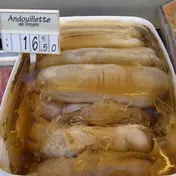
Andouillette de Troyes ★ 3.9
Andouillette de Troyes is the pork chitterling sausage of Troyes in southern Champagne, made from pork alone since 1864 and judged in blind tastings by the AAAAA association.
Where to try it: Brasserie du Boulingrin
The first written trace of the andouillette de Troyes dates from 1560, when royal troops tried to retake Troyes from the Catholic League. Early recipes used chopped veal; by 1855 it was made from calf's mesentery and udder in casings macerated in vinegar and cooked in stock and white wine, and since 1864 Troyes andouillettes have been made from pork only. At the end of the 1960s the Association amicale des amateurs d'andouillette authentique began awarding its AAAAA diploma after blind tastings.
Watch out for: Mustard, Sulphites
-
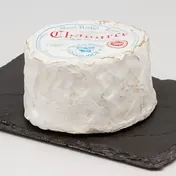
Chaource ★ 4.2
Chaource is the soft, bloomy-rind cheese made from whole cow's milk around the Aube village of Chaource, protected by an AOC since 1970 and best from July to November.
The cheese takes its name from the village of Chaource in the Aube, and the first written traces of cheesemaking there date from the 14th century; Marguerite of Burgundy is said to have demanded it at her table. In the Middle Ages its making was tied to the abbeys and commanderies, and in the 17th and 18th centuries local women kept the craft for family use. It has held an AOC since 1970 and a PDO since 1996, and it is best eaten from July to November.
Watch out for: Milk
-

Langres ★ 4.0
Langres is the washed-rind cow's milk cheese of the Langres plateau in the Grand Est, with a hollow top that connoisseurs fill with a splash of marc before serving.
The cheese comes from the Langres plateau and has held an AOC since 1991 and a PDO since 2009; its zone covers two arrondissements of the Haute-Marne, a canton of the Vosges and four villages of the Côte-d'Or. Shaped like a truncated cone with a hollow on top, it is related to munster and to époisses, its main regional rival, and milder. In 2016 three dairies, one of them a farm, made 605.5 tonnes, and it is at its best from May to August.
Watch out for: Milk
-
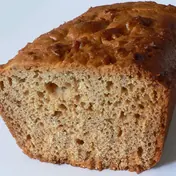
Pain d'épices de Reims ★ 4.2
Pain d'épices de Reims is a dense spiced loaf of rye flour and three kinds of honey, meadow, pale and buckwheat, and the Reims name is reserved for gingerbread made with rye.
Where to try it: Maison Fossier
Reims bakers began spicing honey bread around the 14th century and were given the name pâtissiers de pain d'épices; the city's is held to be the oldest recorded mention of the trade. The pain d'épices makers asserted their monopoly on 2 August 1571 and founded a guild that Henri IV recognised in 1596, and the Reims aldermen offered pain d'épices to Louis XV at his coronation in 1722. Before the Revolution the city had only twelve master makers, and the number halved under the First Empire.
Watch out for: Gluten
-
Moutarde de Reims ★ 3.8
Moutarde de Reims is the city's own mustard, made from brown mustard seed, Reims vinegar and champagne disgorgement wine with spices, straw yellow to dark in colour.
Where to try it: Croquignole
In the 19th century mustard was widely grown in Champagne, especially in the Haute-Marne, and the mustards of Reims and Châlons-en-Champagne rivalled Dijon's. The decline of mustard farming and of the vinegar works around 1900 brought down the Reims trade. Heir to recipes dating from 1797, the Charbonneaux-Brabant house is the only one still making and selling moutarde de Reims and Reims vinegar, under its Clovis brand, including versions with white wine, wholegrain seed and grape must.
Watch out for: Mustard, Sulphites
-
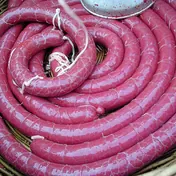
Boudin blanc de Rethel ★ 4.1
Boudin blanc de Rethel is the fine white pork sausage of the Ardennes town of Rethel, made with eggs, fresh milk and shallots and no breadcrumb, traditionally served at Christmas.
Local history credits Jacques-Augustin-Henri Chamarande, a royal officer hiding in Rethel after Richelieu banned duelling in 1626, with opening a charcuterie and making a white sausage of pork alone. The recipe settled in the 19th century, and the sausage was long served at the tables of the well-off; it was the only boudin blanc on Alain Bourguignon's interwar map of French specialities. It has held a PGI since 2001 and is traditionally served at Christmas, and Rethel holds a Foire au Boudin Blanc on the last Sunday of April.
Watch out for: Milk, Eggs
Signature Dishes in Reims, FAQ
What food is Reims known for?
Reims's signature dishes include Champagne, Biscuit rose de Reims, Jambon de Reims, Potée champenoise, Pied de porc à la Sainte-Menehould. See our signature dishes chapter for where to eat each.