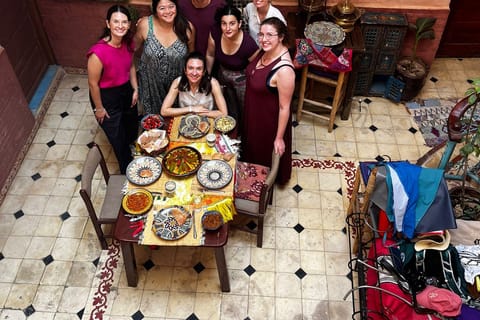

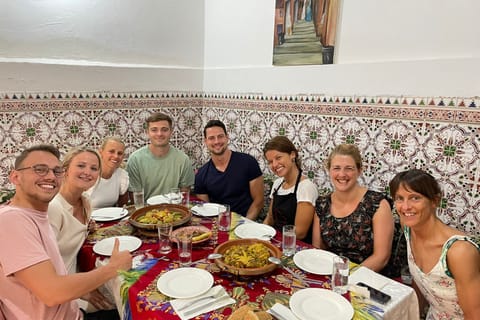
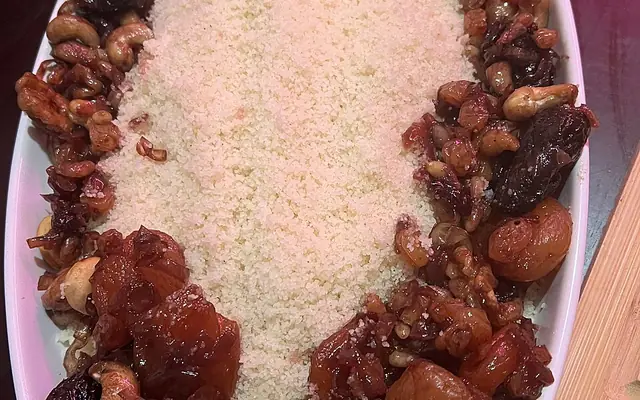
Moroccan cuisine is one of the most layered in North Africa, the product of Amazigh (Berber) indigenous cooking, Arab conquest in the 7th century, Andalusian and Sephardic Jewish migration after the 1492 Reconquista, French and Spanish colonial overlays, and Saharan trade routes that brought spices and ingredients from sub-Saharan Africa. The result is a kitchen that uses preserved lemon, olives, saffron, cumin, cinnamon, ginger, and the complex blend ras el hanout (which translates as 'head of the shop' and can include 20 to 30 spices) with confidence in dishes that mix sweet and savory more freely than almost any other cuisine on earth.
The defining technique is the tagine, both the conical clay pot and the slow-cooked stew that takes its name. A tagine is a one-pot braise of meat or fish with vegetables, fruit, and spices, cooked low and long until the meat falls off the bone and the sauce reduces around it. Lamb with prunes and almonds, chicken with preserved lemon and olives, fish with chermoula, beef with quince: each tagine is its own composition. Couscous, the steamed semolina grain, is the traditional Friday meal, served from a large communal platter with seven vegetables and a meat stew on top.
The other essential layer is street food and snack culture: msemen and beghrir at breakfast, harira soup at Ramadan iftar, b'stilla (the phyllo pigeon pie) at celebrations, briouats (fried savory pastries), and the mint tea that ends every meal and accompanies every transaction. A walk through the Jemaa el-Fnaa night market in Marrakech surfaces all of these in a single hour, alongside the snail vendors, the goat-head stalls, and the orange-juice carts. The cuisine is one of the most legible on the street and the most refined in the riad dining rooms; both registers belong to the same tradition.
Book a food experience
Tours, tastings and classes that match this page, bookable on GetYourGuide.


Top picks
The best-scored Moroccan place in each of 12 cities.
La Grande Table Marocaine ★ 4.8
La Grande Table Marocaine at the Royal Mansour is the only African restaurant in Les Grandes Tables du Monde, overseen by Helene Darroze in Marrakech.
SignatureRefined pastilla, Lamb tasting, Moroccan tasting menu
Book4 weeks ahead
TipLa Liste 2025 ranked it 6th globally with 97 points. Reserve weeks ahead.
Majorelle ★ 4.8
Majorelle is a Moroccan restaurant at Hold u. 23 in Budapest serving fresh, sustainable dishes, with a growing seafood selection and fresh fish.
TipThe menu is a living document, constantly updated to reflect the seasons, so the fish and seafood on offer can change.
Le Ksar ★ 4.3
Le Ksar on Rue Perchepinte near the Saint-Etienne cathedral is the Moroccan room widely credited with the best couscous in Toulouse, with mint tea closer.
SignatureCouscous royal, Tagine d'agneau aux pruneaux, Pastilla
TipThe couscous royal feeds two easily; the tagine d'agneau aux pruneaux is the second-best order. Book on a Friday.
Restaurante Arrayanes ★ 4.3
Restaurante Arrayanes in the Albayzin of Granada is the citys most serious Moroccan restaurant, with tagines, couscous and pastilla off Calderia Nueva.
OrderLamb tagine with prunes and almonds, then mint tea.
TipReservations recommended; no alcohol served, the mint tea closes every meal.
Rashel ★ 4.2
Rashel at Tel Aviv Port is a kosher Moroccan restaurant run by owner Shimon, plating festive dishes like pastilla and matbuha in a striking dining room.
OrderThe pastilla starter and a bowl of warm homemade matbuha to share.
TipKosher hours apply: closed Friday, reopening Saturday evening after Shabbat ends.
Porta Palazzo counters ★ 4.2
Porta Palazzo morning counters serve Turin's cheapest sit-down: Maghrebi sandwiches, cut fruit, coffee at the largest open-air food market in Europe.
TryMaghrebi sandwiches, panini, fresh produce
Le Riad ★ 4.1
Le Riad serves Moroccan pastilla, couscous and tagines in a zellige-tiled dining room on Rue de Tambour in Reims, with 5% off takeaway orders.
OrderThe royal couscous with lamb, chicken, merguez and kefta, or the squab pastilla.
TipClick and Collect takeaway is discounted by 5%; the kitchen serves seven days a week, lunch and dinner.
High Cafe ★ 4.0
High Cafe above the Bunch of Grapes on High Street is Galway's Moroccan destination; tagines, mezze platters and sweet mint tea make it the city's most.
OrderThe tagine of the day; the mezze platter works as a full meal for two with bread
TipCash is preferable; the kitchen can be slow on busy evenings so allow time.
Riad Yacout ★ 4.0
Riad Yacout on Via Cadore is a Moroccan riad with Mediterranean and Moroccan cuisine, open every day from 20:00 to 2:30, with DJs on the decks from midnight.
TipDinner comes with four live shows between 21:30 and 24:00, one every 60 minutes, and valet parking is offered for dinner.
La Tetería ★ 4.0
La Tetería is a Moorish tea room beside Málaga's Picasso Museum, pouring mint tea and infusions with vegan cakes and North African pastries.
DrinkMoroccan mint tea and North African pastries
Atlas ★ 4.0
A few steps off Place du Commerce, Atlas serves home-style Moroccan cooking, a spread of couscous and tagines plus charcoal grills, halal and vegetarian.
SignatureCouscous, Tagines, Charcoal grills
TipIt is one of the few kitchens in central Nantes open both services every day, including Sunday evening.
Cafe Atlas ★ 3.9
Cafe Atlas slow-cooks tagines and pours fresh mint tea at St Nicholas Market, bringing Marrakech lunch plates and baklava to Bristol's Glass Arcade.
TryTagine with couscous and mint tea
TipThe tagine-and-couscous plate with baklava after is one of the market's best-value hot lunches.
Find a place
La Grande Table Marocaine ★ 4.8
La Grande Table Marocaine at the Royal Mansour is the only African restaurant in Les Grandes Tables du Monde, overseen by Helene Darroze in Marrakech.
SignatureRefined pastilla, Lamb tasting, Moroccan tasting menu
Book4 weeks ahead
TipLa Liste 2025 ranked it 6th globally with 97 points. Reserve weeks ahead.
Majorelle ★ 4.8
Majorelle is a Moroccan restaurant at Hold u. 23 in Budapest serving fresh, sustainable dishes, with a growing seafood selection and fresh fish.
TipThe menu is a living document, constantly updated to reflect the seasons, so the fish and seafood on offer can change.
Al Fassia Gueliz ★ 4.7
Run entirely by women since 1987, Al Fassia in Marrakech's Gueliz cooks the refined Fassi (Fez) repertoire under chef Saida Chab, daily lunch and dinner.
OrderThe slow-cooked lamb tagine with caramelised quince, served with khobz bread.
TipOrder tagines a la carte rather than the set menu; the kitchen's strength is single-dish patience, not coursing.
Chez Lamine Hadj Mustapha ★ 4.7
Chez Lamine Hadj Mustapha at Marrakech's Mechoui Alley off Jemaa el-Fna has roasted 40 lambs daily in a pit oven since 1965; tangia is the other signature.
TryMechoui (slow-pit lamb) and tangia
TipMechoui sold by weight; 500g feeds two with khobz. Arrive before 14:00 or the good cuts are gone. Cash only.
Le Ksar ★ 4.3
Le Ksar on Rue Perchepinte near the Saint-Etienne cathedral is the Moroccan room widely credited with the best couscous in Toulouse, with mint tea closer.
SignatureCouscous royal, Tagine d'agneau aux pruneaux, Pastilla
TipThe couscous royal feeds two easily; the tagine d'agneau aux pruneaux is the second-best order. Book on a Friday.
Restaurante Arrayanes ★ 4.3
Restaurante Arrayanes in the Albayzin of Granada is the citys most serious Moroccan restaurant, with tagines, couscous and pastilla off Calderia Nueva.
OrderLamb tagine with prunes and almonds, then mint tea.
TipReservations recommended; no alcohol served, the mint tea closes every meal.
Rashel ★ 4.2
Rashel at Tel Aviv Port is a kosher Moroccan restaurant run by owner Shimon, plating festive dishes like pastilla and matbuha in a striking dining room.
OrderThe pastilla starter and a bowl of warm homemade matbuha to share.
TipKosher hours apply: closed Friday, reopening Saturday evening after Shabbat ends.
Porta Palazzo counters ★ 4.2
Porta Palazzo morning counters serve Turin's cheapest sit-down: Maghrebi sandwiches, cut fruit, coffee at the largest open-air food market in Europe.
TryMaghrebi sandwiches, panini, fresh produce
Le Grenier de Bedouin ★ 4.1
Le Grenier de Bedouin on Avenue de Muret in Saint-Cyprien is the no-fuss Moroccan canteen with couscous at €11, tagines at €13 and a tile-counter takeaway.
SignatureCouscous merguez, Tagine kefta, Pastilla
TipCheap eats canteen for the Empalot students; cash and card both. Sit in for the mint tea pour at the counter.
Le Riad ★ 4.1
Le Riad serves Moroccan pastilla, couscous and tagines in a zellige-tiled dining room on Rue de Tambour in Reims, with 5% off takeaway orders.
OrderThe royal couscous with lamb, chicken, merguez and kefta, or the squab pastilla.
TipClick and Collect takeaway is discounted by 5%; the kitchen serves seven days a week, lunch and dinner.
La Pente Douce ★ 4.0
La Pente Douce on the quiet Rue de la Concorde in Saint-Cyprien is the well-known Moroccan room with a surprise evening menu and strong takeaway couscous.
SignatureCouscous, Harira soup, Surprise evening menu
TipThe surprise evening menu is the best route in; arrive by 19:30 for first sitting. Lunch is a la carte.
High Cafe ★ 4.0
High Cafe above the Bunch of Grapes on High Street is Galway's Moroccan destination; tagines, mezze platters and sweet mint tea make it the city's most.
OrderThe tagine of the day; the mezze platter works as a full meal for two with bread
TipCash is preferable; the kitchen can be slow on busy evenings so allow time.
Ewa Safi ★ 4.0
Ewa Safi hides on Neve Tzedek's edge in Tel Aviv, a Moroccan riad room of tagines, couscous and slow stews built for a long, home style dinner.
OrderA tagine of the day with couscous, shared family style around the table.
TipKosher hours apply: open Sunday to Thursday evenings only, closed Friday and Saturday.
Riad Yacout ★ 4.0
Riad Yacout on Via Cadore is a Moroccan riad with Mediterranean and Moroccan cuisine, open every day from 20:00 to 2:30, with DJs on the decks from midnight.
TipDinner comes with four live shows between 21:30 and 24:00, one every 60 minutes, and valet parking is offered for dinner.
La Tetería ★ 4.0
La Tetería is a Moorish tea room beside Málaga's Picasso Museum, pouring mint tea and infusions with vegan cakes and North African pastries.
DrinkMoroccan mint tea and North African pastries
Atlas ★ 4.0
A few steps off Place du Commerce, Atlas serves home-style Moroccan cooking, a spread of couscous and tagines plus charcoal grills, halal and vegetarian.
SignatureCouscous, Tagines, Charcoal grills
TipIt is one of the few kitchens in central Nantes open both services every day, including Sunday evening.
Cafe Atlas ★ 3.9
Cafe Atlas slow-cooks tagines and pours fresh mint tea at St Nicholas Market, bringing Marrakech lunch plates and baklava to Bristol's Glass Arcade.
TryTagine with couscous and mint tea
TipThe tagine-and-couscous plate with baklava after is one of the market's best-value hot lunches.
Moro Napa ★ 3.9
Moro brings North African street food to Oxbow Market with tagine-spiced meats, couscous bowls and halal-friendly proteins that stand out on the Napa strip.
OrderTagine bowl with merguez sausage.
TipThe tagine bowl with merguez sausage is the best single dish in the Oxbow Market at lunch.
Halal Aladino ★ 3.4
Halal Aladino is a Moroccan bar and restaurant on Carrer de Valls in Salou serving halal food from breakfast to late evening, with a terrace and takeaway.
OrderA Moroccan plate from the halal kitchen.
TipAladino opens at 09:30, so it doubles as a breakfast stop; it is closed on Mondays and takes cards as well as cash.
Moroccan by city
 Marrakech28 places
La Grande Table Marocaine, Al Fassia Gueliz
Marrakech28 places
La Grande Table Marocaine, Al Fassia Gueliz
 Toulouse3 places
Le Ksar, Le Grenier de Bedouin
Toulouse3 places
Le Ksar, Le Grenier de Bedouin
 Bristol2 places
Cafe Atlas
Bristol2 places
Cafe Atlas
 Galway2 places
High Cafe
Galway2 places
High Cafe
 Napa2 places
Moro Napa
Napa2 places
Moro Napa
 Reims2 places
Le Riad
Reims2 places
Le Riad
 Tel Aviv2 places
Rashel, Ewa Safi
Tel Aviv2 places
Rashel, Ewa Safi
 Budapest1 place
Majorelle
Budapest1 place
Majorelle
 Granada1 place
Restaurante Arrayanes
Granada1 place
Restaurante Arrayanes
 Milan1 place
Riad Yacout
Milan1 place
Riad Yacout
 Málaga1 place
La Tetería
Málaga1 place
La Tetería
 Nantes1 place
Atlas
Nantes1 place
Atlas
 Salou1 place
Halal Aladino
Salou1 place
Halal Aladino
 Turin1 place
Porta Palazzo counters
Turin1 place
Porta Palazzo counters
Regional variations
Marrakech and the south
The most internationally visible Moroccan kitchen. Lamb tagines with prunes and almonds, mechoui (whole roast lamb), tanjia marrakchia (the Marrakech slow-cooked meat in a clay urn buried in hammam ashes). Bigger flavors, more sub-Saharan influence.
Fez and the imperial cities
The deepest formal tradition, with court-influenced cooking. B'stilla, the layered phyllo pigeon pie with almonds and cinnamon, is a Fez specialty. Refined tagines with subtle balance and a heavier hand with ras el hanout.
Coastal (Casablanca, Essaouira, Tangier)
Seafood-led tagines, chermoula-marinated grilled fish, sardine cooking, and the lingering French and Spanish colonial influence in patisserie and bistro food.
Atlas Mountains (Berber/Amazigh)
Tagines cooked over open flame on hearth stones, barley couscous, fresh cheese, honey, and the simpler herb-and-vegetable cooking of the highland villages.
North (Tetouan, Chefchaouen)
The most Andalusian-influenced kitchen, with strong Spanish and Sephardic-Jewish layers. Lighter cooking, more vegetables, and the strongest pastry tradition in the country.
Defining Moroccan dishes
- Tagine
- The slow-cooked stew named for its conical clay pot. Canonical versions include lamb with prunes and almonds, chicken with preserved lemon and olives, kefta (meatball) with egg poached on top, and fish with chermoula.
- Couscous
- Hand-rolled steamed semolina, served on a communal platter with seven vegetables (turnip, carrot, zucchini, cabbage, pumpkin, chickpea, onion) and lamb or chicken. The traditional Friday family meal.
- Harira
- Tomato-lentil-chickpea soup with lamb, fresh herbs, and tomato paste, thickened with flour or beaten egg. The Ramadan iftar opener.
- B'stilla
- Layered phyllo pie traditionally filled with pigeon (now often chicken), almonds, eggs, and cinnamon-sugar, with cinnamon-sugar dusted on top. Sweet, savory, salty, the Fez celebration dish.
- Mechoui
- Whole lamb or sheep roasted in a pit oven or on a spit, served with cumin and salt. Marrakech street food and celebration food.
- Tanjia marrakchia
- Marrakech-only specialty: beef or lamb with preserved lemon, cumin, and saffron in a clay urn buried in the hot ashes of the hammam for hours. Bachelor cooking, traditionally.
- Chermoula
- The herb marinade and sauce: cilantro, parsley, garlic, cumin, paprika, lemon, olive oil. Used for fish and seafood preparations.
- Msemen
- Square laminated flatbread, pan-fried until crisp and flaky, eaten at breakfast with honey, jam, or amlou (almond-argan-honey spread).
- Beghrir
- Thousand-hole semolina pancakes, like a thicker Russian blini, served with butter and honey at breakfast.
- Briouats
- Fried phyllo or warqa pastries filled with meat, fish, or sweet almond paste. Triangular or cigar-shaped.
- Zaalouk
- Smoky eggplant and tomato salad with garlic, cumin, paprika, and olive oil. Served warm or at room temperature as part of the cold-salad spread.
- Mint tea
- Green tea brewed with fresh spearmint and a heavy hand of sugar, poured from height into small glasses to create a foam. Drunk throughout the day.
How to order
A traditional Moroccan meal opens with a spread of cold salads (zaalouk, taktouka, carrot and orange, beet) eaten with bread, followed by a tagine or couscous as the main, then mint tea and pastries. At restaurants the salad spread (kemia) may come unbid; at home it is the standard opener. Tagines are made for sharing; a single tagine with bread feeds two to three people. Couscous is traditionally Friday lunch and may not be available other days at home-style places.
The rookie mistakes: cutting the tagine ingredients before serving (it is presented intact, with the bread used to scoop), refusing the mint tea because of the sugar (the sugar is essential to the tea), expecting a knife and fork at casual places (bread is the utensil), ordering a French wine list at a Moroccan restaurant when the local Meknès or Atlas Mountain wines are increasingly worth trying, and rushing the meal (a Moroccan lunch can run three hours, and the conversation between courses is part of the dish). At a serious riad dinner, the host's family may join the table for tea; this is hospitality, not informality, and the right response is to accept and stay.
What to drink with it
Mint tea is the universal pairing, before, during, and after the meal. Moroccan wine has improved markedly: producers like Domaine Ouled Thaleb and Volubilia from Meknès make serious reds (Syrah, Cabernet, and Carignan blends) that pair well with lamb tagines. Almond milk and orange blossom drinks are the non-alcoholic options at celebrations. With harira during Ramadan, dates and honey-sweetened pastries (chebakia) are the traditional accompaniments. The strongest pairing for any tagine, though, is fresh khobz bread for scooping.
Where to eat it
Marrakech and Fez are the great food cities, with the deepest traditional cooking in family-run riads, the Jemaa el-Fnaa night market (Marrakech), and the medina food stalls. Casablanca for modern and French-influenced; Essaouira for seafood; Tangier for the Spanish-Moroccan hybrid. Outside Morocco, Paris has the largest Moroccan diaspora kitchen, with serious cooking from Belleville to the Marais. London, Brussels, and Madrid all hold strong Moroccan scenes anchored by diaspora communities.
A short history
Moroccan cuisine descends from Berber agricultural cooking, layered with Arab conquest (7th century), Andalusian and Sephardic Jewish migration after the 1492 Reconquista, Saharan trade-route spices, and French and Spanish colonial overlays in the 19th and 20th centuries. The royal kitchens of Fez and Marrakech codified the modern dish vocabulary, and the Moroccan diaspora in France carried the cuisine into European mainstream awareness from the 1960s onward.
Frequently asked
Is a tagine the pot or the dish?
Both. The tagine is the conical clay pot, and the dish cooked in it takes the same name. Authentic clay tagines diffuse heat slowly and trap steam in the cone, returning condensation to the meat. Cast-iron or enameled versions are easier but less traditional.
Is Moroccan food spicy?
Spiced, not spicy. Moroccan cooking uses a deep spice cabinet (cumin, cinnamon, ginger, saffron, paprika, ras el hanout) but rarely relies on chile heat. Harissa, the chile paste, is more associated with Tunisia and Algeria than Morocco.
What is ras el hanout?
A complex Moroccan spice blend whose name means 'head of the shop,' indicating the merchant's best blend. Recipes vary wildly and can include 20 to 30 spices: cardamom, cumin, clove, cinnamon, coriander, paprika, mace, nutmeg, peppercorns, turmeric, rose petals, and others. Each family or spice merchant has their own.
More cities are in research. Want Moroccan covered somewhere specific? Tell us where you want to eat.