
The plates that define Savannah: what they are, where they came from, and where to eat the canonical version.
Signature dishes
-
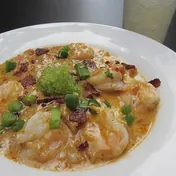
Shrimp and grits ★ 4.9
Shrimp over grits, a Lowcountry plate once eaten at breakfast and now a dinner staple. B. Matthew's Eatery serves shrimp with tasso ham and cherry tomatoes over stone-ground grits.
Where to try it: Husk Savannah, Vic's on the River, B. Matthew's Eatery, The Olde Pink House
Price: $17-39
Shrimp and grits is a dish of the Lowcountry of coastal Georgia and South Carolina, where it was often eaten for breakfast during shrimp season. Food writer Rachel Wharton credits the Gullah Geechee people with its development and describes early versions as fried, flour-coated shrimp served with a roux and grains. Modern restaurant versions add cream and shallots, and more elaborate ones use a sauce made from reduced shrimp-shell stock.
Watch out for: Shellfish, Dairy
-
Lowcountry boil (Frogmore stew) ★ 4.8
A one-pot boil of shrimp, sausage, corn on the cob and red potatoes, sometimes with ham, crabs or crawfish. It is also called Frogmore stew.
Frogmore is a community in the middle of St. Helena Island, near Beaufort, South Carolina. Richard Gay, an owner of the Gay Fish Company on St. Helena Island, is credited with coining the name Frogmore Stew in the 1960s. The dish is part of Lowcountry cuisine. On Tybee Island, Visit Savannah names a Low Country Boil among the dishes at The Crab Shack.
Watch out for: Shellfish
-
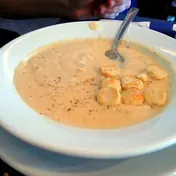
She-crab soup ★ 4.7
A creamy crab soup made with the orange roe of female crabs and finished with a little dry sherry as it is plated. The Olde Pink House and Vic's on the River both list it.
Where to try it: The Olde Pink House, Vic's on the River
Price: $14
She-crab soup is a regional specialty of the South Carolina Lowcountry, named for the female crabs whose orange roe is a chief ingredient in the traditional recipe. It is commonly on the menus of many restaurants in Charleston and Savannah. A small amount of dry sherry is added as the soup is plated.
Watch out for: Shellfish, Dairy, Gluten
Book food experiences in Savannah


-
Pecan praline ★ 4.6
A confection of pecans, sugar, butter and cream. Savannah's Candy Kitchen on River Street pours its pralines from a copper kettle and sells original, chocolate and assorted pralines.
Where to try it: Savannah's Candy Kitchen
Praline may have been inspired in France by the cook of Marshal du Plessis-Praslin (1602 to 1675), and early pralines were whole almonds coated in caramelized sugar. French settlers brought the recipe to Louisiana, where sugar cane and pecan trees were plentiful; in 19th-century New Orleans cooks substituted pecans for almonds and added cream, creating the version known across the American South. Savannah's Candy Kitchen has been on River Street since 1990.
Watch out for: Tree nuts, Dairy
-
Benne wafers ★ 4.5
Thin sesame seed cookies that trace back to Africa. They are a traditional Lowcountry food, most closely linked to South Carolina and Charleston.
The word benne comes from one of the languages of West Africa and means sesame. Benne seeds reached the United States on ships carrying enslaved Africans, who grew the plants in small gardens on Lowcountry plantations; plantation owners also grew benne for oil, as a cheaper substitute for imported olive oil. At Husk Savannah, benne appears as crackers served with pimento cheese and chicken liver pate.
Watch out for: Sesame, Gluten, Eggs, Dairy
-
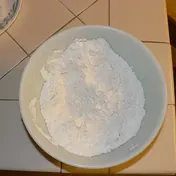
Georgia peach cobbler ★ 4.5
A baked fruit dessert of peaches under a biscuit or batter topping, often served with a scoop of vanilla ice cream. Sisters of the New South and Wiley's Championship BBQ both list peach cobbler.
Where to try it: Sisters of the New South, Wiley's Championship BBQ, Crystal Beer Parlor
English settlers in America could not make traditional suet puddings, so they topped stewed fruit with pastry or batter in Dutch ovens. The earliest possibly recorded cobbler recipe is from 1839, in The Kentucky Housewife. Georgia peach season runs from mid-May through August, according to Lane Southern Orchards.
Watch out for: Gluten, Dairy, Eggs
-
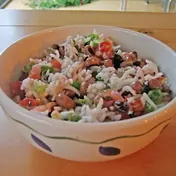
Hoppin' John ★ 4.4
Black-eyed peas and rice cooked with onion and pork such as ham hock, bacon or sausage, a Lowcountry one-pot dish eaten on New Year's Day for luck.
Hoppin' John originated with the Gullah people and was originally a Lowcountry one-pot dish; it may have evolved from rice and bean dishes eaten by enslaved West Africans. Eating it on New Year's Day is thought to bring a prosperous year filled with luck. The origin of the name is uncertain. At The Grey, the side called Rice & Peas is made with sea island red peas and Carolina Gold rice.
-
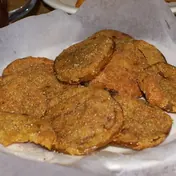
Fried green tomatoes ★ 4.4
Sliced green tomatoes coated in breadcrumbs, flour or cornmeal and fried until golden. The Olde Pink House serves them with applewood smoked bacon and sweet corn cream; Vic's with goat cheese and smoked cheddar grits.
Where to try it: B. Matthew's Eatery, The Olde Pink House, Vic's on the River, The Wyld Dock Bar
Price: $12-14
Historian Robert F. Moss found that newspaper recipes from 1900 to 1911 came from the Northeast and Midwest, and he believes the dish originated there, perhaps with Jewish immigrants. Americans came to know it as a food of the South after the 1991 film Fried Green Tomatoes, although there is little evidence it was widely prepared in the South earlier.
Watch out for: Gluten, Dairy, Eggs
-
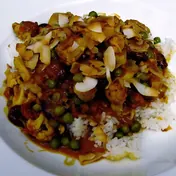
Country Captain ★ 4.4
A mild stew of browned chicken pieces, onions and curry powder, usually with almonds and golden raisins or currants, first printed in a Philadelphia cookbook in 1857.
Country captain first appeared in print in Miss Leslie's New Cookery Book, published in Philadelphia in 1857. One theory holds that an early 19th-century British sea captain brought it to the American South by way of the port of Savannah; the captain may have been linked to the East India Company and the spice trade. Franklin Roosevelt encountered the dish while visiting the Little White House in Warm Springs, Georgia.
Watch out for: Gluten, Nuts (almonds)
-
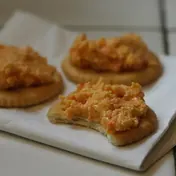
Pimento Cheese ★ 4.4
A spread of cheese, mayonnaise and pimentos. Husk Savannah serves it with hot honey, pickles, benne cracker and pork rinds, and Vic's on the River puts it on a fried chicken sandwich.
Where to try it: Husk Savannah, Crystal Beer Parlor, Vic's on the River
Price: $14-15
Pimento cheese began in the northern United States in the early 20th century as a homemade snack spread; the earliest recipe cited is a 1908 Good Housekeeping recipe using soft cream cheese and chopped pimentos. Southern farmers began growing pimentos as a cheaper option, and Southern cooks swapped in hoop cheese and mayonnaise. Sandwiches of it have been served as a concession at the Masters Tournament since the 1940s.
Watch out for: Dairy, Egg, Gluten (if served on bread)
-
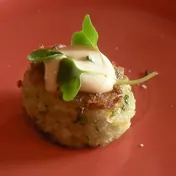
Crab cake ★ 4.6
Crab cakes of lump and claw meat. The Olde Pink House pairs one with fried green tomatoes and remoulade, Vic's on the River serves a jumbo lump cake, and B. Matthew's a lump and claw cake with spicy remoulade.
Where to try it: The Olde Pink House, Vic's on the River, B. Matthew's Eatery
Price: $20-36
Crab cakes are a fixture of Savannah restaurant menus. The Olde Pink House lists a pan-seared jumbo lump crab cake with fried green tomatoes and remoulade sauce among its appetizers, and Vic's on the River lists a jumbo lump crab cake as an appetizer and as an entree. B. Matthew's Eatery serves lump and claw meat crab cakes with green tomato chow chow.
Watch out for: Shellfish, Gluten, Egg, Dairy
-

Sweet Tea ★ 4.2
Tea sweetened with sugar or syrup while brewing or hot and almost always served ice cold, a regional staple of Southern cuisine. Sisters of the New South lists sweet tea on its site.
Where to try it: Sisters of the New South
The oldest known recipe for sweet tea was published in the community cookbook Housekeeping in Old Virginia, by Marion Cabell Tyree, copyrighted in 1878; that recipe called for green tea. Sweet tea is commonly consumed in the United States, especially in the South, and is typically sweetened with sugar or syrup while the tea is brewing or hot.
Signature Dishes in Savannah, FAQ
What food is Savannah known for?
Savannah's signature dishes include Shrimp and grits, Lowcountry boil (Frogmore stew), She-crab soup, Pecan praline, Benne wafers. See our signature dishes chapter for where to eat each.