Signature dishes
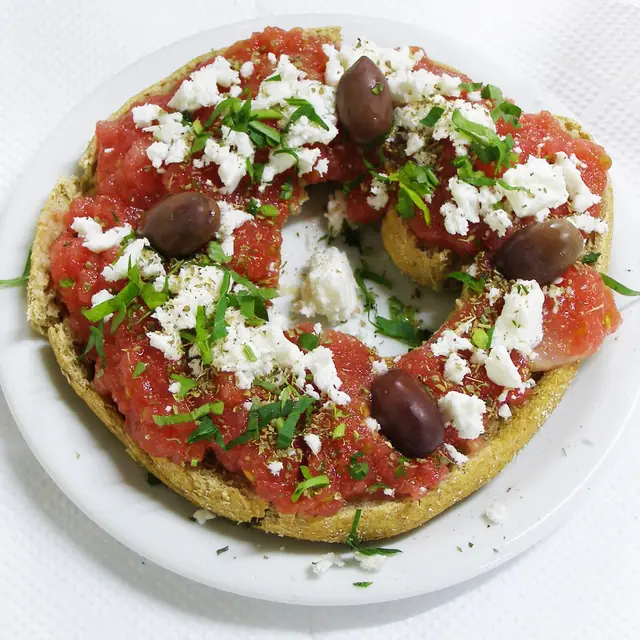
A barley rusk soaked just enough by grated tomato, then buried under crumbled myzithra, oregano, capers and a heavy pour of Cretan olive oil. It is the plate that tells you whether a kitchen respects its ingredients.
Where: Merastri, Parasties
Price: €6-9
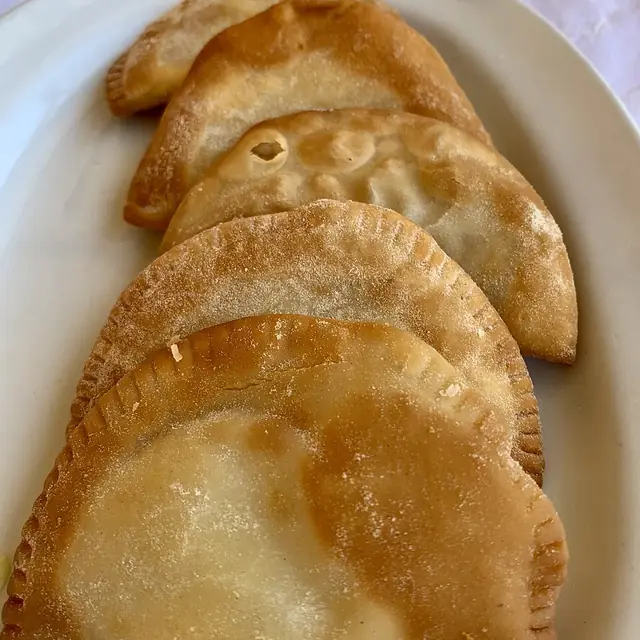
Small Cretan pies, folded open or closed, filled with fresh myzithra or with wild greens fried in olive oil. The sweet cheese ones get honey and cinnamon, the savoury ones get nothing but their own oil.
Where: Savoidakis
Price: €2-4 each
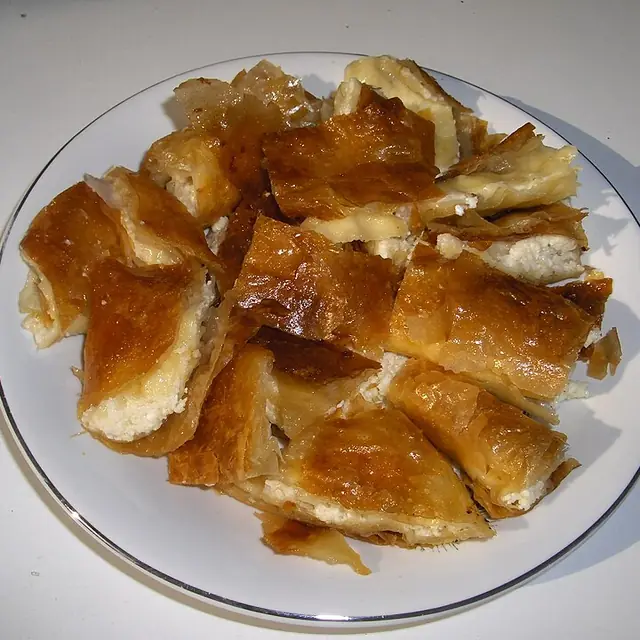
Hand-opened phyllo baked around either semolina custard or sweet myzithra, cut into squares with a scraper, then dusted with icing sugar and cinnamon. In Heraklion it is breakfast, and it is eaten standing up.
Where: Kirkor, Phyllosophies
Price: €3-5
Wedding rice, cooked in the broth left from boiling goat and lamb, then finished with staka butter and lemon until it turns glossy and heavy. It is served at Cretan weddings and christenings, rarely on a normal menu.
Price: €10-16
Pork loin marinated in vinegar, then cold-smoked over aromatic wood and herbs until it turns dark and dense. Cretan kitchens shave it thin over rocket and graviera, or fry it into eggs at breakfast.
Where: Merastri
Price: €8-12
Snails dropped shell-side down into hot olive oil so they seal and steam inside, then doused with vinegar or wine and rosemary. The name means face down, which is exactly how they hit the pan.
Where: Parasties
Price: €8-12
Lamb cooked slowly over or in wood fire until the fat renders and the meat gives way completely. In Heraklion it comes out of a domed wood oven after two and a half to three hours, seasoned with almost nothing.
Where: Merastri, Arismari & Varsamo
Price: €14-22
A thin pan-fried pie, dough rolled around fresh myzithra and flattened out again, cooked dry on a hot surface and served with thyme honey. It should be soft, not crisp, and eaten within minutes of leaving the pan.
Where: Erganos
Price: €3-6
The cream skimmed off goat and sheep milk, cooked slowly with a little flour until it splits into a thick white paste and a clear golden butter. Both halves get used, and both are richer than anything else on the table.
Where: Merastri
Price: €6-10
Ribbons of thin dough wrapped around sour myzithra and coiled like a turban, fried in olive oil and finished with honey and walnuts. The name comes from the sariki, the fringed headscarf Cretan men wear.
Where: Merastri
Price: €4-7
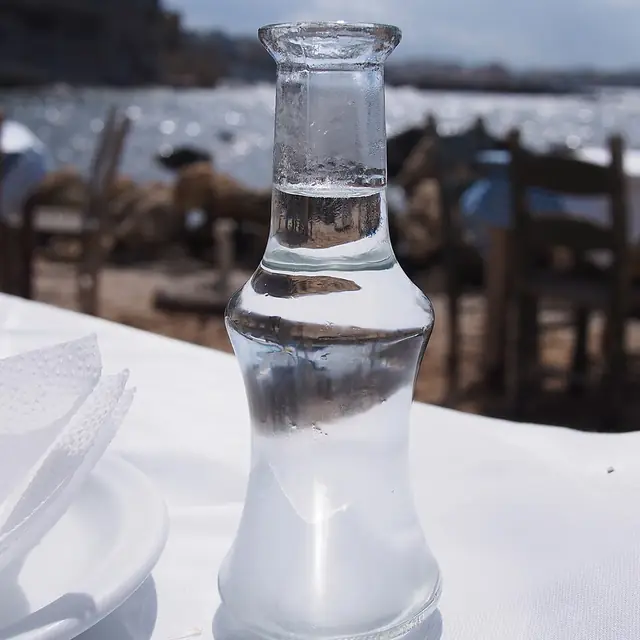
Clear spirit distilled from grape pomace left after the wine press, usually around forty percent, drunk cold and neat. In Crete it arrives free at the end of a meal, with a plate of fruit or a spoon sweet.
Where: Peskesi
Price: €2-4 a shot
Dakos
A barley rusk soaked just enough by grated tomato, then buried under crumbled myzithra, oregano, capers and a heavy pour of Cretan olive oil. It is the plate that tells you whether a kitchen respects its ingredients.
History: Dakos began as shepherd food. Barley rusk, twice-baked so it kept for months, travelled up to the summer pastures with cheese and oil, and softened with whatever tomato or water was to hand. The name comes from the rusk itself, a paximadi cut from a barley loaf. Cretan households ate it as a working lunch long before it appeared on restaurant menus, and it only became a taverna standard in the second half of the twentieth century, once tomatoes were cheap and plentiful across the Messara plain. Purists in Heraklion still argue about whether the rusk should be dipped in water first, and about whether feta is ever an acceptable substitute for fresh myzithra.
Where to try it: Merastri, Parasties
Watch out for: Gluten, Dairy
Kalitsounia
Small Cretan pies, folded open or closed, filled with fresh myzithra or with wild greens fried in olive oil. The sweet cheese ones get honey and cinnamon, the savoury ones get nothing but their own oil.
History: Kalitsounia are the everyday pie of Crete, and the shape changes as you cross the island. Around Heraklion they are usually small and open-topped, the pastry pinched into a star and the myzithra left exposed so it browns in the oven. In the west they are more often closed and fried. The pies belong to the calendar as much as to the kitchen: sweet cheese versions appear at Easter, greens versions through Lent and winter, when horta are at their best. Bakeries across Heraklion sell them all year now, and the Agora on 1866 Street is where most households still buy the myzithra to make them at home.
Where to try it: Savoidakis
Watch out for: Gluten, Dairy
Bougatsa
Hand-opened phyllo baked around either semolina custard or sweet myzithra, cut into squares with a scraper, then dusted with icing sugar and cinnamon. In Heraklion it is breakfast, and it is eaten standing up.
History: Bougatsa came to Crete with refugees from Asia Minor after 1922. Phyllosophies traces its own line to a bougatsa master from Hamidiye, a district of Smyrna, and dates its trade on Lions Square to 1922. Kirkor has worked the same square for close to a century. The Thessaloniki version of the pie sticks to semolina cream. Heraklion made a local variant by swapping in sweetened myzithra, the fresh whey cheese that Cretan dairies produce in quantity, which gives a tangier, less sugary pie. The ritual has not changed in a century: order at the counter, watch the pie cut into squares on the board, take it outside while it is still too hot to hold.
Where to try it: Kirkor, Phyllosophies
Watch out for: Gluten, Dairy
Gamopilafo
Wedding rice, cooked in the broth left from boiling goat and lamb, then finished with staka butter and lemon until it turns glossy and heavy. It is served at Cretan weddings and christenings, rarely on a normal menu.
History: Gamopilafo takes its name from gamos, the Greek word for wedding. At a traditional Cretan wedding the animals are boiled for the crowd, and the broth left behind is far too good to throw away, so the rice goes in and absorbs it. The finish is what makes it Cretan: staka butter, skimmed from goat and sheep milk and cooked with a little flour, is stirred through at the end with lemon juice. The result is closer to a wet risotto than a pilaf. Heraklion families still cook it for christenings and name days, and mountain villages in the Psiloritis foothills argue about whether the lemon belongs at all.
Watch out for: Dairy
Apaki
Pork loin marinated in vinegar, then cold-smoked over aromatic wood and herbs until it turns dark and dense. Cretan kitchens shave it thin over rocket and graviera, or fry it into eggs at breakfast.
History: Apaki is Crete's answer to the problem of keeping pork through a hot summer. The loin is steeped in vinegar with wild herbs for a day or more, then hung over a smouldering fire of sage, cypress, thyme and other mountain wood, which both dries it and perfumes it. Villages guarded their own herb mixes. It predates refrigeration by centuries and survived it because the smoke does something no fridge can. In Heraklion tavernas it now arrives sliced thin with pomegranate seeds and graviera shavings, which is a modern presentation of a very old preserve.
Where to try it: Merastri
Chochlioi boubouristi
Snails dropped shell-side down into hot olive oil so they seal and steam inside, then doused with vinegar or wine and rosemary. The name means face down, which is exactly how they hit the pan.
History: Cretans have eaten snails since Minoan times, and excavations across the island have turned up shell middens beside kitchen debris. They are gathered after autumn and spring rains, purged for several days, and cooked in ways that vary by household. Boubouristi is the most theatrical: the pan is hot, the snails go in face down, and the oil seals each shell so the flesh cooks in its own juices. The splash of vinegar at the end lifts the whole thing. Heraklion tavernas serve them as a meze with bread for the pan juices, and eating them properly requires either a pin or a great deal of confidence.
Where to try it: Parasties
Watch out for: Molluscs
Arni ofto
Lamb cooked slowly over or in wood fire until the fat renders and the meat gives way completely. In Heraklion it comes out of a domed wood oven after two and a half to three hours, seasoned with almost nothing.
History: Ofto means roasted, and the technique is the oldest cooking method on the island: meat set upright around an open fire, salted, and left to cook in its own falling fat. The mountain version, antikristo, stands lamb on stakes facing the flame. Town kitchens in Heraklion adapted it to the wood oven, which does the same job with less smoke and more control. What has not changed is the restraint. Salt, sometimes a little thyme, and time. Merastri holds milk-fed lamb in its oven for two and a half to three hours, which is the standard local benchmark.
Where to try it: Merastri, Arismari & Varsamo
Sfakianopita
A thin pan-fried pie, dough rolled around fresh myzithra and flattened out again, cooked dry on a hot surface and served with thyme honey. It should be soft, not crisp, and eaten within minutes of leaving the pan.
History: The pie takes its name from Sfakia, the mountain region of southwest Crete, but it travelled across the island and now appears on taverna menus everywhere, Heraklion included. The dough is made with raki or wine and no fat, wrapped around a ball of fresh myzithra, then rolled flat again so the cheese spreads to the edges. It cooks on a dry pan in a couple of minutes a side. The honey goes on at the table, never in the kitchen, and thyme honey from the Cretan mountains is the traditional choice. Erganos in Heraklion serves them small, several to a plate, as a starter rather than a dessert.
Where to try it: Erganos
Watch out for: Gluten, Dairy
Staka
The cream skimmed off goat and sheep milk, cooked slowly with a little flour until it splits into a thick white paste and a clear golden butter. Both halves get used, and both are richer than anything else on the table.
History: Staka is dairy economics turned into a delicacy. Cretan shepherds skimmed the cream off milk left to stand, then cooked it down with flour over a low fire. The paste that forms is staka; the butter that separates out is stakovoutyro, and it goes into gamopilafo, into pastries, and over potatoes. Nothing is wasted. It is a mountain product, made where flocks are, and it travels badly, which is why it stays a Cretan speciality rather than a Greek one. Heraklion kitchens use it as a finishing fat: stirred into wedding rice, spooned over grilled pork fillet, or served plain with bread and a glass of raki.
Where to try it: Merastri
Watch out for: Dairy
Sarikopites
Ribbons of thin dough wrapped around sour myzithra and coiled like a turban, fried in olive oil and finished with honey and walnuts. The name comes from the sariki, the fringed headscarf Cretan men wear.
History: Sarikopites belong to the same family as kalitsounia but are shaped differently: the filled dough is rolled into a long rope, then coiled flat so the finished pie looks like a wound headscarf. That headscarf, the sariki, is still worn in Cretan villages and gave the pie its name. Sour myzithra is the traditional filling, sharper than the fresh cheese used in sweet kalitsounia, which is why the honey at the end is not optional. They are fried rather than baked, which makes them a treat rather than an everyday pie, and they turn up on Heraklion dessert menus more often than at breakfast.
Where to try it: Merastri
Watch out for: Gluten, Dairy
Tsikoudia (raki)
Clear spirit distilled from grape pomace left after the wine press, usually around forty percent, drunk cold and neat. In Crete it arrives free at the end of a meal, with a plate of fruit or a spoon sweet.
History: Tsikoudia is what Cretans call the pomace spirit the rest of Greece knows as tsipouro. It is distilled in autumn, when the rakokazana, the village stills, fire up between October and December and turn the pressed grape skins into spirit. The distilling becomes a party in its own right, with roast meat, chestnuts and lyra music around the copper still. Unlike ouzo it takes no anise, which is why it tastes of grape rather than liquorice. Refusing the free glass at the end of a Heraklion meal is possible but nobody will understand why you are doing it.
Where to try it: Peskesi