

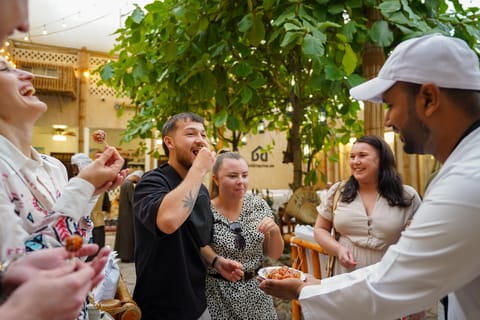
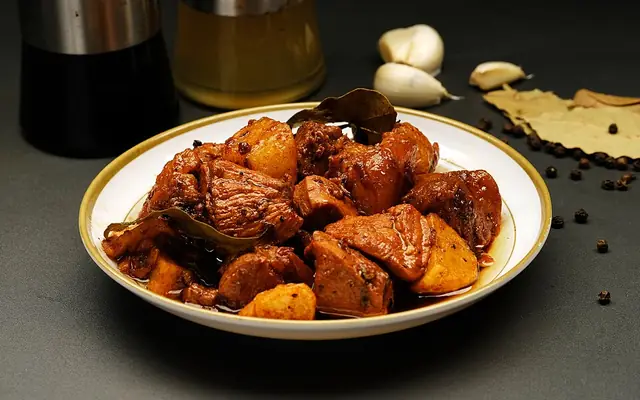
Filipino cuisine is the cooking of a 7,641-island archipelago shaped by indigenous Austronesian tradition, 333 years of Spanish colonization, two centuries of Chinese trade, three years of Japanese occupation, and 48 years of American rule. The result is a kitchen that runs sour-salty-savory as its primary grammar (Filipinos do not chase spicy heat the way Thai or Indonesian cooks do), with vinegar (sukang) as the universal seasoning, fish sauce (patis) and shrimp paste (bagoong) as the salty depth, and a meat-forward (especially pork-forward) main course tradition. The flavor language sits closer to Spanish cooking than to most of Asia, while the technique base remains Austronesian: low slow simmers, banana-leaf wrapping, whole-animal use, rice-as-staple, and a long catalogue of vinegar-cured (kinilaw), grilled (inihaw), and broth-based (sinigang, tinola, nilaga) preparations.
The defining dishes are adobo (the national dish, meat braised in vinegar, soy, garlic, peppercorn, bay leaf; every Filipino family has its own version), sinigang (the sour tamarind-or-calamansi-based soup with pork, fish, or shrimp; the dish UNESCO recognized in 2023 as Intangible Cultural Heritage), lechon (the whole-spit-roasted pig, the Cebu version considered the apex), kare-kare (the peanut-thickened oxtail stew served with bagoong), pancit (the Chinese-derived noodle dish in dozens of regional variants), and the deep merienda (afternoon snack) tradition of kakanin (rice cakes), bibingka, puto, and halo-halo (the icy dessert with sweet beans, ube, leche flan, evaporated milk, shaved ice).
The global moment for Filipino food is now. The 2010s rise of Filipino-American restaurants (Bad Saint in Washington DC, Kasama in Chicago, Lasa in Los Angeles, Pogi Boys in San Francisco) put the cuisine on the New York Times Best Of lists and the Michelin guides for the first time, and the Manila scene (Toyo Eatery, Hapag, Metiz, Hapag Manila) has responded with a serious fine-dining wave that takes regional Filipino ingredients (Ifugao rice, native pigs, indigenous vegetables) seriously.
Book a food experience
Tours, tastings and classes from the cities on this page, bookable on GetYourGuide.


Top picks
The best-scored Filipino place in each of 12 cities.
Canlis ★ 4.9
Canlis in Seattle is the city's enduring fine-dining room: chef Aisha Ibrahim runs a five-course tasting that draws on her Filipino heritage and Pacific.
Book6 to 8 weeks ahead
FOB Kitchen ★ 4.8
FOB Kitchen in Oakland's Temescal carries a Bib Gourmand for Janice Dulce's Filipino cooking. Weekend brunch is longanisa and garlic rice in a tropical room.
SignatureSinigang, Coffee-braised ribs
Kasama 2 ★ ★ 4.8
Kasama at 1001 N Winchester Ave runs counter service and a bakery by day, then a fine dining, modern Filipino tasting menu Thursday to Sunday evenings.
OrderThe Michelin Guide cites an adobo of mussels and wild mushrooms and a mais con yelo of sweet corn semifreddo.
TipDaytime service is first come, first serve; dinner is reservation only, released on a 6 week rolling calendar at 12pm CST.
Bar Magda ★ 4.7
Bar Magda is a basement Filipino wine bar off Cross Street, Auckland; Cuisine-hat-listed three years running, 30 seats. Carlo Buenaventura's kitchen leads.
Why locals goA basement Filipino wine bar off Cross Street that punches above its 30 seats, Cuisine-hat-listed three years running and tucked off the K Road strip.
TipBook the front pair of high-tops if you can; the kitchen window is right there and the wine pours land first.
Kuya Lord ★ 4.6
Chef Lord Maynard Llera's Kuya Lord serves regional Filipino dishes at 5003 Melrose Ave, Los Angeles, from an elevated fast casual restaurant opened in 2022.
Why locals goA 28-seat Filipino restaurant that grew out of a garage pop-up, mostly serving take-out and advance order catering.
TipOrder the Lucenachon, a Filipino-style porchetta, or the pancit chami, which comes with either blue prawns or lechon kawali.
Carabao ★ 4.5
Napa's first Filipino fine-dining restaurant from French Laundry alumna Jade Cunningham, serving a 12-table tasting menu with Napa Valley sourcing.
SignatureFilipino tasting menu, Lechon, Kare-kare
TipReservations via Resy are essential. Saturday lunch adds a more casual format if the tasting menu is sold out.
Purple Patch ★ 4.4
Purple Patch in Washington DC is Patrice Cleary's Mount Pleasant Street Filipino dining room since 2014, with lumpia, pancit and an adobo plate that all run.
TryFilipino lumpia and pancit ($14)
TipThe lunch combo of lumpia, half a pancit and an adobo is the editorial value at under $16; the brunch tocino at weekends is similar.
Humphrey ★ 4.3
Humphrey is a restaurant at Rue Saint-Laurent 36-38 in Brussels serving Filipino-inspired sharing plates, with chef Glen Ramaekers in the kitchen.
TipOpen Monday to Friday from 12:00 to 15:00 and again from 18:00 to 22:30; closed on Saturday and Sunday.
Ihawan ★ 4.2
Ihawan is a family owned Filipino restaurant at 40-06 70th St. in Woodside, specializing in Kapampangan cuisine and BBQ, serving for over 22 years.
TryFilipino BBQ
TipReservations are taken by phone; a credit card is required for groups of 10 or more, with a $100 fee for no shows.
Barrio Fiesta ★ 4.0
Barrio Fiesta runs a Filipino buffet on Al Rigga Road in Deira, Dubai, one of the few in the city open from late morning until 06:00 the next day.
SignatureCrispy pata, Kare-kare, Lumpiang Shanghai, Sisig
Bao Bakery ★ 4.0
Bao Bakery on Joyce Street specializes in Chinese-Filipino steamed buns, pastries and baked goods, with popular BBQ Pork (Asado) and Chicken Deluxe buns.
Why locals goBao Bakery specializes in Chinese-Filipino steamed buns, and it also makes deep-fried sesame balls, coconut buns and mochi.
TipOrders can also be placed from home via UberEats or SkiptheDishes.
Dampa Seafood Grill ★ 3.6
Dampa Seafood Grill serves Filipino boodle-fight seafood in Al Mariah Mall on Fatma Bint Mubarak Street, Abu Dhabi, with platters of shrimp, crab and mussels.
OrderA mixed seafood platter of shrimp, crab and mussels, or the Cajun shrimp, eaten with disposable gloves.
TipWhat's On notes platters arrive on paper with disposable gloves, so the meal suits a group sharing one large seafood platter.
Find a place
Canlis ★ 4.9
Canlis in Seattle is the city's enduring fine-dining room: chef Aisha Ibrahim runs a five-course tasting that draws on her Filipino heritage and Pacific.
Book6 to 8 weeks ahead
FOB Kitchen ★ 4.8
FOB Kitchen in Oakland's Temescal carries a Bib Gourmand for Janice Dulce's Filipino cooking. Weekend brunch is longanisa and garlic rice in a tropical room.
SignatureSinigang, Coffee-braised ribs
Kasama 2 ★ ★ 4.8
Kasama at 1001 N Winchester Ave runs counter service and a bakery by day, then a fine dining, modern Filipino tasting menu Thursday to Sunday evenings.
OrderThe Michelin Guide cites an adobo of mussels and wild mushrooms and a mais con yelo of sweet corn semifreddo.
TipDaytime service is first come, first serve; dinner is reservation only, released on a 6 week rolling calendar at 12pm CST.
Bar Magda ★ 4.7
Bar Magda is a basement Filipino wine bar off Cross Street, Auckland; Cuisine-hat-listed three years running, 30 seats. Carlo Buenaventura's kitchen leads.
Why locals goA basement Filipino wine bar off Cross Street that punches above its 30 seats, Cuisine-hat-listed three years running and tucked off the K Road strip.
TipBook the front pair of high-tops if you can; the kitchen window is right there and the wine pours land first.
Kuya Lord ★ 4.6
Chef Lord Maynard Llera's Kuya Lord serves regional Filipino dishes at 5003 Melrose Ave, Los Angeles, from an elevated fast casual restaurant opened in 2022.
Why locals goA 28-seat Filipino restaurant that grew out of a garage pop-up, mostly serving take-out and advance order catering.
TipOrder the Lucenachon, a Filipino-style porchetta, or the pancit chami, which comes with either blue prawns or lechon kawali.
Carabao ★ 4.5
Napa's first Filipino fine-dining restaurant from French Laundry alumna Jade Cunningham, serving a 12-table tasting menu with Napa Valley sourcing.
SignatureFilipino tasting menu, Lechon, Kare-kare
TipReservations via Resy are essential. Saturday lunch adds a more casual format if the tasting menu is sold out.
Cafe Gabriela ★ 4.4
Cafe Gabriela in Old Oakland is the queer Filipino cafe that has poured small-batch coffee and pulled pork adobo sandwiches since 2010 on Broadway.
OrderPulled pork adobo sandwich with house coffee.
Why locals goQueer Filipino cafe quietly running since 2010 on the Broadway corridor's edge of Old Oakland.
TipWeekday morning only; closed Friday through Sunday. Adobo runs out by noon.
Purple Patch ★ 4.4
Purple Patch in Washington DC is Patrice Cleary's Mount Pleasant Street Filipino dining room since 2014, with lumpia, pancit and an adobo plate that all run.
TryFilipino lumpia and pancit ($14)
TipThe lunch combo of lumpia, half a pancit and an adobo is the editorial value at under $16; the brunch tocino at weekends is similar.
Humphrey ★ 4.3
Humphrey is a restaurant at Rue Saint-Laurent 36-38 in Brussels serving Filipino-inspired sharing plates, with chef Glen Ramaekers in the kitchen.
TipOpen Monday to Friday from 12:00 to 15:00 and again from 18:00 to 22:30; closed on Saturday and Sunday.
Ihawan ★ 4.2
Ihawan is a family owned Filipino restaurant at 40-06 70th St. in Woodside, specializing in Kapampangan cuisine and BBQ, serving for over 22 years.
TryFilipino BBQ
TipReservations are taken by phone; a credit card is required for groups of 10 or more, with a $100 fee for no shows.
Barrio Fiesta ★ 4.0
Barrio Fiesta runs a Filipino buffet on Al Rigga Road in Deira, Dubai, one of the few in the city open from late morning until 06:00 the next day.
SignatureCrispy pata, Kare-kare, Lumpiang Shanghai, Sisig
Bao Bakery ★ 4.0
Bao Bakery on Joyce Street specializes in Chinese-Filipino steamed buns, pastries and baked goods, with popular BBQ Pork (Asado) and Chicken Deluxe buns.
Why locals goBao Bakery specializes in Chinese-Filipino steamed buns, and it also makes deep-fried sesame balls, coconut buns and mochi.
TipOrders can also be placed from home via UberEats or SkiptheDishes.
Dencio's ★ 3.9
Dencio's grills Filipino seafood and sisig on the ground floor of the Asiana Grand Hotel in Al Muraqqabat, Deira, open from noon until 01:00.
SignatureCrispy pata, Sisig, Grilled seafood, Buttered garlic shrimp
Bacolod Inasal BBQ ★ 3.9
Bacolod Inasal BBQ grills chicken inasal over charcoal inside Al Ghurair Centre's Flayva food hall, a Bacolod style counter serving Al Rigga's Dubai.
TryChicken inasal
TipThe chicken inasal comes with garlic rice and a small dish of vinegar dip for the char.
Dampa Seafood Grill ★ 3.6
Dampa Seafood Grill serves Filipino boodle-fight seafood in Al Mariah Mall on Fatma Bint Mubarak Street, Abu Dhabi, with platters of shrimp, crab and mussels.
OrderA mixed seafood platter of shrimp, crab and mussels, or the Cajun shrimp, eaten with disposable gloves.
TipWhat's On notes platters arrive on paper with disposable gloves, so the meal suits a group sharing one large seafood platter.
Filipino by city
 Dubai6 places
Barrio Fiesta, Dencio's
Dubai6 places
Barrio Fiesta, Dencio's
 Oakland4 places
FOB Kitchen, Cafe Gabriela
Oakland4 places
FOB Kitchen, Cafe Gabriela
 Auckland3 places
Bar Magda
Auckland3 places
Bar Magda
 Chicago3 places
Kasama
Chicago3 places
Kasama
 Napa3 places
Carabao
Napa3 places
Carabao
 Brussels2 places
Humphrey
Brussels2 places
Humphrey
 Abu Dhabi1 place
Dampa Seafood Grill
Abu Dhabi1 place
Dampa Seafood Grill
 Los Angeles1 place
Kuya Lord
Los Angeles1 place
Kuya Lord
 New York City1 place
Ihawan
New York City1 place
Ihawan
 Seattle1 place
Canlis
Seattle1 place
Canlis
 Vancouver1 place
Bao Bakery
Vancouver1 place
Bao Bakery
 Washington DC1 place
Purple Patch
Washington DC1 place
Purple Patch
Regional variations
Luzon (Manila, Pampanga, Ilocos, Bicol)
Pampanga is considered the country's culinary heart: kare-kare, sisig (the pork-cheek-and-jowl dish from Pampanga, now a global Filipino signature), tocino (cured pork). Ilocos for bagnet (twice-fried pork belly), pinakbet (Ilocano vegetable stew), empanada. Bicol for the coconut-cream-and-chile dishes (laing, Bicol Express), the spiciest regional cuisine.
Visayas (Cebu, Iloilo, Negros)
Lechon Cebu (the Cebu suckling pig, considered the apex of Filipino lechon, with herbs in the cavity and no dipping sauce needed), batchoy (the Iloilo noodle soup with pork offal), Negros sugar-tradition desserts (silvanas, sansrival), kinilaw (Cebu raw-fish in vinegar).
Mindanao (Davao, Zamboanga, Cotabato)
The most Malay and Muslim-influenced cooking. Halal traditions, beef rendang-adjacent dishes, satti (Filipino satay from Zamboanga), pyanggang (Tausug grilled chicken with charred coconut), pastil (rice in banana leaf). Chavacano-Spanish-Malay crossover in Zamboanga.
Pampanga
Called the culinary capital of the Philippines. Kare-kare, sisig (invented in Angeles City in the 1970s), tocino, longganisa, betute (stuffed frog), camaru (mole crickets). The deepest regional tradition; Pampangan cooks staffed the Spanish colonial kitchens in Manila.
Defining Filipino dishes
- Adobo
- Meat (pork, chicken, or both) braised in vinegar, soy sauce, garlic, peppercorn, and bay leaf, reduced until the meat is tender and the sauce glossy. The national dish. Every family has its own version: with coconut milk (adobo sa gata), with annatto (Cavite style), dry-finished or wet, chicken-only or pork-only.
- Sinigang
- Sour soup with pork, fish, or shrimp, soured with tamarind (the most common), calamansi, kamias (bilimbi), guava, or unripe mango. Vegetables (kangkong, sitaw, eggplant, radish) are added near the end. UNESCO listed sinigang in 2023 as Intangible Cultural Heritage of the Philippines.
- Lechon
- Whole spit-roasted pig, the centerpiece of every celebration. The Cebu version (with lemongrass, garlic, and herbs stuffed in the cavity, no dipping sauce needed because the meat is seasoned through) is considered the apex; Anthony Bourdain called it the best pig he had ever eaten.
- Kare-Kare
- Oxtail (or beef tripe, or both) stewed with bagong-thickened peanut sauce, served with bok choy, eggplant, banana heart, and bagoong (fermented shrimp paste) on the side as a salty counterpoint. The Pampanga regional specialty that became a national favorite.
- Sisig
- Chopped pork (cheek, ear, jowl, sometimes liver), grilled then sauteed with onion, chile, calamansi, and often a cracked egg on top, served sizzling on a hot iron plate. Invented in Angeles City, Pampanga in the 1970s. The defining Filipino bar food, globally exported.
- Pancit
- Filipino noodles, with regional variants: pancit canton (egg noodles, stir-fried), pancit bihon (rice vermicelli), pancit Malabon (thick rice noodles with seafood), pancit palabok (rice noodles with shrimp sauce). Chinese-Filipino heritage; eaten at birthdays for long life.
- Halo-Halo
- Shaved ice with sweet beans, ube (purple yam) jam, leche flan, jackfruit, sago pearls, kaong, macapuno, sweet corn, evaporated milk, and a scoop of ube ice cream on top. The summer dessert; literal translation 'mix-mix'. Pulled from Japanese kakigori via the early-20th-century Japanese-Filipino exchange.
- Lumpia
- Filipino spring rolls. Lumpia Shanghai is the fried meat-filled version (small, finger-sized, the party staple); fresh lumpia (lumpiang sariwa, lumpiang ubod) is the unfried version with peanut-garlic sauce and a soft crepe wrapper.
- Pinakbet
- Ilocano vegetable stew with bitter melon, eggplant, okra, squash, sitaw, and tomato, seasoned with bagoong (fermented fish or shrimp paste). The vegetable-forward Ilocos regional dish.
- Kakanin (Bibingka, Puto, Suman)
- Rice cakes, the deep merienda tradition. Bibingka (banana-leaf-baked rice flour cake with salted egg and grated coconut, eaten at Christmas), puto (steamed rice cakes), suman (rice in banana leaf, sweet), kutsinta (sticky rice flour cakes with palm sugar).
How to order
At a Filipino restaurant, order family-style: one or two soups (sinigang, tinola, bulalo), one or two ulam (the meat-and-rice main: adobo, kare-kare, lechon kawali, crispy pata), one vegetable (pinakbet, laing), and a kakanin or halo-halo at the end. Rice is the universal starch and comes free with most main courses (puti, the plain white rice). The Filipino table is not paced by Western courses; everything arrives together, you mix and match. Bagoong (fermented shrimp paste) is a condiment for kare-kare and grilled meats; calamansi (the local citrus) for sinigang and grilled fish.
The rookie mistakes: expecting Filipino food to be spicy (it is rarely chile-hot; the Bicol region is the exception with its coconut-cream-and-chile dishes), asking for a fork only (the Filipino way is fork-and-spoon, with the spoon as the cutting tool against the fork, then scooping; no knives needed for most dishes), confusing pancit and chow mein (pancit is the Filipino noodle, with its own regional variants and meaning), confusing Filipino lumpia with Vietnamese spring rolls (different wrappers, different fillings, different sauces), and ordering only mains (the kakanin and halo-halo are the soul of Filipino sweets and not optional). Tipping in Manila is 10 percent; tipping in Filipino-American restaurants follows the US norm.
What to drink with it
Filipino beer is the universal pour: San Miguel Pale Pilsen, Red Horse (the stronger one), San Mig Light. Local rum (Tanduay) is the spirit; coconut wine (lambanog), basi (sugarcane wine), and tuba (palm wine) are the regional drinks. Calamansi juice is the universal non-alcoholic option. Filipino chocolate (tablea, from native cacao) is used in tsokolate, the thick hot chocolate drunk with puto and bibingka. Coffee is local-strong: barako (the Liberica variety, regional to Batangas), kapeng tagalog. Wine pairing is challenging but possible; the sour-savory profile of sinigang and adobo pairs with off-dry German Riesling, while richer lechon and kare-kare work with medium-bodied reds (Tempranillo, Garnacha).
Where to eat it
Manila is the densest Filipino-food city, with Toyo Eatery (the modern Filipino flagship, Asia's 50 Best), Hapag (one Michelin star), Metiz, Hapag Manila, Sarsa, Mesa, and the Binondo (Manila Chinatown) Filipino-Chinese restaurants. Cebu for lechon at Rico's, House of Lechon, and CnT. Iloilo for batchoy and lapaz batchoy at Ted's. Davao for Mindanao cooking and the Roxas Night Market. The Filipino-American restaurant scene has grown fast: Kasama in Chicago became the first Filipino restaurant with a Michelin star, in 2022. London has Romulo Cafe and Sarap. Singapore has Lawless. Madrid hosts the deepest European Filipino diaspora dining.
A short history
Filipino cuisine took its modern shape across many layers: pre-colonial indigenous Austronesian cooking (rice cultivation 3,500 years old, kinilaw vinegar-curing predating Spanish ceviche), Chinese trade (Hokkien noodle and dumpling traditions, the basis of pancit and siopao), 333 years of Spanish colonization 1565 to 1898 (adobo, leche flan, the merienda culture), 48 years of American rule 1898 to 1946 (canned-meat traditions, sandwiches, ice cream). UNESCO listed sinigang as Intangible Cultural Heritage of the Philippines in 2023.
Frequently asked
Why is Filipino food often called the world's most underrated cuisine?
The cuisine sat outside Asian-food restaurant booms (Thai in the 1990s, Vietnamese in the 2000s, Korean in the 2010s) for a long time, partly because Filipinos themselves were less aggressive about promoting it abroad. The 2010s diaspora restaurants (Bad Saint, Kasama, Lasa) and the global success of sisig and adobo on social media have changed this. Filipino food is now in the same global-moment phase Vietnamese food was in around 2008.
Is adobo the same as Mexican adobo?
No. The name comes from the same Spanish word (adobar, to marinate), but the dish is different. Filipino adobo is a vinegar-soy-garlic braise unique to the Philippines, pre-dating Spanish arrival in its vinegar-braise form. Spanish missionaries simply named the existing Filipino preparation. Mexican adobo is a chile-based marinade for grilled or roasted meats; the two share only the name.
Is balut as scary as everyone says?
Balut is a fertilized duck egg with a partially developed embryo, boiled and eaten with salt and vinegar. It is a Filipino street-food snack and a deeply ordinary thing for Filipinos to eat. The international reputation for shock value comes from food-travel TV shows that exploit it for reaction. Most Filipino restaurants outside the Philippines do not serve balut; it is a domestic street-food specialty.
More cities are in research. Want Filipino covered somewhere specific? Tell us where you want to eat.