
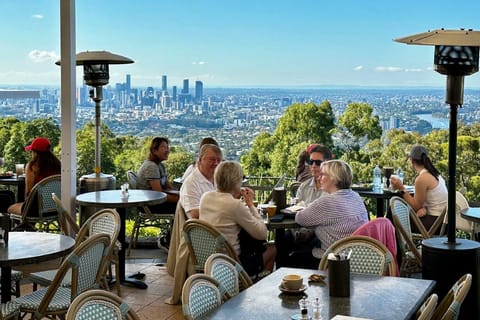
The plates that define Brisbane: what they are, where they came from, and where to eat the canonical version.
Signature dishes
-
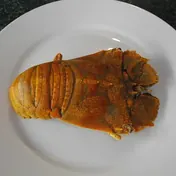
Moreton Bay Bug ★ 4.8
Moreton Bay bug is the Australian name for the flathead lobster, a slipper lobster named after Moreton Bay; Brisbane menus serve it in dumplings, spring rolls, a bug roll and with garlic butter.
Where to try it: Donna Chang, Stanley Restaurant, e'cco bistro, Blackbird Bar & Grill
Moreton Bay bug is the Australian name for Thenus orientalis, a slipper lobster of the Indian and Pacific oceans that the UN Food and Agriculture Organization calls the flathead lobster; the name comes from Moreton Bay in Brisbane. It lives on muddy and sandy bottoms from northern New South Wales around to Shark Bay in Western Australia and is caught mainly between Cairns and Bundaberg as bycatch of the prawn and scallop fisheries. It is sometimes confused with the Balmain bug.
Watch out for: Crustacean
-
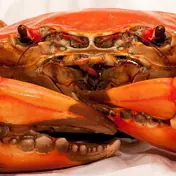
Queensland Mud Crab ★ 4.7
Queensland mud crab is the large crab of mangroves and estuaries, most of it caught in Queensland and the Northern Territory; Stanley serves it live from the tank, steamed or wok tossed.
Where to try it: Stanley Restaurant
Scylla serrata, called the mud crab or mangrove crab, lives in the estuaries and mangroves of Africa, Australia and Asia, from South Africa to south-eastern Australia. In Australia it is caught in pots, drop nets and dillies from New South Wales north around to Shark Bay, and most of the commercial catch comes from Queensland and the Northern Territory, with a peak from January to April in Queensland. A study on the tidal flats of Deception Bay in Queensland found young crabs living in the mangrove zone.
Watch out for: Crustacean
-
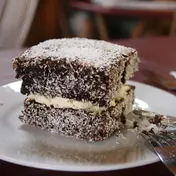
Lamington ★ 4.6
The lamington is a square of sponge or butter cake dipped in chocolate and rolled in desiccated coconut, believed to be named after Lord Lamington, Governor of Queensland from 1896 to 1901.
Lamingtons are believed to be named after Lord Lamington, Governor of Queensland from 1896 to 1901, or his wife, and most sources favour him. Most stories credit his French-born chef Armand Galland, called on to feed unexpected guests; one account places the first lamington at Government House in Brisbane, another at Harlaxton House in Toowoomba. A recipe for Lamington Cakes appeared in the Queensland Country Life newspaper in 1900 and in a Sydney paper in 1901. 21 July is National Lamington Day in Australia.
Watch out for: Gluten, Egg, Dairy
Book food experiences in Brisbane


-
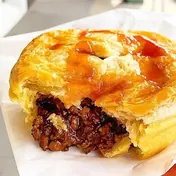
Aussie Meat Pie ★ 4.4
The Australian meat pie is a hand-held pie of diced or minced meat and gravy in a pastry crust, usually eaten with tomato sauce as a takeaway snack or at football matches.
In Australia and New Zealand a meat pie is a hand-held pie of diced or minced meat and gravy, sometimes with onion, mushroom or cheese, in a pastry crust, and the minced beef version has been described as Australia's national dish. It is usually eaten from the hand with tomato sauce, as a takeaway snack or at football matches. The Four'n Twenty pie was first made in 1947 by L. T. McClure in a small bakery in Bendigo, and Sargents could trace its pie making back to 1891.
Watch out for: Gluten, Egg, Dairy
-
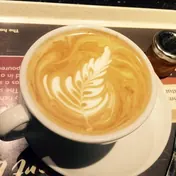
Australian Flat White ★ 4.5
The flat white is espresso with steamed milk and a thin layer of microfoam, with more coffee to milk than a latte; cafe owners in Australia and New Zealand both claim to have invented it.
Where to try it: Strauss
A flat white is espresso with steamed milk, a higher proportion of coffee to milk than a latte and without the thick foam of a cappuccino; cafe owners in Australia and New Zealand both claim it. A review of the Sydney cafe Miller's Treat mentioned its flat white coffee in May 1983, Alan Preston put it on the permanent menu at Moors Espresso Bar in Sydney in 1985, and a Wellington claim dates from 1989. In Australia it is usually served in a ceramic cup with a handle. Strauss in the Brisbane CBD lists it on its drinks menu.
Watch out for: Dairy
-
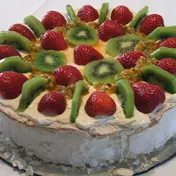
Pavlova ★ 4.5
Pavlova is a meringue cake with a crisp crust and a soft centre, topped with whipped cream and fruit, named after the ballerina Anna Pavlova and eaten most often in summer and at Christmas.
Where to try it: e'cco bistro
Pavlova is named after the Russian ballerina Anna Pavlova, and both Australia and New Zealand claim it. The culinary anthropologist Helen Leach found the first New Zealand recipe for pavlova cake in 1929, while an Australian claim credits Bert Sachse at the Esplanade Hotel in Perth in 1935. It is traditionally topped with whipped cream and soft fruit such as kiwifruit, passionfruit and strawberries, and is eaten most often in summer, including at Christmas. e'cco bistro in Newstead serves a chickpea pavlova with poached pear, almond and blood orange sorbet.
Watch out for: Egg, Dairy
-
Queensland Banana Prawn ★ 4.5
Banana prawns are translucent to yellow prawns with a sweet, mild flavour, caught by trawlers across northern Australia, with the bulk of the catch coming from the Gulf of Carpentaria.
The banana prawn (Fenneropenaeus merguiensis) is widely caught for food. In Australia it lives from the New South Wales and Queensland border around the north to Shark Bay in Western Australia, and trawlers catch it mainly between Exmouth Gulf and Brisbane, the bulk of the catch coming from the Gulf of Carpentaria. It is available all year with peak supply in April; the Northern Territory fishery closes from December to March and again in July. Most are 14 to 17cm long and weigh 20 to 30g.
Watch out for: Crustacean
-
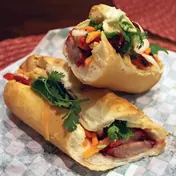
Brisbane Banh Mi ★ 4.6
Banh mi is the Vietnamese baguette roll filled with pate and mayonnaise, pickled carrot, cucumber, coriander and chilli; in Australia it is commonly sold in Asian bakeries.
Where to try it: West End Vietnamese Foods, Rolls Pho Mi
The baguette came to Vietnam with the French in the mid 19th century, and in the 1950s a distinctly Vietnamese sandwich developed in Saigon; after the Vietnam War, overseas Vietnamese made it popular in Australia, where it is commonly sold in Asian bakeries. Vietnamese refugees began to settle in Darra in 1975, and at the 2016 census Inala had the largest Vietnamese Australian community of any suburb in Queensland. West End Vietnamese Foods fills its rolls with house pate and mayonnaise, cucumber, pickled carrot, coriander, onion and chilli.
Watch out for: Gluten
-
Bowen Mango ★ 4.6
The Kensington Pride, also called the Bowen mango, is Australia's most popular mango; Northern Territory fruit comes from September to November and Queensland fruit from December to February.
The Kensington Pride mango, also known as the KP, Bowen or Bowen Special, accounts for over 80 percent of Australia's commercial mango market. The original tree emerged in Bowen, Queensland, in the late 1880s, where it was called the Pride of Bowen; it was possibly brought from India by traders shipping horses, and the fruit was not formally described until the 1960s. Commercial crops grow mainly in the Northern Territory and northern and central Queensland, and very little fruit comes from south-east Queensland.
-
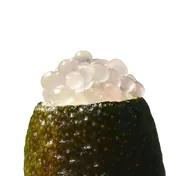
Finger Lime ★ 4.5
Finger lime is a native citrus of the rainforest from around Brisbane to northern New South Wales, whose juice pearls, called lime caviar, burst with a tangy flavour; Brisbane menus pair it with oysters and raw fish.
Where to try it: e'cco bistro, Donna Chang, Blackbird Bar & Grill
Citrus australasica, the finger lime or caviar lime, is a thorny understorey shrub of lowland subtropical rainforest, native from the area around Brisbane to the Clarence River in New South Wales. Its fruit is grown as a commercial crop and has been popularised as a gourmet bushfood, its pearls called lime caviar. In Brisbane, e'cco bistro serves oysters with ponzu and finger lime, Donna Chang raw kingfish with chilli and finger lime, and Blackbird a honey bug with finger lime and shallot mignonette.
-
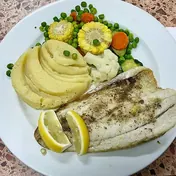
Queensland Barramundi ★ 4.4
Barramundi is a fish of the rivers, estuaries and coast of tropical northern Australia, caught wild from February to November and farmed all year; Brisbane menus steam it, barbecue it whole or fold it into dumplings.
Where to try it: Donna Chang, Hello Please, Stanley Restaurant
Barramundi (Lates calcarifer) takes its name from an Aboriginal language of the Rockhampton area in Queensland, meaning large-scaled river fish. In Australia it is caught with gillnets in the coastal and fresh waters of the tropical north, from the Ashburton River in Western Australia to the Noosa River in Queensland, and is also farmed; the Australian industry produces more than 9,000 tons a year. Wild fish are available from February to November, peaking from February to May. In Brisbane, Donna Chang barbecues a whole baby barramundi Chongqing style and Hello Please steams it with shiitake butter.
Watch out for: Fish
-
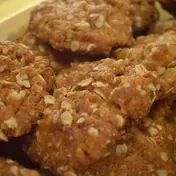
Anzac Biscuit ★ 4.3
The Anzac biscuit is a sweet biscuit of rolled oats, flour, sugar, butter and golden syrup, often with coconut, long associated with the Australian and New Zealand Army Corps of World War I.
Anzac biscuits are made with rolled oats, flour, sugar, butter, golden syrup, baking soda, boiling water and optionally desiccated coconut. They have long been associated with the Australian and New Zealand Army Corps of World War I and are thought to have been sent by wives and women's groups to soldiers abroad because they kept well. The earliest known recipe joining the two words, for ANZAC ginger biscuits, appeared in Perth in June 1916, and the War Chest Cookery Book (Sydney, 1917) held the first recipes resembling the modern biscuit. They are still sold to raise funds for the Returned and Services League of Australia.
Watch out for: Gluten, Dairy
Signature Dishes in Brisbane, FAQ
What food is Brisbane known for?
Brisbane's signature dishes include Moreton Bay Bug, Queensland Mud Crab, Lamington, Aussie Meat Pie, Australian Flat White. See our signature dishes chapter for where to eat each.