
The plates that define Baltimore: what they are, where they came from, and where to eat the canonical version.
Signature dishes
-
Maryland crab cake ★ 4.9
The Baltimore crab cake is jumbo lump blue crab held together with almost no filler and broiled, not fried, so the sweet meat does the talking. The no-filler version is the local point of pride.
Where to try it: Faidley's Seafood, Gertrude's Chesapeake Kitchen, Thames Street Oyster House, True Chesapeake Oyster Co.
Price: $28 to $42
Crab cakes grew out of the Chesapeake's 19th-century oyster-and-crab economy, when Baltimore was the world's leading seafood-packing port. The Maryland style, jumbo lump bound with just egg, mustard and a little binder, then broiled, became fixed as the gold standard. Faidley's at Lexington Market, selling crab cakes since 1886, is often credited with setting the no-filler benchmark that locals still defend against fried, filler-heavy versions elsewhere.
Watch out for: Shellfish, Egg, Gluten
-
Steamed blue crabs ★ 4.9
Whole blue crabs steamed under a heavy coat of Old Bay or J.O. seasoning, dumped on a brown-paper table and cracked open with wooden mallets. The crab feast is a Baltimore summer ritual as much as a meal.
Where to try it: LP Steamers, Mama's on the Half Shell, Faidley's Seafood
Price: $50 to $120 a dozen
Steaming whole crabs in seasoned salt is the oldest way Baltimore eats its Chesapeake catch, a working-waterman tradition that became the city's defining summer feast. Crabs are graded by size and sold by the dozen, steamed to order and piled high. The communal table, the mallets, the cold beer and the slow, messy work of picking are the whole point, and crab houses around the harbour and out on the water have run the ritual for generations.
Watch out for: Shellfish
-
Baltimore pit beef ★ 4.7
Top round grilled hot and fast over charcoal until charred outside and rare inside, sliced thin and piled on a kaiser roll with tiger sauce and raw onion. It is Baltimore's answer to barbecue.
Where to try it: Chaps Pit Beef
Price: $10 to $16
Pit beef grew up along the East Side and Pulaski Highway, where roadside stands grilled cheap cuts of beef over open charcoal for a working lunch crowd. Unlike slow-smoked barbecue, it is cooked hot and fast and served rare, the char doing the flavour work. Tiger sauce, a horseradish-spiked mayo, and a slice of raw onion are the only accompaniments that matter, and stands like Chaps on Pulaski Highway keep the tradition alive.
Watch out for: Gluten, Egg
Book food experiences in Baltimore


-

Lake trout ★ 4.5
Despite the name, lake trout is whiting, a saltwater fish dredged in cornmeal and fried until the edges shatter, then served in a paper bag with hot sauce. It is a Baltimore corner-shop staple.
Where to try it: Faidley's Seafood, Lexington Market
Price: $8 to $14
Lake trout has nothing to do with trout or lakes. The story goes that whiting arriving late in the season at Lexington Market was sold as late trout, which slurred into lake trout. The cheap, flaky white fish became a corner-store and carry-out fixture, fried in cornmeal and folded into white bread with hot sauce. It remains a defining cheap eat of Black Baltimore, sold from steam tables and fish counters across the city.
Watch out for: Fish, Gluten
-
Maryland crab soup ★ 4.4
A tomato-based vegetable soup loaded with blue crab and Old Bay, sharp and a little spicy. It is the savoury counterpart to the city's richer cream of crab, and most rooms pour both.
Where to try it: Gertrude's Chesapeake Kitchen, Faidley's Seafood
Price: $8 to $14 a bowl
Maryland crab soup is the Chesapeake's vegetable-garden soup, a tomato broth packed with corn, lima beans, potatoes and blue crab, seasoned hard with Old Bay. It evolved as a thrifty way to stretch crab through a pot of summer vegetables. Its richer sibling, cream of crab, is a smooth, sherry-laced cream soup. Many Baltimore tables order them side by side, half and half in one bowl, and Chesapeake kitchens treat both as standards.
Watch out for: Shellfish
-
Crab pretzel ★ 4.2
A soft pretzel split flat, slathered with creamy crab dip and melted cheese, then baked until bubbling. It is the bar-snack form of Baltimore's crab obsession, built for sharing over a pitcher.
Where to try it: Mama's on the Half Shell, LP Steamers
Price: $14 to $20
The crab pretzel is a relatively modern Maryland bar invention, marrying the soft pretzel to the region's crab dip. A large soft pretzel is opened flat, topped with a creamy blend of crab, cheese and Old Bay, and baked until the top browns. It spread through Baltimore taprooms and crab houses as the definitive shareable starter, and now turns up everywhere from neighbourhood bars to brewery taprooms.
Watch out for: Shellfish, Gluten, Dairy
-
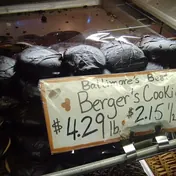
Berger cookie ★ 4.2
A soft, cake-like shortbread base buried under a thick cap of fudge that is heavier than the cookie itself. The Berger cookie is a Baltimore icon, sold through grocery stores across the city.
Where to try it: Lexington Market
Price: $5 to $8 a box
The Berger cookie traces to a German baker, George Berger, who brought the recipe to East Baltimore in the 1830s. The modern version is a plain vanilla cookie topped with a famously thick layer of chocolate fudge, the cap deliberately outweighing the base. DeBaufre Bakeries has produced them for decades, and they remain a near-universal Baltimore souvenir, stacked at supermarket checkouts and corner stores across the region.
Watch out for: Gluten, Egg, Dairy, Soy
-

Snowball ★ 4.0
Finely shaved ice soaked in flavoured syrup and often crowned with marshmallow, the egg-custard flavour being the Baltimore default. It is the city's summer treat, sold from corner stands.
Where to try it: Walther Gardens Snowball Stand
Price: $3 to $6
The Baltimore snowball dates to the 19th century, when ice shaved from blocks was sold cheap to working families through the summer. Unlike a coarse snow cone, the ice is shaved fine enough to drink with a spoon, then drenched in syrup. Egg custard, a vanilla-yellow flavour, is the local signature, frequently topped with a layer of marshmallow. Seasonal stands, some over a century old, still run from spring through summer across the neighbourhoods.
Watch out for: Egg
-
Old Bay fries ★ 4.4
Hand-cut fries showered with Old Bay seasoning, the celery-salt-paprika-mustard spice mix that defines Baltimore palates. Served at every crab house and bar in the city.
Where to try it: Chaps Pit Beef, Mama's on the Half Shell, LP Steamers, Faidley's Seafood
Price: $5-9
Old Bay seasoning was invented in 1939 in Baltimore by Gustav Brunn, a German Jewish refugee, who developed the blend for the Chesapeake crab boil trade. The mix of celery salt, paprika, mustard, bay leaf, cloves and red pepper became inseparable from Baltimore cooking. Old Bay fries are a Baltimore bar-snack staple, the cheap-and-essential side at every crab house and corner pub in the city.
-
Natty Boh and the Maryland shandy ★ 4.0
Baltimore's National Bohemian lager (Natty Boh) on its own, or in the Maryland shandy half-and-half mix with lemonade. The city's signature working-class beer culture, now an icon of Baltimore identity.
Where to try it: Max's Taphouse, Chaps Pit Beef, Of Love and Regret, Mama's on the Half Shell
Price: $3-6 per draft
National Bohemian, brewed in Baltimore since 1885 under the National Brewing Company, became the city's identity beer through the 20th century, with the one-eyed Mr. Boh mascot painted on Brewer's Hill warehouses. Pabst now brews Natty Boh in North Carolina, but Baltimore drinks the beer with the same fierce loyalty. The customer practice of mixing Natty Boh half-and-half with lemonade is the canonical Maryland shandy bar order, since formalised as a sister product. Max's Taphouse, Of Love and Regret and Chaps Pit Beef all pour Natty Boh on draft.
Watch out for: Gluten
-
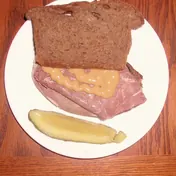
Corned beef on rye ★ 4.5
Hand-sliced kosher corned beef piled thick on Jewish rye bread, with spicy brown mustard. The defining Baltimore Jewish-delicatessen sandwich since 1915.
Where to try it: Attman's Delicatessen, Dooby's, Faidley's Seafood, Cross Street Market
Price: $14-22
Attman's Delicatessen on the Corned Beef Row of Lombard Street has anchored Baltimore's Jewish-deli tradition since 1915, when Harry Attman opened the storefront in the East Baltimore Jewish quarter. The thick-cut corned beef on rye became the city's deli signature. Today Attman's remains the canonical operator alongside Lenny's in Pikesville; The General Muir in Atlanta and Eli's in Manhattan trace their lineage to the same Eastern European Jewish-American tradition. The Maryland take adds a heavy schmear of horseradish-mustard.
Watch out for: Gluten, Mustard
-
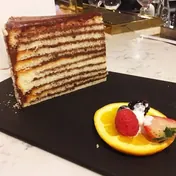
Smith Island cake ★ 4.5
Maryland's official state dessert: nine to fifteen paper-thin yellow-cake layers separated by fudge frosting, stacked tall and chilled. A signature of Smith Island in the Chesapeake Bay.
Where to try it: Patisserie Poupon, Harmony Bakery, Cross Street Market, Pitango Bakery + Cafe
Price: $8-12 per slice; $60-90 whole cake
Smith Island cake originated on Smith Island in the Chesapeake Bay in the 19th century, baked thin in cast-iron pans by watermen's wives for the long fishing trips. The thin layers allowed the cake to keep without drying out. Maryland declared it the official state dessert in 2008. Baltimore bakeries including Patisserie Poupon, Harmony Bakery and Pitango Bakery + Cafe sell whole cakes for special occasions and slices over the counter.
Watch out for: Gluten, Dairy, Egg
Signature Dishes in Baltimore, FAQ
What food is Baltimore known for?
Baltimore's signature dishes include Maryland crab cake, Steamed blue crabs, Baltimore pit beef, Lake trout, Maryland crab soup. See our signature dishes chapter for where to eat each.