Korean classics: kimchi, bibimbap, japchae, sundubu jjigaeGroup: 8 max$65-90 per personJongno and Insadong
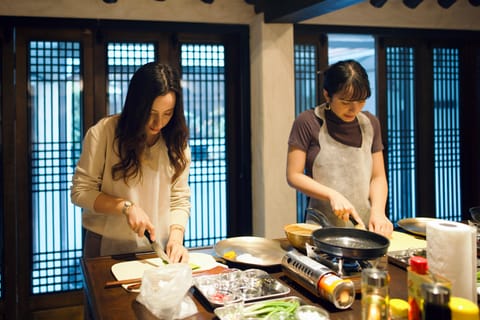
O'ngo Food Communications operates Seoul's longest-running English-language Korean cooking school from a restored hanok studio in Bukchon, two streets from Gyeongbokgung Palace. The standard class runs three hours: a market walk (Tongin or Gwangjang), followed by a hands-on kitchen session making bibimbap, japchae (glass noodles with vegetables), kimchi from scratch, and one soup or stew. All dietary requirements are accommodated including vegan and gluten-free versions of the dishes. O'ngo was founded in 2008 and the instruction is detailed and patient.
Kimchi-making (baechu, kkakdugi, oi sobagi), Korean traditional cultureGroup: 20 max₩30,000-60,000 per personJongno and Insadong
Kimchi School operates what it describes as Korea's largest traditional culture experience centre in Seoul. The kimchi programme covers the full making process: salting, washing, and pressing napa cabbage; making the gochugaru and jeotgal (salted seafood) paste; and packing the finished kimchi in traditional clay pots. Classes run two to three hours and are available in English with advance booking. The institution also offers Korean costume dress (hanbok), calligraphy, and traditional music sessions as companion experiences.
Royal court cuisine: Joseon-era jeongol, gujeolpan, gangjeongGroup: 8 max₩150,000 per personJongno and Insadong
The Institute of Korean Royal Cuisine preserves and teaches the cooking traditions of the Joseon royal court, the haute cuisine that underpins contemporary Korean fine dining including the menu of Michelin-starred Onjium. Classes cover the complex presentation formats of royal court cooking -- the nine-compartment gujeolpan platter, the multi-coloured gangjeong rice confections -- and the philosophical principles (colour, temperature, texture balance) that govern the cuisine. Instruction is primarily in Korean with translation materials; English-language sessions available on specific dates.
Buddhist temple food: vegan Korean cuisine, wild vegetables, soy paste dishesGroup: 10 max₩50,000-80,000 per personJongno and Insadong
The Korea Temple Food Cultural Centre, affiliated with the Jogye Order of Korean Buddhism, teaches the temple food tradition that is entirely plant-based and excludes the five pungent roots (garlic, onion, chive, green onion, and wild garlic). Temple food is one of Korea's most distinctive culinary traditions, relying on fermentation, drying, and seasoning with sesame, perilla, and doenjang. Classes cover seasonal wild vegetable preparation, soy paste-based dishes, and the philosophical approach to food as a form of meditation practice. One of Seoul's most culturally distinctive cooking experiences.