The plates that define Nantes: what they are, where they came from, and where to eat the canonical version.
Signature dishes
-

Beurre blanc nantais ★ 4.9
The sauce Nantes gave French cooking: a hard reduction of shallots in white wine and vinegar, then cold butter beaten in cube by cube until it thickens into a pale, tart emulsion for river fish.
Where to try it: La Souris d'Agneau
Price: €22 to €34 as a main course with fish
The origin story attached to beurre blanc belongs to Clémence Lefeuvre, a cook born at La Chebuette in Saint-Julien-de-Concelles, upriver from Nantes, who was working there around 1890. The version her family told is that a customer complained about her plain melted-butter sauce, and that she answered it by reducing shallots with vinegar first and mounting the butter into that. Whether or not any single cook can be said to have invented an emulsion, the sauce spread from that stretch of river into Nantes dining rooms and then into the wider French repertoire. A confrérie now exists in the city to defend it.
Watch out for: Dairy, Sulphites, Fish
-
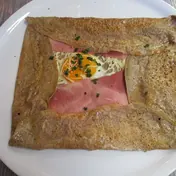
Galette de sarrasin ★ 4.8
The savoury buckwheat pancake that Nantes eats as everyday food thanks to its Breton half: a thin, lacy, nutty galette folded into a square around ham, egg and grated cheese, with cidre in a bolée alongside.
Where to try it: Le Loup, le Renard et la Galette, Crêperie Sainte-Croix, Crêperie Heb Ken, La Crêperie du Bouffay, Barapom Bouffay, Ker Breizh
Price: €9 to €14
Buckwheat took hold across Breton smallholdings from the late middle ages because it grew where wheat would not, on thin acid soil and in a short season, and it was ground into a flour that made a batter rather than a raised loaf. That batter cooked on a flat iron plate became the galette. Nantes spent those centuries as a capital of the Duchy of Brittany, and the eating stuck even after the border moved: the city still has crêperies on more corners than bistros. The galette complète, folded square around ham, a fried egg and emmental, is the fixed point of the format, and a good crêperie uses pure blé noir with nothing but water and salt in the batter.
Watch out for: Gluten, Eggs, Dairy
-
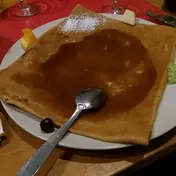
Crêpe au caramel au beurre salé ★ 4.6
The sweet half of the Nantes crêperie order: a soft wheat crêpe folded around a dark salted-butter caramel, the western French answer to the question of what to do with salted butter and sugar.
Where to try it: Crêperie Heb Ken, Ker Breizh
Price: €6 to €10
Where the savoury galette is buckwheat, the sweet crêpe is wheat flour, milk, eggs and sugar, and in a Nantes crêperie the two arrive in that order with cidre poured through both. The salted-butter caramel that fills it is a product of the region's dairy and its salt: the Guérande marshes down the coast supplied salt up the Loire for centuries, and demi-sel butter is the western French default rather than an affectation. Cooking sugar to a dark caramel and then killing it with cold salted butter and cream gives a sauce that is bitter, salty and sweet at once, and it is now the standard sweet order in crêperies across the region.
Watch out for: Gluten, Eggs, Dairy
-
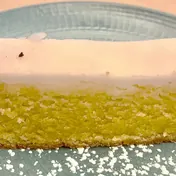
Gâteau nantais ★ 4.7
A dense almond cake soaked and iced with rum, sweet enough to keep for weeks. It is the edible trace of Nantes as a colonial sugar and rum port, and every boulangerie in the centre sells its own version.
Where to try it: Maison Juhel, Vincent Guerlais, Esthète, Maison Arlot Cheng, Lulu le Bistrot
Price: €4 to €6 a slice, €18 to €26 for a whole cake
The gâteau nantais is a 19th-century city cake built out of exactly what the port had too much of: cane sugar refined on the quays and rum shipped in from the Antilles. It was made heavy on both deliberately, because a cake carrying that much sugar and spirit keeps and travels. The result is a low, close-textured almond cake with a thin white rum icing set hard on top, sold in the same window as the berlingots. Nantes cannot tell that part of its food history without also naming the trade that funded it: the city was France's leading slave-trading port in the 18th century, and the sugar and rum economy of the quays is the direct reason this cake tastes the way it does.
Watch out for: Nuts, Eggs, Dairy, Gluten
-
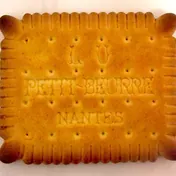
Petit-Beurre nantais ★ 4.5
The rectangular butter biscuit with the scalloped edge that Louis Lefèvre-Utile launched in Nantes in 1886. It is the most copied biscuit shape in France and it still comes off a line in the Nantes vineyard.
Price: €2 to €4 a packet
Louis Lefèvre-Utile was the son of the couple whose initials became LU, and in 1886 he put out a plain butter biscuit modelled on the English biscuits of the day, with a scalloped border and a stamped face. It took over. By the end of the century the Nantes works were turning out hundreds of kilos of biscuits a day and roughly a third of that was Petit-Beurre, and LU took the Grand Prix for biscuits at the 1900 Exposition Universelle. The old central factories were demolished during the city's rebuilding, but the LU tower still stands beside the Cité des Congrès and is now the Lieu Unique arts centre. Production continues at La Haie-Fouassière.
Watch out for: Gluten, Dairy, Eggs
-
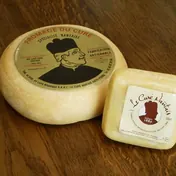
Curé nantais ★ 4.4
A soft raw-milk washed-rind cow's cheese, created in the vineyard villages upriver in 1880 and made at Pornic today, pungent on the nose and mild in the mouth.
Price: €6 to €12 for a small whole cheese
The story the region tells is that a farmer at Saint-Julien-de-Concelles in the Nantes vineyard, Pierre Hivert, made the first of these cheeses around 1880 to a recipe a passing priest gave him, and that it was renamed for the ecclesiastic some years later. It is a raw cow's-milk cheese with a supple, springy paste and an orange washed rind that smells considerably stronger than the cheese tastes. Production left the vineyard for Pornic in the Pays de Retz in 1980 and the raw-milk method went with it. Made in small squares and rounds, it sits on cheese boards across the city and turns up melted into potato and charcuterie dishes in winter.
Watch out for: Dairy
-
Bottereaux nantais ★ 4.3
The carnival fritter of the Nantes country and Anjou: a rich, spirit-scented dough rolled thin, cut into lozenges, deep-fried for barely a minute and buried in icing sugar for Mardi Gras.
Price: €3 to €6 a bag at carnival
Bottereaux are the pays nantais version of the fried carnival dough that most of France makes in some form before Lent, and they are still tied to Mardi Gras rather than sold year round. The dough is closer to a rich biscuit than a batter: eggs, sugar, butter and flour, loosened with a little cream or milk and perfumed with eau-de-vie or kirsch, then rested overnight so it rolls thin without springing back. Cut into lozenges and dropped into hot fat, they puff and blister in under a minute a side, and they are best within a few hours of frying.
Watch out for: Gluten, Eggs, Dairy
-
Berlingot nantais ★ 4.2
The city's emblematic sweet since the 19th century: a hard boiled-sugar pyramid, striped and fruit-flavoured, sold loose by the scoop from confectioners and market stalls around the centre.
Price: €4 to €8 for 100g
The berlingot nantais is a boiled-sugar confection made in the city since the 19th century, when Nantes had the refineries and the confectioners to work cane sugar at scale. It is recognisable by its shape: a four-sided pyramid, cut from a rope of pulled sugar so that each sweet carries a stripe of paler, aerated sugar across a coloured, fruit-flavoured body. It sits alongside the Rigolette, the other surviving Nantes sweet, as evidence of a confectionery trade that was once a serious local industry and is now a handful of specialist shops.
-
Salade de mâche nantaise ★ 4.3
Lamb's lettuce is the emblem of Nantes market gardening, protected by IGP and grown under low shelters on a bed of sand. In the city it is a winter salad with walnuts, apple and a mustard vinaigrette.
Price: €8 to €14 as a starter
Mâche is small, dark, nutty and faintly sweet, and Loire-Atlantique grows more of it than anywhere else in France. That leadership came from a technique rather than luck: Nantes market gardeners worked out a sous-abris system in which the soil is covered with roughly a centimetre of sand, which warms faster and helps the seed germinate evenly. The protected zone for Mâche Nantaise IGP covers more than 200 communes across Loire-Atlantique, Maine-et-Loire and the Vendée. The season opens in autumn and runs through winter, and the classic Nantes plate pairs the leaf with walnuts and apple.
Watch out for: Nuts, Mustard, Sulphites
-
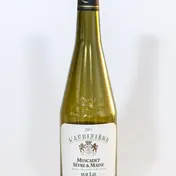
Muscadet Sèvre et Maine sur lie ★ 4.6
The white wine of the Nantes vineyard, made from melon de Bourgogne and left on its lees through the winter before bottling. Dry, saline and cheap for what it is, and the city's default glass.
Where to try it: Muscadothèque, La Bourriche, Le Cellier
Price: €4 to €7 a glass, €12 to €25 a bottle in the shops
The vines start about half an hour outside Nantes, on the schist and gneiss between the Sèvre Nantaise and the Maine, and the grape is melon de Bourgogne. What separates Muscadet Sèvre et Maine sur lie from ordinary Muscadet is the élevage: the wine stays on its fine lees through the winter after harvest and is drawn straight off them at bottling, which gives it a faint prickle of carbon dioxide and a texture it would not otherwise have. For decades the appellation was sold as cheap oyster wine and priced accordingly, and only recently have single-parcel growers pushed the region back up.
Watch out for: Sulphites
-
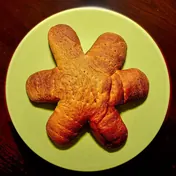
Fouace nantaise ★ 4.2
A dry, faintly sweet enriched bread baked in a six-pointed star, made in the Nantes vineyard since the 19th century and designed from the start to be torn apart and dipped into a glass of Muscadet.
Price: €4 to €8
The fouace comes from La Haie-Fouassière, southeast of Nantes in the middle of the Muscadet vineyard, and it was a growers' invention: a way to make money after two bad harvests, and a thing to eat while tasting the wine. It worked well enough that the village took the name of the bread during the Revolution, and before 1914 a settlement of about 1,200 people supported some 80 fouacier producers. The dough is flour, eggs, butter, sugar and yeast, shaped into a round and slashed into six points so it bakes into a star that pulls apart into horns. It is drier and less sweet than a brioche, which is what you want if you are going to dunk it.
Watch out for: Gluten, Eggs, Dairy
-
Huîtres de la baie de Bourgneuf ★ 4.4
Oysters from the shallow bay south of the Loire estuary, shucked on the fish rows at Talensac and stacked on brasserie plateaux through the cold months with a glass of Muscadet beside them.
Where to try it: La Bourriche, Marché de Talensac, La Cigale, L'Étal, Marché de Doulon
Price: €12 to €22 a dozen
The bay of Bourgneuf sits between the southern edge of the estuary and the Île de Noirmoutier, a wide shallow basin of tidal flats worked for shellfish for centuries and for salt long before that. Its oysters are the ones a Nantes brasserie means when it puts a plateau de fruits de mer on the table, and they arrive at their best through autumn and winter. The pairing with Muscadet is not marketing: the saline, low-alcohol, faintly prickly sur lie style really does hold up against a raw oyster better than most whites.
Watch out for: Molluscs
Signature Dishes in Nantes, FAQ
What food is Nantes known for?
Nantes's signature dishes include Beurre blanc nantais, Galette de sarrasin, Crêpe au caramel au beurre salé, Gâteau nantais, Petit-Beurre nantais. See our signature dishes chapter for where to eat each.