How Copenhagen came to eat the way it does: the people, migrations and accidents that shaped the plate.

Key eras

1840s, the birth of smørrebrød

Smørrebrød as a restaurant dish dates from mid-19th century Copenhagen. Oskar Davidsen opened a basement counter near Vesterport in 1888 and codified the menu of rugbrød with single toppings: marinated herring, leverpostej, ribbensteg. The form was working-class lunch food until the 1880s, when restaurant chefs began plating it as an architectural object.

1877, the Schønnemann template

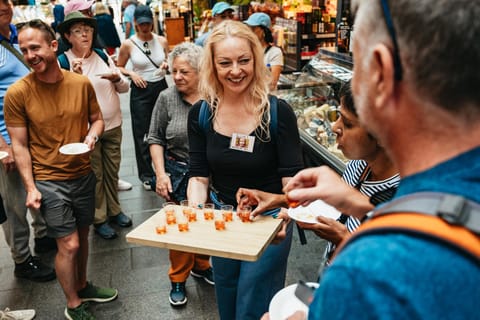
Schønnemann opened on Hauser Plads in 1877, originally as an inn for farmers selling produce at the nearby market. Its lunch-only smørrebrød menu set the modern grammar: house-baked rye, snaps from a glass-fronted cabinet, the staff in white aprons. By 2026 the dining room is largely unchanged and still books out a week ahead.

1980s, the long French interlude

Through the 1980s and 1990s, Copenhagen's ambitious dining rooms cooked French. Kong Hans Kælder, in the city's oldest building on Vingaardstræde, held the country's first Michelin star from 1983. Søllerød Kro north of the city and Kommandanten in Indre By dominated the guide. Smørrebrød counters held the lunch service while French haute cuisine owned the night.

2003, New Nordic and the noma manifesto

noma opened on Strandgade in 2003 under René Redzepi and Claus Meyer. The 2004 New Nordic Manifesto, signed by twelve chefs at a symposium in Copenhagen, rebuilt the regional kitchen around foraged, fermented, locally-grown ingredients. noma topped the World's 50 Best list five times (2010, 2011, 2012, 2014 and 2021). The restaurant ended regular service in 2024 and reopened as a food innovation lab.

2024, the post-noma chapter

noma closed regular service at the end of 2024 and Restaurant Barr, the German-grill spin-off at Strandgade 93, briefly hosted a residency in the noma kitchen in early 2026. The 2026 Michelin Guide lists three three-star rooms in greater Copenhagen: Geranium, Alchemist and Jordnær. The smørrebrød kitchens, once treated as folklore, are now where the most-booked tables sit.
Immigrant influences

  • Turkish: Turkish immigration to Denmark from the 1960s built the doner kebab grills that anchor every neighbourhood. Nørrebrogade and Vesterbrogade hold the densest grids.
  • Vietnamese: Vietnamese refugees arrived from 1975 onward and built the city's pho counters and banh-mi shops. Lê Lê on Vesterbrogade, opened 2003, codified the modern Copenhagen Vietnamese room.
  • Mexican: Mexican-Californian chef Rosio Sanchez, formerly of noma, opened Hija de Sanchez at Torvehallerne in 2015. Her counters now anchor the modern Copenhagen taqueria style across multiple locations.
  • Italian: Italian and Sicilian cooks have shaped the modern pizza and pasta scene since the 2010s. Bæst on Guldbergsgade, Christian Puglisi's sourdough pizzeria, and its sister Mirabelle Spiserìa are the reference rooms.
  • Japanese: Japanese chefs have built the city's ramen and sushi scene since the 2010s. Slurp Ramen on Nansensgade, opened 2017 by Austrian chef Philipp Inreiter (formerly noma and Relae in Copenhagen, with a ramen apprenticeship at Tokyo's Konjiki Hototogisu), is the reference ramen counter.

Signature innovations

  • Smørrebrød as a restaurant form, codified at Schønnemann from 1877
  • The New Nordic Manifesto, signed in Copenhagen in 2004
  • Hyper-local sourcing within a fixed regional radius, noma's 2003 model
  • The brewery-and-bakery district, Refshaleøen from the late 2010s

Food History in Copenhagen, FAQ

When is the best time to eat in Copenhagen?

Peak food season in Copenhagen is year-round.

What time do people eat in Copenhagen?

Local dining hours: lunch around 12:30, dinner from 19:30.

How does tipping work in Copenhagen?

service is typically included; small extra is welcome but not expected.

What is the one dish to try in Copenhagen?

Ask the next local you meet what they would order. Copenhagen rewards trust.

← Back to Copenhagen food guide