Key eras
1499, U Fleku begins brewing
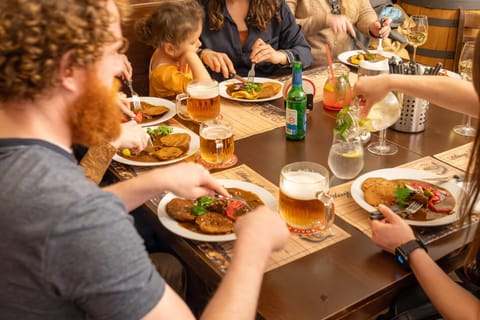
The U Fleku brewery on Kremencova is first documented in 1499, making it the oldest continuously operating brewery in Central Europe. Beer becomes the city's defining drink for the next five centuries, with the 13-degree dark Flek lager still brewed exclusively on site.
1842, Pilsner Urquell and the Czech lager revolution
The 1842 invention of pale lager in Plzen reshapes Czech drinking culture. Prague's pivnice tradition takes its modern form, with tank-poured Pilsner becoming the city's defining beer. U Medvidku, U Fleku and dozens of beer halls anchor the cuisine for generations.
1893 to 1914, the grand cafe boom
Cafe Slavia opens on Smetana Embankment in 1884. Cafe Savoy follows in Mala Strana in 1893. Cafe Imperial opens in 1914 with its ceramic-tiled walls. Kafka, Capek, Smetana and Einstein all keep regular tables in these rooms, building the literary cafe culture.
1948 to 1989, communist-era food
Forty years of communism flatten Prague's restaurant scene. State-run beer halls preserve the pivnice tradition, but innovation freezes. Coffee culture vanishes; canned vegetables and fried cheese sandwiches stand in for proper cooking, with grand cafes nationalised and stripped.
1990s to 2010s, the post-Velvet rebuild
After 1989, Ambiente group's Tomas Karpisek slowly rebuilds restaurant culture, opening Lokal in 2009 to revive tank Pilsner pubs. Doubleshot launches Prague's specialty coffee scene in 2010. La Degustation takes the city's first Michelin star in 2012.
2012 onward, the Michelin city
La Degustation Boheme Bourgeoise takes Prague's first Michelin star in 2012, joined by Field in 2016. Karlin and Vinohrady emerge as serious neighbourhoods for sourdough, natural wine and specialty coffee. Levitate, Stangl and Casa de Carli take stars in 2025.