
Southeast Asian cuisine is the cooking of mainland and maritime Southeast Asia: Thailand, Vietnam, Cambodia, Laos, Myanmar (Burma) on the mainland, plus Indonesia, Malaysia, Singapore, the Philippines, Brunei, and Timor-Leste in the maritime zone. Eleven countries, with several hundred ethnic groups and at least eight distinct national cuisines plus dozens of regional ones. What unites them is a flavor grammar built on rice (the universal staple), fish sauce or shrimp paste as the salty-umami depth (nam pla in Thailand, nuoc mam in Vietnam, kapi in Cambodia, padek in Laos, ngapi in Myanmar, terasi in Indonesia, bagoong in the Philippines), aromatic herb base (lemongrass, galangal, kaffir lime leaf, Thai basil, mint, cilantro), and the simultaneous balance of sweet, sour, salty, spicy, and sometimes bitter across each dish.
The shared cooking techniques include wok stir-frying (brought by Chinese migration from the 16th century onward and now central to mainland Southeast Asian cooking), curry pastes (ground from fresh aromatics and dried chiles, distinct from Indian dry-spice curries), banana-leaf wrapping (universal across the region for grilled fish and steamed rice cakes), the rice-noodle tradition (pho, pad thai, banh canh, kuy teav, mohinga, all rice-noodle-based regional dishes), and the curry-rice-and-side-dishes serving format that runs across Cambodia, Laos, Myanmar, and parts of Thailand. The fish sauce universal does not mean dishes taste alike; nam pla and nuoc mam and ngapi are distinct in fermentation depth and aromatic profile.
The big regional divisions are mainland versus maritime. Mainland (Thailand, Vietnam, Cambodia, Laos, Myanmar) leans on the major rivers (Mekong, Chao Phraya, Irrawaddy) and runs heavier on freshwater fish, sticky rice in the north, and Chinese-influenced wok cooking. Maritime (Indonesia, Malaysia, Singapore, Philippines, Brunei) is the spice-island world, with coconut milk as a cooking medium, deep Indian-Hindu-Muslim influence, more curries, and the Malay-archipelago shared base of rendang, satay, nasi goreng, and the sambal tradition. Vietnam sits at the crossroads, with Chinese-mainland influence in the north (pho, bun cha) and central Khmer-Cham influence in Hue and southern Vietnam, plus the deepest French colonial overlay of any Southeast Asian cuisine.
Book a food experience
Tours, tastings and classes that match this page, bookable on GetYourGuide.

Top picks
The best-scored Southeast Asian place in each of 8 cities.
Vinai ★ 4.7
Yia Vang's Vinai in Northeast Minneapolis runs the country's most serious Hmong dining room since its 2024 opening. James Beard finalist two years running.
Book3 weeks ahead
Cobi's ★ 4.5
Cobi's cooks Southeast Asian food in a florid Main Street bungalow in Santa Monica, a Bib Gourmand room of curries, dumplings and wood-grilled plates.
OrderPork dumplings, nasi goreng and a wok-tossed curry
TipThe Michelin Bib Gourmand crowd books ahead on Resy; the weekend brunch sitting is the calmer way to get a table.
Hawkers Asian Street Food ★ 4.5
Hawkers on North Mills Avenue is the Mills 50 flagship of the homegrown Asian-hawker chain, with roti canai, dumplings and skewers from across Southeast Asia.
SignatureRoti canai, Hawkers wings
Fiz ★ 4.5
Contemporary Southeast Asian tasting menus drawn from pasar malam night market flavours and traditional techniques at Tanjong Pagar. Michelin Guide-listed.
OrderThe tasting menu drawing from pasar malam night market traditions and Southeast Asian produce
TipReserve at least two to three weeks ahead; the restaurant seats fewer than 30 diners at a time.
Ka Pao ★ 4.4
Ka Pao serves colourful Southeast Asian sharing plates in Glasgow, from corn ribs to stir-fried ox tongue, in a basement that was once a garage.
OrderTry the corn ribs or the stir-fried ox tongue from the sharing plates.
TipIt is sister to Ox and Finch and shares its laid-back dining and affordable pricing.
Chin Chin ★ 4.1
Chin Chin on Flinders Lane is the no-bookings Southeast Asian diner: arrive on a weeknight, order the whole fish and a cold beer from the freezer bar.
OrderWhole barramundi with green herbs and tamarind sauce
Mama San ★ 4.0
Mama San serves Southeast Asian sharing plates on Jl. Raya Kerobokan in Seminyak, Bali, with dishes from Thailand, Vietnam, Malaysia, Indonesia and Singapore.
SignatureRendang stuffed doughnuts, Crispy prawn wonton, Black pepper chicken salad
Sama Sama Kitchen ★ 4.0
Michelin Bib Gourmand on State Street. Indonesian-inspired Southeast Asian food from French-trained owners using Bali recipes and Central Coast farm produce.
SignatureBraised pork noodles, Nuri ribs, Tamarind-glazed wings
Find a place
Vinai ★ 4.7
Yia Vang's Vinai in Northeast Minneapolis runs the country's most serious Hmong dining room since its 2024 opening. James Beard finalist two years running.
Book3 weeks ahead
Hai Hai ★ 4.6
Christina Nguyen's Hai Hai on University NE has run Southeast Asian street food in Minneapolis since 2018. Located in Northeast. Priced at $$$.
OrderBanh xeo turmeric crepe and the khao soi northern Thai curry noodles.
TipSaturday lunch dim sum cart pulls hot bites from a steamer. Tiki-style cocktails on the back patio in summer.
Lat14 ★ 4.6
Ann Ahmed's Lat14 in Golden Valley runs refined Southeast Asian cooking in the Twin Cities since 2017. James Beard semifinalist; menu maps the 14th latitude.
OrderSalt-baked branzino with green nam jim and the Wagyu yum nua.
TipSunday lunch family-style is the easy seat. Book three weeks out for Friday or Saturday dinner.
Cobi's ★ 4.5
Cobi's cooks Southeast Asian food in a florid Main Street bungalow in Santa Monica, a Bib Gourmand room of curries, dumplings and wood-grilled plates.
OrderPork dumplings, nasi goreng and a wok-tossed curry
TipThe Michelin Bib Gourmand crowd books ahead on Resy; the weekend brunch sitting is the calmer way to get a table.
Hawkers Asian Street Food ★ 4.5
Hawkers on North Mills Avenue is the Mills 50 flagship of the homegrown Asian-hawker chain, with roti canai, dumplings and skewers from across Southeast Asia.
SignatureRoti canai, Hawkers wings
Fiz ★ 4.5
Contemporary Southeast Asian tasting menus drawn from pasar malam night market flavours and traditional techniques at Tanjong Pagar. Michelin Guide-listed.
OrderThe tasting menu drawing from pasar malam night market traditions and Southeast Asian produce
TipReserve at least two to three weeks ahead; the restaurant seats fewer than 30 diners at a time.
Ka Pao ★ 4.4
Ka Pao serves colourful Southeast Asian sharing plates in Glasgow, from corn ribs to stir-fried ox tongue, in a basement that was once a garage.
OrderTry the corn ribs or the stir-fried ox tongue from the sharing plates.
TipIt is sister to Ox and Finch and shares its laid-back dining and affordable pricing.
Chin Chin ★ 4.1
Chin Chin on Flinders Lane is the no-bookings Southeast Asian diner: arrive on a weeknight, order the whole fish and a cold beer from the freezer bar.
OrderWhole barramundi with green herbs and tamarind sauce
Mama San ★ 4.0
Mama San serves Southeast Asian sharing plates on Jl. Raya Kerobokan in Seminyak, Bali, with dishes from Thailand, Vietnam, Malaysia, Indonesia and Singapore.
SignatureRendang stuffed doughnuts, Crispy prawn wonton, Black pepper chicken salad
Sama Sama Kitchen ★ 4.0
Michelin Bib Gourmand on State Street. Indonesian-inspired Southeast Asian food from French-trained owners using Bali recipes and Central Coast farm produce.
SignatureBraised pork noodles, Nuri ribs, Tamarind-glazed wings
Southeast Asian by city





Regional variations
Mainland (Thailand, Vietnam, Cambodia, Laos, Myanmar)
Rice-and-noodle-based, Chinese-wok-influenced. The Mekong river runs through Laos, Cambodia, and Vietnam, and freshwater fish (catfish, snakehead, fermented padek) is central. Sticky rice in northern Thailand and Laos. Thai four-region cuisine, Vietnamese north-central-south, Cambodian Khmer, Laotian, and Burmese tea-leaf cooking. The mainland is more directly influenced by China and India than the maritime.
Maritime (Indonesia, Malaysia, Singapore, Brunei)
Spice-island world with coconut milk, sambal, and deep Indian-Arab-Chinese trade influence. The shared Malay-archipelago base of rendang, satay, nasi goreng, gado-gado, laksa. The Peranakan (Chinese-Malay) crossover in Malacca, Penang, and Singapore. Heavier on chile, curry pastes, and the rijsttafel-style multi-dish format.
The Philippines
A distinct branch within Southeast Asia. Spanish colonial overlay (333 years) makes Filipino food the most Western-influenced regional cuisine, with adobo, lechon, leche flan, and the sour-salty-savory rather than sweet-spicy profile that dominates the rest of the region. Heavy on vinegar and pork; lighter on chile.
Burma (Myanmar)
An overlooked corner of Southeast Asia. Indian and Chinese influences blend with indigenous Bamar cooking. Mohinga (the fish-noodle soup, the unofficial national dish), tea-leaf salad (lahpet thoke, the most distinctive Burmese dish), curries closer to Indian than Thai in technique. The cuisine is starting to reach Western diners through restaurants like Burma Superstar in San Francisco.
Cambodia and Laos
Khmer and Lao cooking share much with Thai-Isaan but lean on prahok (Khmer fermented fish paste) and padek (Lao fermented fish), respectively. Amok (Cambodian fish curry steamed in banana leaf), kuy teav (Khmer noodle soup, ancestor of pho), larb (Lao minced-meat salad, the original of the Isaan dish), tam som (Lao papaya salad). Less Westernized than Thai and Vietnamese.
Defining Southeast Asian dishes
- Pho (Vietnam)
- Vietnamese rice-noodle soup with beef or chicken in clear aromatic broth, served with herbs (Thai basil, cilantro, mint), bean sprouts, lime, chile. The northern-Vietnamese style is purer; the southern style adds more herbs and sauces.
- Pad Thai (Thailand)
- Thai stir-fried rice noodles with shrimp or chicken, egg, tamarind, palm sugar, fish sauce, dried shrimp, peanuts, lime. A 1930s government-promoted Thai dish that became globally iconic.
- Rendang (Indonesia)
- Minangkabau slow-cooked dry beef curry, reduced for 4 to 6 hours in coconut milk and spice paste. CNN World's Best Food twice (2011, 2017).
- Adobo (Philippines)
- Meat braised in vinegar, soy sauce, garlic, peppercorn, bay leaf. The Filipino national dish.
- Mohinga (Myanmar)
- Burmese rice-noodle soup with catfish, lemongrass, garlic, ginger, and chickpea flour, served with hard-boiled egg, fried split peas, cilantro, lime, and chile flakes. The unofficial Burmese national dish.
- Amok (Cambodia)
- Cambodian fish curry steamed in banana-leaf cups with coconut milk, kroeung paste (the Khmer aromatic paste with lemongrass, galangal, kaffir lime, turmeric), and noni leaves. The Khmer national dish.
- Larb (Laos and Thailand)
- Lao minced-meat salad with toasted rice powder, fish sauce, lime, mint, shallot, chile. The dish crosses the Thai-Lao border (Isaan and Lao versions are essentially identical).
- Nasi Lemak (Malaysia)
- Malaysian coconut rice with sambal, anchovies, peanuts, cucumber, hard-boiled egg, and often beef rendang or fried chicken. The Malay-archipelago breakfast classic.
- Laksa (Malaysia and Singapore)
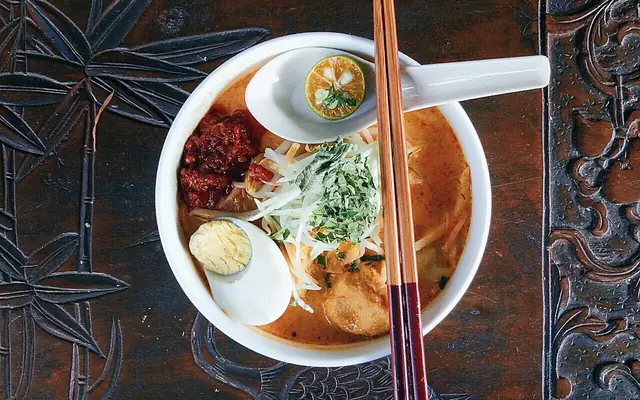
- Umbrella term for several noodle soups across the region. Penang asam laksa (sour, mackerel), curry laksa (coconut-curry), Sarawak laksa (prawn-shrimp paste), Singapore katong laksa (with chopped noodles). Cross-regional canonical dish.
- Banh Mi (Vietnam)
- Vietnamese baguette sandwich with pate, cold cuts, pickled vegetables, cilantro, and chile. The French-colonial-era fusion dish that became globally famous in the 2010s.
- Som Tam (Thailand and Laos)
- Green papaya salad pounded in a clay mortar with lime, fish sauce, palm sugar, chile, dried shrimp, peanut, tomato. The Isaan-Lao border dish, UNESCO Intangible Cultural Heritage of Thailand 2018.
How to order
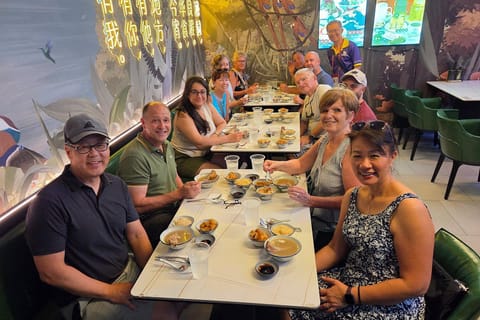
Southeast Asian dining is overwhelmingly family-style. At a Thai, Vietnamese, Indonesian, or Malaysian restaurant, order multiple dishes for the table to share: one curry, one stir-fry, one soup, one salad, plus rice. At a Filipino restaurant, order ulam (the meat-and-rice main) plus rice. Spice tolerance varies enormously; ask for Thai-spicy, Indonesian-spicy, or local-spicy if you want what locals eat, or non-spicy if you want it Western-toned. Each cuisine has a primary table condiment: nam pla and chile-vinegar for Thai, nuoc mam and chile sauce for Vietnamese, sambal for Indonesian and Malaysian, vinegar and patis for Filipino. The condiments are central, not optional.
The rookie mistakes: assuming all Southeast Asian food is spicy (Filipino food is not chile-led; northern Thai and Laotian are spice-moderate; Cambodian is spice-mild), conflating Thai and Vietnamese (different fish sauces, different aromatic profiles, different curry traditions; Thai uses fresh-aromatic curry pastes and coconut milk, Vietnamese uses lighter broths and more herbs), eating Vietnamese pho with a fork only (the Vietnamese way is chopsticks for noodles and spoon for broth, used together), and ordering only one dish (Southeast Asian dining is sharing). Tipping varies: 10 percent in tourist-zone restaurants is common, but most domestic restaurants in mainland Southeast Asia round up the change rather than calculating percentage.
What to drink with it
Beer is the universal Southeast Asian pour: Singha and Chang in Thailand, Saigon and 333 in Vietnam, Bintang in Indonesia, Tiger in Malaysia and Singapore, San Miguel in the Philippines, Angkor in Cambodia, Beerlao in Laos, Myanmar Beer in Burma. All are light lagers, the global tropical-beer style that pairs with chile and palm sugar. Local spirits: Thai whisky (Mekhong, Sangsom; rum-leaning despite the name), Vietnamese rice wine (ruou), Indonesian arak, Filipino rum (Tanduay), Cambodian sombai, Lao-Lao rice whisky. Coconut water from young coconuts is the universal non-alcoholic option. Sweetened iced tea (Thai tea, Vietnamese ca phe sua da, teh tarik) for sugar-rich cooling. Wine pairing is challenging but possible; off-dry Riesling, Gewurztraminer, and high-acid sparkling handle the sweet-spicy-sour-salty balance.
Where to eat it
Bangkok is the densest Southeast Asian-food city in the world. Ho Chi Minh City and Hanoi for Vietnamese. Jakarta and Bali for Indonesian. Kuala Lumpur and Penang for Malaysian. Singapore as a Southeast Asian capital (with the hawker-centre culture UNESCO-listed since 2020). Manila and Cebu for Filipino. Yangon for Burmese. Phnom Penh for Cambodian. Vientiane and Luang Prabang for Laotian. Outside the region, Sydney and Melbourne (large Southeast Asian diasporas, world-class restaurant scenes), London (Soho and East London Vietnamese, Burma Superstar, Sambal Shiok), Los Angeles (the deep Vietnamese OC enclave and the Cambodian Long Beach community), Houston (the largest Vietnamese-American population), Paris (the largest Cambodian and Vietnamese diaspora in Europe), and Berlin (one of the largest Vietnamese-European communities).
A short history
Southeast Asian cuisine took its modern shape across many layers: indigenous Austronesian and Tai-Kadai rice cooking (5,000+ years), Indian Hindu-Buddhist trade (curries, the spice tradition, sambal-paste precursors), Chinese trade and migration (wok cooking, noodles, soy and fish sauce evolution), Arab-Muslim trade (the Islamic dietary framework in Indonesia, Malaysia, Brunei), Portuguese arrival in the 16th century (the introduction of chile peppers from the Americas, without which modern Southeast Asian cuisine would not exist), and European colonization (French in Indochina, Dutch in Indonesia, British in Burma and Malaysia, Spanish-then-American in the Philippines). UNESCO listed the Singaporean hawker culture in 2020, Thai som tam in 2018, Filipino sinigang in 2023.
Frequently asked
Is Southeast Asian cuisine just spicy food?
No. Some regional cuisines are spice-aggressive (northeastern Thai, Padang Indonesian, Malaysian curries), others are restrained (Vietnamese, Filipino, Cambodian, northern Thai). The defining grammar is the four-or-five-taste balance (sweet, sour, salty, spicy, sometimes bitter), not heat per se. A Vietnamese pho is barely spicy by default; a Thai green curry is moderately so; an Indonesian rendang relies on aromatic spice rather than chile heat.
What is the difference between fish sauce and shrimp paste?
Fish sauce (nam pla in Thai, nuoc mam in Vietnamese) is a thin amber-brown liquid fermented from anchovies and salt over months. Shrimp paste (kapi in Thai, mam tom in Vietnamese, terasi in Indonesian, belacan in Malaysian, bagoong in Filipino) is a thick brown-purple block or paste fermented from shrimp and salt. Fish sauce is the table condiment; shrimp paste is a cooking ingredient that adds deep umami when incorporated into curries, dips, and stir-fries.
Why are Vietnamese and Thai cuisines so often confused?
Both are mainland Southeast Asian, both use rice noodles, fish sauce, lemongrass, and chile. But Vietnamese cooking is broth-and-herb-led (pho, bun, banh canh) with French baguette influence, while Thai cooking is curry-paste-and-coconut-milk-led with deeper Indian and Chinese influences. The languages, the religions (Buddhist Vietnam is mostly Mahayana, Buddhist Thailand is mostly Theravada), and the colonial histories (French Vietnam, never-colonized Thailand) are also distinct.
More cities are in research. Want Southeast Asian covered somewhere specific? Tell us where you want to eat.