

Sicily was conquered by every Mediterranean civilization in turn, and each one left an ingredient. The Greeks brought olives, wine, and bread; the Arabs (827-1091 CE) brought citrus, sugarcane, rice, almonds, saffron, and the cous-cous tradition still alive in Trapani; the Normans brought salt cod and meat-pie traditions; the Spanish brought tomatoes, peppers, and chocolate from the New World. Modern Sicilian cooking carries all of it, and the result is an Italian regional kitchen that does not taste like the rest of Italy.
The cooking grammar is sweet-and-sour (agrodolce), almond and pistachio, anchovy and salt cod, citrus and fennel, eggplant in every form, and tomato sauce that runs longer and richer than the mainland version. Pasta is durum-wheat, often hand-rolled (busiate, anelletti, casarecce); the sauces are bold and the fish is local (sardines, swordfish, tuna, anchovies). Street food (arancini, panelle, sfincione, pane con la milza) is its own deep category. Pastry (cannoli, cassata, granita) is a separate national obsession.
At the table, Sicilian meals are slower, larger, and louder than the mainland. Antipasto is a procession of small plates (caponata, sarde a beccafico, polpo, panelle); pasta is a serious primi course; secondi often centers on grilled or roasted fish; dessert is a destination in itself. Wine is local: Etna Rosso from the volcano, Nero d'Avola from the south, Grillo and Catarratto whites from Trapani, Marsala from the west.
Book a food experience
Tours, tastings and classes that match this page, bookable on GetYourGuide.

Top picks
The best-scored Sicilian place in each of 8 cities.
Osteria Mercede ★ 4.8
Osteria Mercede is a trattoria at Via Sammartino 1 with a seafood cuisine of Sicilian and Mediterranean character and a blackboard of daily specials.
OrderThe bruschette del marinaio, the Caciucco Mercede and a Scannolo to close.
TipCheck the blackboard of daily specials in the dining room, where recipes of local tradition sit beside offerings that celebrate the sea.
Catherine and Mary's ★ 4.7
Catherine and Mary's is Ticer and Hudman's downtown Memphis room pairing Tuscan and Sicilian grandmother cooking with Southern produce in the Chisca on Main.
OrderWhatever pasta they are rolling that night plus the wood-roasted whole fish.
Book2 weeks ahead
TipWalk-in seats at the bar most weeknights; the dining room books on Resy two weeks out.
Caserta Pizzeria ★ 4.6
Caserta on Spruce Street has been selling Rhode Island pizza strips since 1953. Sicilian-style square slices with sauce only or sauce-and-cheese.
TryPizza strips
Mama Santa's ★ 4.4
Mama Santa's on Mayfield Road in Little Italy, the Sicilian-style pizzeria run by the Santa family since 1961, anchors the cheap lunch slice scene.
TrySquare Sicilian pizza slice and a side of meatballs
Adriana's On The Hill ★ 4.2
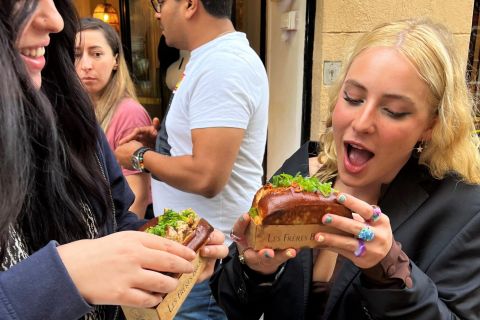
Adriana's On The Hill is a sicilian room in The Hill. Get the Sicilian sub and split it; it is huge. Lunch only, so plan a midday Hill visit.
Why locals goOvershadowed by the Hill's marquee restaurants, this family sandwich shop builds foot-long Sicilian subs that regulars rate above the famous names.
TipGet the Sicilian sub and split it; it is huge. Lunch only, so plan a midday Hill visit.
Chez Sauveur ★ 4.2
Chez Sauveur in Marseille's 1er Noailles has cooked Sicilian-rooted Marseillais pizza since 1943, the Pizza Speciale around €15, the cheapest wood-fired.
TrySicilian wood-fired pizza
TipClosed Sunday and Monday; takeaway saves the queue at peak Cash is faster than card.
Messina ★ 4.0
A Sicilian fine-dining room on Leuvehaven with a short seasonal menu of Mediterranean seafood and produce. Located in Centrum. Tasting menu on request.
Book1 week ahead
Osteria Ruggera ★ 3.8
Osteria Ruggera has served Sicilian dishes from a small family kitchen on Via Ruggera in central Modena since the late 1700s, closed on Tuesdays.
OrderOrecchiette alla norma or spaghetti alle sarde, with cassata to finish.
TipGo for the orecchiette alla norma and leave room for the homemade cassata.
Find a place
Osteria Mercede ★ 4.8
Osteria Mercede is a trattoria at Via Sammartino 1 with a seafood cuisine of Sicilian and Mediterranean character and a blackboard of daily specials.
OrderThe bruschette del marinaio, the Caciucco Mercede and a Scannolo to close.
TipCheck the blackboard of daily specials in the dining room, where recipes of local tradition sit beside offerings that celebrate the sea.
Buatta Cucina Popolana ★ 4.8
Buatta Cucina Popolana cooks authentic home recipes in Palermo and Turin, on ancient recipes and traditional methods, at Via Vittorio Emanuele 176.
TipThe restaurant also takes events: an informal buffet or a dinner served at the table, with customised menus of Sicilian tradition.
I Segreti del Chiostro ★ 4.8
I Segreti del Chiostro is a dolceria inside the ancient monastery of Santa Caterina d'Alessandria in Palermo, a project to promote Sicily's convent pastry.
Why locals goThe dolceria sits inside the ancient monastery of Santa Caterina d'Alessandria, two steps from Piazza Pretoria, and its entrance is on Via Discesa dei Giudici.
TipThe entrance for the dolceria is on Via Discesa dei Giudici 33, and the sweets are made with the nuns' recipes.
Catherine and Mary's ★ 4.7
Catherine and Mary's is Ticer and Hudman's downtown Memphis room pairing Tuscan and Sicilian grandmother cooking with Southern produce in the Chisca on Main.
OrderWhatever pasta they are rolling that night plus the wood-roasted whole fish.
Book2 weeks ahead
TipWalk-in seats at the bar most weeknights; the dining room books on Resy two weeks out.
Caserta Pizzeria ★ 4.6
Caserta on Spruce Street has been selling Rhode Island pizza strips since 1953. Sicilian-style square slices with sauce only or sauce-and-cheese.
TryPizza strips
Mama Santa's ★ 4.4
Mama Santa's on Mayfield Road in Little Italy, the Sicilian-style pizzeria run by the Santa family since 1961, anchors the cheap lunch slice scene.
TrySquare Sicilian pizza slice and a side of meatballs
D. Palmieri's Bakery ★ 4.4
D. Palmieri's, in the Palmieri family since the 1905 Providence original, still slings pizza strips, spinach pies and Sicilian loaves from Johnston under $6.
TryPizza strip and spinach pie
Adriana's On The Hill ★ 4.2
Adriana's On The Hill is a sicilian room in The Hill. Get the Sicilian sub and split it; it is huge. Lunch only, so plan a midday Hill visit.
Why locals goOvershadowed by the Hill's marquee restaurants, this family sandwich shop builds foot-long Sicilian subs that regulars rate above the famous names.
TipGet the Sicilian sub and split it; it is huge. Lunch only, so plan a midday Hill visit.
Chez Sauveur ★ 4.2
Chez Sauveur in Marseille's 1er Noailles has cooked Sicilian-rooted Marseillais pizza since 1943, the Pizza Speciale around €15, the cheapest wood-fired.
TrySicilian wood-fired pizza
TipClosed Sunday and Monday; takeaway saves the queue at peak Cash is faster than card.
Messina ★ 4.0
A Sicilian fine-dining room on Leuvehaven with a short seasonal menu of Mediterranean seafood and produce. Located in Centrum. Tasting menu on request.
Book1 week ahead
Osteria Ruggera ★ 3.8
Osteria Ruggera has served Sicilian dishes from a small family kitchen on Via Ruggera in central Modena since the late 1700s, closed on Tuesdays.
OrderOrecchiette alla norma or spaghetti alle sarde, with cassata to finish.
TipGo for the orecchiette alla norma and leave room for the homemade cassata.
Sicilian by city
 Palermo24 places
Osteria Mercede, Buatta Cucina Popolana
Palermo24 places
Osteria Mercede, Buatta Cucina Popolana
 Cleveland2 places
Mama Santa's
Cleveland2 places
Mama Santa's
 Providence2 places
Caserta Pizzeria, D. Palmieri's Bakery
Providence2 places
Caserta Pizzeria, D. Palmieri's Bakery
 St. Louis2 places
Adriana's On The Hill
St. Louis2 places
Adriana's On The Hill
 Marseille1 place
Chez Sauveur
Marseille1 place
Chez Sauveur
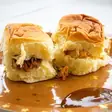 Memphis1 place
Catherine and Mary's
Memphis1 place
Catherine and Mary's
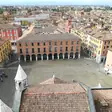 Modena1 place
Osteria Ruggera
Modena1 place
Osteria Ruggera
 Rotterdam1 place
Messina
Rotterdam1 place
Messina
Regional variations
Palermo and Western Sicily
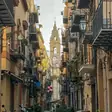
The Arab-influenced kitchen: cous-cous alla trapanese with fish broth, pasta con le sarde, sfincione (focaccia-like pizza), panelle (chickpea fritters), pane con la milza (spleen sandwich), arancini con burro. The street-food capital.
Catania and Eastern Sicily
Pasta alla Norma (the Catanese signature, with fried eggplant and salted ricotta), arancini con ragu (rice balls, masculine in Catania, feminine in Palermo), granita with brioche for breakfast, the Etna wine zone.
Ragusa and the Val di Noto (southeast)
Ragusano cheese, scacce (folded flatbread filled with tomato or onion), pasta with chocolate sauce (yes, savory mole-like), pork-heavy cuisine. The Baroque towns inland and the Modica chocolate (still ground stone-cold the Aztec way).
Trapani and the Egadi islands
Cous-cous tradition (Arab inheritance), tuna fisheries (the historic tonnara), salt pans, bottarga, Marsala wine. The Tunisian-facing kitchen.
Defining Sicilian dishes
- Pasta alla Norma
- Tomato sauce, fried eggplant, salted ricotta, basil. Named for Bellini's opera; the Catanese national dish.
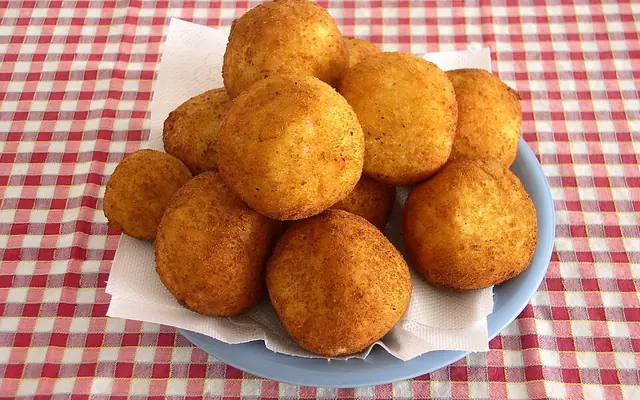
- Arancini / Arancine
- Stuffed rice balls (saffron rice, ragu, or butter-and-mozzarella core), breaded and deep-fried. Cone-shaped in Catania (masculine, arancini), round in Palermo (feminine, arancine).
- Caponata
- Sweet-and-sour eggplant relish with celery, capers, olives, tomato, pine nuts, sugar, vinegar. Served at room temperature as antipasto.
- Pasta con le sarde
- Bucatini with fresh sardines, wild fennel, pine nuts, raisins, saffron, anchovy. The Palermitan Arab inheritance dish.
- Sarde a beccafico
- Sardines butterflied, stuffed with breadcrumbs, pine nuts, raisins, and parsley, then rolled and baked. The Palermitan antipasto.
- Cous-cous alla trapanese
- Hand-rolled semolina cous-cous steamed and served with a fish broth of scorpionfish, mullet, prawns, and tomato. Trapani's Arab inheritance.
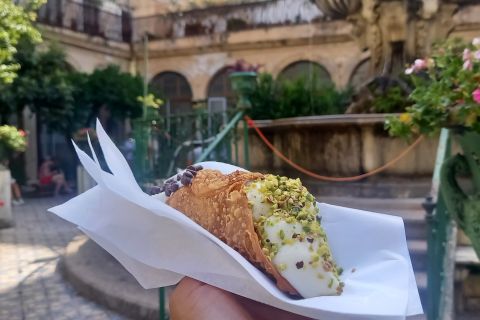
- Cannoli
- Crisp fried pastry tubes filled to order with sweet sheep's-milk ricotta, dotted with candied citrus or pistachio. Always filled at order, never in advance.
- Cassata siciliana
- Sponge cake layered with sweet ricotta, marzipan, and candied fruit, glazed in green icing. The Easter centerpiece dessert.
- Granita con brioche
- Coarse-textured fruit or coffee ice (almond, lemon, mulberry, pistachio) served with a brioche col tuppo. The Sicilian summer breakfast.
- Sfincione
- Thick spongy Palermitan focaccia-pizza topped with tomato, onion, anchovy, caciocavallo, and breadcrumbs. Eaten by the slab at street stalls.
- Pesce spada alla ghiotta
- Swordfish steaks braised with tomato, capers, olives, celery, and onion. The Messina classic.
How to order
At a trattoria, expect antipasto della casa to arrive as a parade of small plates (caponata, panelle, sarde a beccafico, polpo, marinated anchovies) for 12-18 euros and worth ordering as the starter for a table. Pasta is the heart of the meal; ask what's hand-rolled. Secondi will be local fish (the day's catch posted on a board) or grilled lamb, pork, or rabbit. Pastry and granita are not afterthoughts; finish at a pasticceria rather than at the trattoria.
The rookie mistakes: ordering a cappuccino with breakfast in summer (locals drink granita con brioche), expecting Italian-mainland pasta (Sicilian pasta is bolder, often with anchovies and breadcrumbs), and skipping the street food (a Palermo trip without arancini, panelle, and pane con la milza is incomplete).
What to drink with it
Sicilian wine is one of Italy's most exciting categories. Etna Rosso (Nerello Mascalese from volcanic soil) is the prestige red, comparable to Burgundy at half the price. Nero d'Avola is the everyday red; Grillo, Catarratto, and Carricante are the major whites. Marsala is the historic fortified wine, served as aperitif (Vergine, Superiore) or with dessert (Dolce). Granita and brioche for breakfast; bitter Averna or sweet limoncello as digestif.
Where to eat it
Palermo for street food and Arab-influenced classics; Catania for pasta alla Norma, arancini, and the Etna wine scene; Ragusa and Modica for baroque inland cuisine and chocolate; Trapani for cous-cous and tuna; Noto for granita and the southeast bakeries. Outside Sicily: New York (Brooklyn's historic Sicilian-American neighborhoods), Buenos Aires (deep Sicilian diaspora), Melbourne (Italian-Australian heart), and Tunis (where Sicilian cooking met its North African cousin) all hold serious Sicilian kitchens.
A short history
Sicily's culinary identity reflects 2,500 years of conquest: Greek colonization (8th c BCE), Roman annexation (3rd c BCE), Byzantine rule, then the Arab emirate of Sicily (827-1091 CE) that introduced citrus, sugarcane, almonds, and rice. The Normans, Hohenstaufens, and Spanish followed, each layering ingredients. Modern Sicilian cuisine codified in the 19th century alongside the Italian Risorgimento, but the regional flavor profile remains older and more Mediterranean than mainland Italian.
Frequently asked
Is Sicilian food the same as Italian-American food?
Italian-American descends largely from southern Italian (especially Neapolitan and Sicilian) immigrants, but the American version is heavier on red sauce, melted cheese, and large portions. Real Sicilian food is more varied, more vegetable-forward, and includes Arab inheritances (almonds, citrus, raisins) that Italian-American mostly dropped.
Where's the best granita?
Eastern Sicily, especially Catania, Acireale, Noto, and the Aeolian Islands. The granita-and-brioche breakfast is the Sicilian summer tradition; pistachio (from Bronte), almond (mandorla), and lemon are the canonical flavors.
Are arancini called arancini or arancine?
Both, by region. Palermo says arancina (feminine, round). Catania says arancino (masculine, cone-shaped). The dispute is centuries old and unresolved.
More cities are in research. Want Sicilian covered somewhere specific? Tell us where you want to eat.