Amsterdam
45 minutes
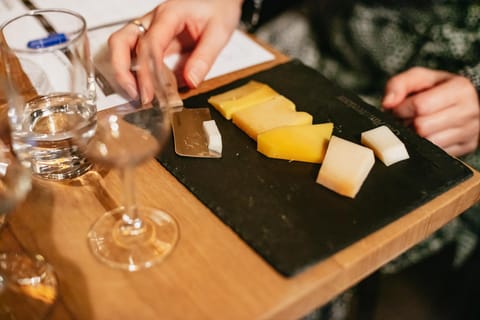
Old Amsterdam: Dutch Cheese Tasting with Wine Pairing
Discover the diversity of Dutch cheese with a cheese-tasting session in Amsterdam. Learn about Dutch cheese-making traditions, the story of Old...
from€20Check dates
42 editor-picked dutch restaurants across 5 cities.
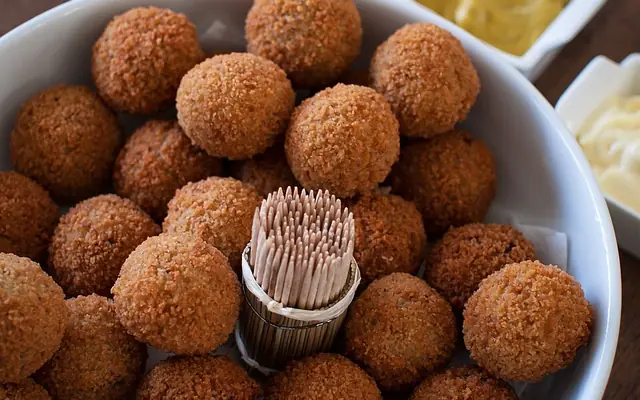
Dutch cuisine has a reputation problem abroad that does not match its reality at home. Outside the Netherlands, Dutch food is often dismissed as cheese and chips, but the actual repertoire is broader: cold-smoked and salt-cured herring eaten standing up at street stalls, dozens of farmhouse cheeses with regional varieties, stamppot (mashed potato with vegetables and sausage) for cold months, and an enormous range of street-food snacks built around frying, including bitterballen, kroketten, frikandel, and patatje oorlog.
The second, and arguably equal, half of Dutch food is the Indonesian inheritance. Three centuries of colonial rule left Indonesia inscribed into the Dutch table, and the rijsttafel (a procession of small Indonesian dishes around rice) is as Dutch a meal as stamppot. Sate, nasi goreng, bami goreng, gado-gado, and rendang are sold in every Dutch supermarket and feature on most casual menus. Indonesian-Dutch (Indisch) restaurants are a distinct category, separate from authentic Indonesian, with their own codified dishes.
Dutch dining is informal, direct, and unfussy. Lunches lean cold (sandwiches on dense bread, called broodjes, with cheese, kroket, or herring). Dinner is the warm meal of the day, eaten relatively early (18:00 to 19:30). Coffee culture is strong, and koffie verkeerd (the Dutch latte) plus a piece of appeltaart is a near-universal afternoon ritual.
Tours, tastings and classes that match this page, bookable on GetYourGuide.
45 minutes
Discover the diversity of Dutch cheese with a cheese-tasting session in Amsterdam. Learn about Dutch cheese-making traditions, the story of Old...

Guided tour · 2h 30m
Discover Philly's most popular food favorites on a guided foodie walking tour. Get a taste of the city's history and culture as you chow down on...
Guided tour · 1 hour
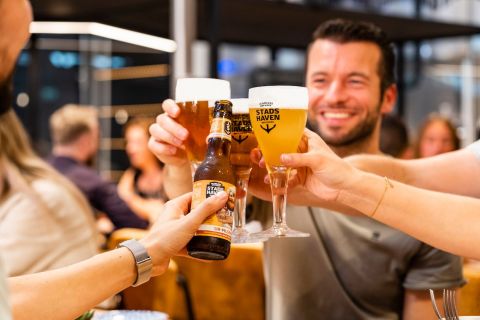
Tour Rotterdam's Stadshaven Brewery and learn all about how beer is made. Get to know more about the impressive building and taste a selection of...
Guided tour · 4 hours
Discover Utrecht, the most beautiful city in the Netherlands while tasting vegan delicacies. Pass the Dom tower, and taste local specialties like...
The best-scored dutch place in each of 5 cities.
Maeve in Utrecht holds one Michelin star in the 2025 guide. Tommy Janssen cooks Dutch terroir with Japanese technique and locally sourced vegetables.
OrderFive-course tasting menu with natural wine pairings by Vera Voorend
The original kapsalon restaurant -- birthplace of Rotterdam's signature dish in 2003 -- stays open until 1am every night. The most historically significant.
Modern Dutch restaurant on Javaplein in Indische Buurt, set-menu format 3 to 5 courses from Dutch soil, game and sustainable fish, open kitchen, brick walls.
Why locals goFar enough east in Indische Buurt that day-trippers skip it; the city's reference game-and-modern-Dutch room runs at half the price of central equivalents.
TipThree-course menu early in the week is the value sweet spot.
Beiler's Doughnuts in Philadelphia is the Pennsylvania Dutch Reading Terminal Market bakery since 1984, with hand-cut yeasted doughnuts for 3 dollars.
TryHand-cut yeasted doughnut
Broodje Benidorm has baked Dutch bread in Benidorm since 2023, from tijgerbrood and multigrain loaves to Dutch pastries and filled broodjes for lunch.
Worth the queueTijgerbrood, Dutch tiger bread
TipIt is a morning bakery, open Wednesday to Sunday until 14:00, and announces its seasonal bakes and closures on Facebook in Dutch.
Maeve in Utrecht holds one Michelin star in the 2025 guide. Tommy Janssen cooks Dutch terroir with Japanese technique and locally sourced vegetables.
OrderFive-course tasting menu with natural wine pairings by Vera Voorend
The original kapsalon restaurant -- birthplace of Rotterdam's signature dish in 2003 -- stays open until 1am every night. The most historically significant.
Modern Dutch restaurant on Javaplein in Indische Buurt, set-menu format 3 to 5 courses from Dutch soil, game and sustainable fish, open kitchen, brick walls.
Why locals goFar enough east in Indische Buurt that day-trippers skip it; the city's reference game-and-modern-Dutch room runs at half the price of central equivalents.
TipThree-course menu early in the week is the value sweet spot.
Karel 5 holds one Michelin star in the 2025 guide inside a 14th-century Utrecht monastery. Leon Mazairac refreshes the seasonal menu quarterly.
OrderFive-course seasonal menu with wine pairing, Wed to Sat
De Kas grows its own vegetables in a 1926 municipal greenhouse in Frankendael Park and runs a daily-changing menu out the kitchen built inside the glasshouse.
OrderThere is no choice: the day's tasting menu, whatever has come in from the garden.
TipLunch is the value play. Trams 9 and 14 stop nearby; cycling is the local move.
The Witte de With branch of Frietboutique stays open late on weekends, serving twice-fried patat and house sauces to bar-hoppers from the Witte de With strip.
Van Dobben between Rembrandtplein and Muntplein has run an Amsterdam eetsalon since 1945, the rundvleeskroket on a soft white bun the city's reference.
TryBroodje kroket and rundvleeskroket
Hemel en Aarde in the Michelin Guide Netherlands occupies the former gentlemen club inside Nox Hotel. Chef Rene van der Weijden, seasonal Dutch tasting.
OrderHemels five-course menu with wine pairing by the glass
Beiler's Doughnuts in Philadelphia is the Pennsylvania Dutch Reading Terminal Market bakery since 1984, with hand-cut yeasted doughnuts for 3 dollars.
TryHand-cut yeasted doughnut
A Michelin-starred modern Dutch fine-dining restaurant in Capelle aan den IJssel, just outside Rotterdam, with a tasting menu centred on Dutch produce.
Book2-3 weeks ahead
Broodje Benidorm has baked Dutch bread in Benidorm since 2023, from tijgerbrood and multigrain loaves to Dutch pastries and filled broodjes for lunch.
Worth the queueTijgerbrood, Dutch tiger bread
TipIt is a morning bakery, open Wednesday to Sunday until 14:00, and announces its seasonal bakes and closures on Facebook in Dutch.
Café De Kroon is a Dutch eetcafé on Avenida de Murcia in Benidorm's Levante quarter, a terrace bar serving snacks and plain Dutch and Belgian comfort food.
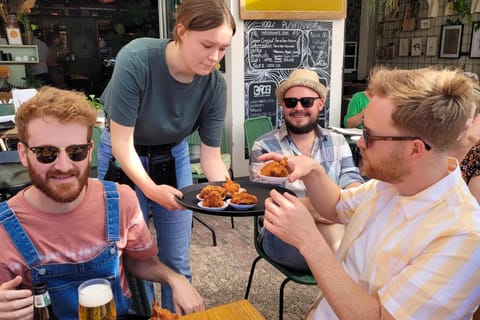
OrderA frikandel or a pair of kroketten with a Belgian beer on the terrace.
TipIt draws a Dutch and Belgian crowd and posts in Dutch on its Facebook page; Sunday is the one closing day.
Urban Dutch with the strongest Indonesian and Surinamese influence. Herring stalls, street kroketten, modern bistros, and the rijsttafel tradition all concentrate here. Rotterdam adds a Caribbean and West African layer through Suriname-Dutch cooking.
Heavier farmhouse cooking, sugar bread (suikerbrood), Frisian dry sausage (drûge woarst), and the deep cheese tradition (Friese nagelkaas, spiced with cloves). Cold-weather stamppot variants dominate.
Closer to Belgian and German cooking. Zuurvlees (sweet-sour beef braise, Limburg's answer to carbonnade), vlaai (fruit-topped tart), and a stronger Catholic culinary calendar with carnival foods like nonnevotten (sugared fried dough).
At a herring stall, ask for haring with uitjes (onions) and zuur (pickle). You can have it as a sandwich (broodje haring) or whole on a paper plate with toothpicks. At a brown café (the traditional Dutch pub), bitterballen are the standard order with beer; ask for portie bitterballen and a Heineken or Amstel. At a FEBO automaat, the snacks live behind little glass doors; insert coins to release. At a sit-down restaurant, lunch and dinner menus are usually short and ordered by main; sides come on the plate. Bills are split casually (the Dutch invented going Dutch); tipping is included, with a round-up of one to two euros for good service. The rookie mistakes are asking for a large entrée at lunch (the Dutch eat cold sandwiches midday), expecting tap water (you have to specify; bottled is the default), and treating Indonesian food at an Indisch restaurant as the same as authentic Indonesian (the recipes have drifted).
Beer is the most common pair. Heineken, Amstel, Bavaria, and Grolsch are the mass-market lagers; craft is widening fast, with Brouwerij 't IJ and Oedipus from Amsterdam leading. Genever (jonge or oude) is the traditional Dutch spirit, predating English gin by two centuries, drunk neat in a tulip glass from the rim without lifting (kopstootje, with a beer chaser). Dutch wine is minor; Indonesian-Dutch food often pairs with off-dry German Riesling. With coffee and dessert, Dutch coffee is filter or espresso-based; appeltaart with slagroom is the classic afternoon snack.
Amsterdam concentrates the full range: from herring stalls (Stubbe's Haring, Frens Haringhandel) to FEBO automats to high-end Indonesian (Sampurna, Tempo Doeloe, Blauw) to modern Dutch tasting menus. Rotterdam adds a stronger Surinamese-Dutch scene. The Hague has the densest Indisch restaurant cluster (the colonial-return community settled there). For traditional rural Dutch cooking, head to Friesland, Drenthe, or Zeeland. Outside the Netherlands, Dutch food rarely travels except as cheese; Indonesian-Dutch is more common in former colonial cities (Jakarta carries an interesting reverse-import scene).
Dutch cuisine took its modern shape during the Golden Age (17th century), when global trade brought spices, sugar, and coffee into a national diet that had been austere and Calvinist. The Indonesian colonial inheritance arrived in waves from the 17th century through 1949, codified into Dutch home cooking by the 'Indische Nederlanders' who repatriated after Indonesian independence. Stroopwafel and frikandel are 20th-century inventions; herring and cheese are medieval.
No. The Dutch eat a huge amount of Indonesian and Indonesian-Dutch food, plus an extensive snack-and-fried-food culture (bitterballen, kroket, frikandel, friet) that visitors rarely see in restaurants. The cheese and herring reputation comes from what travels easily as a souvenir.
Indisch is the Dutch-Indonesian fusion that developed in the colonial era and consolidated in Holland after 1949. Recipes shifted: less heat, more sweetness, more dairy, larger portions. Authentic Indonesian restaurants in Amsterdam are a separate category and have grown sharply since the 1990s.
Hold by the tail, tilt the head into your mouth, and bite from the top. Onions and pickles go on top. The fish has been gutted but not deboned; the spine is soft enough to eat. The standing-and-tilting technique is the local marker.
More cities are in research. Want dutch covered somewhere specific? Tell us where you want to eat.