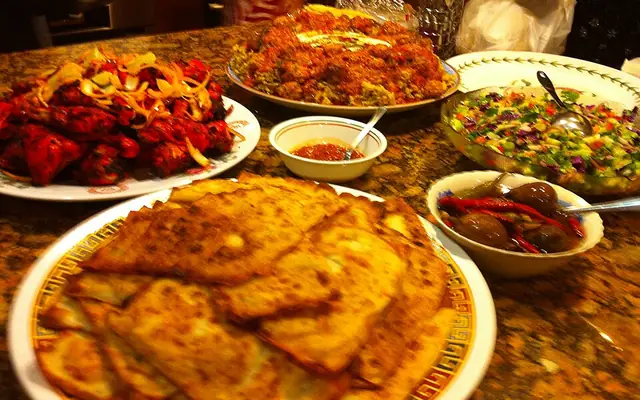
Afghan cuisine sits at the geographical and culinary crossroads of Central Asia, Persia, India, and the Middle East, drawing techniques from each while remaining distinct. The defining grammar is rice (especially the long-grain basmati and sela varieties), slow-roasted lamb, fresh-baked bread (naan-e Afghan, often 50 to 80 centimeters long), and a small but precise spice repertoire: dried coriander, cumin, black pepper, cardamom, saffron, and dried mint. Afghan cooking uses less heat than Indian or Pakistani cuisines; the dominant flavors are aromatic and savory rather than spicy.
The centerpiece dish is qabili palau (or Kabuli pulao), a layered rice dish with lamb, raisins, julienned carrot, and toasted nuts, considered the national dish. Mantu (steamed dumplings filled with onion and lamb, topped with yogurt and a tomato-lentil sauce) and ashak (leek-filled dumplings with a similar topping) reflect Central Asian dumpling traditions. Aushak and mantu are eaten across Afghanistan; the difference in shape and filling distinguishes them. Kebabs (chapli, shami, seekh, lamb chop) overlap with Pakistani versions but use Afghan spice blends with less chile.
Afghan hospitality is one of the most formalized in Central Asia. Tea (chai), almost always green and sometimes flavored with cardamom, is served constantly. The chai-khana (tea house) is a social institution. Meals are eaten on the floor at a dastarkhan (cloth spread), with diners sitting cross-legged around large platters. Bread is shared (one large naan typically feeds two or three). Eating is done with the right hand, with bread used to scoop or wrap.
Book a food experience
Tours, tastings and classes from the cities on this page, bookable on GetYourGuide.
Choose a 2-hour express or 3-hour full Boston food tour. Taste clam chowder, arancini, brick oven pizza, cannoli, and more while exploring the North...
Fells Point is the wonderful historic Port of Baltimore. Enjoy small plates from local culinary gems! Learn some fun history, and enjoy spending the...
Kabob Palace just outside Washington DC is the Crystal City Eads Street 24-hour Afghan halal kabob counter, the metro area's most-known late-night halal lamb.
TryLamb and chicken kabobs
TipThe kitchen runs around the clock; the lamb kabob is $23.75 and the kabob-e-kubideh $18.95, each served with bread, rice and salad.
Kabob House serves halal Afghan and Persian cuisine, including lamb kabobs, beef kofta, and fragrant basmati rice, to Boise's diverse west side community.
Sameem plates Afghan kabuli palaw, aushak dumplings and grilled kabobs in The Grove, an affordable kitchen that has fed the city Afghan classics for years.
OrderAushak leek dumplings, kabuli palaw and sambosas.
TipThe aushak leek dumplings under yogurt and meat sauce are the order to lead with. Plenty of vegetarian dishes too.
Kabob Palace just outside Washington DC is the Crystal City Eads Street 24-hour Afghan halal kabob counter, the metro area's most-known late-night halal lamb.
TryLamb and chicken kabobs
TipThe kitchen runs around the clock; the lamb kabob is $23.75 and the kabob-e-kubideh $18.95, each served with bread, rice and salad.
Lapis in Washington DC is Shamim Popal's Adams Morgan Afghan dining room on Columbia Road, a family-run kitchen with mantu dumplings and the Kabuli pulao.
OrderThe mantu dumplings under tomato sauce and yoghurt; the menu's editorial signature.
TipThe brunch buffet on Saturday and Sunday is the city's best Afghan-food deal at under $25 a head.
Kabob House serves halal Afghan and Persian cuisine, including lamb kabobs, beef kofta, and fragrant basmati rice, to Boise's diverse west side community.
Sameem plates Afghan kabuli palaw, aushak dumplings and grilled kabobs in The Grove, an affordable kitchen that has fed the city Afghan classics for years.
OrderAushak leek dumplings, kabuli palaw and sambosas.
TipThe aushak leek dumplings under yogurt and meat sauce are the order to lead with. Plenty of vegetarian dishes too.
Afghan Kebab House grills chapli kebab near the Montreal Naif Hotel in Naif, a Deira kitchen most visitors walk straight past on their way to the souks.
Why locals goIt sits on a Naif side street near the Montreal Naif Hotel, a workers' lunch room rather than a tourist stop.
TipOrder the bolani as a starter while the chapli kebab finishes on the grill.
The most refined regional tradition. Qabili palau in its canonical form, mantu, ashak, and the broader meat-and-rice repertoire. Strong Persian and Mughal influence; the Kabul restaurant scene drew on both.
Northern Afghanistan (Mazar-e-Sharif, Balkh)
Closer to Uzbek and Tajik traditions. Heavier on dumplings (mantu in Uzbek style), bolani (stuffed flatbread), and the use of laghman noodles. The Tajik-influenced kitchen is dense and noodle-heavy.
Southern Afghanistan (Kandahar, Helmand)
Pashtun cooking with strong Pakistani-Balochi overlap. Chapli kebab (the Peshawar dish that crosses the border), shorwa (lamb soup), pit-roasted meats. Spicier than central Afghan cuisine.
Western Afghanistan (Herat)
Persian-influenced. Lamb and saffron rice dishes, sangak-style bread, the use of pomegranate molasses and walnut, and stronger desserts including jelabi and baklava variants.
Defining afghan dishes
Qabili Palau
Layered rice with lamb shank, raisins, julienned carrot, almonds, pistachios, and a saffron-touched broth. The Afghan national dish. Cooked dum-style (sealed pot, slow steam) for the final hour.
Mantu
Steamed dumplings with a thin wheat-flour wrapper filled with minced lamb, onion, and chile, topped with garlic-yogurt sauce and a chana dal-tomato sauce. Topped with dried mint and red chile. The Afghan dumpling classic.
Aushak / Ashak
Leek-and-scallion-filled steamed dumplings (the vegetarian companion to mantu), topped with garlic yogurt and a meat-tomato sauce. Often served at weddings and feasts.
Bolani
Stuffed flatbread filled with leek, potato, pumpkin, or lentil, pan-fried in oil until crisp. Eaten with mint-yogurt sauce. A casual street and home dish.
Chapli Kebab
Flat ground-meat patty (originally Peshawari, also Afghan) with pomegranate seed, coriander, dried chile, and tomato, shallow-fried in oil. Eaten with naan.
Kebab-e Chopan
Shepherd's lamb kebab. Lamb cubes marinated in onion juice and yogurt, skewered with lamb fat between pieces, grilled over charcoal. The classic Afghan grill.
Shorwa
Slow-simmered lamb soup with vegetables, chickpeas, and bread soaked in the broth. The Afghan winter staple. Served with chunks of naan torn into the bowl.
Sheer Yakh
Afghan ice cream. Hand-churned with cream, milk, cardamom, rosewater, and saffron, often with chunks of pistachio. Sold from carts during summer.
Firnee
Cardamom-and-rosewater-perfumed rice flour pudding, topped with pistachios. The everyday Afghan dessert.
Naan-e Afghani
Large oval flatbread (50 to 80 centimeters long) baked in a tandoor, often patterned with finger marks and sesame or nigella seeds. Eaten with everything.
How to order
At an Afghan restaurant, the meal centers on rice (Qabili palau is the gateway), grilled meat (kebab-e chopan or chapli kebab), and a dumpling course (mantu or ashak). A typical four-person order includes one large palau plate, a kebab platter, a dumpling dish, a bolani, a salad (sliced cucumber, tomato, raw onion), and a small bowl of soup or shorwa. Bread arrives free and in abundance. Eat the bread first to test the kitchen; a great Afghan naan should be slightly chewy, charred underneath, and warm. Pour green tea throughout the meal. Tipping 10-15% is standard at Afghan restaurants in the diaspora; in Afghanistan, a smaller round-up is the norm. The rookie mistakes are ordering everything spicy (Afghan cuisine is aromatic, not chile-hot), using a fork as the primary utensil (bread is the primary scooper, fingers second), and skipping the salad (the raw vegetable balance is part of the meal structure).
What to drink with it
Green tea (chai sabz) is the universal Afghan pair, drunk before, during, and after the meal in small handle-less cups. Cardamom and saffron sometimes flavor it. Doogh (salted yogurt and water with mint, similar to Iranian doogh or Turkish ayran) is the classic accompaniment to grilled meats and palau. Limeade with mint for hot weather. Alcohol is restricted in Afghanistan and absent from authentic Afghan restaurants. Outside Afghanistan, Afghan restaurants in the diaspora occasionally serve wine; the cuisine pairs best with off-dry whites or light reds.
Where to eat it
Kabul historically held the deepest Afghan food scene, with the restaurants of Wazir Akbar Khan and Shar-e Naw representing the modern Afghan kitchen. Mazar-e-Sharif for northern dishes; Herat for Persian-influenced cuisine. Outside Afghanistan, the diaspora has built strong scenes in Fremont and Hayward in California (the densest Afghan community in the US), Northern Virginia (Khyber Pass, Helmand), Toronto, Frankfurt (one of the largest Afghan diasporas in Europe), Hamburg, London (Ariana, Kabul Palace), and Sydney. Helmand Restaurant in Baltimore (owned by Hamid Karzai's brother) was the first Afghan restaurant to gain US national attention in the 1980s.
A short history
Afghan cuisine took its modern shape across centuries of empire and trade: the Persian Safavid influence, the Mughal court, the Silk Road exchange with Central Asia and China, and the British-Russian Great Game period. The post-1978 Soviet invasion and the subsequent civil wars dispersed Afghan cooks across Pakistan, Iran, the Gulf, Europe, and North America, creating a global Afghan restaurant tradition often more developed than in Afghanistan itself. UNESCO has not formally listed Afghan cuisine, but qabili palau is widely recognized as the national dish.
Frequently asked
Is Afghan food spicy?
No. Afghan cuisine uses minimal chile compared to neighboring Pakistani and Indian traditions. The dominant flavors are aromatic (cardamom, saffron, dried mint) and savory (cumin, coriander, black pepper). Some Pashtun southern dishes (chapli kebab) have moderate heat; most Afghan cooking is mild.
What is the difference between mantu and aushak?
Both are steamed dumplings with garlic yogurt and meat-tomato sauce on top. The difference is the filling: mantu has spiced ground lamb and onion; aushak has chopped leek and scallion (vegetarian). They are often served alongside each other at festive meals.
Why is qabili palau called the national dish?
Qabili palau is eaten at virtually every Afghan celebration, family gathering, and guest meal. The dish combines rice (the staple grain), lamb (the prestige meat), and the symbolic carrot-and-raisin topping (sweetness and abundance). It is the most universally agreed-upon Afghan dish across regions, ethnicities, and class lines.