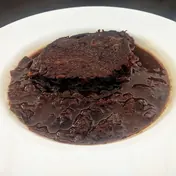
Pašticada is a Dalmatian beef dish: a whole eye of round marinated overnight in wine vinegar, stuffed with garlic, cloves, carrot, celery and bacon, and stewed in sweet prošek with prunes.
The exact origin of pašticada is unclear. Wikipedia says its roots may trace to French cuisine brought during the Napoleonic conquest, while another theory points to the Veronese pastissada de caval; Dalmatia and Corfu were both once ruled by Venice. The oldest known recipe for Dalmatian pašticada dates to the fifteenth century and is documented in Dubrovnik. It is usually served with gnocchi or homemade pasta.
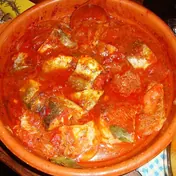
Brudet is a fish stew from the Croatian regions of Dalmatia, Kvarner and Istria: several kinds of fish stewed with spices, vegetables and red or white wine, usually served with polenta or toasted bread.
Wikipedia describes brudet, also spelled brodet, as a signature dish of the Italian Adriatic coast too, and says its style, ingredients and flavour vary with the cook; some versions use vinegar as well as wine. Konoba Korta in Diocletian's Palace names brudet, with peka and black risotto, among the dishes its kitchen is known for on its own site.
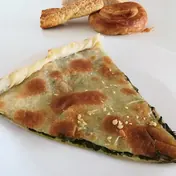
Soparnik is the chard pie of Poljica, between Split and Omiš: two thin sheets of unleavened dough around a filling of chard, garlic and olive oil, traditionally baked on a hearth under embers.
Wikipedia dates soparnik to about the 13th century and says it was probably created under oriental influence, as its name suggests. In the past it was prepared as a fasting dish and for celebrations, and its original season was the colder time of the year, when older, sweeter chard was available. The preparation method is a protected intangible cultural heritage of Croatia, and in 2016 the European Commission entered the dish in its register of protected names. Taste of Split 2026 ended with a soparnik workshop.
Come with an empty stomach to our Split food tour and experience the exciting combination of wine, food and history in Split with a fun & knowledgeable local guide by ...
Split Cooking Classes are great for all levels and lovers of food and they are designed to give you an authentic taste of Croatian cuisine. Your class will include a v...
After we got all ingredients on Green Market, we ll had to my kitchen and terrace in heart of Split.
We 'll cook, talk, eat, drink...good food in good mood.
I try to i...
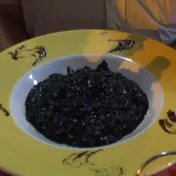
Crni rižot is black risotto: short-grain rice cooked with onion, garlic, white wine and olive oil, with squid, calamari or cuttlefish added and the ink that turns the dish black.
Total Croatia News calls crni rižot one of the least attractive but tastiest dishes on the Adriatic and says it is on the menu of most restaurants along the coast. In Venice it is the signature risotto nero di seppia, and the author suggests that is how it reached Croatia, given Venetian influence on the Dalmatian coast. In Split, Konoba Varos lists a black cuttlefish risotto and Konoba Korta names black risotto among its favourite dishes.
Peka, called sač elsewhere in the Balkans, is a bell-shaped lid placed over food in a hearth or oven and covered with ashes and live coals; Konoba Varos lists veal, lamb and octopus under it.
Wikipedia says the sač probably comes from the saj, a curved metal utensil used in the Middle East and large parts of Asia, and that it is used today across the Balkans; lamb is its illustrated example. In Split, Konoba Varos lists peka of veal at €25, lamb at €27 and octopus at €32 among its house specialities, to be ordered three hours ahead, and Konoba Korta names peka, brudet and black risotto among its favourite dishes.
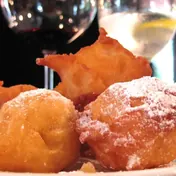
Fritule are small fried doughnuts from the Trieste and Venice area; the Croatian version is made particularly for Christmas and is usually flavoured with rum and citrus zest, with raisins in the dough.
Wikipedia describes fritule as a type of Italian fried doughnut eaten in and around Friuli-Venezia Giulia and Veneto, where the Venetian version is round, yeast-leavened and served only during Carnival. The Croatian and Montenegrin variants are named as separate regional forms, and in Croatia fritule are made particularly for Christmas. Typical flavourings are raisins and orange or lemon peel.
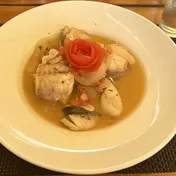
Gregada is a Croatian fish dish from the island of Hvar and one of the oldest ways to prepare fish in Dalmatia; at Restaurant Kadena in Split the gregada is a fish stew served for two.
Wikipedia says gregada is a Croatian dish from the island of Hvar, that its origins most likely lie in Illyrian culinary traditions, and that it is one of the oldest ways to prepare fish in Dalmatia. The Michelin Guide entry for Restaurant Kadena in Split points to the gregada, a fish stew, as a dish for two to order.
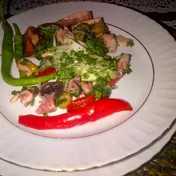
Octopus salad is a beloved dish along the Dalmatian coast, typically made with tender octopus, fresh vegetables, olive oil and a tangy vinaigrette, and best served chilled or at room temperature.
Dalmatia Oil's recipe simmers the octopus in unsalted water for about 45 minutes to an hour, until tender, and serves the salad as a starter or light main course, often with a glass of Croatian white wine such as Pošip or Malvazija. In Split, Konoba Varos lists an octopus salad among its cold starters, priced at €19.
Dalmatinski pršut is Dalmatian prosciutto, a protected geographical indication that, unlike the Italian product, is smoked; Konoba Varos and Konoba Korta both list it as a starter.
Wikipedia lists Dalmatinski pršut as a protected geographical indication registered in 2016, and says the pršut of Dalmatia and Herzegovina is smoked, unlike the Slovenian, Istrian and Krk versions. In Split, Konoba Varos lists Dalmatian smoked ham at €13 per 100 g, Konoba Korta lists Dalmatinski pršut among its starters, and Lvxor serves Dalmatian prosciutto with burrata.
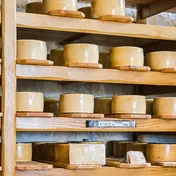
Paški sir is a hard sheep's milk cheese from the Adriatic island of Pag, flavoured by the aromatic plants the sheep graze and by the salt dust the Bora wind spreads over the island.
Wikipedia notes that the Bora wind spreads salt dust over Pag, so only resilient, aromatic plants survive, and the sheep that graze them give the milk its taste. The European Commission granted protected designation of origin on 25 November 2019. The cheese is aged five to eighteen months depending on the end product: younger cheeses are creamy and yellow, older ones darker, harder and grainy. Paška sirana won gold at the 2017 Global Cheese Awards.
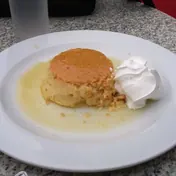
Rožata is a traditional medieval dessert widespread around the Adriatic: a caramel custard of eggs, sugar and milk, slowly baked in a bain-marie and flavoured with rozalin, the Dubrovnik rose liqueur.
The 196 Flavors guide says rožata comes from Dubrovnik and that the recipe dates to the end of the 15th century. The local version contains a sweet liquor made from brandy, or another strong alcohol, and rose petals. Wikipedia describes the dessert as flavoured with the Dubrovnik liqueur rozalin, which gives it its characteristic aroma, with a documented history stretching from medieval times.
Plavac mali is the primary red wine grape of the Dalmatian coast, grown on Pelješac and the islands of Hvar, Brač and Vis, and a cross of Crljenak Kaštelanski (Zinfandel) and Dobričić from Šolta.
Wikipedia names Crljenak Kaštelanski (Zinfandel) and Dobričić, an ancient variety from the island of Šolta, as the parents of Plavac mali, and says its wines are high in alcohol, typically 13 percent and up to 17, and in tannins. Dingač on the Pelješac peninsula became Croatia's first protected wine region in 1961, with Plavac mali as its sole authorised variety. At Konoba Varos in Split a glass of Pri-Mus Plavac Mali is €6.50.
Watch out for: Sulphites
Signature Dishes in Split, FAQ
What food is Split known for?
Split's signature dishes include Pasticada, Brudet, Soparnik, Crni Rizot (Black Risotto), Peka (Under the Bell). See our signature dishes chapter for where to eat each.