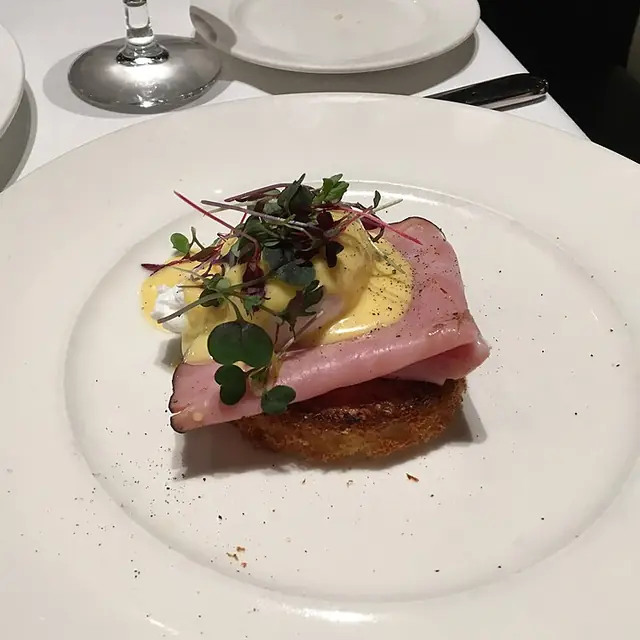
Eggs Benedict is a split, toasted English muffin topped with Canadian bacon or ham, a poached egg and hollandaise sauce, a brunch dish believed to have been born in New York.

Its origin is contested. Delmonico's in Lower Manhattan says on its menu that the dish was first created in its ovens in 1860, and its former chef Charles Ranhofer published a recipe for Eggs a la Benedick. In 1942 the retired stockbroker Lemuel Benedict told The New Yorker that in 1894 he had ordered buttered toast, poached eggs, crisp bacon and hollandaise at the Waldorf Hotel to cure a hangover, and that the maitre d' Oscar Tschirky put it on the menu with ham and an English muffin. Variations swap the bacon for smoked salmon, spinach or crab; Sadelle's offers salmon, ham or avocado.

Where to eat Eggs Benedict in New York City

2 editor picks for Eggs Benedict in New York City, ranked by editorial score. All New York City signature dishes · Eggs Benedict across every city.

More places near Sadelle's and Russ & Daughters Cafe

Not on this list, but close by, nearest first. Every one is in our guide with its address, hours and what to order.

Make it at home

Serves 230 minIntermediate

Ingredients

  • 4 large eggs (very fresh)
  • 1 tbsp white wine vinegar
  • 2 English muffins, split
  • 4 slices Canadian bacon (or thick-cut ham)
  • 2 tbsp unsalted butter
  • For the hollandaise: 3 large egg yolks
  • 1 tbsp lemon juice
  • 1 tsp white wine vinegar
  • 175g unsalted butter (melted and hot)
  • pinch of fine sea salt
  • pinch of cayenne pepper
  • Chives, finely chopped, to serve
  • Freshly cracked black pepper

Method

  1. Make the hollandaise: bring a small saucepan of water to a simmer. Whisk yolks, lemon juice and vinegar in a heatproof bowl over the simmering water (the bowl must not touch the water).
  2. Whisk constantly for 2 to 3 minutes until the yolks thicken to a loose ribbon. Take off the heat.
  3. Drizzle the hot melted butter into the yolks in a thin steady stream, whisking constantly, until you have a glossy hollandaise. Season with salt and a pinch of cayenne. Keep warm over barely-warm water; whisk occasionally.
  4. Toast the English muffin halves until deep golden. Butter generously while hot.
  5. Heat the butter in a small frying pan over medium; cook the Canadian bacon 2 to 3 minutes per side until lightly browned. Set aside.
  6. Bring a wide pan of water to a bare simmer (do not boil). Add 1 tbsp vinegar. Crack each egg into a fine sieve, drain off the watery white, then slide each into the simmering water from a small cup.
  7. Poach 3 minutes; the white should set firmly around a still-runny yolk. Lift each egg out with a slotted spoon onto kitchen paper to drain.
  8. Assemble each plate: place a muffin half on the plate, top with Canadian bacon, then a poached egg, then a generous ladle of hollandaise.
  9. Scatter chives over and crack fresh black pepper on top. Serve at once; hollandaise waits for no one.

Editor tip. Sieve each cracked egg before poaching to lose the watery white; clean compact eggs result. Rescue split hollandaise with a fresh yolk and hot water.

Common allergens: Gluten, Egg, Dairy, Pork.