The plates that define Indianapolis: what they are, where they came from, and where to eat the canonical version.
Signature dishes
-

Breaded pork tenderloin sandwich ★ 4.9
Indiana's unofficial state sandwich, a pork cutlet pounded paper-thin, dredged in seasoned breadcrumbs, deep-fried until plate-wide and served on a small hamburger bun with yellow mustard, pickles and raw onion.
Where to try it: Workingman's Friend, The Aristocrat Pub & Restaurant
Price: 8 to 14 dollars
Nick Freienstein, son of German immigrants, opened Nick's Kitchen in Huntington in 1908 and adapted the Wiener schnitzel of his parents' kitchen for Indiana ingredients. Veal was scarce and expensive in early-1900s Indiana but pork was abundant, so he butterflied a pork loin, pounded it thin, dredged it and fried it. Served on a hamburger bun for one-handed eating, the sandwich migrated across the state through diners and county fairgrounds. The Indiana legislature has considered making it the official state sandwich.
Watch out for: Gluten, Egg
-
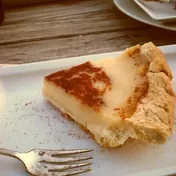
Sugar cream pie ★ 4.9
Indiana's official state pie since 2009, a single-crust custard pie made with cream, sugar, flour and butter, baked golden and finished with nutmeg dust at every Hoosier bakery.
Where to try it: Long's Bakery, Taylor's Bakery, Shapiro's Delicatessen
Price: 5 to 6 dollars per slice
Quaker and Amish settlers brought the recipe to Indiana in the early 1800s. The pie became Indiana's official state pie in 2009. Wick's Pies of Winchester produces over 750,000 of them each year for groceries and diners statewide, and Mrs. Wick's classic version is the canonical commercial sugar cream pie.
Watch out for: Gluten, Dairy, Egg
-
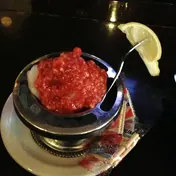
St. Elmo shrimp cocktail ★ 4.9
The most famous appetizer in Indianapolis, a chilled jumbo-shrimp cocktail set in St. Elmo Steak House's house horseradish sauce so fierce it brings the eyes to water from across the dining room.
Where to try it: St. Elmo Steak House
Price: 18 dollars
St. Elmo Steak House has served the cocktail since the early 1900s in its 127 South Illinois Street dining room. The kitchen grinds the horseradish daily; commercial prepared horseradish is not used. National food writers have called it one of the most-imitated appetizers in American steakhouse cooking, and St. Elmo bottles the sauce for retail through its online store.
Watch out for: Shellfish
-
Shapiro's Reuben ★ 4.7
Shapiro's Delicatessen's New York-style Reuben, stacked with house-cured corned beef, sauerkraut, Swiss cheese and Russian dressing on house-baked rye,.
Where to try it: Shapiro's Delicatessen
Price: 16 to 18 dollars
Louis and Rebecca Shapiro emigrated from Ukraine in the late 1800s, sold coffee and flour from a horse-drawn wagon, and opened their grocery and deli at 808 South Meridian Street in 1905. The deli has stayed in the family for four generations and still cures the corned beef, bakes the rye and slices to order. The Reuben has been the signature sandwich for the better part of a century.
Watch out for: Gluten, Dairy
-
Hoosier ham balls ★ 4.2
Ground ham mixed with breadcrumbs, milk and egg, formed into meatballs, baked under a brown-sugar and mustard glaze. A reliable Indianapolis pick.
Price: 10 to 14 dollars
Ham balls show up in Indiana church cookbooks from the 1930s onward, almost always with a brown-sugar, vinegar and dry-mustard glaze. The dish is closely associated with the Brethren, Mennonite and rural Methodist communities of central and northern Indiana, where ground ham was a way to stretch a Sunday roast.
Watch out for: Gluten, Dairy, Egg, Mustard
-
Fried biscuits and apple butter ★ 4.4
Small pillows of yeast biscuit dough deep-fried until puffed and golden, served warm with a side ramekin of spiced apple butter. A reliable Indianapolis pick.
Price: 7 to 9 dollars per basket
The Nashville House in Brown County popularized the fried biscuit with apple butter combination from the 1920s onward, drawing weekend visitors from Indianapolis to the Brown County art-colony town. The dish has roots in German-Hoosier farm cooking where leftover dough was fried in lard and served with fruit preserves, and the Bill Knight's Farm apple butter pairing remains the Indiana orchard signature.
Watch out for: Gluten, Dairy
-
Indianapolis tavern-style pizza ★ 4.0
A thin, cracker-crusted pizza cut into small squares rather than wedges, the Midwest tavern style common in central Indiana neighborhood bars.
Where to try it: Iaria's Italian Restaurant, The Aristocrat Pub & Restaurant
Price: 15 to 22 dollars
Tavern-style pizza migrated to Indianapolis from St. Louis and Chicago neighborhood bars in the mid-20th century, the format crystallised at Iaria's Italian Restaurant and The Aristocrat Pub by the 1960s. The square cut and cracker crust suited eat-with-one-hand bar dining and a low oven; the Italian sausage on top reflected the central Indiana pork supply, with the canonical version pulled by neighborhood tap houses across the Mass Ave corridor.
Watch out for: Gluten, Dairy
-
Hoosier fried chicken ★ 4.5
Buttermilk-brined chicken, seasoned, breaded and fried to order in cast iron, the Hoosier standard threading Upland South and Black migration cooking through Indianapolis neighborhood rooms.
Where to try it: The Eagle Mass Ave, Workingman's Friend
Price: 16 to 24 dollars
Indiana fried-chicken culture pulls from the Upland South and the Black South, transmitted through both white-flight migration and the Great Migration into Indianapolis neighborhoods. The pan-fried, cast-iron preparation predates the pressure-fried fast-food version and survives at independent rooms across the city.
Watch out for: Gluten, Dairy, Egg
-
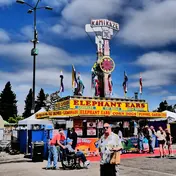
Elephant ears ★ 4.0
Indiana State Fair classic. A flattened circle of yeast dough fried in vegetable oil to a wide, ridged disc and dusted heavily with cinnamon sugar.
Where to try it: The Garage Food Hall, The Original Farmers' Market
Price: 8 to 10 dollars
Elephant ears arrived at the Indiana State Fair in the 1970s and have stayed in the food-building rotation ever since, alongside corn dogs, deep-fried Snickers and the long-running Pioneer Village pioneer-cooking demo. The same disc shape and topping appear at midwestern county fairs from Ohio to Iowa under various names (palmiers, fried dough, beaver tails); in Indiana it is reliably called an elephant ear and dusted heavily with cinnamon sugar.
Watch out for: Gluten
-
Workingman's Friend double cheeseburger ★ 4.6
Two thin all-beef patties seared hard on a flat-top, with melted American cheese, mustard, onion and pickle on a soft white bun. A reliable Indianapolis pick.
Where to try it: Workingman's Friend
Price: 8 to 10 dollars
Workingman's Friend opened in 1918 as the Belmont Lunch, run by Macedonian immigrant Louis Stamatkin in Haughville on the near-west side. The smash double has been the signature ever since, served the same way at the same long counter. The name came from Louis allowing gas-station workers to run tabs during strikes.
Watch out for: Gluten, Dairy
-
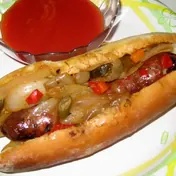
Italian sausage sandwich ★ 4.1
A grilled Italian sausage on a soft bun with sweet onions and peppers, sold from a smoking grill outside Holy Rosary Catholic Church during the Italian.
Where to try it: Iaria's Italian Restaurant
Price: 10 dollars
Italian families that settled around Holy Rosary Catholic Church in the early 1900s brought the sausage sandwich tradition from southern Italy. The Holy Rosary Italian Street Festival has run since 1984 and serves thousands of sausage sandwiches in two evenings each June. Iaria's, the Italian-American room a few blocks away, has anchored the neighborhood since 1933.
Watch out for: Gluten
-
Brown County persimmon pudding ★ 4.3
A dense, dark-spiced steamed pudding made with the puree of native Indiana persimmons, served warm with a spoonful of softly whipped cream and a fall-only run at Late Harvest Kitchen.
Where to try it: Late Harvest Kitchen
Price: 9 to 12 dollars
Native Indiana persimmons fruit in October across the wooded southern half of the state, especially the hills of Brown County. The Mitchell Persimmon Festival has run since 1947 and crowns a Persimmon Pudding Queen each fall. The dish moved north into Indianapolis dining rooms in the late 1900s as a seasonal Hoosier specialty.
Watch out for: Gluten, Dairy, Egg
Signature Dishes in Indianapolis, FAQ
What food is Indianapolis known for?
Indianapolis's signature dishes include Breaded pork tenderloin sandwich, Sugar cream pie, St. Elmo shrimp cocktail, Shapiro's Reuben, Hoosier ham balls. See our signature dishes chapter for where to eat each.