

The plates that define Porto: what they are, where they came from, and where to eat the canonical version.
Signature dishes
-
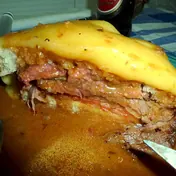
Francesinha ★ 4.7
Toasted bread layered with hot meats such as ham, sausage and steak, topped with melted cheese and covered in a near-boiling spiced tomato-and-beer sauce.
Where to try it: Cafe Santiago, Francesinha Cafe, Lado B Cafe, Yuko Tavern
A 20th-century creation attributed to Daniel David da Silva, a barman who had spent time in France and Belgium and who joined the restaurant A Regaleira on Rua do Bonjardim in the 1950s. Inspired by the croque monsieur, he made a small sandwich with roast beef and smoked meat and a secret hot sauce, and it became the francesinha, the little French girl. A Regaleira, open since 1934, still serves it to the original recipe and moved to number 83 of the same street in 2021.
Watch out for: Gluten, Dairy
-
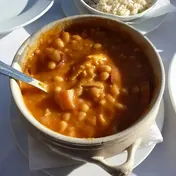
Tripas a moda do Porto ★ 4.5
Porto's tripe stew, cooked with white beans, carrots and rice, with sausage in some versions, and the dish behind the nickname tripeiros for its people.
Where to try it: O Buraco, Adega Sao Nicolau, Abadia do Porto
By tradition, in 1415 the ships built at the Lordelo do Ouro shipyard in Porto were secretly meant for Ceuta, and Prince Henry the Navigator arrived unexpectedly to check on the work. The story says the townspeople gave the sailors their best meat and kept the offal, cooking a poor dish of tripe and dark bread, and earned the nickname tripeiros, the tripe-eaters. Today's tripas à moda do Porto is a stew of tripe with white beans, carrots and rice.
Watch out for: Gluten
-
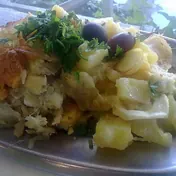
Bacalhau a Gomes de Sa ★ 4.6
Salt cod flaked and cooked with olive oil, garlic and onion, served with potatoes, black olives, parsley and boiled eggs: a Porto dish named for its creator.
José Luís Gomes de Sá Júnior (1851 to 1926), a cod merchant working in a warehouse on Rua do Muro dos Bacalhoeiros in Ribeira, created the dish in the 19th century. He sold the recipe to his colleague and close friend João, the chef of the now-defunct Restaurante Lisbonense on Travessa dos Congregados. In the original method the cod is flaked and soaked in milk for about an hour and a half to two hours before it is cooked.
Watch out for: Fish, Egg
Book food experiences in Porto
-
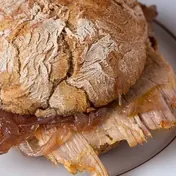
Sandes de pernil ★ 4.5
Slow-roasted pork leg in a bread roll, with ham, sheep's cheese or caramelised onion in port wine: the sandwich Casa Guedes serves on Praça dos Poveiros.
Where to try it: Casa Guedes Tradicional
Price: €5.90 to €7.90 (Casa Guedes menu)
In 1987 the Correia brothers bought the Snack Bar Guedes on Praça dos Poveiros, whose menu then ran to cheap meals, roast pork leg, hot dogs and francesinhas. The pernil grew popular with Porto diners, though the 2001 works on the square hurt trade. In 2006 the owner Sr. César began supplying the sandwiches to the club Maus Hábitos on weekend nights, a Time Out article in 2008 or 2009 brought wider attention, and a new space opened on the same square in 2019.
Watch out for: Gluten, Dairy
-
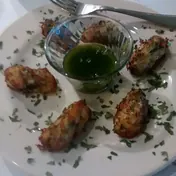
Bolinhos de bacalhau ★ 4.4
Croquettes of salt cod, potato, egg, parsley and onion, shaped between two spoons and deep-fried, eaten as an appetiser, with a drink or with rice and salad.
Where to try it: Adega Sao Nicolau, Casa Guedes Tradicional
Bolinhos de bacalhau, also called pastéis de bacalhau, are a traditional Portuguese fried dish made from potatoes, salt cod, eggs, parsley and onion, sometimes with a hint of nutmeg. By the 1700s salt cod had become a basic food for ordinary Portuguese, and the croquettes are eaten as an appetiser or a full meal, usually with rice, salad and olives. In Porto, Adega São Nicolau and Casa Guedes list them on their menus.
Watch out for: Fish, Egg, Gluten
-
Cachorrinho da Batalha ★ 4.4
Porto's hot dog: fresh sausage and linguiça on crisp baguette-style bread with spicy sauce and flamengo cheese, pressed on a hot griddle and cut into pieces.
Where to try it: Cervejaria Gazela
Cervejaria Gazela opened in 1962 next to the Teatro São João near Praça da Batalha, one of three beer halls its first owner opened that year and the only one still open. Street hot dogs then used canned sausage in ordinary bread; Gazela used baguette-style bread, fresh sausage and linguiça, a spicy sauce and three slices of cheese, pressed on a griddle. Anthony Bourdain filmed part of a Parts Unknown episode there, and a second house opened 130 metres away in 2018.
Watch out for: Gluten, Dairy
-
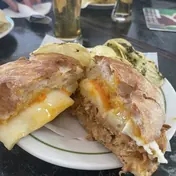
Bifana ★ 4.5
Marinated pork cooked with garlic and wine and served hot inside a crusty roll, with mustard or chilli sauce: the sandwich behind Conga Casa das Bifanas.
Where to try it: Conga Casa das Bifanas
The bifana is a Portuguese sandwich found across the country, and its name is often translated as small steak. Traditionally the pork is thinned or sliced and cooked with garlic and wine, then served inside heated bread; in the north it is usually made with shredded pork and a sauce, while the south favours a pork cutlet in a light marinade. In Porto, Conga Casa das Bifanas on Rua do Bonjardim is named after the sandwich.
Watch out for: Gluten
-
Port wine flight ★ 4.7
A tasting of several styles of port, such as white, ruby, tawny and vintage, usually taken in a lodge or wine bar around Porto and Vila Nova de Gaia.
Port became very popular in England after the Methuen Treaty of 27 December 1703, under which Portuguese wine paid a third less duty than French wine while war with France made French wine hard to get. A royal charter of 10 September 1756 defined the Port production region, and the Douro Wine Company was founded that year during the rule of the Marquis of Pombal. Barrels came down the Douro on rabelo boats to be aged in lodges at Vila Nova de Gaia, where shipper names such as Croft, Sandeman and Taylor show the British trade.
-

Pastel de Nata ★ 4.7
Egg custard tart in crisp puff pastry, dusted with cinnamon and icing sugar, eaten fresh from the oven at Porto shops such as Manteigaria and Castro.
Where to try it: Manteigaria, Castro Atelier de Pasteis de Nata, Fabrica da Nata, Nata Lisboa
The pastel de nata grew out of the pastéis de Belém, created before the 18th century by monks at the Jerónimos Monastery in Lisbon. After the monastery closed in 1834 the recipe went to a nearby sugar refinery, whose owners opened the Fábrica de Pastéis de Belém in 1837. In Porto, Manteigaria has shops at Bolhão, Clérigos, Santa Catarina and Largo São Domingos, Castro runs an atelier, and Fábrica da Nata and Nata Lisboa also have shops.
Watch out for: Gluten, Dairy, Egg
-
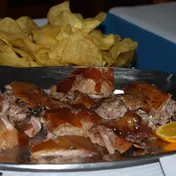
Leitão à Bairrada (Roast Suckling Pig) ★ 4.6
Roast suckling pig, the typical dish of the Bairrada region south of Porto and one of 21 finalists for the 7 Wonders of Portuguese Gastronomy in 2011.
Leitão assado à Bairrada is a typical dish of the Bairrada region of Portugal. Álvaro Pedro, who had sold suckling pig sandwiches to motorists on the EN1 road from 1941, opened the first restaurant to sell it to the general public in 1949, at Sernadelo near Alpalhão, in what is now Mealhada. In 2011 the dish was one of 21 finalists for the 7 Wonders of Portuguese Gastronomy.
-
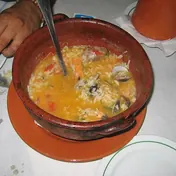
Arroz de Marisco (Portuguese Seafood Rice) ★ 4.7
A Portuguese rice with shellfish, squid and fish cooked in white wine; Taberna dos Mercadores in Ribeira serves it with prawns, clams, mussels and cockles.
Where to try it: Taberna dos Mercadores
Arroz de marisco is a Portuguese dish of rice and seafood, and its typical ingredients may include shellfish, squid, white wine and fish. It is cooked as a wet rice rather than a dry one. In Porto's Ribeira, Taberna dos Mercadores lists it as a popular dish, made with prawns, clams, mussels and cockles in a rich, intense broth.
Watch out for: Crustaceans, Molluscs, Fish
-
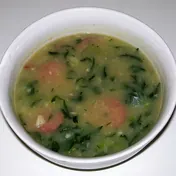
Caldo Verde (Green Soup) ★ 4.4
Potato and finely shredded collard-green soup finished with sliced chouriço and olive oil, eaten with broa on the side; it comes from the Minho.
Where to try it: Casa Guedes Tradicional
Caldo verde originated in the Minho province of northern Portugal and was based on an earlier recipe that English merchants brought to Portugal. The traditional base is julienned couve galega, a collard-green cultivar, with potatoes, olive oil, onion and garlic, and the chouriço is boiled whole with the potatoes, then sliced and added at serving. It is eaten with broa, a cornbread or rye bread, for dipping, and on the night of São João it is one of the dishes Porto eats beside grilled sardines.
-
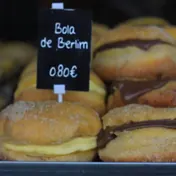
Bola de Berlim ★ 4.4
A doughnut split half-way and filled with creme pasteleiro, a yellow egg-yolk cream, with sugar on top: a typical Portuguese beach food sold by vendors.
The Portuguese bola de Berlim is a doughnut cut half-way through and filled with an egg-yolk-based yellow cream, creme pasteleiro, so the filling stays visible, with ordinary sugar sprinkled on top. It is typical beach food, sold by street vendors. No Porto bakery we list names it on its own pages, so this page lists none.
Watch out for: Gluten, Egg, Dairy
-
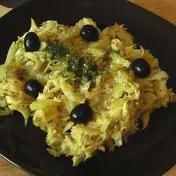
Bacalhau à Brás ★ 4.5
Shredded salt cod with onion, matchstick fried potatoes and eggs, garnished with black olives and flat-leaf parsley: a Lisbon dish eaten across Portugal.
Bacalhau à Brás is said to have originated in the second half of the 19th century in the Bairro Alto, in Lisbon, and probably evolved from older cod dishes cooked in similar ways. The name is supposedly that of its creator. It combines shredded salt cod, onions, thinly chopped fried potatoes and eggs, garnished with black olives and parsley. In Portugal it is said there are more than 365 ways to cook bacalhau, one for every day of the year.
Watch out for: Fish, Egg


Signature Dishes in Porto, FAQ
What food is Porto known for?
Porto's signature dishes include Francesinha, Tripas a moda do Porto, Bacalhau a Gomes de Sa, Sandes de pernil, Bolinhos de bacalhau. See our signature dishes chapter for where to eat each.