5 hours
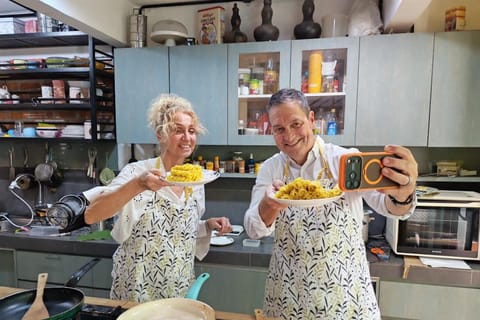
Kuala Lumpur: Market Visit & Cooking Class with Lunch
Explore a bustling morning market and discover the secrets of Malaysian cuisine. Cook a three-course meal in a local chef’s home and enjoy a shared lunch.
from$222 Check dates
How Kuala Lumpur came to eat the way it does: the people, migrations and accidents that shaped the plate.
How Kuala Lumpur came to eat the way it does: the people, migrations and accidents that shaped the plate.
Kuala Lumpur began around 1857 as a mining camp where the Gombak meets the Klang, after a member of the Selangor royal family hired Chinese tin prospectors to push upriver. The food was camp food: rice, salt fish, pork and whatever the Malay villages downstream would sell. Nothing about it was built to last, and most of it burned.
Kuala Lumpur was made capital of Selangor in 1880, and capital of the Federated Malay States in 1896. The whole town burned on 4 January 1881 and flooded later the same year, so it was rebuilt in brick under Yap Ah Loy, the third Kapitan Cina. The rebuilt shophouse grid is still the shape the food trade works in.
The Malay Agricultural Settlement at Kampung Baru was established in 1899 by a grant from the Sultan of Selangor and formally gazetted in 1950. It kept a kampung food economy running inside a colonial town: nasi lemak wrapped in banana leaf, satay over charcoal, and a Sunday market that the skyline later grew around rather than over.
Rubber pulled Tamil labour from south India onto Malayan estates, and the workers who left the estates for the city settled around Brickfields. Banana leaf rice, unlimited refills of rice and vegetables eaten with the right hand, is the kitchen tradition that arrived with them and never moved out of that quarter.
The Hainanese were among the last Chinese dialect groups to reach Malaya, arriving without the clan networks the Hokkien, Cantonese and Teochew already held. The work left was cooking and housekeeping for British households, and when those households went, the cooks opened kopitiams and sold what they had learned to make.
Nasi kandar started with Tamil Muslim vendors at Weld Quay in George Town, Penang, in the early 1900s, carrying brass pots on a shoulder pole, which is what the name records. Kuala Lumpur inherited rather than invented it, and the Indian Muslim shops that serve it became the city's default late meal.
Independence in 1957 left Kuala Lumpur with three food cultures operating side by side and a habit of eating at every hour. The first Michelin selection for Kuala Lumpur and Penang was announced on 13 December 2022, and put hawker stalls and tasting menus in the same book for the first time.
5 hours
Explore a bustling morning market and discover the secrets of Malaysian cuisine. Cook a three-course meal in a local chef’s home and enjoy a shared lunch.
Private tour · 12 hours
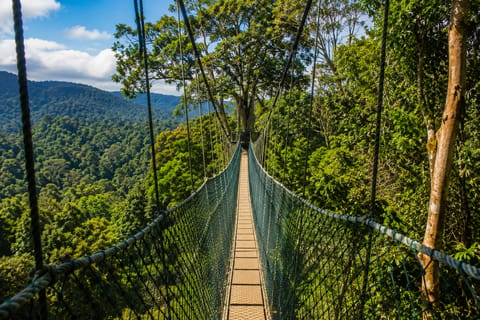
Explore Taman Negara, one of the world’s oldest rainforests, with jungle walks, river activities, and nature experiences on a full-day adventure.
6 hours
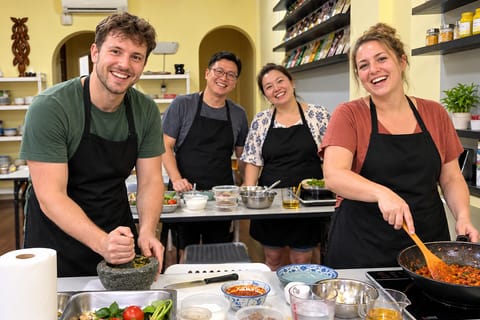
Discover Malaysian culture with a Peranakan cooking experience and 5-course lunch, followed by a free Batik DIY where you draw and color your own tote bag. Hotel trans...