How Modena came to eat the way it does: the people, migrations and accidents that shaped the plate.
Key eras
-
183 BC, Roman Mutina on the Via Emilia
Mutina was refounded as a Roman colony in 183 BC and the Via Emilia, built on the initiative of the consul Aemilius Lepidus, tied it to Parma and Bologna. The road carried troops and trade goods, gave the region its name and still runs through the centre of Modena, where the old market streets and today's Mercato Albinelli sit a few steps from it.
Taste it todayMercato Albinelli -
1046, the vinegar sent to an emperor
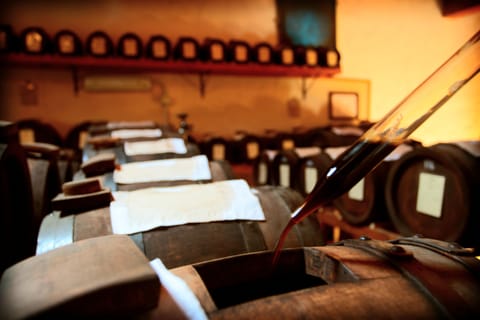
Balsamic production in Modena is documented from 1046, when Henry III, on his way to Rome to be crowned emperor, asked Boniface of Canossa for the vinegar he had heard was made there to perfection. Boniface sent it in a small silver barrel. The word balsamico does not appear yet, but the gift shows how far the vinegar's reputation already travelled.
-
1288 to 1598, the Este court
When Obizzo II d'Este became lord of Modena in 1288, his court already kept many barrels of vinegar, and the Este ducal register of 1556 sorts vinegars by type and use. In 1598 Duke Cesare d'Este lost Ferrara to the Pope and moved his capital to Modena, which stayed the Este seat until the Napoleonic period and again after 1815.
-
1511, the siege of Mirandola and the first zampone
Modenese tradition dates the zampone, a spiced pork mix stuffed into a pig's trotter, to the 1511 siege of Mirandola in Modena province. Its cousin the cotechino is cited by Vincenzo Tanara in 1644, and Modena and Ferrara argued over who invented it for centuries. The IGP rules for Cotechino Modena finally credit Modena.
-
1839 to 1863, balsamic written down
In September 1839 Count Giorgio Gallesio described the methods he saw in the Salimbeni counts' acetaia at Nonantola. In 1862 Francesco Aggazzotti set down his family's recipes and techniques in a letter to Pio Fabriani, the first detailed record of how the vinegar is made, and in 1863 the chemist Fausto Sestini published the first scientific study of it.
-
1931, the covered market on Via Albinelli
Mayor Luigi Albinelli (1900-1908) cleared the area beside Piazza XX Settembre, next to Piazza Grande, for a food market with a central fountain by the sculptor Giuseppe Graziosi. The covered Mercato Albinelli opened on 28 October 1931 and today draws about 30,000 people a week for fruit, vegetables, bread, cheese, fish and meat, with five places to eat inside in 2026.
Taste it todayMercato Albinelli -
1967 to 2000, protecting the tradizionale
The Consorteria dell'Aceto Balsamico Tradizionale di Modena was founded at Spilamberto in 1967 to study and promote the vinegar. A ministerial decree of 5 April 1983 separated Aceto Balsamico Tradizionale di Modena from the industrial product, and on 17 April 2000 the EU recognised it as a DOP, with a minimum of 12 years of ageing in barrels kept in attics.
Taste it todayAceto Balsamico Tradizionale di Modena -
1995 onward, Osteria Francescana
Massimo Bottura opened Osteria Francescana in a former trattoria in Modena's historic centre on 19 March 1995. It gained its third Michelin star in 2012 and topped The World's 50 Best Restaurants in 2016 and 2018, the first Italian restaurant to do so. In 2011 Bottura added Franceschetta58, a more casual Modena restaurant built on local ingredients.
Taste it todayOsteria Francescana
Immigrant influences
- Apennine mountain villages
- The Modenese Apennines gave the city its crescentine, bread discs once baked between red-hot terracotta tigelle, and the borlengo, a paper-thin crepe spread with lard, garlic and rosemary.
- Ferrara and the Po plain
- Ferrara disputed the cotechino with Modena for centuries: Antonio Frizzi's 1772 Salameide gave Ferrara the cotechino and Modena the zampone, a split Modena never accepted.
- French liqueur makers
- Walnut liqueur probably reached Italy from France before spreading to the Modenese, where nocino is still made from green walnuts traditionally picked on the night of St John in June.
- The Lombards
- Some sources read the lard at the centre of Modena's gnocco fritto dough as a sign of a Lombard origin for the recipe, though the question is not settled.
Signature innovations
- Aceto Balsamico Tradizionale di Modena DOP: aged at least 12 years, 25 for the extravecchio, in attic barrels.Taste it todayAceto Balsamico Tradizionale di Modena
- Zampone: seasoned pork stuffed into a pig's trotter, dated by tradition to the 1511 siege of Mirandola.Taste it todayZampone
- Cotechino Modena IGP: the same pork, fat and rind mix in a casing, cited by Vincenzo Tanara in 1644.Taste it todayCotechino
- Tortelloni: the Modenese filling adds spinach to ricotta and Parmigiano, served with butter and sage.
- Crescentine: the dough discs Bologna calls tigelle, named after the terracotta discs they were baked in.Taste it todayCrescentine (tigelle)
- Gnocco fritto: flour, lard and sparkling water, with no yeast in the Modenese recipe, fried until puffed.Taste it todayGnocco fritto
- Borlengo: a batter crepe filled with cunza, first documented at Guiglia in 1266.
- Bensone: an oval cake of flour, milk, eggs and butter, sliced and dipped in Lambrusco.Taste it todayBensone
- Torta Barozzi: Vignola's peanut, almond, cocoa and coffee cake, fixed as a recipe in 1886.
- Lambrusco di Sorbara DOC: the pale, violet-scented Lambrusco grown only in Modena province.Taste it todayLambrusco
Book food experiences in Modena