Frankfurt's cold green sauce blends exactly seven herbs with soured cream, poured over halved boiled eggs and potatoes. It is a main course here, not a condiment, and the city argues about every family's ratio.
Grüne Soße belongs to Frankfurt the way pesto belongs to Genoa. The canonical seven herbs are borage, sorrel, garden cress, chervil, chives, parsley and salad burnet, most of them grown in the Oberrad district, which styles itself the city's herb garden. Legend ties the sauce to Goethe's mother, and the city now stages a week-long Grüne Soße Festival each May where restaurant versions compete on the Roßmarkt. Season traditionally opens around Maundy Thursday, when the first bundled herb packets appear at the markets.
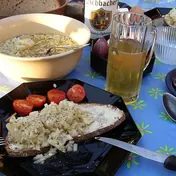
A puck of sour-milk cheese marinated in onion vinaigrette, eaten with dark bread and butter in Frankfurt's apfelwein taverns. The Musik, the music, is the onions, and what they do to you later.
Handkäs is a hand-formed sour-milk cheese from the Hessen countryside, low in fat and high in pungency. Sachsenhausen's taverns made it their standard apfelwein companion by the 19th century, marinating the cheese in vinegar, oil and raw onions, the mixture locals call Musik. Tradition says you eat it with a knife on bread, never a fork, and the caraway on top is a dividing line between families. It survives because it does one job perfectly: it makes the next Schoppen of sharp cider taste sweeter than the last.
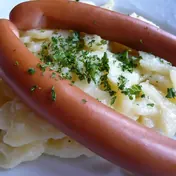
The original slim pork sausage in natural casing, gently heated in water, never boiled, and eaten with bread, mustard and horseradish. Every hot dog on earth is a distant, lesser descendant.
Frankfurt's butchers were smoking slim pork sausages for the city's fairs centuries before the name travelled. The designation Frankfurter Würstchen has been protected in Germany since 1929, reserved for the smoked pork sausage in sheep casing made in the Frankfurt region. Emigrant butchers carried the style to Vienna and on to America, where it mutated into the hot dog. At home the rules stay strict: warmed in hot water off the boil so the casing never splits, served in pairs, eaten with the fingers.
Get to know Frankfurt from its most enjoyable side: between the Kaiserdom, the Römer, and Sachsenhausen, exciting stories, Frankfurt originals, and selected Ebbelwoi t...
No time for long tours? Discover Frankfurt in 60 minutes (in German): Experience the festive Old Town and one of the most beautiful Christmas markets. See highlights l...
Come on our popular food tour and experience the culinary highlights in Frankfurt. Discover 3-4 charming cafés, local restaurant tips & insider food spots that you abs...
Frankfurt's all-beef sausage, invented in 1894 at Gref-Völsings, eaten hot from the pot with mustard and a roll. Smooth, snappy and still made on the same Ostend street.
In 1894 the Gref-Völsings butchery on Hanauer Landstraße began producing a sausage of pure beef, opening Frankfurt's sausage tradition to residents whose faith ruled out pork. It became a working city's staple across every community, and the firm, now in its fifth generation, still calls its version the original. The Braterei window on the same street sells them hot at lunchtime as it has for over a century, and the queue of office workers and tradespeople is its own institution.
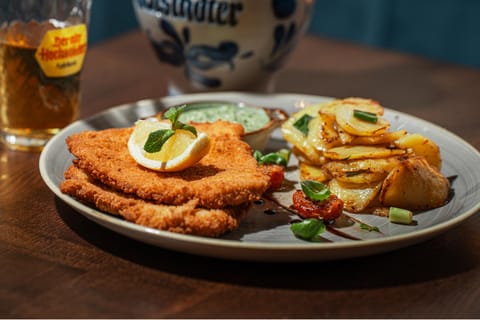
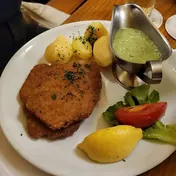
A crisp pork schnitzel served the Frankfurt way: cold Grüne Soße over or beside it, with fried potatoes. The collision of hot crumb and cold herb sauce is the whole point.
Vienna may own the schnitzel, but Frankfurt annexed it by sauce. The Frankfurter Schnitzel is pork rather than veal, pan-fried in butterfat and served with the city's cold seven-herb Grüne Soße, usually with halved boiled eggs and fried or boiled potatoes. Apfelwein taverns standardised the pairing in the 20th century as their kitchens grew from cheese-and-bread snacks into full menus, and it remains the single most ordered plate on Sachsenhausen's tavern strips.
Cured pork cutlets warmed slowly on sauerkraut until rosy and sliding off the bone, with bread or mash. Frankfurt tavern winter on one plate, with mustard on the side.
Rippchen are Kasseler-style cured pork rib cutlets, and Frankfurt's taverns have served them on sauerkraut for as long as the Bembel has existed. The dish is engineering as much as cooking: the cured meat warms gently in the steam of the kraut, staying pink and juicy while the cabbage sharpens with pork fat. It is the canonical cold-weather order in the apfelwein houses, where the acidity of the cider cuts the richness, and it appears boiled or grilled depending on the house's persuasion.
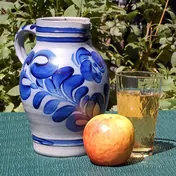
Frankfurt's tart, still apple wine, poured from a stoneware Bembel into a ribbed Gerippte glass. Drink it pure, spritzed with sparkling water, or sweetened with lemonade if you must.
When Frankfurt's riverside vineyards faded, pressed apples took over, and by the 18th century Ebbelwoi was the city's daily drink. The service ritual is fixed: the grey salt-glazed Bembel jug, the diamond-cut Gerippte glass that grips greasy tavern fingers, and the deckel lid to claim your place. Sachsenhausen's taverns turned the drink into a civic institution, several still pressing their own, and autumn brings the young stages, sweet Süßer and part-fermented Rauscher, straight from the vats.
A small dome of marzipan pressed with three almond halves, baked golden and eaten through Advent. Frankfurt's signature Christmas sweet, named for the Bethmann banking family.
The Bethmännchen is credited to the household of the Bethmann banking dynasty in the 19th century, its three almond halves said to represent the family's sons, with a fourth almond retired from the design after one son died. It became the defining sweet of the Frankfurt Christmas market, where stalls sell them by the paper bag beside hot apple wine, and Konditorei counters begin production in late autumn. The city treats the little marzipan domes with complete seriousness, and recipes pass through families like heirlooms.
A crown-shaped ring of sponge layered with buttercream and jam, armoured in caramel brittle Krokant and topped with cherries. Frankfurt's imperial cake, built to be shown off.
The Frankfurter Kranz is said to date to the 18th century, its ring shape and golden Krokant crust designed to evoke a crown honouring Frankfurt's centuries as the coronation city of Holy Roman emperors. The construction is fixed: a firm ring sponge split into three, buttercream and a sharp red jam between the layers, the whole clad in hazelnut or almond brittle with buttercream rosettes and glacé cherries on top. It remains the benchmark of a Frankfurt Konditorei's buttercream work, and the centrepiece of family birthdays across Hessen.
Pickled pork knuckle simmered until wobbling, served with sauerkraut, bread and mustard in Frankfurt's old tavern tradition. Gelatinous, unfashionable and quietly magnificent.
Haspel is the lower shank of the pig, cured in brine and simmered whole, an economy cut from the era when Frankfurt's taverns fed dock workers and market porters rather than tourists. The meat cooks to a sticky, gelatinous richness that the city's sharp apfelwein was practically designed to cut. It has faded from many menus as schnitzel conquered the tavern kitchen, which makes the houses still simmering Haspel a marker of the old school, worth seeking out for the disappearing plates of working Frankfurt.
A whipped cream-cheese spread shaped like a barrel bung, dusted with paprika and eaten with pretzels or dark bread. A wine-country snack the apfelwein taverns adopted as their own.
Spundekäs comes from the Rheinhessen wine villages across the river, where cellar masters whipped fresh cheese with butter and paprika into a shape recalling the Spund, the bung of a wine barrel. Frankfurt's taverns and festival stands absorbed it decades ago as a partner for both Riesling and Ebbelwoi, and it now sits beside Handkäs on menus like Apfelwein Wagner's as the milder, richer of the city's two cheese rituals. At the Rheingauer Weinmarkt on the Fressgass it is practically the official food.
A thick ring of mild, garlicky boiled sausage eaten hot at a market counter with mustard and a roll. In Frankfurt this is a ritual with a queue, not a snack.
Fleischwurst is the Rhineland-Hessen family of fine boiled sausage, sold warm at butcher counters across the region. Frankfurt gave it a temple: the Kleinmarkthalle, where Metzgerei Schreiber's stand serves hot Fleischwurst, Krakauer and Gelbwurst over the glass, with a queue that bends around the aisle every Saturday. The etiquette is fixed, cash ready, mustard yes or no, eat it standing at the rail, and the whole exchange takes less time than reading this history.
Sliced sausage under curry-spiced tomato sauce, but with a Frankfurt twist: graded chilli heat levels that climb from mild to legally dubious, ordered by letter at the counter.
Currywurst may be Berlin's invention, but Frankfurt built its own cult around heat. Best Worscht in Town, grown by Lars Obendorfer, whom the local press calls Frankfurt's Godfather of Worscht, grades its curry sauces from gentle Bissi Prickeln through Godfather's Deathkiss to the waiver-worthy FBI level, served on handmade sausage with Huck bakery sourdough. The format spread across a dozen branches and turned the humble curry sausage into a Frankfurt endurance sport, complete with regulars who order letters most humans should not.
Watch out for: Gluten
Signature Dishes in Frankfurt, FAQ
What food is Frankfurt known for?
Frankfurt's signature dishes include Grüne Soße, Handkäs mit Musik, Frankfurter Würstchen, Rindswurst, Frankfurter Schnitzel. See our signature dishes chapter for where to eat each.