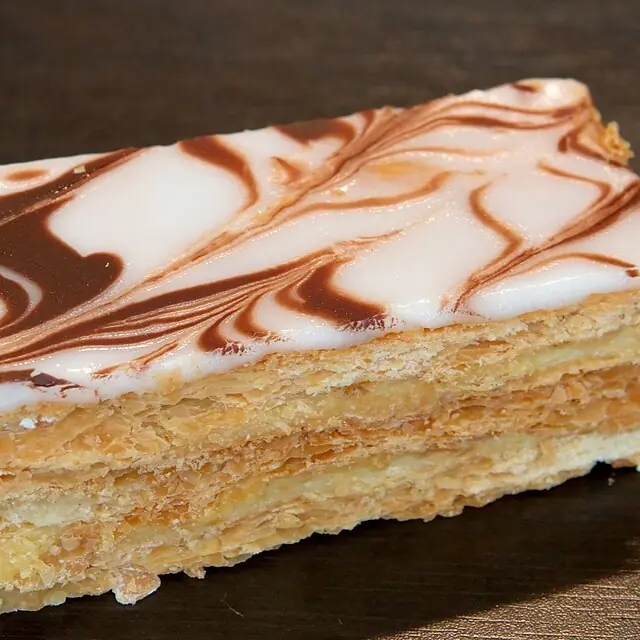
Mille-feuille is three sheets of caramelised puff pastry layered with vanilla crème pâtissière, capped with a marbled fondant or a snow of icing sugar. The pâtissier's signature exam piece.
The mille-feuille appears in 17th-century French confectionery, but the modern three-layer form was codified by Marie-Antoine Carême in early 19th-century Paris and refined by the city's grand pâtissiers through the 1900s. The marbled-fondant top with chevron pattern is the Parisian visual signature. Stohrer (Paris's oldest pâtisserie, founded 1730 by Louis XV's pastry chef) still plates the classical version on Rue Montorgueil. Cédric Grolet at Opéra runs a refined modern interpretation. Des Gâteaux et du Pain by Claire Damon plates an inverted-puff version that the city's pâtissiers cite as a reference. The dish is a Sunday-afternoon pâtisserie ritual.
Stohrer in Paris is the city's oldest patisserie, founded in 1730 by Nicolas Stohrer who served Marie Leszczyńska at Versailles. Open daily 07:30-20:30.
TipThe original puits d'amour and the baba travel well. The whipped-cream cake is best in shop.
Boulangerie Pâtisserie l'Équilibre in Paris's 15e occupies an 1889 Monument Historique storefront on rue Blomet. At 108 Rue Blomet. Booking recommended.
TipClosed Sunday and Monday. The Pain Suisse with its puff-pastry layers is the room's signature, baked through the morning.
Liberté Pâtisserie Boulangerie in Paris's 10e is Benoît Castel's open-kitchen counter where the bakery floor doubles as the eat-in dining room from 09:00.
TipThe Paris-Brest individual size is €6; the cake-by-the-slice in the back room runs half that price.
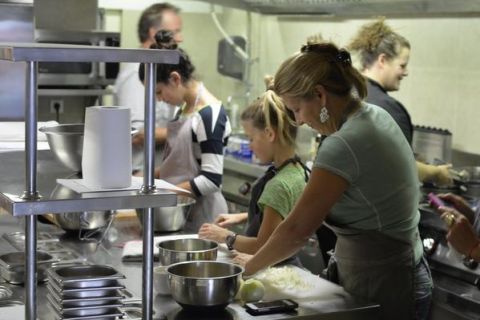
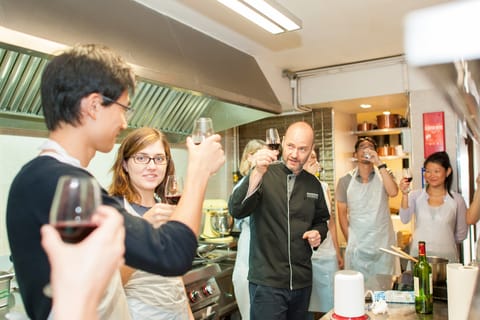
Learn classic French cooking techniques at a 6-hour cooking class in the Latin Quarter of Paris, visiting a local open air market to forage for fresh produce to turn i...
Learn classic French cooking techniques at a 5-hour cooking class in the Latin Quarter of Paris, using fresh produce from the local market to turn into a memorable 3-c...