History

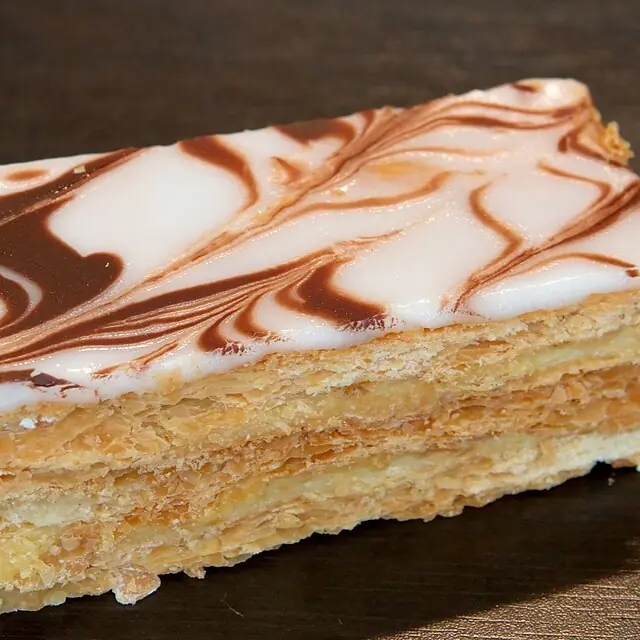
The mille-feuille appears in 17th-century French confectionery, but the modern three-layer form was codified by Marie-Antoine Carême in early 19th-century Paris and refined by the city's grand pâtissiers through the 1900s. The marbled-fondant top with chevron pattern is the Parisian visual signature. Stohrer (Paris's oldest pâtisserie, founded 1730 by Louis XV's pastry chef) still plates the classical version on Rue Montorgueil. Cédric Grolet at Opéra runs a refined modern interpretation. Des Gâteaux et du Pain by Claire Damon plates an inverted-puff version that the city's pâtissiers cite as a reference. The dish is a Sunday-afternoon pâtisserie ritual.

Common allergens: Gluten, Egg, Dairy

Make it at home

Yield 6Hands-on 45 minTotal 4 hrDifficulty Advanced

Ingredients

  • 500g all-butter puff pastry, chilled (homemade or the best frozen butter puff you can buy)
  • 50g caster sugar (for caramelising the pastry sheets)
  • For the crème pâtissière: 500ml whole milk
  • 1 vanilla pod (split and scraped)
  • 5 large egg yolks
  • 100g caster sugar
  • 40g cornflour
  • 30g unsalted butter
  • For the fondant top: 200g icing sugar
  • 30 to 40ml warm water
  • 1 tsp glucose syrup
  • 30g melted dark chocolate (for the marbled chevron)

Method

  1. Make the crème pâtissière first: bring milk and split vanilla pod to a bare simmer. Take off the heat; infuse 10 minutes; remove the pod.
  2. Whisk egg yolks, sugar and cornflour to a pale paste. Pour the warm vanilla milk over, whisking constantly.
  3. Return to the saucepan; cook over medium, whisking, 3 to 4 minutes until thick and bubbling. Whisk in the butter off the heat. Press cling film onto the surface; chill at least 2 hours.
  4. Heat oven to 200°C. Roll the puff pastry to 3mm thick on a lightly floured surface; cut three 30cm by 20cm rectangles. Lay on lined baking sheets.
  5. Prick all over with a fork. Cover with a second sheet of parchment, then place a heavy baking tray on top (this weight keeps the pastry flat as it bakes; classical Parisian technique).
  6. Bake 15 minutes weighted, then remove the top tray and parchment; sprinkle each pastry sheet with caster sugar; return to the oven (no weight) 5 to 8 minutes more until deep amber and glossy.
  7. Cool on a wire rack. Trim each sheet to exactly the same dimensions with a serrated knife.
  8. Whisk the chilled crème pâtissière smooth; transfer to a piping bag with a large round nozzle.
  9. Lay one pastry sheet on a serving board. Pipe an even layer of crème (1cm thick) edge to edge. Lay the second pastry sheet on; press very gently. Pipe a second layer of crème. Lay the third pastry sheet on top.
  10. Make the fondant: whisk icing sugar, glucose and warm water to a thick spreadable paste.
  11. Spread the fondant evenly across the top pastry. Pipe parallel lines of melted chocolate across the fondant; draw a skewer perpendicular through the lines in alternating directions to create the chevron pattern.
  12. Chill 1 hour to set the fondant.
  13. Slice across the layers with a hot serrated knife (warm the blade in hot water, wipe dry) in clean cuts; the layers should stay distinct.

Tip from the editors. Bake the pastry between two trays so it stays flat; unweighted puff rises like brioche and ruins the profile. Cut with a serrated knife warmed between cuts.

Where to eat mille-feuille

Mille-feuille in Paris

Stohrer ★ 4.4

BakeryDaily 07:30-20:30Walk-in onlyHistoric patisserie

Stohrer in Paris is the city's oldest patisserie, founded in 1730 by Nicolas Stohrer who served Marie Leszczyńska at Versailles. Open daily 07:30-20:30.

Tip: The original puits d'amour and the baba travel well. The whipped-cream cake is best in shop.

Worth the queue: Baba au rhum

Cédric Grolet Opéra ★ 4.5

BakeryMon-Sun 12:00-18:00Walk-in onlySculpted pastry

Cédric Grolet Opéra in Paris is the chef's lemon-fruit-and-flowers museum: every cake a sculpted trompe-l'œil fruit, priced at €18 to €25 a piece.

Tip: Queue starts at 11:30 for the 12:00 opening; book online to skip it for the citron tart.

Worth the queue: Trompe-l'œil fruit

Des Gâteaux et du Pain ★ 4.6

BakeryTue-Sun 10:00-19:30Walk-in onlyPastry

Claire Damon's Des Gâteaux et du Pain in Paris's 15e is the pastry-architect shop where every tart is signed off as a numbered edition, on display.

Tip: Closed Monday. The Mont-Blanc is autumn-only; the strawberry tart anchors the summer carte.

Worth the queue: Le Mont-Blanc

Liberté Pâtisserie Boulangerie ★ 4.3

BakeryDaily 07:00-20:00Walk-in onlyModern French pastry

Liberté Pâtisserie Boulangerie in Paris's 10e is Benoît Castel's open-kitchen counter where the bakery floor doubles as the eat-in dining room from 09:00.

Tip: The Paris-Brest individual size is €6; the cake-by-the-slice in the back room runs half that price.

Worth the queue: Paris-Brest

Boulangerie Pâtisserie l'Équilibre ★ 4.4

BakeryTue-Fri 07:15-20:00, Sat 07:30-19:00, closed Sun-MonWalk-in onlySourdough breads and palace-trained viennoiserie

Boulangerie Pâtisserie l'Équilibre in Paris's 15e occupies an 1889 Monument Historique storefront on rue Blomet. At 108 Rue Blomet. Booking recommended.

Tip: Closed Sunday and Monday. The Pain Suisse with its puff-pastry layers is the room's signature, baked through the morning.
Worth the queue: Pain Suisse

More cities are in research. Want mille-feuille covered somewhere specific? Tell us where you want to eat.

Browse all dishes →