
How Montpellier came to eat the way it does: the people, migrations and accidents that shaped the plate.

Key eras

Medieval spice port and medical school, 12th to 15th century

Montpellier grew rich on the spice and drug trade routed through the coastal lagoons, and on the medical faculty founded in 1220, the oldest still operating anywhere. Apothecaries, spicers and confectioners clustered inside the Ecusson because doctors prescribed sugar and liquorice as medicine. That overlap is why the city's oldest sweet, the grisette, is honey and liquorice.

The wine boom and the phylloxera crash, 1850 to 1907

Railways turned the Languedoc plain into the largest vineyard on earth, shipping bulk red north to industrial France. Montpellier became its capital: brokers, cooperage, and the agronomy school whose researchers helped beat phylloxera by grafting European vines onto American rootstock. Overproduction then crashed prices, and the 1907 winegrowers' revolt followed.

Quality replaces quantity, 1980s to 2000s

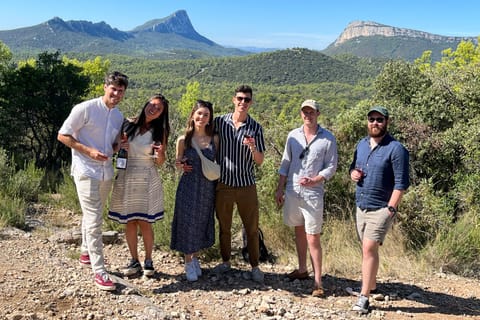
Languedoc growers pulled out high-yield hybrids and replanted syrah, grenache and mourvèdre on the garrigue slopes. Pic Saint-Loup, Terrasses du Larzac and Picpoul de Pinet built the case for the appellations they were granted in the 2010s, and Montpellier wine lists stopped apologising for the region. The same decades brought the Pourcel twins their stars at Jardin des Sens.

The market rebuild, 2018 to 2020

Halles Laissac reopened at the end of 2018 in a new building after years of demolition and dispute, and Halles Jacques Coeur and the Quatre Saisons halls were refitted. The city treated covered markets as public infrastructure rather than heritage decoration, and the result is that Montpellier now runs four covered halls plus six neighbourhood open-air markets in a city of roughly 307,000.

Bistronomy and the natural-wine turn, 2015 to today

A generation of cooks trained in starred kitchens took small Ecusson rooms with twenty covers and no maitre d': Ebullition, Leclere, Artisane, Reflet d'Obione. Alongside them the cave-a-manger format spread, where the wine list is Languedoc, mostly low-intervention, and the food is a short blackboard. The city's student population, roughly a fifth of all residents, keeps prices lower than in Lyon or Bordeaux.

Immigrant influences

  • Pieds-noirs and Sephardi Jews from North Africa: The 1962 repatriation from Algeria brought thousands of families to Montpellier and reshaped its pantry: merguez on the grill, kemia snacks before dinner, brik pastry, and the anise habit that fills cafe terraces at six.
  • Italian: Fishermen from Gaeta settled the Sète coast from the 1880s and their descendants moved inland, which is why the Hérault eats tielle as local food and why Montpellier supports so many serious pizzerias.
  • Moroccan, Algerian and Tunisian: Maghrebi families anchored the Figuerolles quarter around the Plan Cabanes market, where the mint, coriander, olives and preserved lemons that flavour half the city's Mediterranean cooking are sold six mornings a week.
  • Vietnamese and Chinese: Post-1975 arrivals from Indochina opened counters around Rue de l'Universite and Figuerolles, giving students a run of pho, banh xeo and hand-folded ravioli that remain the cheapest hot lunches in the centre.
  • Spanish and Catalan: Republican exiles crossing the Pyrenees after 1939 settled across the Languedoc plain, and their descendants kept the tapas habit, the paella pans of the village fêtes, and the rice-and-seafood cooking of the etangs.

Signature innovations

  • The grisette de Montpellier: a honey and liquorice sweet with medieval apothecary roots, still sold at the city's market stalls
  • The escalette: a wafer-thin occitan waffle cooked flat in cast-iron moulds, revived after centuries as a home recipe
  • Grafting European vines onto American rootstock, worked out by Montpellier agronomists after phylloxera
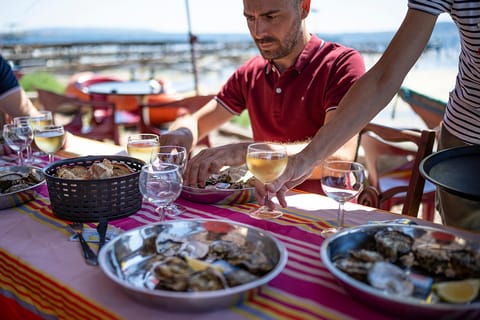
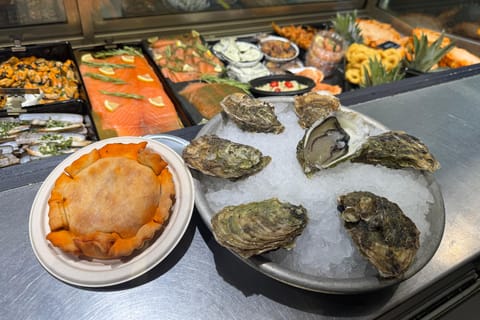
  • The Thau oyster table: shucking huts and city counters selling Bouzigues oysters by the dozen with a glass of Picpoul
  • Twenty-cover Ecusson bistronomy: one chef, a blackboard menu and a Languedoc-only wine list
← Back to Montpellier food guide