South African cuisine is one of the most layered fusion kitchens on the African continent, built from indigenous Khoisan and Bantu cooking, Dutch and Huguenot settler farming traditions (the boerekos), Cape Malay cooking brought by enslaved Indonesians and Indians to the Cape in the 17th and 18th centuries, British colonial-era influences (pies, puddings, tea), Indian indenture-era cooking (especially Durban's), and the urban Black cooking that emerged in the townships of Johannesburg, Cape Town, and Durban. The cuisine is not a single tradition but a federation of regional and cultural kitchens that share a national obsession: the braai, the outdoor wood-and-charcoal grill that is South Africa's defining social meal.
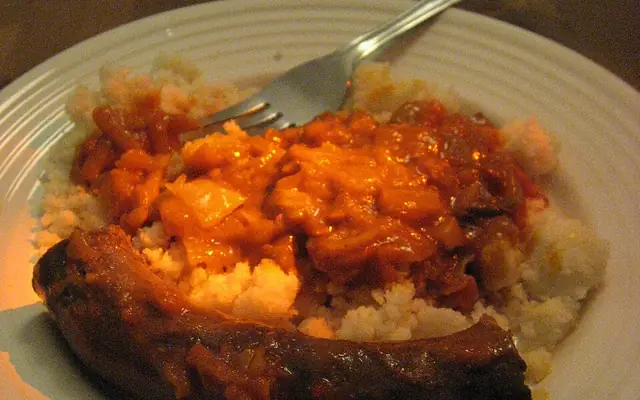
The foundational dishes span the country's communities. Boerewors (the coiled farmer's sausage, lightly spiced with coriander and clove) is the braai centerpiece. Bobotie (the Cape Malay curried mince with an egg-custard topping) is the closest thing to a national dish. Pap (maize porridge, called mealie pap or putu) and chakalaka relish anchor the urban Black table. Durban-style bunny chow (a hollowed-out bread loaf filled with curry) is one of the great street foods of southern Africa. Biltong (air-dried spiced beef) is the universal snack.
The cuisine has been internationally undersold for years, but the post-apartheid generation of chefs in Cape Town, Johannesburg, and Durban (Wandile Mabaso, Luke Dale-Roberts, Liam Tomlin, and the Test Kitchen alumni) has pushed it onto the world map. South African wine, particularly from Stellenbosch and Franschhoek, is genuinely world-class. The Test Kitchen in Cape Town held a spot on the World's 50 Best Restaurants list for years before its 2021 closure, and a new generation of chefs at Salsify, FYN, and Wolfgat (on the West Coast) are continuing the work of asserting modern South African cuisine on the global stage. Outside the country, the diaspora carries a quieter version of the cuisine: London's South African community supports a small but committed restaurant scene, and the boerewors roll has crossed into Australian and British weekend braai culture.
Book a food experience
Tours, tastings and classes that match this page, bookable on GetYourGuide.
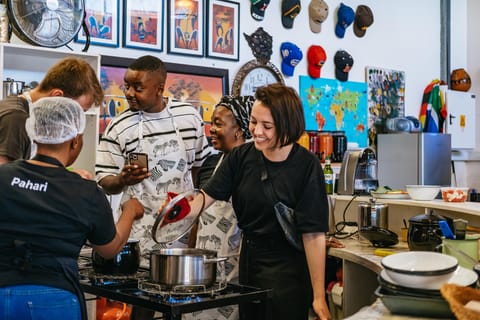
Discover how to cook a traditional African meal from start to finish with this hands-on cooking class in Cape Town. Try some tasty dishes along with...
€€€€Tasting €175NiceSouth AfricanChef Jan Hendrik van der Westhuizen
JAN in Nice's Port district holds one Michelin star under Jan Hendrik van der Westhuizen, the first South African chef to earn the award, in an intimate 20.
Biesmiellah cooked Cape Malay food in Bo-Kaap, Cape Town, for four decades under the Osman family; new owners now run it as a polished Muslim-owned eatery.
OrderA Cape Malay curry with roti, the cooking that built this corner's reputation.
TipNo alcohol is served here; it is a family room built around Cape Malay tradition, not a bar scene.
Shaka Zulu on Limburger Strasse in Cologne's Belgisches Viertel serves South African-inspired sharing plates with braai-style grilled meat and chakalaka.
OrderThe Communal Meal with braai-style grilled meat skewers, chakalaka relish and pap
TipOrder the Communal Meal for the table rather than individual plates; the sharing format reflects how the food is meant to be eaten.
€€€€Tasting €175NiceSouth AfricanChef Jan Hendrik van der Westhuizen
JAN in Nice's Port district holds one Michelin star under Jan Hendrik van der Westhuizen, the first South African chef to earn the award, in an intimate 20.
Biesmiellah cooked Cape Malay food in Bo-Kaap, Cape Town, for four decades under the Osman family; new owners now run it as a polished Muslim-owned eatery.
OrderA Cape Malay curry with roti, the cooking that built this corner's reputation.
TipNo alcohol is served here; it is a family room built around Cape Malay tradition, not a bar scene.
OneEighty dines inside the Edwardian mansion of Ellerman House above Bantry Bay in Cape Town, a seasonal lunch and dinner room looking over the Atlantic.
OrderThe seasonal menu, paired from a cellar of more than 9,000 bottles
TipThe kitchen closes at 21:00 though the room stays open to 22:00, and children aged 12 and older are welcome at the table.
Shaka Zulu on Limburger Strasse in Cologne's Belgisches Viertel serves South African-inspired sharing plates with braai-style grilled meat and chakalaka.
OrderThe Communal Meal with braai-style grilled meat skewers, chakalaka relish and pap
TipOrder the Communal Meal for the table rather than individual plates; the sharing format reflects how the food is meant to be eaten.
Cape Malay cooking is the most distinctive: bobotie, denningvleis (sweet-sour lamb stew), bredies (slow-cooked meat and vegetable stews), koesisters (Cape doughnuts with coconut, distinct from the Afrikaner version), pickled fish at Easter. French-Huguenot wine country influence. Seafood from both coasts (snoek, yellowtail, kingklip).
Durban and KwaZulu-Natal
The strongest Indian-South African scene in the country (the largest Indian-descent community outside India until recently). Bunny chow, breyani (the local biryani), gatsby-style submarine sandwiches, hot Durban-style curry. Strong Zulu food culture inland.
Johannesburg and Gauteng
The urban Black food capital of southern Africa. Shisanyama (the township braai), pap and chakalaka, kota (the township equivalent of bunny chow), tripe (mogodu), and a deep informal restaurant scene in Soweto and Alexandra.
Boerekos / Afrikaner farm cooking
The Dutch-Afrikaner settler tradition: boerewors, biltong, droewors, koeksisters, melktert, vetkoek (fried dough), potjiekos (the slow-cooked stew in a three-legged iron pot over coals). Preserved-meat and slow-cooked one-pot identity.
Defining south african dishes
Braai
The South African barbecue: meat (boerewors, lamb chops, steak, chicken, sosaties) grilled over wood or hardwood charcoal. Closer to Argentine asado than American BBQ in its slow, social pacing. The braai is a verb and a noun; everyone has a braai every weekend.
Bobotie
Cape Malay curried mince beef or lamb with raisins, almonds, and apricot jam, topped with an egg-and-milk custard and baked until set. Served with yellow rice (turmeric and raisin) and chutney.
Boerewors
Coiled farmer's sausage of beef (and sometimes pork), seasoned with coriander, clove, nutmeg, and vinegar. Grilled on the braai, often served in a roll (boerie roll) with chakalaka.
Pap and chakalaka
Stiff maize porridge with a tomato-onion-bean-and-carrot relish (often spiked with chile). The everyday meal across the urban Black community, eaten with grilled meat or stew.
Bunny chow
A quarter or half loaf of white bread hollowed out and filled with hot Durban-style curry (chicken, lamb, or bean). Eaten by hand. Created by Durban's Indian community as a worker's lunch in the mid-20th century.
Biltong
Air-dried spiced beef (or kudu, ostrich, springbok), cured with coriander, vinegar, salt, and pepper. Distinct from American jerky: thicker cut, drier, less sweet. The universal South African snack.
Potjiekos
Slow-cooked stew in a three-legged cast-iron pot (the potjie) over wood coals, layered and cooked for hours without stirring. Lamb, chicken, or beef with root vegetables.
Sosatie
Cape Malay skewered marinated meat (lamb is traditional) with apricot and onion, marinated in curry-spiced vinegar. Grilled at braais.
Koeksister
Plaited doughnut deep-fried and dipped in cold sugar syrup. The Afrikaner version is crisp and syrup-soaked; the Cape Malay version is smaller, spiced with cardamom and ginger, and coated in coconut.
Malva pudding
Spongy baked pudding with apricot jam, served warm with custard or cream. Cape Dutch origin, now universal.
Vetkoek
Fried dough ball, split and filled with curried mince or served sweet with jam and cheese. The South African answer to fry bread.
Gatsby
Cape Town's submarine sandwich: a half-meter-long French loaf filled with hot chips, masala steak or polony, peri-peri, sauces. Designed to feed four. Township and working-class food.
How to order
A braai is by invitation and built around the host's grill, with each guest bringing meat. At a sit-down restaurant, the Cape Malay menu opens with bobotie or denningvleis, often paired with yellow rice. Durban Indian restaurants are curry-focused: order a bunny chow, a breyani, or a sit-down curry with sambals and roti. Township shisanyama spots are walk-up: order meat by weight from the butchery counter, hand it to the grill, and pair it with pap, chakalaka, and a beer.
The rookie mistakes: ordering bobotie at a generic restaurant (Cape Malay specialists do it best), expecting bunny chow to come with a knife and fork (it is eaten by hand), confusing braai with American BBQ (the South African version is direct-heat grilling, not low-and-slow smoking), skipping the South African wine (it is world-class and underpriced internationally), and missing the rusks at breakfast (the twice-baked dried biscuit dunked in coffee is the morning ritual). Tipping is 10 to 15 percent at restaurants, more for excellent service. Cash is welcome but card is universally accepted in cities.
What to drink with it
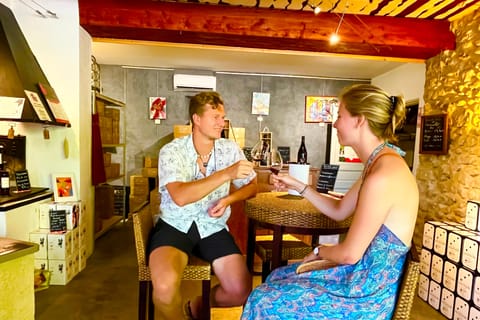
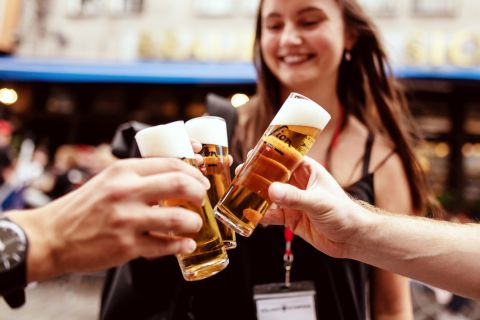
South African wine is genuinely excellent: Chenin Blanc (the most-planted variety), Pinotage (the indigenous Cabernet-Cinsault cross), Cabernet Sauvignon and Bordeaux blends from Stellenbosch, and increasingly serious Chardonnay and Pinot Noir from Walker Bay and Hemel-en-Aarde. With braai, a Pinotage or a Cabernet blend; with Cape Malay, an off-dry Chenin or Riesling balances the spice; with Durban curry, a beer (Castle, Black Label) or a Chenin. Rooibos tea closes any meal. Amarula, the cream liqueur from the marula fruit, is the after-dinner pour.
Where to eat it
Cape Town has the strongest contemporary scene, with the Test Kitchen alumni network and the Bo-Kaap Cape Malay neighborhood for traditional cooking. Johannesburg for urban Black, township food (Mzansi, Vilakazi Street), and the chef-driven Maboneng scene. Durban for Indian-South African curry and bunny chow. Stellenbosch and Franschhoek for wine country and Cape Dutch fine dining. Outside South Africa, London has the largest South African diaspora restaurant scene, with serious braai and biltong joints; New York and Sydney have smaller representation.
A short history
South African cuisine emerged from the collision of Khoisan and Bantu indigenous cooking with Dutch settlement (1652), the importation of enslaved Indonesian and Indian Muslims to the Cape (which created Cape Malay cuisine in the 17th and 18th centuries), British colonization (1814 onward), the indenture of Indian laborers to Natal (from 1860, creating the Durban Indian community), and a century of apartheid that segregated and developed distinct urban Black, Cape Malay, and Afrikaner kitchens. The post-1994 democratic era has begun to fuse these traditions in restaurants.
Frequently asked
Is a braai the same as a barbecue?
Not quite. A braai is direct-heat grilling over wood or charcoal, closer to Argentine asado, with social pacing and the host attending the fire personally. American BBQ is low-and-slow smoking with sauces, a different technique entirely.
What is Cape Malay cuisine?
The cooking developed by the Muslim community of Cape Town, descended from enslaved Indonesians (Malays) and Indians brought to the Cape from the 17th century onward. It is a sweet-savory, spiced (not chile-hot) tradition with bobotie, denningvleis, sosaties, and koesisters as its anchors.
Where does pinotage come from?
Pinotage is an indigenous South African grape variety, created in 1925 by Abraham Izak Perold at Stellenbosch University by crossing Pinot Noir and Cinsault. The wines are typically deeply colored, bold, and sometimes carry smoky or coffee-tinged notes; the style is contested among South African winemakers.