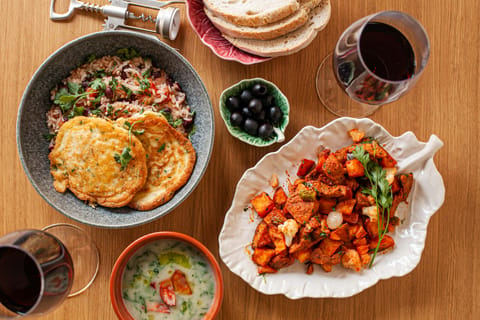

Portuguese food is shaped by 800 years of seafaring. The Portuguese were the first Europeans to round Africa, the first to reach India and Japan, and the country still eats more seafood per capita than any other European nation. Bacalhau (salt cod, caught in the North Atlantic since the 15th century) is the national obsession, with a popular saying that Portuguese cooks know 365 preparations of it. The coastal kitchens cook grilled sardines and mackerel, octopus, clams, percebes, and the day's catch from the fish market; the interior cooks pork, game, lamb, and the slow stews of the Alentejo plains.
The cooking grammar is olive oil, garlic, bay leaf, paprika, parsley, cilantro (in the south), wine, and the four key proteins: salt cod, fresh fish, pork (especially the black Iberian pig), and chicken. The Portuguese also taught the world to use chile peppers: Portuguese traders introduced chiles to India, Africa, China, Japan, and Korea after Columbus brought them from the Americas. Modern Portuguese cooking carries traces from Goa (vindaloo descends from Portuguese vinha d'alhos), Macau (Portuguese-Chinese fusion is its own deep tradition), Brazil (feijoada), and Angola and Mozambique (the African-influenced piri-piri sauce and chicken).
At the table, Portuguese meals are generous and slow. Couvert (the bread, olives, sardine pate, and cheese laid out at the start) is charged per item you eat. Lunch is the main meal at 1-3pm; dinner is at 8-10pm and lighter. Coffee (bica in Lisbon, cimbalino in Porto) ends every meal. Tipping is not mandatory but 5-10% on a sit-down meal is appreciated.
Book a food experience
Tours, tastings and classes that match this page, bookable on GetYourGuide.


Top picks
The best-scored Portuguese place in each of 12 cities.
Belcanto 2 ★ ★ 4.9
Belcanto, by José Avillez, has two Michelin stars and offers contemporary Portuguese cuisine as a tasting menu or à la carte, at Rua Serpa Pinto 10A, Lisbon.
Frigideiras do Cantinho ★ 4.8
Braga's most famous street bite: a fried puff-pastry pocket of egg-yolk custard cream, made here continuously since 1796 for under €2 per piece.
OrderFrigideira with a galão at the counter for the most honest €2.50 in Braga.
TipEat immediately outside on the steps for the optimal temperature. One frigideira, one tíbia and one sameirinho is the full three-pastry tasting for under €5.
Desarma 1 ★ ★ 4.8
Desarma is Octávio Freitas's rooftop restaurant above Funchal, Michelin-starred since February 2024 and cooking menus of six, nine or twelve moments.
OrderThe Chef's Battle menu, nine moments built on Madeiran produce.
TipSeatings run 19:00 to 21:00 Tuesday to Saturday, and the rooftop is best booked at dusk.
Conga Casa das Bifanas ★ 4.8
Conga Casa das Bifanas is a Portuguese bifana restaurant at Rua do Bonjardim 318, 4000-115 Porto.
SignatureBifana
Adega ★ 4.8
Adega is San Jose's only Michelin-starred restaurant, serving a seasonal Portuguese tasting menu with 500+ Iberian wines in the Alum Rock neighborhood.
OrderMulti-course tasting menu with Portuguese wine pairing
Romados ★ 4.7
Romados is at 115 Rue Rachel Est in Montreal, open daily from 10:00 to 21:00.
Leonard's Bakery ★ 4.7
Leonard's Bakery in Kapahulu Honolulu sells the canonical Hawaii malasada for around $2 each at the counter, the lowest-cost taste of Portuguese-Hawaii sweet.
TryOriginal sugar malasada
TipDaily 05:30-19:00. Order half a dozen sugar plus a custard; box stays warm for 30 minutes.
Adega Pérola ★ 4.5
Adega Pérola lines a glass counter with more than 50 petiscos on Rua Siqueira Campos in Copacabana, a Rio de Janeiro bar founded by Madeirans in 1957.
OrderSardinhas em escabeche, polvo à vinagrete and provolone à milanesa from the glass counter.
TipGo with two or three friends so you can share several petiscos; the bar is closed on Sundays.
Tasca by José Avillez 1 ★ ★ 4.5
Tasca by José Avillez is a one Michelin star Portuguese room on the sixth floor of Mandarin Oriental Jumeira in Dubai, over an infinity pool.
Caldense Bakery ★ 4.4
Caldense Bakery on Dundas West has run Portuguese pastries since 1968, the pastel de nata baked through the day plus full savoury counter with rissois.
OrderA pastel de nata at the counter, plus a galao for the walk home.
TipTake a number from the dispenser at the counter. Multiple Caldense locations across the GTA including Symington, Eglinton and Royal York.
OvenBird ★ 4.3
OvenBird at Pepper Place Birmingham is Chris Hastings's live-fire sibling concept to Hot and Hot, with Spanish, Portuguese, Uruguayan and Argentine grills.
Book1 week ahead
Mallorca ★ 4.2
Mallorca on West 9th Street in the Warehouse District, Cleveland's longest-running Spanish-Portuguese fine-dining room since 1997, was named a 2026 James.
Book1 week ahead
Find a place
Belcanto 2 ★ ★ 4.9
Belcanto, by José Avillez, has two Michelin stars and offers contemporary Portuguese cuisine as a tasting menu or à la carte, at Rua Serpa Pinto 10A, Lisbon.
Frigideiras do Cantinho ★ 4.8
Braga's most famous street bite: a fried puff-pastry pocket of egg-yolk custard cream, made here continuously since 1796 for under €2 per piece.
OrderFrigideira with a galão at the counter for the most honest €2.50 in Braga.
TipEat immediately outside on the steps for the optimal temperature. One frigideira, one tíbia and one sameirinho is the full three-pastry tasting for under €5.
Desarma 1 ★ ★ 4.8
Desarma is Octávio Freitas's rooftop restaurant above Funchal, Michelin-starred since February 2024 and cooking menus of six, nine or twelve moments.
OrderThe Chef's Battle menu, nine moments built on Madeiran produce.
TipSeatings run 19:00 to 21:00 Tuesday to Saturday, and the rooftop is best booked at dusk.
Conga Casa das Bifanas ★ 4.8
Conga Casa das Bifanas is a Portuguese bifana restaurant at Rua do Bonjardim 318, 4000-115 Porto.
SignatureBifana
Adega ★ 4.8
Adega is San Jose's only Michelin-starred restaurant, serving a seasonal Portuguese tasting menu with 500+ Iberian wines in the Alum Rock neighborhood.
OrderMulti-course tasting menu with Portuguese wine pairing
Prado ★ 4.7
Prado is a farm-to-table Portuguese restaurant in Lisbon where chef Antonio Galapito lets the seasons guide his dishes, with a tasting menu in the evening.
OrderThe evening tasting menu, which showcases all of the chef’s culinary skill.
Ze dos Cornos ★ 4.7
Ze dos Cornos, at Beco dos Surradores 5, serves regional dishes and home cooking; no booking is needed in opening hours, and Sunday is a rest day.
OrderThe sandwiches with a glass of wine, as the restaurant itself suggests.
O Golfinho ★ 4.7
O Golfinho is a small restaurant at Rua de Sa de Noronha 137, very close to downtown Porto, and is normally known for its famous francesinha.
OrderThe francesinha, the dish the restaurant is known for.
Café Aviz ★ 4.7
Café Aviz, on Rua de Aviz next to the Hotel Infante Sagres, is a diner serving Portuguese specialties, salads and cheesecake from breakfast to dinner.
OrderThe salads and the cheesecake, both highlighted on its site.
TipIt is open 6 days a week, 11:00 to 15:00 and 19:00 to 23:00, and closed on Sundays.
Romados ★ 4.7
Romados is at 115 Rue Rachel Est in Montreal, open daily from 10:00 to 21:00.
Leonard's Bakery ★ 4.7
Leonard's Bakery in Kapahulu Honolulu sells the canonical Hawaii malasada for around $2 each at the counter, the lowest-cost taste of Portuguese-Hawaii sweet.
TryOriginal sugar malasada
TipDaily 05:30-19:00. Order half a dozen sugar plus a custard; box stays warm for 30 minutes.
Gavião Novo ★ 4.6
Gavião Novo grills fish off the Funchal coast on Rua de Santa Maria, the old town street where the day boat rather than the menu decides dinner.
OrderFish from the Funchal coast, grilled whole off the day boat.
TipBook ahead for dinner. The dining room is small and the pavement tables on Rua de Santa Maria go first.
Kampo ★ 4.6
Kampo is chef Júlio Pereira's land-facing Funchal restaurant, built on island growers and on matured Rubia Galega beef carved at the table for sharing.
OrderThe maturado chuletón or T-bone from the beef section, carved for sharing.
TipNo two sources agree on the schedule and the operator publishes none, so call before lunch. Dishes are built to share across the table.
Cruz Sobral ★ 4.5
Operating since 1926 and run by the Cruz Sobral family's third and fourth generations. The kitchen in Campo das Carvalheiras slow-cooks everything.
OrderWood-oven roasted meats: the Cruz family has used the same wood-fired oven since 1926 and it shows in the crust on everything.
TipSmall dining room. Book ahead for weekends or arrive at noon.
Inato Bistrô ★ 4.5
Michelin Bib Gourmand 2025. Chefs Miguel Rodrigues and Tiago Costa present a menu as acts I to VII, blending Portuguese classicism with modern invention.
Book1 week ahead
TipThe VII-act tasting menu is better value than a la carte. Book at least a week ahead at weekends.
Adega Pérola ★ 4.5
Adega Pérola lines a glass counter with more than 50 petiscos on Rua Siqueira Campos in Copacabana, a Rio de Janeiro bar founded by Madeirans in 1957.
OrderSardinhas em escabeche, polvo à vinagrete and provolone à milanesa from the glass counter.
TipGo with two or three friends so you can share several petiscos; the bar is closed on Sundays.
Ma Poule Mouillee ★ 4.5
Ma Poule Mouillee is a Portuguese restaurant at 969 Rue Rachel Est, open Tuesday to Sunday from 11:00 to 21:00.
OrderThe Louis Cyr half chicken with fries and salad, or the poutine with Sao Jorge cheese and chourico.
Tasca by José Avillez 1 ★ ★ 4.5
Tasca by José Avillez is a one Michelin star Portuguese room on the sixth floor of Mandarin Oriental Jumeira in Dubai, over an infinity pool.
Bar da Portuguesa ★ 4.4
Dona Donzília Gomes runs Bar da Portuguesa, a Ramos botequim on Rua Custódio Nunes in Rio de Janeiro known for bolinho de bacalhau and aipim croquettes.
OrderBolinho de bacalhau, the fritada de bacalhau or camarão, and the aipim croquette with carne seca.
TipIt placed second at Botecar 2025 with a trio of cod bolinhos stuffed with whole shrimp; it is shut on Mondays.
Caldense Bakery ★ 4.4
Caldense Bakery on Dundas West has run Portuguese pastries since 1968, the pastel de nata baked through the day plus full savoury counter with rissois.
OrderA pastel de nata at the counter, plus a galao for the walk home.
TipTake a number from the dispenser at the counter. Multiple Caldense locations across the GTA including Symington, Eglinton and Royal York.
Ferreira Cafe ★ 4.3
Ferreira Cafe is a Portuguese restaurant in downtown Montreal with a fish and seafood kitchen and a wine list of 400 references, predominantly Portuguese.
OrderSardine fillets roasted with fleur de sel, or creamy seafood rice with scallops, prawns, squid and mussels.
TipA $55 menu is offered after 9pm, and the restaurant opens at 5 PM on match nights or for major events at the Bell Centre.
OvenBird ★ 4.3
OvenBird at Pepper Place Birmingham is Chris Hastings's live-fire sibling concept to Hot and Hot, with Spanish, Portuguese, Uruguayan and Argentine grills.
Book1 week ahead
Rancho Português ★ 4.2
Rancho Português in Ipanema serves traditional Portuguese cooking, from suckling pig to salt cod, and won Veja Rio's 2025 Portuguese award in Rio de Janeiro.
OrderLeitão à Bairrada, the suckling pig, or the bacalhau da terra
TipThe menu also lists a Trás-os-Montes feijoada and tomato rice; the group's wine list passes 700 labels.
Mallorca ★ 4.2
Mallorca on West 9th Street in the Warehouse District, Cleveland's longest-running Spanish-Portuguese fine-dining room since 1997, was named a 2026 James.
Book1 week ahead
Casa Cruz ★ 4.2
Casa Cruz cooks Portuguese street food on Rue Maréchal Joffre in Nantes, chicken grilled to order with house frites and local baker's bread.
SignatureGrilled chicken, House frites, Fresh steak haché
TipIt only opens Wednesday to Sunday and lunch is the busier service; takeaway orders go through the operator's own ordering page.
Martim ★ 4.2
Martim brings Portuguese seafood to the Oder bank in Wrocław. Bacalhau, octopus, salt cod fritters, and a wine list that runs Vinho Verde to Madeira.
OrderPolvo à lagareiro, octopus baked with paprika potatoes and olive oil.
TipBring a group; the platters scale for four and drop the per-head bill noticeably.
Alma ★ 4.1
Alma is Galway's only Portuguese restaurant; the Wednesday to Saturday dinner menu features bacalhau and Atlantic seafood inspired by Portugal's coast.
OrderAsk for the bacalhau preparation of the day; the dessert section is worth leaving room for
TipOne of the city's genuinely unique cuisine addresses; booking ahead is essential at weekends.
Petiscos ★ 4.0
Petiscos has grilled Luso-Mozambican prawns and peri-peri chicken in Parklands near Table View, on the northern edge of Cape Town, since 2006.
OrderThe grilled lemon-butter prawns, the dish that built this no-frills room's following.
TipThe kitchen closes at 21:00 from Tuesday to Thursday, 21:30 on Friday and Saturday and 16:00 on Sunday.
Dias Tavern ★ 4.0
Dias Tavern has served Portuguese trinchado, prego steaks on hot skillets and grilled chicken on Caledon Street in Cape Town's District Six since 1988.
Why locals goIt has cooked Portuguese food on Caledon Street in District Six since 1988, often with live music, on a stretch most City Bowl visitors walk straight past.
TipBook ahead for a weekend table, order the rump trinchado in its homemade sauce, and note it is closed on Sundays.
Portuguese Taste ★ 4.0
Portuguese Taste ladles feijoada and stacks pastel de nata in the Glass Arcade, St Nicholas Market's little corner of Lisbon in central Bristol.
TryPastel de nata and feijoada
TipTake the custard tarts to the harbour wall; the pork and bean stew sells out before the office crowd clears.
Villa Portuguese ★ 3.7
Villa Portuguese on Buitenkant Street in Cape Town serves chicken trinchado, spare ribs and grilled queen prawns, with happy hour daily from five to seven.
OrderChicken trinchado, with grilled queen prawns if the table is sharing
TipHappy hour runs daily from five to seven and all day on Mondays, when the doors only open at 16:00.
Portuguese by city
 Braga56 places
Frigideiras do Cantinho, Cruz Sobral
Braga56 places
Frigideiras do Cantinho, Cruz Sobral
 Funchal41 places
Desarma, Gavião Novo
Funchal41 places
Desarma, Gavião Novo
 Lisbon37 places
Belcanto, Prado
Lisbon37 places
Belcanto, Prado
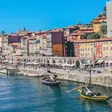 Porto25 places
Conga Casa das Bifanas, O Golfinho
Porto25 places
Conga Casa das Bifanas, O Golfinho
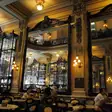 Rio de Janeiro14 places
Adega Pérola, Bar da Portuguesa
Rio de Janeiro14 places
Adega Pérola, Bar da Portuguesa
 Montreal8 places
Romados, Ma Poule Mouillee
Montreal8 places
Romados, Ma Poule Mouillee
 Cape Town3 places
Petiscos, Dias Tavern
Cape Town3 places
Petiscos, Dias Tavern
 San Jose2 places
Adega
San Jose2 places
Adega
 Birmingham1 place
OvenBird
Birmingham1 place
OvenBird
 Bristol1 place
Portuguese Taste
Bristol1 place
Portuguese Taste
 Cleveland1 place
Mallorca
Cleveland1 place
Mallorca
 Dubai1 place
Tasca by José Avillez
Dubai1 place
Tasca by José Avillez
 Galway1 place
Alma
Galway1 place
Alma
 Honolulu1 place
Leonard's Bakery
Honolulu1 place
Leonard's Bakery
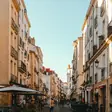 Nantes1 place
Casa Cruz
Nantes1 place
Casa Cruz
 Toronto1 place
Caldense Bakery
Toronto1 place
Caldense Bakery
 Wrocław1 place
Martim
Wrocław1 place
Martim
Regional variations
Lisbon and the south
Coastal seafood (grilled sardines, octopus, ameijoas a Bulhao Pato), bacalhau a Bras (salt cod scrambled with potato and egg), cataplana (copper-pan seafood stew from the Algarve), pastel de nata, ginjinha. The city's tasca (small family tavern) tradition is the everyday eating culture.
Porto and the north
Francesinha (meat-and-cheese sandwich in spicy beer sauce, a Porto specialty), tripas a moda do Porto (tripe stew that gave Porto residents their nickname tripeiros), bacalhau a Gomes de Sa, port wine, the Douro valley wines. Heartier and more rustic than the south.
Alentejo and the interior
Black pork (porco preto), migas (bread crumbs with pork or asparagus), porco a alentejana (pork with clams), acorda (bread-thickened soup), sheep's-milk cheese (Serpa, Azeitao). The slow, pastoral kitchen.
Madeira and the Azores
Bolo do caco (Madeira garlic-butter flatbread), espetada (skewered beef on bay branches), Madeira wine, Azorean cozido (cooked in volcanic ground at Furnas), local cheeses. The Atlantic islands.
Defining Portuguese dishes
- Bacalhau
- Salt-cured cod, prepared in dozens of ways: a Bras (with scrambled eggs and matchstick potatoes), a Gomes de Sa (baked with potato, onion, olive, egg), com natas (baked with cream), a lagareiro (roasted with olive oil and potatoes). The national dish in countless forms.
- Sardinhas assadas
- Whole sardines grilled over charcoal, served with boiled potato, roasted pepper, salad, and bread. Peak season is June; the feast of Santo Antonio in Lisbon (12-13 June) is the sardine festival.
- Polvo a lagareiro
- Octopus boiled, then roasted with olive oil and smashed boiled potatoes (batatas a murro). The cleanest preparation of the Portuguese seafood pantry.
- Cataplana de mariscos
- Seafood stew (clams, prawns, white fish, chorizo, tomato, wine) cooked in a hinged copper cataplana pan that steams everything together. The Algarve signature.
- Francesinha
- Porto's answer to the croque monsieur: a layered sandwich of cured meats, steak, sausage, and cheese, smothered in a spicy beer-and-tomato sauce and topped with a fried egg. Served with fries.
- Caldo verde
- Soup of finely shredded kale, potato puree, chorizo, garlic, and olive oil. The Portuguese household soup.
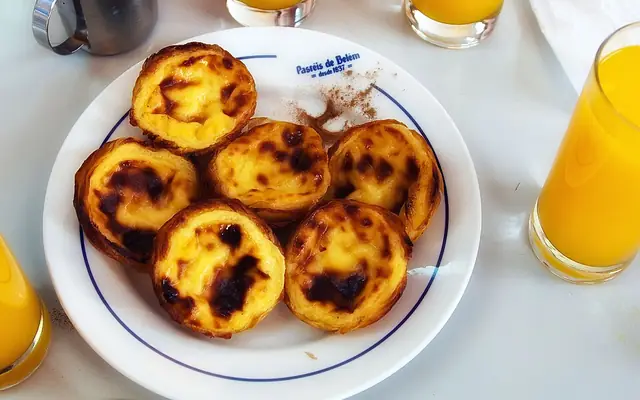
- Pastel de nata
- Custard tart in flaky puff pastry, scorched on top, served warm with cinnamon and powdered sugar. The Pasteis de Belem (1837) and Manteigaria are the canonical Lisbon makers.
- Frango piri-piri
- Spatchcocked grilled chicken in piri-piri sauce (small bird's-eye chiles, garlic, lemon, olive oil). The dish travelled Portugal-Angola-Mozambique-South Africa and back, with Nando's now exporting the franchise globally.
- Bifana
- Marinated pork loin sandwich in a soft bread roll, with mustard and piri-piri sauce. The Portuguese workers' lunch.
- Arroz de marisco
- Loose, soupy seafood rice with prawns, clams, lobster, fish, tomato, cilantro. The wet-rice cousin of paella.
- Cozido a portuguesa
- Mixed boiled meats and vegetables: beef, pork, chicken, chorizo, blood sausage, cabbage, carrots, potatoes, rice, served with the broth. The Portuguese Sunday lunch.
How to order
Lunch is the main meal in Portugal, served 12:30-3pm. The pratos do dia (daily specials) chalkboard at any tasca is the right place to start: a single dish at 8-14 euros, often with bread, soup, salad, and a drink included. At dinner, order shared starters (couvert plus 2-3 small plates) and a main per person. Bacalhau is the menu test: a serious place will have at least 4-5 bacalhau preparations on the menu. Petiscos (small plates) are the Portuguese tapas equivalent.
The rookie mistakes: eating the couvert and assuming it's free (every olive, every slice of bread, every sardine pate is itemized; refuse what you don't want), expecting fast service (Portuguese meals are paced over 90-120 minutes), and skipping the pastel de nata (it's the national dessert and is genuinely worth seeking out at Manteigaria or Pasteis de Belem rather than supermarket versions).
What to drink with it
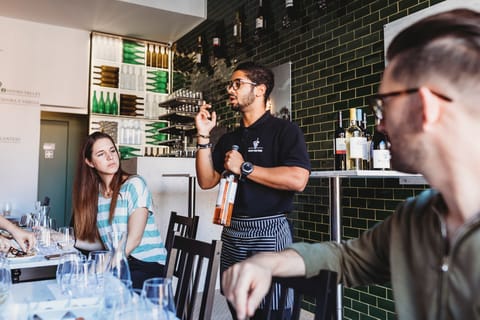
Portuguese wine is wildly underrated. Vinho Verde (the slightly fizzy, low-alcohol northern white) pairs with seafood. Douro reds (the wine country that also produces port) are the major still red. Alentejo reds for richer meat dishes. Madeira (the fortified Atlantic wine) and Port (the fortified Douro wine) bracket the dessert course. Ginjinha (cherry liqueur, Lisbon's spirit) and aguardente bagaceira (grape marc) as digestifs. Bica (espresso) ends every meal. Super Bock and Sagres are the workhorse beers; both go fine with grilled fish.
Where to eat it
Lisbon for the tasca tradition, Belem for pastel de nata, the Algarve for cataplana and grilled fish; Porto for francesinha, tripas, and port wine; Evora and the Alentejo for black pork and migas; the Douro valley for wine-country cooking; Madeira for espetada and bolo do caco. Outside Portugal: Macau (the Portuguese-Chinese fusion is its own deep tradition), Goa (vindaloo, sorpotel, bebinca all trace to Portuguese colonial cooking), Rio de Janeiro and Sao Paulo (the Brazilian-Portuguese link is the deepest in the Americas), Toronto and Newark for North American diaspora cooking.
A short history
Portuguese cuisine is built on the Age of Discovery (15th-17th centuries) when Portuguese seafarers established trade routes to Africa, India, China, Japan, and the Americas. Salt cod (caught off Newfoundland and Norway, cured for the long voyage home) became the national protein. Tea, sugar, chiles, tomatoes, and potatoes all entered Portuguese cooking before they reached the rest of Europe. The 19th-century pastel de nata recipe escaped from the Jeronimos Monastery in 1837 and the original recipe is still made at Pasteis de Belem.
Frequently asked
Is Portuguese food the same as Spanish food?
No. The two share the Iberian Peninsula but have separate languages, separate culinary traditions, and very different default flavors. Portugal cooks more seafood, uses cilantro (rare in Spain), uses piri-piri chile heavily, and has the salt-cod tradition that Spain treats marginally. Spanish food leans on jamon, paella, and tapas; Portuguese leans on bacalhau, grilled fish, and the colonial influences from Brazil, Africa, and Asia.
What's the difference between pastel de nata and pastel de Belem?
Pastel de Belem is the name reserved for the original 1837 recipe sold only at the Pasteis de Belem bakery in Lisbon. Pastel de nata is the generic name for the same custard tart sold everywhere else. Manteigaria, in central Lisbon, is the modern challenger considered by many to make the better version.
How do I get good salt cod?
Look for thick fillets of well-cured Norwegian or Icelandic bacalhau, soaked 24-48 hours in cold water (changed three or four times) before cooking. Restaurants do this for you; supermarkets sell pre-soaked or frozen ready-to-cook. The pre-cured stuff in vacuum packs is generally fine; canned bacalhau is not.
More cities are in research. Want Portuguese covered somewhere specific? Tell us where you want to eat.