Chesapeake cuisine is the food tradition of the Chesapeake Bay watershed, anchored by Maryland and Virginia, and built on the bay's extraordinary seafood: blue crab, eastern oysters, rockfish (striped bass), shad, soft-shell crab, clams, and freshwater perch. The bay is the largest estuary in the United States and one of the most productive seafood waters in the world, and the cuisine of its shores reflects that abundance. Baltimore and the Eastern Shore of Maryland, the Northern Neck and Tidewater of Virginia, and the small fishing communities of Smith Island and Tangier Island are the heart of the tradition.
The defining items are the Maryland blue crab (Callinectes sapidus, the 'beautiful swimmer') in its various preparations: steamed whole with Old Bay seasoning and dumped on newspaper-covered tables for hand-picking, made into Maryland crab cakes (lump backfin meat with minimal binder, broiled or pan-fried), soft-shell crab (the same blue crab molted, eaten whole), Maryland crab soup (tomato-based, with vegetables and the spice), and cream of crab soup (the richer alternative). Eastern oysters from the Chesapeake (Choptank, Rappahannock, Stingray, Olde Salt, Lynnhaven) are smaller and brinier than Pacific oysters and are the basis of one of the great American oyster traditions.
The broader cuisine includes Smith Island cake (a 10-layer cake with cooked chocolate icing, the Maryland state dessert), pit beef (a Baltimore charcoal-grilled rare beef sandwich with horseradish sauce), Old Bay seasoning (the celery-salt-and-paprika spice blend that defines the regional palate), country ham (especially Virginia's Smithfield ham, a distinct cure-and-smoke tradition), peanuts (Virginia is the country's largest peanut producer), and a strong Southern-influenced side culture (collards, hush puppies, biscuits, sweet tea) that blends into Lowcountry territory the farther south one goes.
Book a food experience
Tours, tastings and classes from the cities on this page, bookable on GetYourGuide.
Choose a 2-hour express or 3-hour full Boston food tour. Taste clam chowder, arancini, brick oven pizza, cannoli, and more while exploring the North...
$$$$Tasting $60-95 a la carteRichmondChesapeakeWesthamptonChef Dale Reitzer
Dale Reitzer's third Acacia location, at Libbie Mill. Multi-time James Beard nominee and a 1999 Food and Wine Best New Chef; modern coastal Virginia cooking.
Lexington Market gathers cheap counters under one roof, from Faidley's crab cake to lake trout and chicken boxes, the city's oldest market and its best value.
TryCrab cake, lake trout, market stalls
TipGraze the stalls for lake trout, a chicken box or a crab cake; cash speeds the older counters.
Crab country: from Crisfield (the crab-picking capital) to St. Michaels and Cambridge, the shore is dotted with crab houses where the steamed-crab table tradition is preserved. Smith Island and Tangier Island (off the bay) have distinct dialects and food traditions, including the Smith Island cake.
Baltimore and central Maryland
The Maryland crab cake's institutional home: Faidley Seafood at Lexington Market, Mama's on the Half Shell, G&M Restaurant, Thames Street Oyster House. Plus the distinct Baltimore Polish-American and African-American food traditions (pit beef, lake trout, half-and-half iced tea, Berger cookies).
Virginia Tidewater and Northern Neck
The Chesapeake's southern shore: Smithfield ham country, the Stingray Point oysters, Mathews County's Tangier Sound, and Williamsburg's colonial-era cooking tradition. The Inn at Little Washington (technically inland) sits adjacent to this region.
Washington DC
Often included in the Chesapeake culinary region. Strong crab and seafood scene (BlackSalt, Hank's Oyster Bar, The Salt Line), the Maryland-DC half-smoke at Ben's Chili Bowl, and the broader Mid-Atlantic restaurant culture.
Defining chesapeake dishes
Steamed blue crabs
Live male blue crabs steamed with Old Bay seasoning, vinegar, and beer, dumped on a newspaper-covered table for hand-picking with a wooden mallet and crab knife. A summer crab feast is the defining communal Chesapeake meal.
Maryland crab cake
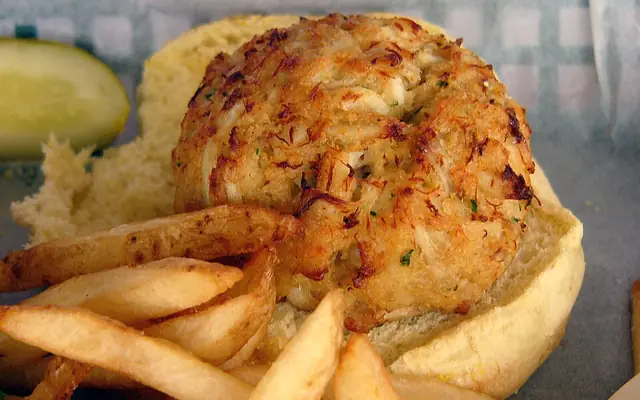
Jumbo lump or backfin crab meat bound with minimal mayonnaise, egg, and breadcrumb, formed by hand into a hockey-puck shape, and broiled or pan-fried. The Maryland style emphasizes the crab itself, not the binder. Faidley's at Lexington Market is the canonical version.
Soft-shell crab
Blue crab caught in the brief window after molting and before the new shell hardens. The entire crab is eaten, often dredged in flour and fried, served whole in a sandwich on white bread with lettuce, tomato, and mayo, or pan-sauteed with butter and lemon.
Maryland crab soup
Tomato-based soup with corn, lima beans, carrots, potato, and crab meat, seasoned heavily with Old Bay. The Eastern Shore tradition; distinct from the cream-based version.
Cream of crab soup
Rich, creamy soup with lump crab meat, sherry, and Old Bay. The Sunday-dinner version of Maryland crab soup.
Oysters on the half shell
Eastern oysters (Choptank, Rappahannock, Stingray Point, Olde Salt, Lynnhaven) served raw with mignonette, cocktail sauce, and lemon. The Chesapeake oyster is smaller, brinier, and more 'cucumber-noted' than the Pacific oyster.
Oyster stew
Oysters poached in cream and butter, with celery and a pinch of paprika or Old Bay. The simple Chesapeake winter dish.
Rockfish (striped bass)
The Chesapeake's signature finfish, grilled, pan-seared, or stuffed. Maryland's state fish; the spring run is celebrated annually.
Pit beef
Top round of beef rubbed with salt, pepper, and garlic, charcoal-grilled to rare, sliced thin, and served on a kaiser roll with horseradish sauce or 'tiger sauce' (mayo-horseradish-spice). A Baltimore specialty.
Smithfield ham
Virginia dry-cured, salt-and-pepper-rubbed, hickory-smoked country ham, aged for 6 to 12 months. Sliced very thin (the salt content is high), served on biscuits or with a glass of dry sherry. The state of Virginia regulates the name; only hams cured in Smithfield can be called Smithfield.
Smith Island cake
Ten thin layers of yellow cake with cooked chocolate icing between each layer and on top, originating on Smith Island, Maryland. The Maryland state dessert (designated 2008).
Old Bay seasoning
A spice blend of celery salt, paprika, mustard, bay leaves, allspice, and other spices, created in Baltimore in 1939 by Gustav Brunn. The defining Chesapeake seasoning, used on crab, shrimp, fish, fries, and almost everything else.
How to order
At a crab house, the order is steamed crabs by the dozen (a half-dozen large or a dozen smaller per person is a starting point), corn on the cob, hush puppies, and a Natty Boh (National Bohemian, the regional cheap beer). The crabs come on butcher paper, you get a wooden mallet and a knife, and you pick. Maryland crab cakes are ordered as a sandwich (on a soft white roll, with mayo or tartar sauce) or as a platter (two cakes with sides). Soft-shell crab is summer-only (June and July is the peak). At a Chesapeake fine-dining restaurant, the format is similar to PNW or Lowcountry: oyster starter, fish main, seasonal vegetable sides, a dessert.
The rookie mistakes: ordering female crabs (the males have more meat; locals dispute this but the law of crab houses runs on male-only), expecting the meat to be picked for you (it is hand-picking; the experience is the labor), missing the Old Bay (it should be heavy; do not flinch), and confusing Chesapeake oysters with Pacific oysters (they are different species, with the Chesapeake/Atlantic Crassostrea virginica producing a distinctly different flavor).
What to drink with it
Beer is the universal Chesapeake table drink: National Bohemian (Natty Boh) for nostalgia, Flying Dog (Frederick, Maryland) and Heavy Seas for the modern craft scene. Maryland and Virginia wine country (Linganore, Boordy, Barboursville, RdV) produces serious whites and reds, with the Virginia Cabernet Franc tradition particularly strong with crab dishes. Bourbon and rye from the small but growing regional distilleries (Sagamore Spirit in Baltimore, A. Smith Bowman in Virginia). With steamed crabs, beer is essentially mandatory. With oysters, a crisp white (Sauvignon Blanc, Albariño) or champagne.
Where to eat it
Baltimore is the institutional center: Faidley's at Lexington Market (the Maryland crab cake benchmark since 1886), Thames Street Oyster House, Mama's on the Half Shell, G&M Restaurant. Annapolis and the Eastern Shore for the crab-house tradition (Cantler's Riverside Inn, Schaefer's Canal House, Suicide Bridge Restaurant, Crab Claw in St. Michaels). Washington DC for the modern Mid-Atlantic restaurant scene (The Salt Line, Hank's Oyster Bar, BlackSalt). Tidewater Virginia and the Northern Neck for the Southern Chesapeake tradition. Smith Island for the cake. Outside the region, Chesapeake cuisine has limited explicit representation; Maryland-style crab cakes appear on East Coast menus but are often poor imitations.
A short history
Chesapeake cuisine descends from the indigenous Powhatan and Piscataway foodways of the bay region (oysters, fish, corn, beans, squash), layered with English colonization (Virginia 1607, Maryland 1634), the African-American culinary contribution (especially in Tidewater Virginia and Maryland's Eastern Shore), and the great 19th-century blue-crab and oyster industries that made the bay one of the most productive seafood waters in the world. Old Bay seasoning was created in Baltimore in 1939. The Smith Island cake was designated Maryland's state dessert in 2008.
Frequently asked
What is the difference between a male and female crab?
Male crabs (jimmies) have a long, pointed apron on the underside, and they are larger with more meat. Female crabs (sooks) have a rounded apron (resembling the U.S. Capitol dome). Crab houses traditionally sell only males by the dozen, since they have more usable meat. Some seasons restrict female crab harvesting to protect breeding populations.
Why is Maryland crab cake so different from other crab cakes?
Style. The Maryland tradition uses jumbo lump or backfin blue crab meat (large, fragile pieces from the back of the crab) with minimal binder (just enough egg and breadcrumb to hold the cake together), letting the crab itself be the dish. Other regional crab cakes (Gulf Coast, Pacific Northwest, Chesapeake-influenced restaurants nationally) often use more filler and additional seasonings; the Maryland style is the purist version.
Is Old Bay really on everything?
In Maryland, essentially yes. Beyond crab, Old Bay goes on French fries, popcorn, corn on the cob, potato chips, Bloody Marys, deviled eggs, and the rims of beer cans. It is part of the regional palate in a way that has no equivalent outside the bay's communities.