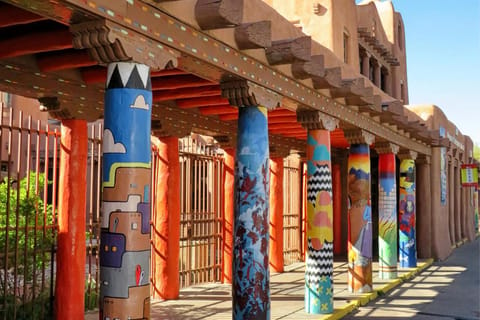
How Santa Fe came to eat the way it does: the people, migrations and accidents that shaped the plate.
Key eras
-
Pre-1610, Ancestral Pueblo cooking
Long before Spanish arrival, the Tewa-, Tiwa- and Keres-speaking Pueblo people of the Rio Grande Valley grew the Three Sisters (corn, beans, squash), made blue corn into masa, dried wild plums and roasted pinon nuts. The Pueblo bread oven, the horno, is still in use across the Eight Northern Pueblos today.
-
1610-1821, Spanish colonial Santa Fe
Founded as Spanish capital in 1610, Santa Fe absorbed European wheat, beef, pork, lamb, wine and brandy into the existing Pueblo grain base. The chile pepper, brought up from Mexico, met the local growing conditions of the Rio Grande Valley and produced the long-pod ancestors of today's Hatch and Chimayo crops. Sopaipillas, biscochitos and posole all stabilised in this period.
-
1821-1912, Mexican-American territorial era
After Mexican independence in 1821, Santa Fe became the western terminus of the Santa Fe Trail; wagon trains brought eastern goods, coffee, sugar, hardware. Spanish-speaking New Mexican cooks codified what is now known as Northern New Mexican cuisine, distinct from Tex-Mex or Sonoran Mexican: red and green chile, posole, calabacitas, carne adovada. Statehood arrived in 1912.
-
1940s-1950s, Manhattan Project and the modern restaurant
Los Alamos's wartime population brought outside cooks and tastes; Plaza Cafe (founded 1905, sold to the Razatos family in 1947) was already pouring Greek-American diner food on the Plaza. Post-war, restaurants like The Shed (1953) made New Mexican chile plates exportable as a tourist experience, with red and green options codified for visitors.
-
1987-present, the Santa Fe fine-dining boom
Mark Miller's Coyote Cafe (1987) defined Modern Southwestern as a national restaurant style; the Compound's 2000 reopening under Mark Kiffin and Geronimo's 1991 launch on Canyon Road followed. James Beard awards landed for Kiffin (2005) and Olea (2022); Santa Fe became a Tier-2 American food city with chile as the through-line.
Immigrant influences
- Spanish and Mexican (1598 onward)
- Hispano community brought wheat, livestock, the chile pepper, and the techniques that built Northern New Mexican cuisine; the language and recipes pass through families.
- Pueblo and Native American (continuous)
- Blue corn, the horno bread oven, frybread, posole, the Three Sisters: every meal in Santa Fe touches Pueblo ingredients. Indian Market each August is the public face of this living tradition.
- Greek-American (1900s)
- Greek families like the Pomonis and Razatos brought diner culture to the Plaza in the early 20th century; Plaza Cafe's lineage runs back to 1905 and Greek immigrant hands.
- Salvadoran and Mexican migration (1990s-2020s)
- More recent Central American arrivals brought pupusas, banana-leaf tamales and a deeper taco-truck network; Tune-Up Cafe pairs Salvadoran specialities with New Mexican chile in one room.Taste it todayTune-Up Cafe
- Italian and European chef migration (1980s onward)
- Italian-trained chefs like Cristian Pontiggia (Anasazi) and French operators like the Ligiers (Clafoutis) brought European technique to the city's fine-dining and bakery scenes.
Signature innovations
- Red or green or Christmas chile ordering convention
- The breakfast burrito as a menu category (Tia Sophia's, 1975)
- Modern Southwestern cuisine as a national category (Coyote Cafe, 1987)Taste it todayCoyote Cafe
- Green Chile Cheeseburger Trail as a state tourism productTaste it todayGreen chile cheeseburger
- Stuffed sopaipilla codification (Rancho de Chimayo, 1965 onward)
Book food experiences in Santa Fe