How Chicago came to eat the way it does: the people, migrations and accidents that shaped the plate.

Key eras

1865 to 1971, the Union Stockyards era

The Union Stock Yards opened on Christmas Day 1865 on 320 acres of South Side prairie and made Chicago the world's largest meatpacking centre. By 1900, Armour and Swift packed more than half the meat eaten in the United States from Chicago. The yards closed in 1971 but the city's steakhouse culture, butcher-counter density and Italian-beef tradition all run back to them.

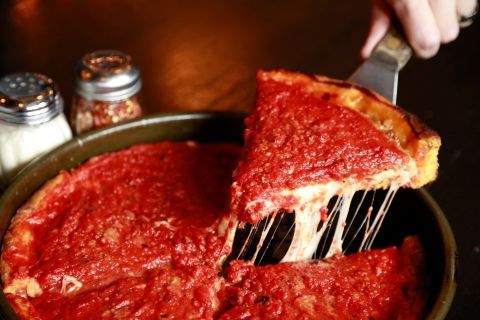
1943, the invention of deep-dish pizza

Pizzeria Uno opened on Ohio Street in 1943 under owner Ike Sewell. Original cook Rudy Malnati Sr., a Sicilian-American from Halsted Street, developed the pan-baked pizza with cheese under tomato to break from the East Coast slice and serve a meal rather than a snack. The Malnati family later spun off Lou Malnati's; Pizano's followed in 1991 from Rudy Jr. Deep-dish became Chicago's most-exported food fact.

1930s, Italian beef and the Maxwell Street market

The Italian beef sandwich was invented in Chicago in the 1930s among Italian-American workers on Taylor Street: cheap roast beef sliced paper-thin and ladled with jus on bread. The Maxwell Street market had been the immigrant shopping district since 1912; the Polish sausage counter and bagel cart both emerged there. Al's Beef opened in 1938; Mr. Beef followed in 1979.

1893, Vienna Beef at the Columbian Exposition

Austrian-Hungarian immigrants Emil Reichel and Sam Ladany introduced their all-beef frankfurter at the 1893 World's Columbian Exposition. Vienna Beef has made the canonical Chicago hot dog frankfurter ever since, with the dressed Chicago hot dog (no ketchup) crystallising during the 1930s Depression as a five-cent Maxwell Street vendor meal: a frank, salad, pickle and poppy-seed bun for a nickel.

2005 to present, the West Loop fine-dining cluster

Alinea opened on Halsted in May 2005 under Grant Achatz, a Charlie Trotter and Thomas Keller alumnus. By 2010 it held three Michelin stars. Around the same Fulton Market grid, Next opened 2011, The Aviary 2011, Smyth 2016, Oriole 2016, Ever 2020 and Porto 2022. The cluster around Randolph and Fulton became the country's densest concentration of Michelin-starred tasting menus outside New York and the Bay Area.
Immigrant influences

  • Italian-American (Taylor Street and Heart of Chicago): Invented the Italian beef sandwich in the 1930s. Brought tavern-style thin pizza to South Side rooms. Founded Pizzeria Uno in 1943. Built Gene & Georgetti (1941) and the steakhouse-Italian template.
  • Polish (Milwaukee Avenue corridor): Largest Polish population of any city outside Warsaw. Smoked kielbasa, pierogi, paczki, Polish rye breads. Anchors include Bobak's Sausage, Andy's, Weber's Bakery on Archer, Staropolska on Milwaukee.
  • Mexican (Pilsen and Little Village): Country's densest concentration of taquerias. Birrieria Zaragoza, Taqueria Los Comales, La Chaparrita. 26th Street is the highest-grossing retail corridor in Chicago after Michigan Avenue.
  • Puerto Rican (Humboldt Park): Invented the jibarito sandwich at Borinquen in 1996. Paseo Boricua on Division Street. Pasteles, mofongo, lechon, the Three Kings Day food calendar. The two giant steel Puerto Rican flags frame the corridor.
  • Greek (Greektown, Halsted Street): Reinvented gyros for America in 1973 with the cone-shaped beef-and-lamb commercial loaf, scaled nationally by Kronos Foods (founded same year in Chicago). Saganaki and Opa, lamb on the spit, Greek Islands since 1971.
  • Chinese (Chinatown, Wentworth Avenue): South-side Chinatown enclave with banquet halls, dim sum, Hong Kong roast meats. Founded in 1912 after the original Loop Chinatown was forced south. Phoenix Restaurant since 1996, MingHin Cuisine, Cai dim sum.
  • Swedish (Andersonville, Clark Street): Swedish bakery and meatball tradition along Clark Street since the 1920s. Ann Sather since 1945 with the maple-glazed cinnamon roll. Lost Larson runs the contemporary Scandinavian bakery counter.
  • African-American Great Migration (South and West sides): Brought wood-smoked barbecue from Mississippi and Tennessee between 1910 and 1960. Developed the Chicago aquarium smoker. Lem's Bar-B-Q since 1954 on 75th, Honey 1 on 43rd, the rib-tip tradition.

Signature innovations

  • Deep-dish pizza, invented at Pizzeria Uno in 1943.
  • The Italian beef sandwich, dipped in jus on Gonnella bread.
  • The fully-dressed Chicago hot dog: no ketchup, by unwritten law.
  • The jibarito (fried-plantain-bread sandwich), invented at Borinquen in 1996.
  • Tavern-cut thin pizza, party-cut into squares since the 1930s.
  • Vienna Beef all-beef frankfurter, introduced at the 1893 World's Fair.
  • The Chicago aquarium smoker, a glass-and-steel cabinet for oak-and-hickory barbecue.
  • American modernist tasting menu, codified by Alinea in 2005.
  • The American gyros cone, commercialised by Kronos Foods in 1973.

Food History in Chicago, FAQ

When is the best time to eat in Chicago?

Peak food season in Chicago is year-round.

What time do people eat in Chicago?

Local dining hours: lunch around 12:30, dinner from 19:30.

How does tipping work in Chicago?

service is typically included; small extra is welcome but not expected.

What is the one dish to try in Chicago?

Ask the next local you meet what they would order. Chicago rewards trust.

← Back to Chicago food guide